Pilates exercises at home for beginners: a 10-move mat routine
By The Pilates Verdict Team · October 7, 2026 · 18 min read
This article contains affiliate links. If you buy through them, we may earn a commission at no extra cost to you. As an Amazon Associate I earn from qualifying purchases. Learn more.
Pilates exercises at home for beginners need only a mat and some floor space. Healthline's beginner guide adds just an optional towel, and Balanced Body, a Pilates equipment brand, says you can practice "with just a mat and some floor space."
Below are 10 beginner mat moves, each taken from a named instructor or outlet with the reps that source gives. They're ordered to warm you up first and take about 15–25 minutes.
How we researched this: We built this routine from beginner sequences that overlap across Pilates Anytime (Amanda Altman and Marchel Ackler), BASI Pilates (CJ Kelly, NCPT), TODAY (Stephanie Mansour), Healthline's medically reviewed guides and WebMD (Alycea Ungaro, PT). Safety notes come from Cleveland Clinic, ACOG, the Bone Health & Osteoporosis Foundation and Healthline. We read the Cochrane review and peer-reviewed studies for the evidence section. We don't coach or test workouts. Every source is listed at the end.
Quick version:
- What you need: a mat (or a blanket or towel, per Healthline) and room to stretch out.
- How long: about 15–25 minutes, depending on rest (our estimate; Healthline's own at-home routine runs 20 minutes).
- How often: Healthline suggests 1–2 days a week to start, building to 3–4.
- Check first if: you're pregnant, injured, have osteoporosis or are new to exercise.
Before you start (no equipment needed)
Space and setup
Ashley Patten, Katie Couric's Pilates instructor, told KatieCouric.com: "In an ideal world, you'll have enough space for your mat and two to three feet around you in all directions." If you follow a video, she suggests placing "your device a couple of feet away from you, so you can see your screen without having to strain," or streaming it to a TV.
Balanced Body also notes that "taking a few classes at your local Pilates studio or club is a smart and safe way to begin Pilates." That's a brand statement, but a few in-person sessions can help you learn the form before you practice alone.
Do you need a mat?
Healthline's beginner guide suggests a mat that's thicker than a typical yoga mat, plus an optional towel. Healthline's at-home routine says a yoga mat, blanket or towel will do. For a cushioned option, the Retrospec Solana comes in a 1-inch version:
Check price on AmazonNot sure a yoga mat is enough? See Pilates mat vs. yoga mat, or compare picks in our best Pilates mats guide.
Three principles: breath, center, control
Healthline's beginner guide sums up three ideas to keep in mind:
- Breathing: "Pilates breathing focuses on breathing three-dimensionally through the rib cage and diaphragm."
- Centering: "Everything in Pilates comes from your core, your body's 'powerhouse.'"
- Control: "Always choose quality of movement over quantity."
To find your core, Stephanie Mansour, a certified personal trainer and Pilates instructor, tells TODAY readers to "take a deep breath in, allowing your belly to expand, and then exhale fully, drawing your belly button in toward your spine."
Go slowly. CJ Kelly writes on the BASI Pilates blog: "Please be patient. If you stick to the basics, strength will come in order to add variety." Cleveland Clinic's Judi Bar agrees that "the exercises have to be at your level — and you have to build up the difficulty slowly."
10 Pilates exercises for beginners at home
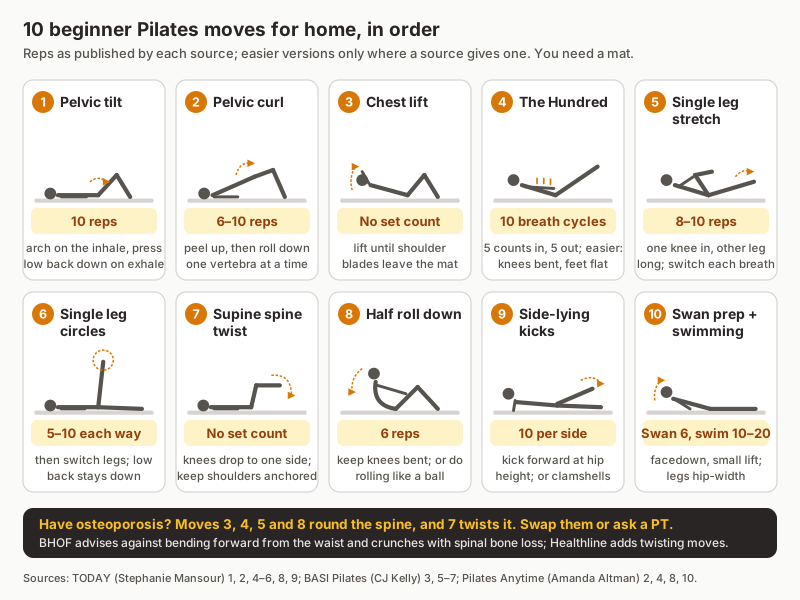
Tap the diagram to enlarge
Moves 1–8 are on your back or seated, move 9 is on your side and move 10 is facedown. Rest whenever you need to, and stop any move that hurts. If you have osteoporosis or are pregnant, read who should modify or check first before you begin.
Where a source doesn't give an easier version, we suggest shrinking the range (a smaller tilt, lift or circle). That's general advice, not from a named instructor.
1. Breathing and pelvic tilt
Lie on your back with your knees bent and feet hip-width apart. Mansour (TODAY) cues you to arch your low back as you inhale, then tilt your pelvis as you exhale, pressing your low back into the mat.
- Reps: 10 (TODAY).
- Easier: a smaller tilt.
2. Pelvic curl (shoulder bridge)
Lie on your back with your knees bent and "knees and heels are about sit-bone distance apart," per BASI's Kelly. Exhale to engage your low abs and peel your spine off the mat as your hips lift. Exhale again to come down "one vertebra at a time."
- Reps: 6 (Pilates Anytime) to 10 (TODAY).
- Easier: lift your hips less high.
3. Chest lift
Lie on your back with your knees bent and fingers laced behind your head. BASI's Kelly cues you to exhale and lift your head, neck and chest "just until you feel the tip of your shoulder blades leave the mat," inhale to pause, then exhale to lower. BASI's page doesn't give a rep count, so do a few controlled reps.
- Skip if: you have spinal bone loss. See the osteoporosis section.
4. The Hundred (modified)
Pilates Anytime's beginner sequence curls you up to the tips of your shoulder blades with your legs at 45 degrees. Pump your arms while you breathe in for 5 counts and out for 5 counts. Alycea Ungaro, PT, author of 15 Minute Everyday Pilates, tells WebMD to keep your "lower back still pressed to the floor" and "pump the arms up and down in small motions."
- Reps: 10 breath cycles (Pilates Anytime), which works out to 100 pumps, as in TODAY's version.
- Easier: keep your knees bent with your feet flat, or legs on the mat (Pilates Anytime). TODAY suggests holding your legs closer to 90 degrees.
- Skip the head lift if: you have osteoporosis.
5. Single leg stretch
From the chest-lift position, put your hands on your knees. BASI's Kelly cues you to exhale as one leg extends, then quickly inhale to switch legs.
- Reps: 8–10 (BASI) or 10 per side (TODAY).
- Easier: none of our sources gives one. Keep your head down and try toe taps (below), or skip this move for now.
Pilates Anytime lists this move as intermediate, while BASI and TODAY include it for beginners. If it strains your neck or back, leave it out for now.
6. Single leg circles
Lie on your back with your arms out in a T, one leg long on the mat and the other reaching toward the ceiling. BASI's Kelly has you draw circles with the raised leg, reverse direction, then switch legs. Mansour (TODAY) says to keep your lower back pressed to the floor.
- Reps: 5 circles each direction (BASI) or 10 each direction (TODAY).
- Easier: make the circles smaller.
7. Supine spine twist
Lie on your back with your arms in a T, palms up, and legs in tabletop. Per BASI's Kelly, inhale to let your knees drop to one side, then exhale and draw your abs in to bring them back to center. Keep the opposite shoulder blade anchored to the mat.
- Reps: BASI doesn't give a count. Alternate sides for a few slow reps.
- Skip if: you have osteoporosis (it's a twisting move), or ask a PT.
8. Half roll down or rolling like a ball
Choose one:
- Half roll down: sit tall with your knees bent and hands behind your thighs. Pilates Anytime cues you to curl your tailbone under and roll back until your arms are straight, then return. 6 reps (Pilates Anytime) or 10 (TODAY). TODAY keeps your knees bent and says straightening your legs makes it "a more advanced exercise."
- Rolling like a ball: roll back to the tips of your shoulder blades and up again, 6 reps (Pilates Anytime; 10 in TODAY). BASI says to "maintain your c-curve, ball shape throughout." Easier: a smaller roll.
- Skip both if: you have osteoporosis. Both are rounded-spine moves.
9. Side kick or clamshell
Lie on your side. Choose one:
- Side kick (TODAY): lift your top leg to hip height and kick it forward. 10 per side. Easier: a smaller kick.
- Clamshell (Healthline): bend your knees with your feet together, lift your top knee and hold for 5 seconds. Healthline's routine lists 15 reps for 3–5 sets per side, which is a lot for a first session, so start with fewer. Easier: place a cushion between your knees.
10. Swan prep and swimming
Lie facedown.
- Swan prep: make a small lift of your head, chest, arms and legs. 6 reps (Pilates Anytime). Easier: keep your legs hip-width apart. BASI starts with a back extension that lifts the head, then progresses to "Baby Swan."
- Swimming: flutter your opposite arm and leg. 10–20 sets (Pilates Anytime) or 20 total (TODAY).
Optional swaps and extras
- Toe taps (TODAY): knees in tabletop, lower one leg at a time to tap your toe down, back "gently pressing into the ground," 20 taps total. Use these if the head lift in moves 4–5 is too much.
- Bird dog (BASI's "All Fours"): wrists under shoulders, knees under hips, reach one leg back, then add the opposite arm.
- Spine stretch forward (Healthline): sit tall and exhale to round into a "C-shape," 10 reps. Your head doesn't need to reach your knees, and a towel around your feet can help. Skip it if you have osteoporosis.
Common beginner mistakes
- Rushing reps: Healthline's advice is to "always choose quality of movement over quantity."
- Low back lifting off the mat in the Hundred: Ungaro (WebMD) cues keeping your "lower back still pressed to the floor."
- Rolling onto your neck in rolling like a ball: Pilates Anytime has you roll back only to the tips of your shoulder blades.
- Doing too much too soon: Cleveland Clinic's Judi Bar says to "build up the difficulty slowly."
Beginner Pilates workout at home: reps and session length
| Move | Reps | Easier version | Source |
|---|---|---|---|
| 1. Pelvic tilt | 10 | Smaller tilt | TODAY |
| 2. Pelvic curl | 6–10 | Lower lift | PA, TODAY |
| 3. Chest lift | A few | Smaller lift | BASI |
| 4. Hundred | 10 breaths | Knees bent | PA, TODAY |
| 5. Single leg stretch | 8–10/side | Toe taps | BASI, TODAY |
| 6. Leg circles | 5–10 each way | Smaller circles | BASI, TODAY |
| 7. Spine twist | A few/side | Smaller drop | BASI |
| 8. Roll down or roll | 6–10 | Knees bent | PA, TODAY |
| 9. Side kick | 10/side | Smaller kick | TODAY |
| 10. Swan, swimming | 6; 10–20 | Legs apart | PA, TODAY |
PA is Pilates Anytime. Easier versions without a source are general range reductions (see note above). No source we found sets a minimum session length.
How often to do Pilates at home
Healthline suggests starting with 1–2 days a week and building to 3–4 times a week if Pilates becomes your main exercise, with recovery time between sessions. Cleveland Clinic's Judi Bar says "doing Pilates three to five times a week is great, but make sure you're also dedicating time to strength-building activities," along with aerobic exercise.
Treat mat Pilates as one part of your week. The CDC's adult guidelines call for:
- Aerobic: 150 minutes of moderate activity a week (CDC).
- Strength: "at least 2 days of muscle-strengthening activity each week" covering all major muscle groups (CDC).
A beginner mat routine focuses mostly on the core and hips, so it's unlikely to cover all of that alone.
How to progress
Once the routine feels easy, Pilates Anytime's intermediate list is a natural next step. It includes the Roll Up, Double Leg Stretch, Spine Stretch and Saw. Joseph Pilates laid out 34 mat exercises in his book Return to Life, and Pilates Anytime notes that he "designed them in this order with one facilitating the next." It adds: "For beginners, the later exercises on this list may be a challenge and it may take some time to work up to being able to do them fully. Make modifications as necessary."
Props are the other way to add challenge. Patten told KatieCouric.com that if you buy only one piece of equipment, "it should be a Pilates ring." That's her personal pick, not a consensus. See our Pilates equipment for beginners guide for rings, bands and balls.
Want more support for your legs and back? A wall works as a free prop. See our wall Pilates exercises for beginners routine. If you're curious about machines, compare reformer vs mat Pilates.
Who should modify or check first
Healthline advises talking to a healthcare provider if you're new to exercise, pregnant, recovering from an injury or have limited mobility, and stopping if you feel pain. Cleveland Clinic adds: "It's especially important to talk to a doctor if you're injured or recovering from surgery … starting too early could make things worse."
Back pain
A Cochrane review of 10 trials with 510 people found that "Pilates is probably more effective than minimal intervention in the short and intermediate term for pain and disability" in chronic low back pain. It found "no conclusive evidence that it is superior to other forms of exercises," and rated the evidence low to moderate quality.
Cleveland Clinic also gives an honest caveat for mat work: "When you use a mat, you're working your body against gravity. Freeform Pilates can actually be harder on the back than using a reformer." If you have back pain, ask a physical therapist or clinician which moves suit you.
Osteoporosis
The Bone Health & Osteoporosis Foundation says people with spinal bone loss should not "bend forward from the waist" or do "sit-ups or abdominal crunches." Healthline, citing the Royal Osteoporosis Society, lists Pilates moves to avoid, including Rolling Like a Ball, Roll Down, Roll Up, Curl Up and Roll Over. Safer options it names include the side leg series, bridge variations, all-fours work and back extension (except with spinal stenosis or spondylosis).
Healthline also advises against moves with a lot of twisting.
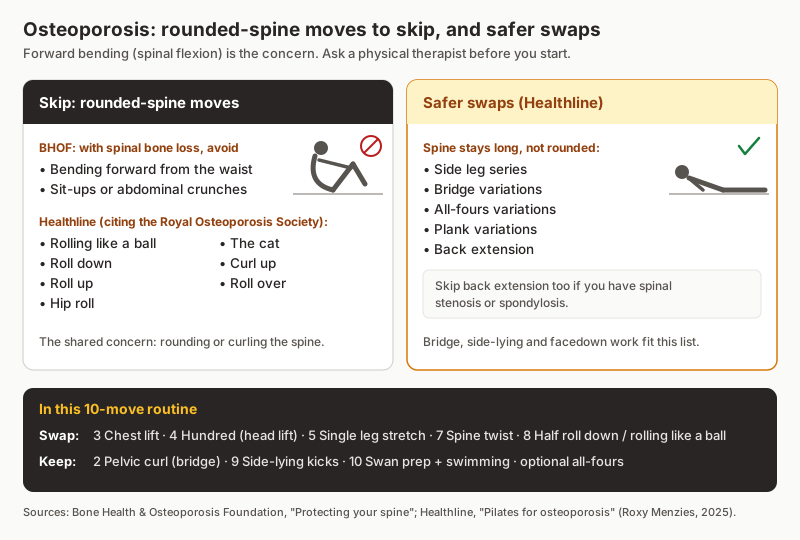
Tap the diagram to enlarge
In this routine:
- Skip or swap: the chest lift, the Hundred's head lift, the single leg stretch, the supine spine twist (a twisting move), the half roll down, rolling like a ball and the seated spine stretch.
- Keep: the pelvic curl, side kicks, all-fours work and swan prep (a back extension), which match the safer options Healthline lists.
A physical therapist can help you adapt the rest.
Pregnancy
ACOG's exercise-during-pregnancy guidance mentions modified yoga and modified Pilates among options, and advises avoiding hot Pilates and lying flat on your back for long periods. Most of this routine is done on your back, so check with your ob-gyn and ask about side-lying or seated alternatives.
What the research says
Studies suggest mat Pilates may improve some measures of fitness, but most are small and short:
- Healthy adults: in a 2010 study by Kloubec in the Journal of Strength and Conditioning Research, 50 middle-aged adults did two 60-minute mat sessions a week for 12 weeks. They showed "statistically significant increases in abdominal endurance, hamstring flexibility, and upper-body muscular endurance" compared with a control group. Posture and balance did not improve compared with controls.
- Older adults: a 2021 meta-analysis by Meikis, Wicker and Donath in Frontiers in Neurology pooled 51 studies with 2,485 adults (average age 66.5). Against inactive control groups, it found moderate effects on strength, balance and flexibility, but smaller effects against other exercise. The authors flag big differences between studies and many inactive control groups.
- Low back pain: see the Cochrane findings above.
Cleveland Clinic notes there's "considerable research into its health benefits," but "most studies only have a small number of participants — and only monitor those participants for a short period of time." Don't expect Pilates to fix your posture on its own, and none of the studies cited here looked at weight loss.
Your first two weeks
- Weeks 1–2: do the routine 1–2 times a week (Healthline), using the easier version of every move. Pick rolling like a ball or the half roll down, not both.
- Then: as a general guideline, try the standard version of a move once the easier one feels controlled, for example when you can keep your low back on the mat through the Hundred, the cue Ungaro gives WebMD.
- Over time: build toward 3–4 sessions a week (Healthline) and add aerobic and strength work (CDC).
Optional gear
Nothing beyond a mat is required. If you want one prop, Patten's choice is a Pilates ring. Compare options in our best Pilates rings guide, or start with this one:
Check price on AmazonGaiam Classic Solid Color Yoga Mat (5mm)
- Use
- Budget pick if a yoga mat is enough for you
- Price tier
- $20–30
THERABAND Non-Latex Resistance Band Beginner Kit (Yellow, Red, Green)
- Use
- Light resistance once moves feel easy
- Price tier
- $15–30
15-Minute Pilates (Alycea Ungaro, DK)
- Use
- Book by Alycea Ungaro, PT
- Price tier
- $10–20
| Product | Use | Price tier | |
|---|---|---|---|
| Gaiam Classic Solid Color Yoga Mat (5mm) | Budget pick if a yoga mat is enough for you | $20–30 | View |
| THERABAND Non-Latex Resistance Band Beginner Kit (Yellow, Red, Green) | Light resistance once moves feel easy | $15–30 | View |
| 15-Minute Pilates (Alycea Ungaro, DK) | Book by Alycea Ungaro, PT | $10–20 | View |
For more reading, see our best Pilates books guide, or browse more Pilates workouts.
Frequently Asked Questions
Can beginners do Pilates at home?
Yes. Healthline says a mat, plus an optional towel, is all you need to start, and Balanced Body (a Pilates equipment brand) says you can practice at home 'with just a mat and some floor space.' Balanced Body also suggests a few in-person classes as a smart and safe way to begin.
How often should a beginner do Pilates?
Healthline suggests starting with 1–2 days a week and building to 3–4. Cleveland Clinic's Judi Bar calls 3–5 times a week 'great,' alongside other strength and aerobic exercise.
Can I do Pilates without equipment?
Yes. The beginner routines from Pilates Anytime, TODAY and Healthline use only body weight on a mat, and Healthline says a blanket or towel works if you don't have a mat.
Which Pilates exercises should beginners start with?
Beginner lists from Pilates Anytime, BASI and TODAY all include the pelvic curl or bridge and rolling like a ball. Most also include a modified Hundred and back-extension work (swan or swimming). BASI and TODAY add leg circles and the single leg stretch, which Pilates Anytime treats as intermediate. Pilates Anytime says the later classical exercises 'may be a challenge' at first.
Is 20 minutes of Pilates enough?
Healthline's at-home mat routine runs about 20 minutes, and no source we found sets a minimum. The CDC still recommends 150 minutes of moderate aerobic activity plus 2 days of muscle-strengthening activity each week, so treat Pilates as one part of your week.
Can Pilates help you lose weight?
Cleveland Clinic notes most Pilates studies are small and short. We didn't find good evidence that mat Pilates alone drives weight loss. Pair it with aerobic activity per the CDC.
Is mat Pilates good for back pain?
A Cochrane review found Pilates 'probably more effective than minimal intervention' for chronic low back pain, but found no conclusive evidence that it beats other exercise, and rated the evidence low to moderate quality. Cleveland Clinic advises talking to a doctor first, especially if you're injured.
Sources
- Healthline (Roxy Menzies; medically reviewed by Danielle Hildreth, RN, CPT): Pilates for beginners
- Healthline (Anisha Mansuri; medically reviewed by Micky Lal, MA, CSCS, RYT): Pilates mat exercises
- Balanced Body (brand): Guide to Pilates for beginners
- KatieCouric.com (Ashley Patten): How to build an at-home Pilates studio
- TODAY (Stephanie Mansour): 20 Pilates exercises for beginners
- BASI Pilates (CJ Kelly, NCPT): 10 essential Pilates exercises for beginners
- Cleveland Clinic (Judi Bar): Pilates 101
- Pilates Anytime (Marchel Ackler): The 34 Pilates mat exercises
- Pilates Anytime (Amanda Altman): Mat sequences for every level
- WebMD (Alycea Ungaro, PT): 15 Pilates moves
- CDC: Adult activity guidelines
- Kloubec, J Strength Cond Res (2010): Study abstract on PubMed
- Cochrane (Yamato et al., 2015): Pilates for low back pain
- Meikis, Wicker and Donath, Frontiers in Neurology (2021): Meta-analysis on PubMed Central
- Bone Health & Osteoporosis Foundation: Protecting your spine
- Healthline (Roxy Menzies; medically reviewed by Danielle Hildreth, RN, CPT): Pilates for osteoporosis
- ACOG: Exercise during pregnancy
Update history
- : Published.
Found an error? See how we research and correct guides in our editorial policy.
Was this guide helpful?
Related Articles
How-To
28-Day Wall Pilates Challenge: A Free Schedule and What to Expect
Free 28-day wall Pilates challenge options, a 4-week schedule with rest days, 8 sourced moves, and what 28 days can realistically change.
October 7, 2026 · 16 min read
How-To
Wall Pilates: What It Is, Does It Work, and a 7-Move Routine
What wall Pilates is, what the research does and doesn't say about it, a 7-move beginner routine from Pilates instructors, and the only gear you need.
October 7, 2026 · 18 min read
How-To
Wall Pilates Exercises for Beginners: A 15-Minute Routine (With Chart)
10 wall Pilates exercises for beginners from instructors and health experts, with reps, easier options, a free printable chart and what the evidence says.
October 7, 2026 · 16 min read