Ankle weight Pilates exercises: an 8-move mat routine
By The Pilates Verdict Team · October 13, 2026 · 19 min read
This article contains affiliate links. If you buy through them, we may earn a commission at no extra cost to you. As an Amazon Associate I earn from qualifying purchases. Learn more.
Ankle weight Pilates exercises work best as slow, controlled leg moves on the mat, not as something you wear on a walk. "The weight places a greater load on the muscle group being targeted," Spaulding Rehabilitation physical therapist Terry Downey tells Harvard Health. "The muscles have to work harder to move this increased load against gravity, and in turn this will increase strength."
Pilates classes keep the load small. Pilates Anytime's "Ankle & Wrist Weight Mat" class with Dane Sorensen uses 1-pound ankle and wrist weights "to target small stability muscles through rhythmic movements."
This ankle weight Pilates workout uses eight standard leg moves. For each one you get the cues, the reps the sources give and which ankle wears the weight. After that: what ankle weights can and can't do, and who should skip them.
How we researched this:
- Move cues: Pilates Anytime exercise pages (Sarah Bertucelli, Mychele Sims), Pilates Andrea, Alo Moves (Tela Anderson), Complete Pilates (Magda Strugariu) and Absolute Pilates
- How heavy and how often: Harvard Health, University Hospitals, the Otago Exercise Programme manual, TODAY, Fit&Well, Garage Gym Reviews and Pilates Collective Club
- Benefits and safety: the Otago falls-prevention trials, a 2022 peer-reviewed study, Texas A&M, ACOG and the Bone Health & Osteoporosis Foundation
We don't coach or test workouts. Every source is listed at the end.
Quick version:
- Weight: 1–2 lb per ankle to start, per Harvard Health and University Hospitals.
- Tempo: lift in 2–3 seconds, lower in 4–5, and never hold your breath (Otago Exercise Programme).
- Time: 10–20 minutes in the weights at a time, 2–3 times a week, per Club Pilates master trainer Julie Marques (via Fit&Well).
- Don't: walk, run or do cardio in them.
How heavy should ankle weights be for Pilates?
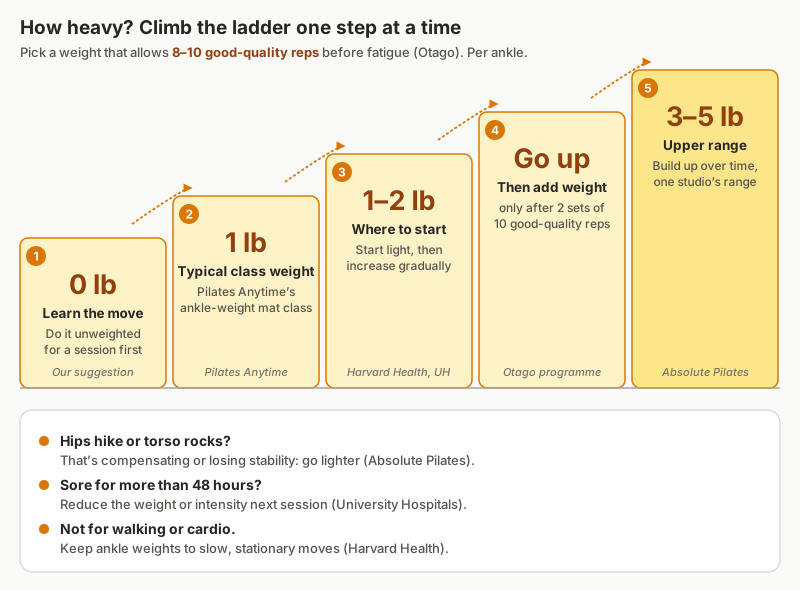
Light. Harvard Health says to start with "as little as a pound or two" and increase the load gradually. University Hospitals physical therapist Jonathan Morales, DPT, gives the same 1–2 lb starting point: "To avoid injury, it's important to start off light."
Pilates teachers stay in a similar range:
- Pilates Anytime: 1 lb in its ankle-weight mat class.
- Iris Poldervaart (Fit&Well): a pair "typically between 1lb and 3lb each."
- Julie Marques (Fit&Well): "light to medium weights," and only if your form and alignment are solid; otherwise, do the workout without weights.
- Absolute Pilates (studio): start at "1 to 2 lbs per leg," work up to "3 to 5 lbs" over time, and go lighter if you start to compensate or lose stability.
Not everyone agrees on going heavier. Pilates Collective Club, a Pilates studio-guide site, says 0.5–1 lb per ankle is "generally cited" as the Pilates range, because heavier weights "tend to compromise form." It doesn't name a source for that range.
For when to move up, the Otago Exercise Programme gives a clear rule. Otago is a falls-prevention program for older adults, not Pilates, so its loads don't transfer, but its logic does. Choose a weight that allows "8 to 10 good quality repetitions before fatigue," and progress once you can do "two sets of 10." Starting light, the manual says, "will minimise both muscle soreness and compliance problems."
Fit matters too. Garage Gym Reviews says someone untrained or returning from injury "might only need a one-pound ankle weight per leg," and that the cuff should sit snug "without limiting movement flexion of the foot."
Tap the diagram to enlarge
A light 1 lb pair is enough to start. Bala Bangles come in 1, 2 or 3 lb per bangle; for specific pairs, see our best ankle weights for Pilates.
Check price on Amazon8 ankle weight Pilates exercises (mat routine)
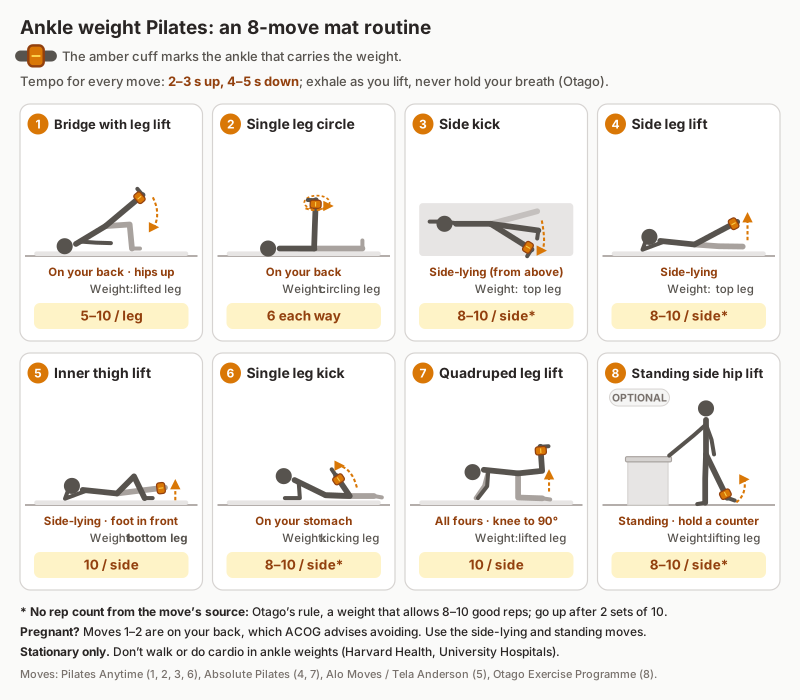
Use the same tempo for every move. The Otago manual says to take "two to three seconds to lift the weight, four to five seconds to lower," and to "never hold your breath while lifting. Inhale before lifting, exhale while lifting and inhale again while lowering the weight." Absolute Pilates says to avoid jerky movements and "high-impact or jumping movements" with ankle weights on.
Our suggestion: do each move unweighted for a session or two before you strap the weights on, so you know what good form feels like.
Tap the diagram to enlarge
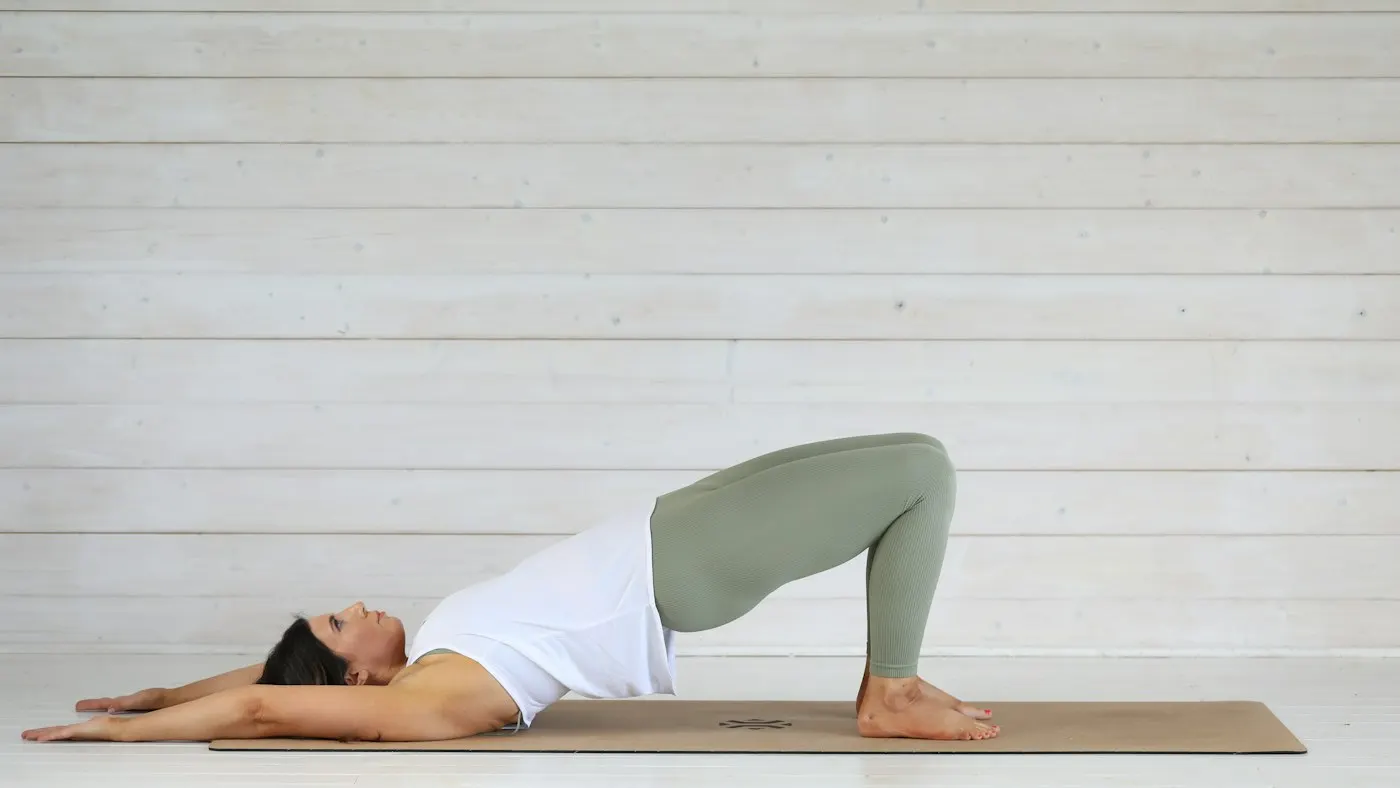
1. Shoulder bridge with leg lift
Weight on: both ankles.
Pilates Anytime's Sarah Bertucelli (BASI) starts you on your back, knees bent and feet hip-width apart. "Exhale while curling the pelvis toward the chest," then lift into a high bridge. "Lift one leg and flex the foot," point and reach the leg toward the floor, then flex the foot as it returns. She gives "5 to 10 repetitions per leg." The focus is abdominals, glutes and hips.
If your knees feel vulnerable, Bertucelli suggests widening the feet or lowering the hip lift. For an easier start, Alo Moves' Tela Anderson does glute bridge pulses (both feet down) for 10 reps. Absolute Pilates also lists the single-leg glute bridge as an ankle-weight move.
2. Single leg circle
Weight on: the lifted leg.
Bertucelli's setup: lie on your back with one leg long on the mat and the other toward the ceiling, foot flexed. Draw circles, pausing at the top, then reverse. She gives "6 in each direction or 3 breaths" per side. The aim is to "create freedom in the hip and stability in the core."
Her modifications: arms out to the sides makes it easier, and "reduce leg height to maintain pelvic stability." Don't lift the leg too high, she says, to avoid the hip popping or snapping.
Our suggestion: keep the circles small when you're weighted. A long, straight leg plus a weight at the ankle is a big lever on the hip and low back.
3. Side kick (front and back)
Weight on: the top leg.
Pilates Anytime's Mychele Sims: "Lie on one side with the hips stacked." Then "inhale to lift the top leg to hip height. Exhale as you kick the top leg forward, then point the foot and sweep the leg back toward the Mat." The focus is obliques, glutes, hip abductors and abdominals. To modify, Sims says to "lower the legs or adjust arm position as needed."
Pilates instructor Andrea Maida (Pilates Andrea) cues you to "relax your leg and connect it to the center of your body, your stomach, your powerhouse," and to keep the trunk from rocking forward and back as the leg moves. That matters more with a weight on the ankle.
4. Side leg lift
Weight on: the top leg.
Lie on your side, lift the top leg up and lower it with control. Absolute Pilates lists side-lying leg lifts as an ankle-weight move. Marques's routine for Fit&Well includes a side-lying leg lift for the abductors: prop up on your forearm, lift and lower the top leg with the hips and shoulders still, 2 sets of 10 per side plus 10 pulses at the top.
Want a smaller lever? Tela Anderson's bent-knee version has you lie on your side with "legs at a 90-degree angle" and lift the top leg, for 20 reps.
Variation: Complete Pilates' Magda Strugariu, a clinical Pilates instructor, adds small circles. "Press your bottom leg down into the ground until you feel the top leg wants to lift, continue lifting the top leg to hip height... start to trace small circles with your foot. Perform 6, then reverse the direction. Repeat 3 sets." She says it targets "the stabilising muscles on the outside of your pelvis."
5. Inner thigh lift
Weight on: the bottom leg.
Anderson: "Lie down on your left side, propping up your head with your left hand. Bend your top right leg and step your right foot in front of you." Then lift the bottom leg in small pulses, 10 reps each side. Marques includes a side-lying leg lift for the adductors too, 2 sets of 10 per side.
The bottom leg is the one doing the work here, so that's where the weight goes. That's our reading of the move, not a source's instruction.
6. Single leg kick
Weight on: both ankles.
Bertucelli: "Lie on your stomach with the legs straight and together. Prop yourself onto your forearms with the elbows directly beneath the shoulders." Then "exhale as you draw one heel toward your seat with two precise kicks. Extend the leg long and place it back on the Mat. Switch legs." Keep the knees close and the pelvis steady. The focus is back extensors, hamstrings and glutes. If your back complains, she suggests a lower chest lift.
Otago's standing "back knee strengthening" exercise (bend the knee to bring your foot toward your bottom) works the same knee flexors, standing at a support.
7. Quadruped leg lift (donkey kick)
Weight on: the working leg.
Absolute Pilates: start on all fours, keep the knee bent at 90 degrees and lift the leg behind you, lower it deliberately, then switch.
Variations:
- Forearms, straight leg (Tela Anderson, Alo Moves): extend the leg back and lift, then 10 pulses; 10 reps.
- Turned-out leg (Julie Marques, Fit&Well): on hands and knees, extend the leg back and rotate it outward from the hip, 10 straight-leg lifts, then 10 with the knee bent; 2 sets per side. If the rotation is uncomfortable, she says to keep the leg straight.
8. Standing side hip lift (optional)
Weight on: the working leg.
This one comes from the Otago program and suits anyone who can't easily get down to the floor. "Stand up tall beside the bench. Hold on to the bench." A kitchen counter works. "Keep the exercising leg straight and the foot straight forward. Lift the leg out to the side and return." Then switch the weight to the other ankle, turn around and repeat.
Otago does almost all of its strengthening standing, which, the manual says, "aids balance as well as strength." Marques's Fit&Well routine adds two more standing moves, a step-back for the quads and a heel raise for the calves (2 sets of 10 per side), if you want a longer standing block.
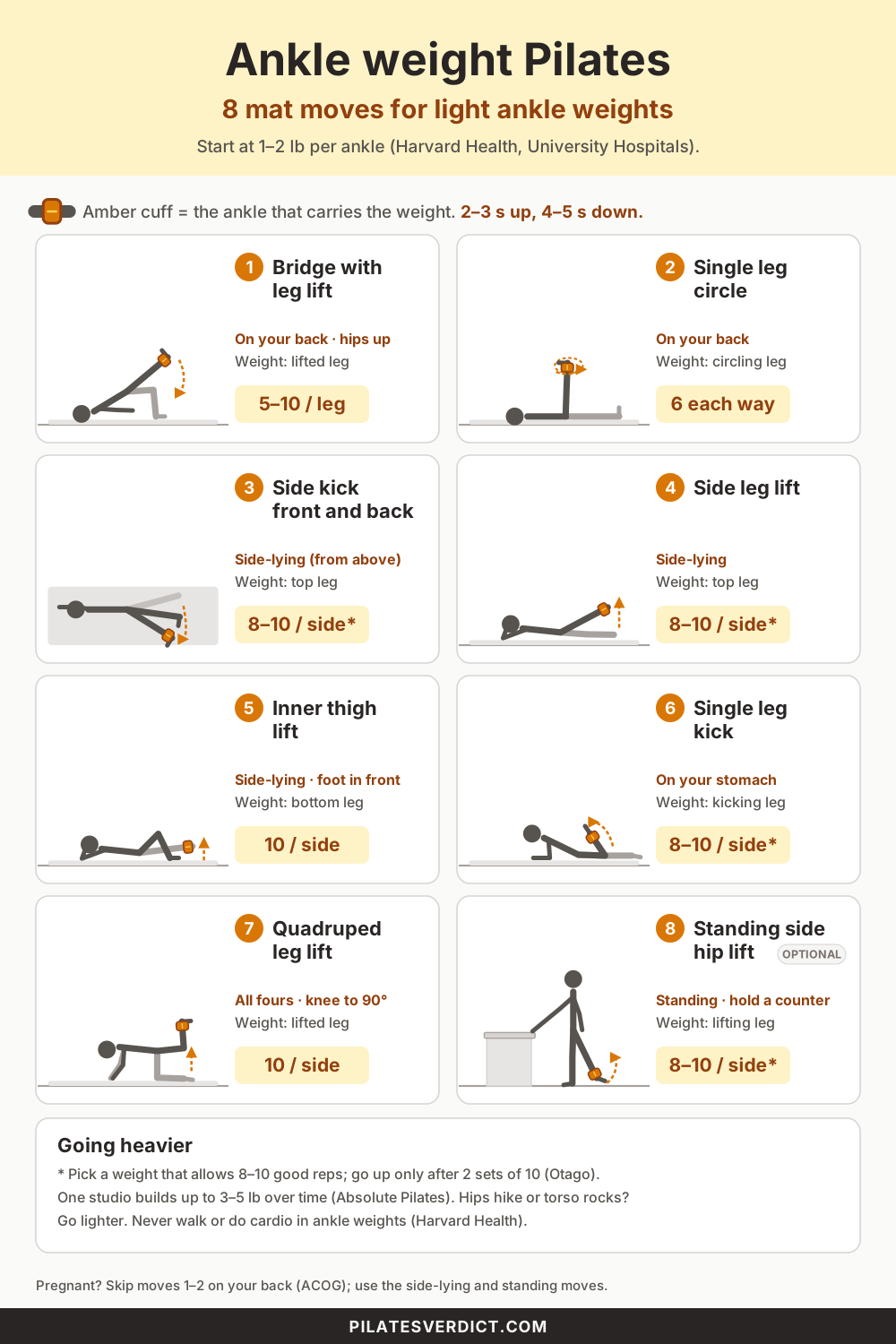
Ankle weight Pilates workout at a glance
| Move | Position | Reps | Weight on |
|---|---|---|---|
| 1. Bridge + leg lift | On back | 5–10 per leg | Both |
| 2. Leg circle | On back | 6 each way | Lifted leg |
| 3. Side kick | On side | 2×10* | Top leg |
| 4. Side leg lift | On side | 20 (bent knee) | Top leg |
| 5. Inner thigh lift | On side | 10 per side | Bottom leg |
| 6. Single leg kick | On stomach | 2×10* | Both |
| 7. Quadruped lift / donkey kick | All fours | 10 + pulses | Working leg |
| 8. Standing hip lift | Standing | Up to 2×10 | Working leg |
Reps come from Pilates Anytime (moves 1–2), Alo Moves (4, 5 and 7) and Otago (8).
*Pilates Anytime gives no number for these: Sims says to "repeat the sequence several times," and Bertucelli doesn't give a count for the single leg kick. 2 sets of 10 is our suggestion, based on Otago's progression rule (two sets of 10) and the 2 sets of 10 per side Marques uses for each move in her Fit&Well routine.
Tap the diagram to enlarge
Benefits of Pilates with ankle weights
No study we found has tested adding ankle weights to Pilates. Here's what the wider evidence supports, and what it doesn't.
More work for the target muscles. That's the mechanism Downey describes for Harvard Health, which calls ankle weights helpful for exercises that target the leg and hip muscles, like leg lifts. University Hospitals lists strength and endurance among the benefits.
Fewer falls in older adults, as part of a program. The strongest evidence comes from the Otago Exercise Programme. It combines leg strengthening with ankle cuff weights, balance exercises and a walking plan. Across four controlled trials of 1,016 people aged 65–97 living at home, it reduced "by 35% both the number of falls and the number of injuries resulting from falls." Chair-stand and balance test scores also improved in the exercise groups, the manual says.
The results weren't uniform:
- In one trial of people 65+ taking psychotropic (sleeping) medication, there was "no evidence" that the exercise program reduced falls.
- Another found no significant reduction among 75–79 year olds; it worked best in people 80 and older.
- It's individually prescribed by a trained instructor and includes balance training, so the weights alone don't get the credit.
A small, preliminary walking study. In Akatsu et al. (2022), 73 community-dwelling adults with a median age of 71 wore 0.5–1.5 kg per ankle on 20-minute outdoor walks at least twice a week for 12 weeks. Their 30-second chair-stand scores improved, while grip strength, balance and cognition didn't change. The study had no control group and reported interim data. It also used walking, which Harvard Health and University Hospitals advise against, so read it as a narrow early finding.
Core challenge, per instructors. Poldervaart told Fit&Well that "ankle weights add extra resistance, which challenges your core to stabilize the body during movement." That's a teacher's observation, not a measured result.
For how often: US guidelines call for muscle-strengthening activity at least 2 days a week. Otago schedules its strength work three times a week with a rest day in between.
Don't walk or do cardio in them
Harvard Health, University Hospitals and Texas A&M all agree on this:
- Harvard Health: walking or doing aerobics in ankle weights makes you rely on the quadriceps more than the hamstrings. "That causes a muscle imbalance," Downey says. The weights also pull on the ankle joint, which risks tendon or ligament injuries in the knees, hips and back.
- University Hospitals: running or walking with them "can lead to muscle imbalance, because they work the muscles in the front of your legs rather than the muscles in the back," and can cause strain and overuse injuries.
- Texas A&M: wearable weights "are recommended primarily for stationary exercises" such as leg lifts, and walking in them can change your gait.
Keep sessions short. Marques tells Fit&Well that ankle weights "put load on your peripheral joints," so "you shouldn't walk around with them," and suggests 10–20 minutes in them at a time, 2–3 times a week. Physical therapist Karena Wu, speaking to TODAY, advises starting with "no more than 15-30 minutes." University Hospitals says that if soreness lasts more than 48 hours, reduce the weight or intensity next time.
Who should modify or skip
- Balance problems, severe osteoarthritis, recent leg injuries, or postpartum and not yet cleared: Wu (TODAY) says to skip ankle weights.
- Arthritis, osteoporosis, joint problems or a musculoskeletal injury: University Hospitals says to consult a provider first. Harvard Health says the same for balance, joint or back problems. The Otago manual says people with arthritis should work "in a pain-free range."
- Warning signs: Otago says to stop and contact a doctor for dizziness, chest pain, shortness of breath, or muscle pain that doesn't go away.
- Pregnancy: ACOG lists modified Pilates among exercises experts consider safe, advises avoiding lying flat on your back as much as possible, and recommends talking with your ob-gyn. Moves 1 and 2 are on your back. Our suggestion: swap them for the side-lying and standing moves, and ask your ob-gyn about the weights.
- Osteoporosis: the Bone Health & Osteoporosis Foundation advises people with spinal bone loss to avoid bending forward from the waist, sit-ups, crunches and extreme twisting. None of these eight moves is a forward bend. Rolling up through the spine in the bridge may still need a physical therapist's OK; a flat-back hip lift is an option to ask about.
Bottom line
If you can do these moves unweighted with a steady pelvis, 1 lb ankle weights are a reasonable next step for 10–20 minutes, 2–3 times a week. If you have balance, joint or back problems, are pregnant or have osteoporosis, check with your clinician first (see above). Never walk or do cardio in them.
Check price on AmazonWhat you need
A mat and a light pair of ankle weights. Most light ankle weights double as wrist weights, as Alo Moves points out: Bala Bangles are made for either, and Pilates Anytime's Sorensen class uses 1 lb weights on both. Strapped to your wrists, the same pair works for arm moves; see our Pilates arm workout with weights.
Bala Bangles (pair, 1/2/3 lb each)
- Weight per ankle
- 1, 2 or 3 lb (fixed)
- Best for
- Low-profile pick for wrist or ankle
TheraBand Comfort Fit Ankle & Wrist Weights (pair)
- Weight per ankle
- 1, 1.5 or 2.5 lb (fixed)
- Best for
- Budget light pair
Sportneer Adjustable Ankle Weights (1–5 lb per ankle)
- Weight per ankle
- 1–5 lb (adjustable)
- Best for
- Progressing over time
| Product | Weight per ankle | Best for | |
|---|---|---|---|
| Bala Bangles (pair, 1/2/3 lb each) | 1, 2 or 3 lb (fixed) | Low-profile pick for wrist or ankle | View |
| TheraBand Comfort Fit Ankle & Wrist Weights (pair) | 1, 1.5 or 2.5 lb (fixed) | Budget light pair | View |
| Sportneer Adjustable Ankle Weights (1–5 lb per ankle) | 1–5 lb (adjustable) | Progressing over time | View |
Our best ankle weights for Pilates compares them.
New to Pilates? Learn the unweighted basics first with our Pilates exercises at home for beginners. More routines are in Pilates workouts.
Frequently Asked Questions
How heavy should ankle weights be for Pilates?
Light. Pilates Anytime's ankle-and-wrist-weight mat class uses 1 lb weights. Harvard Health and University Hospitals both say to start at 1–2 lb. One studio, Absolute Pilates, suggests working up to 3–5 lb over time, but going lighter if you start compensating.
What are the benefits of Pilates with ankle weights?
Added weight makes the targeted leg and hip muscles work harder against gravity, which builds strength, says Spaulding Rehabilitation physical therapist Terry Downey. The firmest evidence for ankle-weight leg work comes from older adults: the Otago Exercise Programme, which uses ankle cuff weights plus balance work, cut falls by 35% across four trials. No study we found has tested ankle weights in Pilates specifically.
Can you do Pilates with ankle weights every day?
It isn't what the sources suggest. US guidelines call for muscle-strengthening activity at least 2 days a week. Otago schedules its ankle-weight work three times a week with a rest day in between, and Club Pilates master trainer Julie Marques suggests 2–3 times a week (via Fit&Well). If soreness lasts longer than 48 hours, University Hospitals says to cut the weight or intensity.
Are ankle weights bad for your knees or hips?
Used during walking or cardio, they can strain the ankle and cause muscle imbalance and tendon or ligament problems in the knees, hips and back, according to Harvard Health and University Hospitals. Slow, stationary moves like leg lifts are the recommended use. People with arthritis, joint problems or recent leg injuries should check with a clinician first.
Are ankle weights good for Pilates?
For slow, stationary leg work, yes, used light. Harvard Health calls them helpful for exercises that target the leg and hip muscles, like leg lifts, and Pilates Anytime's ankle-weight mat class uses 1 lb. They aren't meant for walking or cardio, and no study we found has tested them in Pilates specifically.
Which Pilates exercises work best with ankle weights?
Slow leg work: side kicks, side leg lifts, leg circles, bridges with a leg lift, inner thigh lifts and quadruped leg lifts (donkey kicks), all of which Pilates Anytime, Absolute Pilates or Alo Moves teach. Absolute Pilates says to avoid jumping or high-impact moves with ankle weights on.
Can you use ankle weights on a reformer?
Sometimes. Pilates Collective Club says they're typically used for mat work and the reformer's standing or side-lying series, but not for footwork or other exercises where your feet press against the footbar, since the springs supply the resistance there. Check with your instructor before adding them to a reformer class.
Sources
- Harvard Health Publishing: Wearable weights: how they can help or hurt
- University Hospitals (Jonathan Morales, DPT): Will wearable weights improve your fitness?
- ACC / University of Otago: Otago Exercise Programme to prevent falls in older adults (PDF manual)
- Akatsu et al., Int J Environ Res Public Health (2022): Effect of ankle weights as a frailty prevention strategy in the community-dwelling elderly
- Pilates Anytime: Ankle weights classes
- Pilates Anytime (Mychele Sims): Side kick
- Pilates Anytime (Sarah Bertucelli): Single leg circle
- Pilates Anytime (Sarah Bertucelli): Shoulder bridge
- Pilates Anytime (Sarah Bertucelli): Single leg kick
- Absolute Pilates (Allison Zang; studio content): Level up your Pilates: the power of ankle weights
- Complete Pilates (Magda Strugariu; studio content): Pilates with weights
- Alo Moves blog (Tela Anderson; brand content): The best Pilates exercises for strong, sculpted legs
- Alo Moves blog (brand content): 8 best ankle weight workouts
- Pilates Collective Club (gear guide; affiliate content): Best Pilates ankle weights
- Pilates Andrea (Andrea Maida): Pilates mat exercise #25: side kick series
- Fit&Well (Julie Marques, Club Pilates): A Pilates master trainer shares her ankle weight workout
- Fit&Well (Iris Poldervaart): This underrated piece of equipment might be the best way to strengthen your core
- TODAY: There are benefits of ankle weights for walking. But are they safe?
- Texas A&M Howdy Health: Walking with weights
- Garage Gym Reviews: Best ankle weights
- ODPHP: Physical Activity Guidelines, top 10 things to know
- ACOG: Exercise during pregnancy
- Bone Health & Osteoporosis Foundation: Protecting your spine
Update history
- : Published.
Found an error? See how we research and correct guides in our editorial policy.
Was this guide helpful?
Related Articles
How-To
Wunda chair exercises for beginners: an 8-move routine
Eight beginner Wunda chair exercises in order, with spring settings, reps and form cues, plus the full classical list, a free PDF and combo chair tips.
October 13, 2026 · 25 min read
How-To
Pilates arm workout with weights: a 10-move standing arm series
A Pilates arm workout with weights you can do at home: the 10-move standing series with 1–3 lb dumbbells, a no-weights version and wrist-weight tips.
October 12, 2026 · 18 min read
How-To
Pilates board exercises for beginners: an 8-move home routine
Eight Pilates board exercises for beginners you can do at home, with form cues, reps, a 15–20 minute routine, setup checks and who should skip which moves.
October 12, 2026 · 15 min read
How-To
Pilates reformer exercises for beginners: 8 moves, springs and reps
Eight Pilates reformer exercises for beginners, in the order studios teach them, with spring settings, reps and form cues, plus how to do them at home.
October 11, 2026 · 20 min read