Pilates ring exercises for beginners: a 10-move routine
By The Pilates Verdict Team · October 7, 2026 · 20 min read
This article contains affiliate links. If you buy through them, we may earn a commission at no extra cost to you. As an Amazon Associate I earn from qualifying purchases. Learn more.
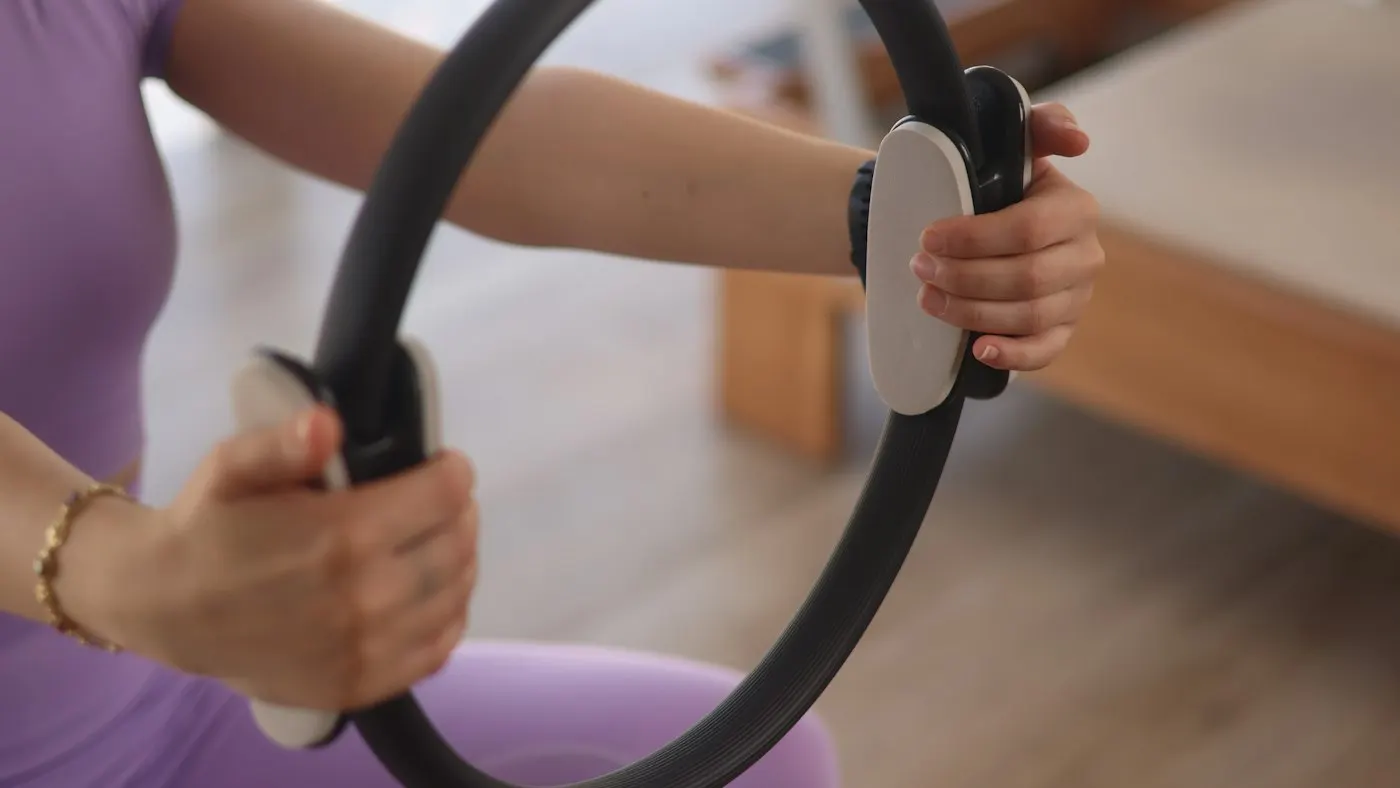
Pilates ring exercises for beginners add light resistance and feedback to familiar mat moves. TODAY describes the ring, also called a magic circle, as "a flexible, circular ring covered in soft padding with a grip on either side."
A ring doesn't only make moves harder. It can also make some easier, for example by supporting your head while you curl up. Beginners should learn both uses.
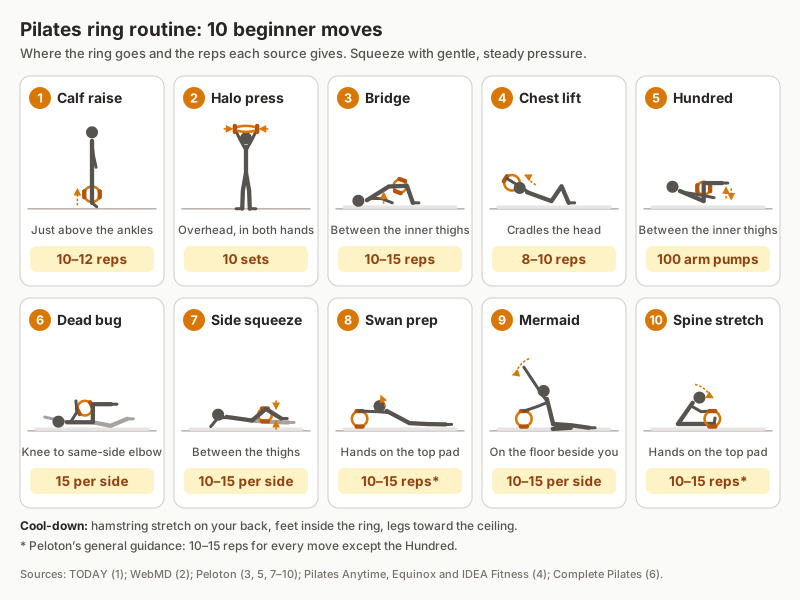
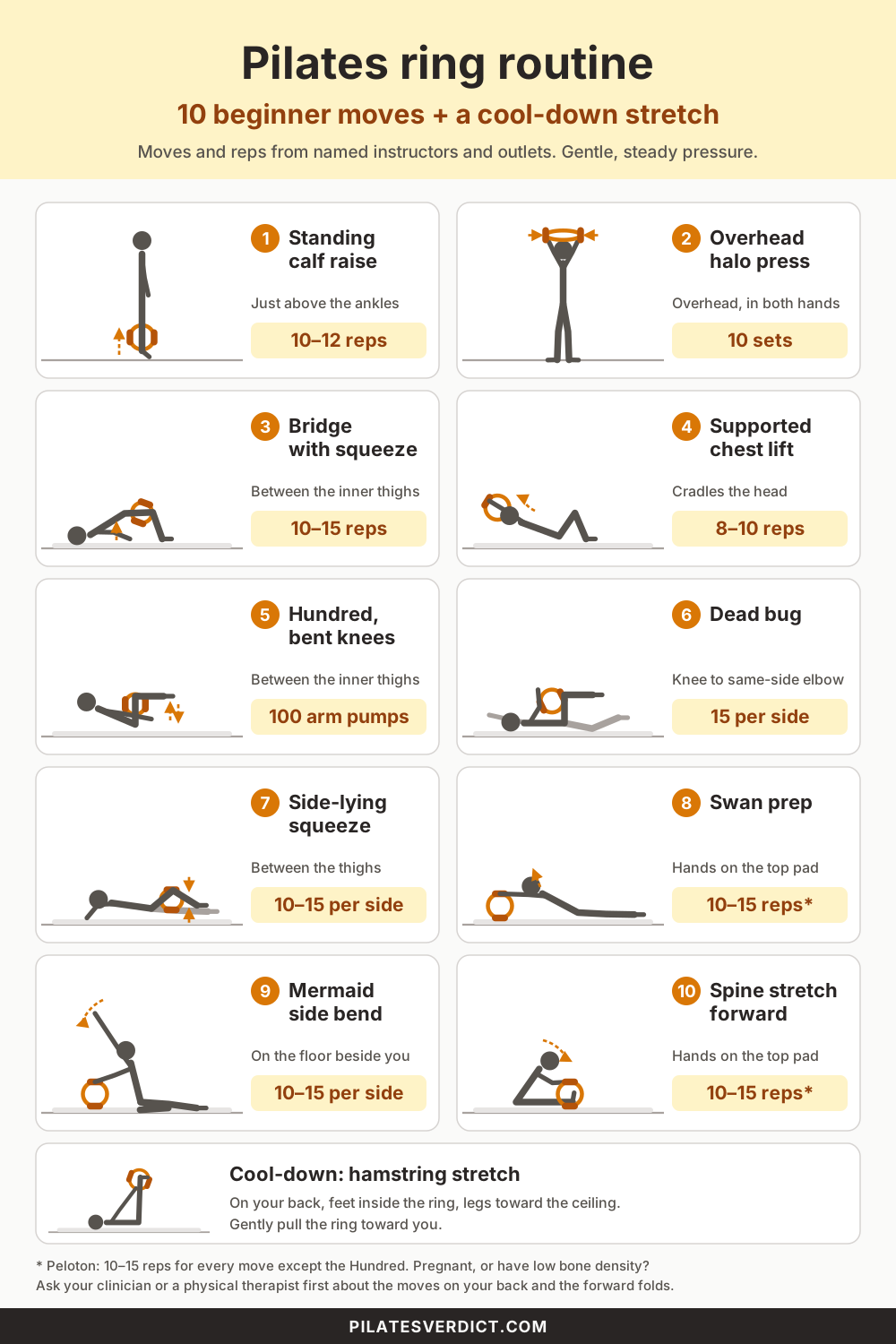
Below are 10 beginner Pilates ring (magic circle) exercises, each taken from a named instructor or outlet, with where the ring goes and the reps that source gives. The whole routine takes roughly 15–20 minutes (our estimate).
How we researched this: We built this routine from ring exercises published by TODAY (trainer Raven Ross), Peloton (instructor Kristin McGee), Complete Pilates (clinical Pilates instructor Magda Strugariu), Equinox (Jennifer DeLuccia), Pilates Anytime (Alison Manheim), Alo Moves and WebMD's medically reviewed guide. The research section draws on peer-reviewed studies and conference abstracts. Safety notes come from ACOG, the Bone Health & Osteoporosis Foundation and Mayo Clinic. We don't coach or test workouts. Where we could read only a search snippet of a source, we say so. Every source is listed at the end.
Quick version:
- What you need: a soft, padded Pilates ring (12–15 inch; we suggest Balanced Body's 15-inch Ultra-Fit Circle, or the 12-inch Mini if you're under 5'4"; see best Pilates rings) and a mat.
- How hard to squeeze: gently and steadily, not as hard as you can.
- How often: Peloton's McGee suggests Pilates 2–3 times a week, with the ring in at least one session.
- Check first if: you're pregnant, have osteoporosis, or have a shoulder, ankle, knee or hip problem.
What a Pilates ring does (and doesn't do)
Three ways to use it
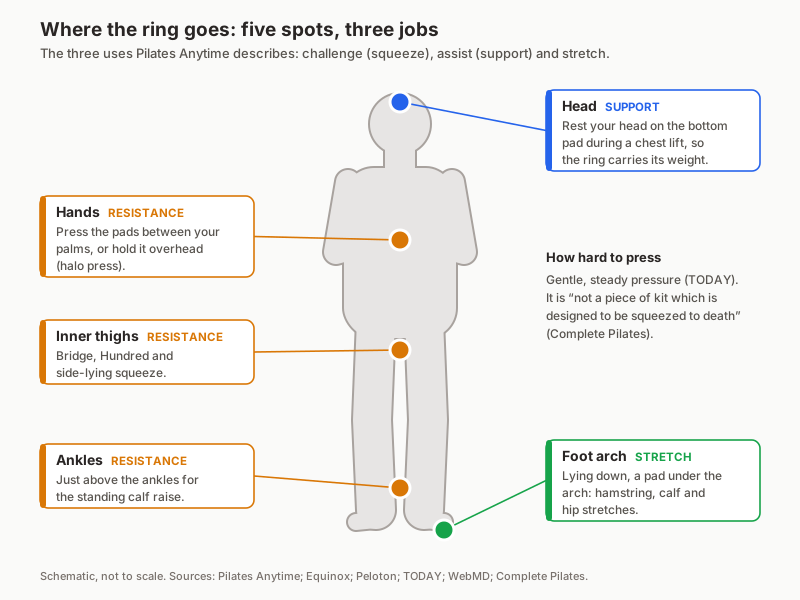
Pilates Anytime, a Pilates streaming service, describes three uses:
- Challenge: squeeze the ring between your inner thighs, ankles or hands.
- Assist: cradle your head on a pad during chest lifts, or use the ring to support your body weight in push-ups.
- Stretch: use it like a yoga strap, with a pad under the arch of your foot for hamstring, calf and hip stretches.
Tap the diagram to enlarge
Equinox Pilates manager Jennifer DeLuccia makes the same point: the ring can support a move as well as progress it. Her example is resting your neck on it during single-leg stretch if your neck aches.
How hard to squeeze
Less than you might think. TODAY's cues call for "gentle pressure." Magda Strugariu, a clinical Pilates instructor at Complete Pilates in the UK, says the ring gives "gentle to moderate resistance" plus tactile feedback, and it's "not a piece of kit which is designed to be squeezed to death!" She suggests deciding "whether it is acting as assistance or resistance" and setting the pressure to match.
Instructor Hannah Lawrence tells Fit&Well something similar: "The magic circle isn't about adding a ton of resistance like a dumbbell... Instead, it gives you feedback."
You may also hear the classical cue "imagine you could break the Circle," which Pilates Anytime uses. Treat it as imagery for staying engaged, not an instruction to squeeze as hard as you can.
A medium-resistance padded ring such as Balanced Body's Ultra-Fit Circle suits every move here:
Check price on AmazonForm first
TODAY trainer Raven Ross, creator of Pilates Body by Raven, recommends mastering an exercise's form first: "Then add the circle when you're ready to level up!" If a move is new to you, try it without the ring first. Our Pilates exercises at home for beginners routine covers the bodyweight versions.
A short history
Complete Pilates says the ring was "designed by the inventor of Pilates, Joseph Pilates." You'll often read that the first one was made from a beer-keg hoop. That story is unverified: Complete Pilates introduces it with "rumour has it," and Pilates Anytime calls it a "possibly apocryphal story" that Joseph Pilates got the idea from the metal hoops on beer barrels.
10 Pilates ring exercises for beginners (magic circle routine)
Tap the diagram to enlarge
The routine starts standing, moves to the floor on your back, then side-lying, facedown and seated. Rest whenever you need to, and stop any move that causes pain.
1. Standing calf raise (warm-up)
Stand with the ring between your legs just above the ankles. Per TODAY, keep gentle inner-thigh pressure on the ring, rise onto your toes, pause, then lower.
- Works: calves and inner thighs (TODAY).
- Reps: 10–12 (TODAY).
- Easier: hold a wall or chair for balance.
2. Overhead halo press
Hold the ring horizontally overhead with both hands. WebMD's guide has you squeeze twice on the exhale and twice on the inhale, which counts as one set.
- Reps: 10 sets (WebMD).
- Easier: do fewer sets.
- Harder: bend your elbows to bring the ring closer to your head (WebMD).
Optional: standing chest squeeze
For more upper-body work, hold the ring at chest height with a pad in each palm and, per TODAY, "gently squeeze it to create tension in the upper body." Equinox's DeLuccia describes the same squeeze with your arms extended in front of your chest and kept straight.
- Works: chest ("not just your pecs," DeLuccia says) and the shoulder stabilizers that connect your shoulders to your back (Equinox).
- Reps: neither source gives a count for this on its own, so use McGee's general 10–15 guide (Peloton).
- Easier: squeeze more gently.
3. Bridge with inner-thigh squeeze
Lie on your back with your knees bent, feet a few inches from your seat and the ring between your inner thighs, knees about hip-width apart. Peloton's McGee cues you to keep tension on the ring, press through your heels and lift until your body makes a line from knees to shoulders. Hold for one breath, then lower slowly. "Make sure not to arch your lower back."
- Works: glutes and inner thighs (Peloton's McGee, who says pulsing the ring adds even more challenge for them and the pelvic floor).
- Reps: 10–15 (McGee's general guide, Peloton). WebMD's version lifts your back off the mat one vertebra at a time, for 3 sets of 10.
- Easier: lift your hips less high.
4. Supported chest lift
This move uses the ring as support, not resistance. Lie on your back with your knees bent. Rest your head on the bottom pad and place your hands on the top pad, so the ring carries the weight of your head as you curl up. Pilates Anytime and Equinox's DeLuccia both describe using the ring this way.
- Works: pressing your hands into the top pad adds "some bonus arm work," according to Pilates Anytime.
- Reps: 8–10 (IDEA Health & Fitness; snippet only).
- Easier: a smaller curl.
- Skip if: you have spinal bone loss. See the safety section.
5. The Hundred (bent-knee version)
McGee's full version on the Peloton blog puts your legs at about 45 degrees with the ring between your ankles. You pump your arms while breathing in for 5 counts and out for 5, up to 100 pumps.
For beginners, McGee's modification is to "bend your knees to 90 degrees in tabletop position and squeeze the ring between your inner thighs."
- Works: core (Kim and Lee's EMG study; see the research section).
- Reps: 100 arm pumps (10 breath cycles).
- Progression: straight legs. One small study found higher core activation with straight legs (see the research section), but that's a later step, not where to start.
- Skip the head lift if: you have osteoporosis.
6. Dead bug
Lie on your back with your legs in tabletop. Complete Pilates' Strugariu places the ring between one knee and the elbow on the same side. As you exhale, reach the other leg straight and the arm on that side behind you.
- Works: abdominals and hip flexors (Complete Pilates).
- Reps: 15 per side (Complete Pilates).
- Easier: "If you feel this in your back, lift the leg higher" (Strugariu).
7. Side-lying inner-thigh squeeze
Lie on your side with your hips stacked and the ring between your thighs, then press your thighs together. McGee's variation puts your legs inside the ring so you press out instead, which works the outer thighs.
- Works: inner thighs; the legs-inside variation works the outer thighs (Peloton's McGee).
- Reps: 10–15 per side (McGee's general guide, Peloton).
- Easier: press more gently.
8. Swan prep
Lie facedown with the ring standing on one pad in front of you and your hands stacked on the top pad. Press into the ring to float your chest up, per Peloton's McGee. Alo Moves instructor Tela Anderson teaches the same setup.
- Reps: neither source gives a count here. McGee's general guide is 10–15 reps for most moves.
- Easier: make the lift smaller.
9. Mermaid side bend
Sit with your shins folded to one side and the ring standing on the floor on your other side. McGee cues you to lean, press down on the ring and reach your top arm overhead, then use your core to pull back up.
- Works: obliques; McGee says pressing down on the ring engages them "even more" (Peloton).
- Reps: 10–15 per side (McGee's general guide, Peloton).
- Easier: a smaller lean.
10. Spine stretch forward
Sit with the ring standing between your legs and your hands stacked on the top pad. Per McGee, press into the ring to sit tall, fold forward over your legs, hold, then roll back up.
- Reps: 10–15 (McGee's general guide, Peloton).
- Easier: fold less far.
- Skip if: you have osteoporosis. It's a forward-bending move.
Cool-down: hamstring stretch with the ring
Equinox's DeLuccia suggests lying on your back with both legs extended toward the ceiling, placing your feet inside the ring and pulling it toward you to stretch your hamstrings.
One leg at a time works too. Pilates Anytime's version has you extend one leg up, catch the arch of the foot with one padded handle, hold the other handle with both hands and gently pull the leg toward your face.
Pilates ring workout at a glance
| Move | Ring placement | Reps | Easier option |
|---|---|---|---|
| 1. Calf raise | Above ankles | 10–12 | Hold a wall |
| 2. Halo press | Hands, overhead | 10 sets | Fewer sets |
| 3. Bridge | Inner thighs | 10–15 | Lower lift |
| 4. Chest lift | Head and hands | 8–10 | Smaller curl |
| 5. Hundred | Inner thighs | 100 pumps | Fewer pumps |
| 6. Dead bug | Knee to elbow | 15/side | Leg higher |
| 7. Side squeeze | Between thighs | 10–15/side | Lighter press |
| 8. Swan prep | Hands, on floor | 10–15 | Smaller lift |
| 9. Mermaid | Hand, on floor | 10–15/side | Smaller lean |
| 10. Spine stretch | Hands, on floor | 10–15 | Less fold |
Reps for moves 3, 7, 8, 9 and 10 use McGee's general 10–15 guide. Easier options without a named source above are simple range reductions.
Tap the diagram to enlarge
How often to do it, and when to progress
Peloton's Kristin McGee says: "Practice Pilates two to three times a week, and incorporate props like the ring into at least one of those workouts." For everything except the Hundred, she says to "aim for 10 to 15 reps."
Start slowly. WebMD's medically reviewed guide says even experienced practitioners should go easy at first because the ring intensifies the workout, and to keep your breathing slow and even.
For context, a 2016 meta-analysis of studies on general Pilates used 2–3 sessions a week for 5–12 weeks (details in the research section).
A ring routine can count toward your weekly strength work, but it isn't a whole program. US guidelines from ODPHP call for 150–300 minutes of moderate aerobic activity a week plus muscle-strengthening activity on at least 2 days.
Once the routine feels easy, the sources suggest these next steps:
- Roll-up with the ring in your hands (Peloton).
- The Series of Five with the ring held above your chest (Equinox).
- A full classical magic circle mat class, such as Lesley Logan's 30-minute workout on OnlinePilatesClasses.
What the research says
There's very little research on the ring itself, and the studies that exist are small. Here's what we found.
Core activation in the Hundred
Kim and Lee (Journal of Bodywork and Movement Therapies, 2021) used surface EMG to measure core muscle activity in 28 men in their twenties during the Hundred. Activation was lowest with no prop, higher with a soft mini ball and highest with a Pilates ring. Straight legs produced more activation than bent knees.
This was one small study of young men who could already do the full Hundred. It measured muscle activity during the exercise, not strength gains over time, so it doesn't show that a ring builds a stronger core.
Inner-thigh squeezes and the pelvic floor
In a study of 21 postpartum mothers (Ojukwu et al., 2022), squeezing a ball between the thighs produced more pelvic floor muscle activity on surface EMG than a Kegel alone. The highest activity came from combining abdominal, inner-thigh and pelvic floor contractions. That's similar to a ring squeeze, but the ring itself wasn't tested.
An International Continence Society abstract from 2018 adds a caution: the inner-thigh and glute muscles can contract without the pelvic floor, and surface sensors may pick up signals from nearby muscles (snippet only).
A small ring trial
Joshi and Rathi presented a randomized controlled trial at the 2023 World Physiotherapy Congress. In 52 women with stress urinary incontinence, pelvic floor strength and core strength improved significantly more in the Pilates ring group than in the control group. The authors described the differences in incontinence severity and quality of life as "moderately significant," and the abstract gives no effect sizes.
It's a conference abstract, not a peer-reviewed paper, and it gives few details about the control group. It's also one small study. If you have leaking or other pelvic symptoms, see a pelvic floor physical therapist rather than relying on ring exercises.
General Pilates evidence
No large trials compare ring Pilates with mat Pilates. For Pilates in general:
- A 2016 meta-analysis of 9 randomized trials in healthy adults (Campos et al.) found that mat or apparatus Pilates 2–3 times a week for 5–12 weeks improved abdominal endurance compared with no exercise, by about 10 more curl-ups in a 1-minute test. It found no significant difference in flexibility.
- A 2011 systematic review of 16 studies (Cruz-Ferreira et al.) found strong evidence for flexibility and dynamic balance and moderate evidence for muscular endurance, though the studies were of low methodological quality.
Some articles say ring workouts help heart health, but the ones we read didn't cite a study, so we've left that claim out.
Safety: who should modify
Pregnancy
ACOG lists modified Pilates among exercises that are generally safe in pregnancy and advises avoiding lying flat on your back as much as possible (snippet only). Several moves here are done on your back: the bridge, chest lift, Hundred and dead bug. Get clearance from your ob-gyn or midwife, and ask about seated, side-lying or standing options.
Osteoporosis or low bone density
The Bone Health & Osteoporosis Foundation says people with spinal bone loss should not "bend forward from the waist" or do "toe-touches, sit-ups or abdominal crunches," and should avoid extreme twisting. Mayo Clinic gives similar advice, warning that bending forward and twisting at the waist raise the risk of spinal fractures (snippet only).
In this routine, that means the chest lift (4), the Hundred's head lift (5) and the spine stretch forward (10). Progressions like the roll-up fall in the same group. Ask a physical therapist for alternatives.
Shoulder, ankle, knee or hip problems
Complete Pilates' Strugariu says to skip ring press-ups if you can't hold a plank or have a shoulder injury. She calls one of her harder moves, a side-lying-to-teaser sequence, "only suitable if you have no recent or current injury," so we left it out of this routine.
Lesley Logan of OnlinePilatesClasses notes that some standing magic circle work is intermediate and "not ideal for some ankle, knee or hip issues" (snippet only).
Which ring works for these moves
Any soft, padded ring with handles inside and out works for this routine. Balanced Body's 15-inch Ultra-Fit Circle is flexible plastic with a rubberized shell, and the brand says its resistance is "approximately equivalent to a 3-Band Spring Circle." Balanced Body also offers a free exercise video by Shelly Power on its product page.
Size matters too. Merrithew recommends its 14-inch ring for people 5'4" and taller, and it also sells a 12-inch ring for shorter users. NBC Select's expert says smaller rings suit petite users and people with limited range of motion. Steel rings are a poor fit for this routine: Women's Health says Balanced Body's steel ring is "best suited for advanced pilates practitioners given that it has a steel build and high resistance."
Our pick for this routine: Balanced Body's Ultra-Fit Circle (15-inch, medium resistance). If you're under 5'4" or have limited range of motion, go for the 12-inch Mini instead.
Balanced Body Ultra-Fit Circle (15")
- Best for
- Main pick, 15-inch, medium resistance
- Price tier
- $20–40
ProBody Pilates Circle (14")
- Best for
- Value 14-inch ring
- Price tier
- $20–40
Gaiam Pilates Ring Fitness Circle
- Best for
- Budget pick (check the size on the listing)
- Price tier
- Under $20
Merrithew Fitness Circle Lite (14")
- Best for
- Lighter 14-inch option
- Price tier
- $20–40
Balanced Body Ultra-Fit Circle Mini (12")
- Best for
- Petite users or limited range of motion (12-inch)
- Price tier
- $20–40
| Product | Best for | Price tier | |
|---|---|---|---|
| Balanced Body Ultra-Fit Circle (15") | Main pick, 15-inch, medium resistance | $20–40 | View |
| ProBody Pilates Circle (14") | Value 14-inch ring | $20–40 | View |
| Gaiam Pilates Ring Fitness Circle | Budget pick (check the size on the listing) | Under $20 | View |
| Merrithew Fitness Circle Lite (14") | Lighter 14-inch option | $20–40 | View |
| Balanced Body Ultra-Fit Circle Mini (12") | Petite users or limited range of motion (12-inch) | $20–40 | View |
For full comparisons, see our best Pilates rings and best Pilates mats guides. Building a home setup? Start with Pilates equipment for beginners. For another prop-light routine, try wall Pilates exercises for beginners, or browse more Pilates workouts.
Frequently Asked Questions
Is a Pilates ring good for beginners?
Yes, if you use a light-to-medium ring and keep the pressure gentle. TODAY trainer Raven Ross recommends mastering a move's form first, then add the circle. The ring can also make some moves easier, for example by supporting your head in a chest lift, as Pilates Anytime and Equinox describe.
How hard should I squeeze a Pilates ring?
Gently and steadily. TODAY's cues call for 'gentle pressure,' and Complete Pilates' Magda Strugariu says the ring is 'not a piece of kit which is designed to be squeezed to death.' Pilates Anytime's 'imagine you could break the Circle' is an imagery cue for staying engaged, not a call to squeeze as hard as you can.
How often should I do Pilates ring exercises?
Peloton instructor Kristin McGee suggests Pilates two to three times a week, with props like the ring in at least one session, and 10–15 reps of most moves. Studies of general Pilates used 2–3 sessions a week for 5–12 weeks.
Does a Pilates ring work your core more than mat Pilates alone?
One small EMG study of 28 young men found higher core muscle activation during the Hundred with a ring than with a mini ball or no prop. It's a single study, and it measured muscle activity during the exercise, not long-term strength gains.
What size Pilates ring should a beginner get?
Merrithew recommends its 14-inch ring for people 5'4" and taller and also sells a 12-inch ring for shorter users. NBC Select's expert says smaller rings suit petite users and people with limited range of motion. Choose a soft, padded ring rather than steel.
What muscles does a Pilates ring work?
Mostly the inner thighs, glutes, core, chest and arms, depending on where you place it. TODAY trainer Raven Ross says the ring tones your inner thighs, arms and core. Peloton's Kristin McGee says the bridge squeeze challenges the glutes and inner thighs, and the mermaid works the obliques. WebMD says some ring moves work the whole arm, including the biceps, triceps and forearms. Complete Pilates adds the hips, shoulders and upper back.
Is a magic circle the same as a Pilates ring?
Yes. TODAY describes the Pilates ring, also called a magic circle, as a flexible, padded ring with a grip on either side.
Can Pilates ring exercises help the pelvic floor?
The evidence is limited. One small conference-reported trial in women with stress incontinence found greater pelvic floor and core strength gains with ring exercises; effects on symptoms were less clear. Inner-thigh squeezes raised pelvic floor activity in postpartum women in another study, though researchers caution these muscles can contract without the pelvic floor. If you have symptoms, see a pelvic floor physical therapist.
Sources
- TODAY (Brianna Steinhilber; trainer Raven Ross): The best Pilates ring exercises for a full-body workout at home
- Peloton blog (Sarah Klein; instructor Kristin McGee; brand content): Pilates ring exercises
- WebMD (Alyssa Anderson; medically reviewed by Jabeen Begum, MD): What is a Pilates ring?
- Complete Pilates (Magda Strugariu; studio content): The magic circle: Pilates ring exercises and benefits
- Equinox (Megan Falk; instructor Jennifer DeLuccia): Do more with a Pilates ring
- Pilates Anytime (Alison Manheim): Magic circle for every mood
- Alo Moves (Tela Anderson; brand content): 12 Pilates ring exercises for beginners
- OnlinePilatesClasses (Lesley Logan): 30-minute magic circle workout and Magic circle legs inside
- Fit&Well (Hannah Lawrence): The Pilates magic circle
- IDEA Health & Fitness: Pilates workout: the magic circle
- NBC Select (Zoe Malin; instructor Kristen Lilley): Best Pilates rings
- Women's Health: Best Pilates rings, picks from instructors
- Merrithew (brand): Fitness Circle Pro 14-inch
- Balanced Body (brand): Ultra-Fit Circle
- Kim and Lee, J Bodyw Mov Ther (2021): Core muscle activation with props in the modified Pilates Hundred
- Ojukwu et al., J Bodyw Mov Ther (2022): Abdominal and lower limb exercises and pelvic floor recruitment
- International Continence Society (2018): Abstract 318, pelvic floor activation during contractions of surrounding muscles
- Joshi and Rathi, World Physiotherapy Congress (2023): Pilates ring exercises and the pelvic floor in stress urinary incontinence
- Campos et al., J Sports Med Phys Fitness (2016): Pilates and physical conditioning in healthy adults, meta-analysis
- Cruz-Ferreira et al., Arch Phys Med Rehabil (2011): Systematic review of Pilates in healthy people
- ODPHP: Physical Activity Guidelines, top 10 things to know
- ACOG: Exercise during pregnancy
- Bone Health & Osteoporosis Foundation: Protecting your spine
- Mayo Clinic: Exercising with osteoporosis
Update history
- : Published.
Found an error? See how we research and correct guides in our editorial policy.
Was this guide helpful?
Related Articles
How-To
28-Day Wall Pilates Challenge: A Free Schedule and What to Expect
Free 28-day wall Pilates challenge options, a 4-week schedule with rest days, 8 sourced moves, and what 28 days can realistically change.
October 7, 2026 · 16 min read
How-To
Pilates ball exercises: a 10-move mini ball routine for beginners
10 Pilates ball exercises for beginners, with where the mini ball goes, reps and easier versions from named instructors, plus size, inflation and safety tips.
October 7, 2026 · 18 min read
How-To
Pilates exercises at home for beginners: a 10-move mat routine
10 Pilates exercises at home for beginners, no equipment beyond a mat. Reps and easier versions from instructor guides, plus how often to practice.
October 7, 2026 · 18 min read
How-To
Wall Pilates: What It Is, Does It Work, and a 7-Move Routine
What wall Pilates is, what the research does and doesn't say about it, a 7-move beginner routine from Pilates instructors, and the only gear you need.
October 7, 2026 · 18 min read