Bed Pilates: 10 gentle exercises for beginners (with chart)
By The Pilates Verdict Team · October 16, 2026 · 16 min read
This article contains affiliate links. If you buy through them, we may earn a commission at no extra cost to you. As an Amazon Associate I earn from qualifying purchases. Learn more.
Bed Pilates is classical mat Pilates adapted to your mattress. Pilates teacher Lesley Logan's pitch for it is simple: "We all have a bed we sleep in," and a few moves there can be a "gentle start to the day or a wonderful way to end your day."
Cleveland Clinic says bed exercises can help whether you're recovering from surgery or just have a hard time getting up in the morning. Our view: it's also an option when getting down to the floor is hard.
Below is a 10-move routine for doing Pilates in bed, ordered from gentle to stronger and finishing with a seated stretch. Each move has a named source and reps, and there's a printable chart. After that: a bedtime version, what the research says and who should modify.
Looking for the Reformer, which some people call a "Pilates bed"? See our best home Pilates reformers instead.
How we researched this:
- Move cues: Pilates teacher Lesley Logan (OnlinePilatesClasses), Cleveland Clinic sports medicine physician Michael Dakkak, DO, physical therapist and Club Pilates instructor Dr. Femi Betiku (via Eat This, Not That!), occupational therapist Natasha Freutel (via Healthline) and instructor Alexa Idama (via Sleep.com)
- Benefits: two peer-reviewed meta-analyses and the Sleep Foundation
- Safety: ACOG, the Bone Health & Osteoporosis Foundation and Cleveland Clinic
We don't coach or test workouts. Every source is listed at the end.
Quick version:
- Time: about 10 minutes for one slow round (our estimate).
- Reps: 5 slow reps per move to start (our suggestion). Logan suggests 3–5.
- Surface: a firm mattress. If yours sinks, do the same moves on the floor.
- Bedtime: do moves 1, 2, 3, 6, 7 and 10 only, slowly.
- Skip or modify: moves 5, 8 and 10 if you have osteoporosis, and keep move 9 small (BHOF).
What is bed Pilates?
Bed Pilates takes familiar mat exercises, such as the pelvic curl, single leg stretch, leg circles and spine twist, and does them lying or sitting on your bed. Logan's pitch is accessibility: you don't need to get up first.
Experts are clear that it's a convenience, not an upgrade. Dr. Femi Betiku, a physical therapist and certified Club Pilates instructor, told Eat This, Not That! that his 8-minute core routine can be done in bed, though a mat works as well or better.
Cleveland Clinic's Dr. Dakkak gives the same starting advice for anyone exercising in bed: "You'll want to start off with pretty basic exercises."
Did Pilates start on hospital beds?
You may read that Joseph Pilates built his first spring equipment from hospital beds at the Knockaloe internment camp during World War I. That story is unproven.
The Pilates Teacher Association says neither the Knockaloe researchers nor biographer Javier Perez Pont "have found any trace of bed springs being on internment camp beds and there is no evidence of him having worked in the camp hospital." Popular Science says the hospital story "is yet to be confirmed by historical evidence." What is documented, per the Pilates Teacher Association, is that he taught exercises at the camp.
Before you start: set up your bed
- Use a firm bed. Logan: "If the bed is too soft then a lot of exercises are just going to feel like you're overusing your neck, or you're not going to feel this, feel like your core can engage enough to support your back."
- Clear the space. Move the duvet aside and lie near the middle of the bed (our suggestion).
- Support your neck. Logan suggests a pillow under your head if curling up strains your neck, and pillows behind you for the seated moves.
- Lock the wheels. If your bed has wheels, Cleveland Clinic says to lock them, and to use extra pillows or blankets to stay stable.
- Move slower than usual. Logan's cues: breathe deeply, keep your alignment and keep reps low, ideally 3–5. "When in doubt, you always should leave it out."
- Stop if it hurts. Cleveland Clinic says to stop if "something feels painful or unnatural." Dakkak: "Any movement is good movement if it's pain-free."
Skip anything that needs a hard surface, such as planks and push-ups (our suggestion). Occupational therapist Natasha Freutel told Healthline that "most mattresses provide a slightly unstable surface" that recruits stabilizing muscles. That's her view; we found no study showing a mattress makes the core work harder.
The 10-move bed Pilates workout
Rep counts vary by source: 3–5 from Logan, 10–15 from Cleveland Clinic and mostly 2 sets of 6–10 in Betiku's routine. For beginners, we suggest one round of 5 slow reps per move.
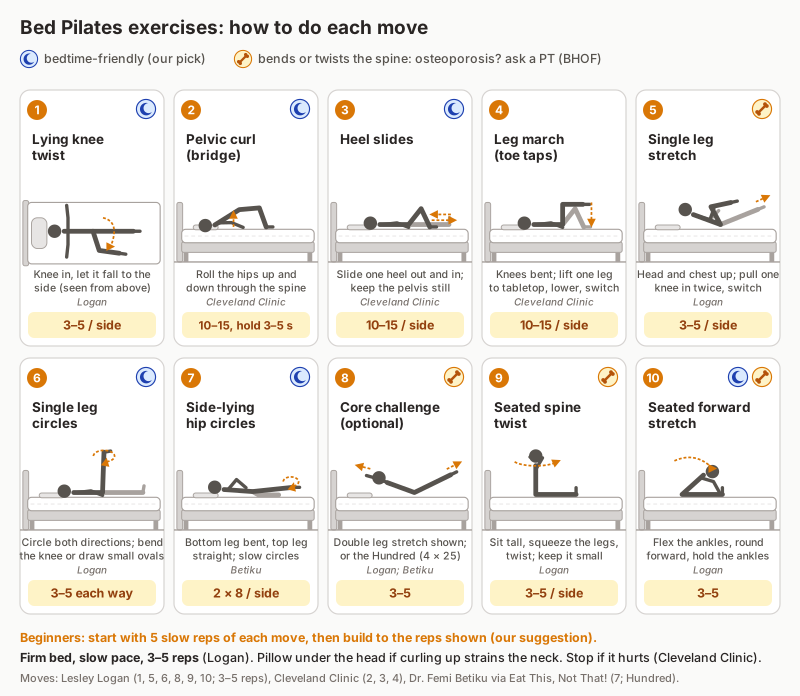
Tap the diagram to enlarge
1. Lying knee twist
Logan's gentle alternative to a spine twist. Lie on your back, bring one knee in toward your chest and let it twist over to the side. Return to center and switch sides.
Think of it as a warm-up: small, slow and easy on the back.
2. Pelvic curl (bridge)
Lie on your back with knees bent and feet flat on the mattress. Logan's cue: "Roll through your spine to roll your hips up and roll through your spine to lower your hips down." You choose how high to go.
Cleveland Clinic's version: 10–15 bridges, holding each for 3–5 seconds at the top. Instructor Alexa Idama's bedtime routine on Sleep.com adds the arms, lifting them overhead as the hips rise, for 5 reps.
Optional prop: a soft mini ball squeezed between your knees (our suggestion; none of the bed sources use props). See our best Pilates balls.
3. Heel slides
Lie on your back with knees bent. Slowly slide one heel away until the leg is straight, then slide it back. Cleveland Clinic suggests 10–15 per side.
Pilates cue (ours): keep your pelvis still while the leg moves.
4. Leg march (toe taps)
From the same position, lift one bent knee toward you, lower the foot back down, and alternate. Cleveland Clinic suggests 10–15 per side.
Harder version: Freutel's version on Healthline lifts the hips into a bridge first, then marches, for 20 reps.
5. Single leg stretch
Logan: curl your head and chest up, draw one knee in and reach the other leg out. "Pull one of your legs two times and switch." Put pillows under your head if your neck strains.
Osteoporosis: this is spinal flexion. See the safety section below.
6. Single leg circles
Logan: lift one leg toward the ceiling and circle it in "both directions," then switch legs. If a straight leg isn't comfortable, bend the knee or draw small ovals. Idama includes leg circles in her bedtime routine on Sleep.com.
7. Side-lying hip circles
Betiku: lie on your side with the bottom leg bent and the top leg straight. Stack your hips, engage your core, lift the top leg slightly and draw slow, tiny circles. He suggests 2 sets of 8 per side.
8. Optional core challenge
Pick one:
- Double leg stretch (Logan): reach your arms and legs out, circle your arms around and pull your knees back in. Don't let your back arch.
- The Hundred (Betiku): legs at 45 degrees, pulse the arms, 4 sets of 25.
- Reverse crunch (Dakkak): "Unlike traditional crunches, where your back is coming off the mattress, you're bringing your knees up toward your chest."
All three are flexion moves; see the osteoporosis note below. Skip this one at bedtime if it feels energizing (our suggestion).
9. Seated spine twist
Logan: sit tall, with pillows behind you if needed, hands on your shoulders or behind your head. "Squeeze those legs super tight" and twist. Return to center and twist the other way.
Osteoporosis: keep the twist small.
10. Seated forward stretch
Logan's "Tendon Stretch" for the bed: "Flex your ankles, ground forward over your legs, and you can pull on those ankles and stretch." It targets the ankles, hamstrings and spine.
Her alternative is a hip opener: cross your legs and round forward, or try a pigeon-like variation.
Osteoporosis: this rounds the spine forward. Skip it or ask a physical therapist.
Printable bed Pilates chart
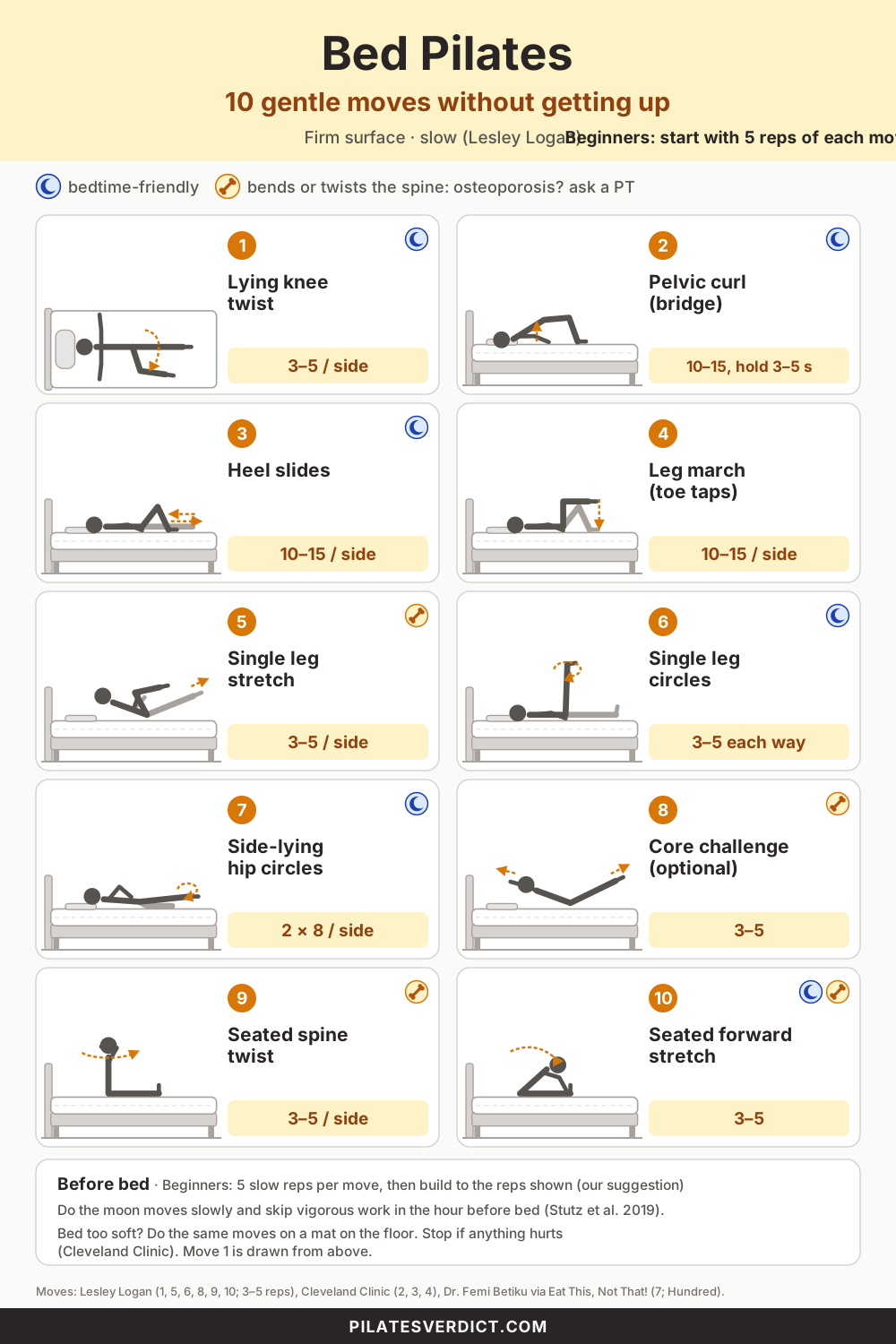
Tap the diagram to enlarge
Download the printable bed Pilates chart (PDF) or open the chart on its own page to print it. Keep it by your bed. Beginners: start with 5 slow reps of each move (our suggestion). The table below is a text version.
| Move | Reps | Easier option |
|---|---|---|
| 1. Lying knee twist | 3–5 per side | Smaller range |
| 2. Pelvic curl | 3–5 (Logan); 10–15 (CC) | Lower hips |
| 3. Heel slides | 10–15 per side | Shorter slide |
| 4. Leg march | 10–15 per side | Slower pace |
| 5. Single leg stretch | 3–5 | Head on pillows |
| 6. Single leg circles | 3–5 each way | Bent knee, small ovals |
| 7. Side-lying hip circles | 2×8 per side | One set |
| 8. Core challenge | 3–5; Hundred 4×25 | Skip |
| 9. Seated spine twist | 3–5 per side | Pillows behind |
| 10. Seated forward stretch | Hold and breathe | Bend knees |
Moves and reps: Lesley Logan (1, 2, 5, 6, 8–10), Cleveland Clinic, "CC" (2–4, 8), Natasha Freutel via Healthline (4), Dr. Femi Betiku via Eat This, Not That! (7, 8) and Alexa Idama via Sleep.com (2, 6). Where Logan gives no exact count, we applied her 3–5 guidance.
Bed Pilates for beginners: how to build up
Start small. Logan suggests 3–5 careful reps, never more than 10. Our suggestion is one round of 5 slow reps per move, which takes about 10 minutes.
As it gets easier, build toward Cleveland Clinic's 10–15 reps or Betiku's routine, which uses mostly 2 sets of 6–10. Add the optional core challenge (move 8) last.
How often? Cleveland Clinic's general advice is to make exercise part of your daily routine. None of our sources gives a set number of bed sessions per week. Many people use it as a morning or bedtime habit; rest on days anything feels sore (our suggestion).
A sample first week (our suggestion)
| Day | Moves | Reps |
|---|---|---|
| 1–2 | Moves 1–4 | 5 each |
| 3 | Rest or the bedtime version | 5 each |
| 4–5 | Moves 1–7 | 5 each |
| 6 | The full 10 | 5 each |
| 7 | Rest | — |
This plan is ours, not from a source. Repeat or slow it down if anything feels hard.
When the whole routine feels easy, or your mattress keeps sinking, take it to the floor. Our Pilates exercises at home for beginners covers the mat versions step by step. If getting down to the floor is the problem, try our standing Pilates exercises.
Bedtime version (and a morning version)
Bedtime: do moves 1, 2, 3, 6, 7 and 10, slowly, with long exhales (our selection). The Sleep Foundation says "slow, low-intensity stretches are generally preferred before bed, while vigorous exercise close to bedtime may interfere with sleep for some people." Logan adds that if the seated spine twist feels too energizing at night, use the lying knee twist instead.
Morning: do the full 10 moves, including the core challenge.
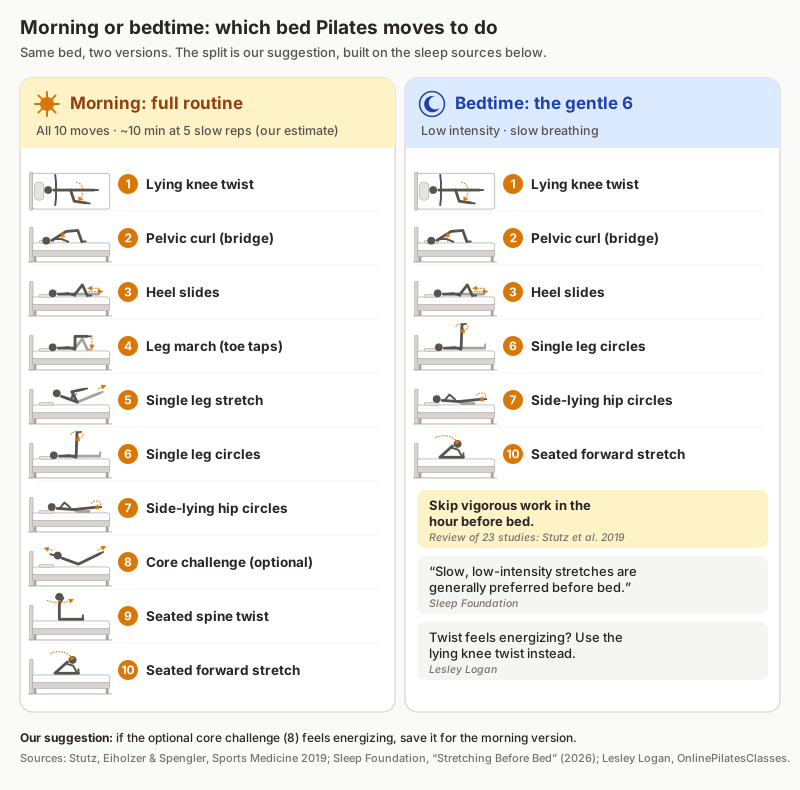
Tap the diagram to enlarge
Bed Pilates benefits: what the research says
No published study has tested Pilates done on a bed. Everything below is about Pilates or exercise in general.
- Sleep quality: Chen et al. (2020, Frontiers in Neurology) pooled 6 randomized trials with 477 participants. "Overall, Pilates improved sleep quality but had no significant effect on the use of sleeping medication." They found no significant benefit for healthy adults over 40 or postmenopausal women. The studies were few, their protocols varied, and the authors rated quality "fair to mild" and called for "well-designed and large-scale RCTs."
- Evening exercise: Stutz, Eiholzer and Spengler (2019, Sports Medicine) reviewed 23 studies in healthy adults: "the studies reviewed do not support the hypothesis that evening exercise negatively affects sleep." But sleep "might be impaired after vigorous exercise ending ≤ 1 hour before bedtime."
- Stretching before bed: the Sleep Foundation says gentle stretching "may help reduce muscle tension, promote relaxation, and prepare your body for sleep."
- Staying active as you age: physical therapist Dr. Femi Betiku designed an 8-minute core routine for adults over 60 and says it can be done in bed (via Eat This, Not That!). That's expert opinion, not a study.
- Some movement beats none: Logan argues a short routine in bed is better than skipping movement entirely, and Dakkak says "any movement is good movement if it's pain-free." Both are expert opinion.
We found no source that measured calories, weight loss or posture changes from bed Pilates, so we don't make those claims.
Bed Pilates for seniors and limited mobility
Physical therapist Dr. Femi Betiku built his bed routine for adults over 60 (via Eat This, Not That!), and Cleveland Clinic says bed exercises can help when you're recovering from surgery or have a hard time getting up in the morning.
For the gentlest start, try moves 1–4 and 7 only (our suggestion). Check the safety notes below first, especially if you have osteoporosis or are recovering from surgery.
Who should modify or skip
- Pregnancy: ACOG advises avoiding lying flat on your back as much as possible. Most of this routine is on your back, so talk with your ob-gyn. Moves 7, 9 and 10 are side-lying or seated (our note).
- Osteoporosis or low bone density: the Bone Health & Osteoporosis Foundation (BHOF) advises avoiding bending forward from the waist, sit-ups, crunches and extreme twisting. Skip or modify moves 5, 8 and 10, and keep move 9 small. BHOF suggests a physical therapist can help you choose safe exercises.
- After surgery or with mobility limits: Cleveland Clinic suggests consulting a physical therapist during recovery from surgery and stopping if anything hurts.
- Neck strain: use pillows under your head, or drop the head-lift moves (5 and 8), as Logan suggests.
- Very soft mattress: move to the floor (Logan, Betiku).
When to move to the floor
A mat gives you the firm surface Logan recommends and opens up moves a bed can't support, like planks. Eat This, Not That! reports Betiku saying a mat works as well or better than a bed.
A basic yoga mat on a carpet or rug is enough to start (our view). A low-cost, widely sold option is the Gaiam Classic 5mm mat:
Check price on AmazonFor thicker, Pilates-specific options, see our best Pilates mats.
More routines live in our Pilates workouts section.
Frequently Asked Questions
What is bed Pilates?
Pilates exercises adapted to your mattress, such as pelvic curls, leg circles, the single leg stretch and a seated spine twist. Pilates teacher Lesley Logan pitches it as an easy way to start or end the day, since everyone has a bed.
Is bed Pilates effective?
No study has tested Pilates on a bed specifically. A 2020 meta-analysis of Pilates in general found modest improvements in sleep quality, based on a small number of varied trials. Physical therapist Dr. Femi Betiku says a mat works as well or better if you can get to the floor, and Lesley Logan says a too-soft bed makes it harder to engage your core.
Can beginners do bed Pilates?
Yes, if you start with basic moves, go slowly and stop if anything hurts, as Lesley Logan and Cleveland Clinic advise. Logan suggests 3–5 careful reps rather than many fast ones.
Is it OK to do Pilates right before bed?
A review of 23 studies found evening exercise doesn't appear to hurt sleep in healthy adults, though vigorous exercise ending within an hour of bedtime might. The Sleep Foundation says slow, low-intensity stretching is preferred before bed.
Do I need a firm mattress for bed Pilates?
A firmer bed helps. Lesley Logan says a too-soft bed can make you overuse your neck and struggle to support your back with your core. If your mattress sinks, do the same moves on a mat on the floor.
Can bed Pilates help you lose weight?
We found no source that measured calories burned or weight loss from bed Pilates. Treat it as gentle movement, not a weight-loss workout.
Is bed Pilates good for seniors?
Physical therapist Dr. Femi Betiku designed an 8-minute core routine for adults over 60 that he says can be done in bed. Start with basic moves, and check with a doctor or physical therapist if you have osteoporosis or are recovering from surgery.
Did Joseph Pilates invent Pilates on hospital beds?
Not proven. The Pilates Teacher Association found no evidence of bed springs on the Knockaloe internment camp beds or of him working in the camp hospital, and Popular Science says the story is yet to be confirmed. What is documented is that he taught exercises at the camp.
How long should a bed Pilates workout be?
One slow round of the 10 moves takes about 10 minutes (our estimate). The bedtime version uses six moves and is shorter.
Sources
- OnlinePilatesClasses (Lesley Logan): 5 benefits of bed Pilates: how to do Pilates in bed?
- Eat This, Not That! (Dr. Femi Betiku, PT, DPT): The 8-minute bed routine that restores core strength faster than planks after 60
- Cleveland Clinic (Michael Dakkak, DO): 8 bed exercises to add to your routine
- Healthline (Natasha Freutel, OT): Exercises you can do from bed
- Sleep.com (Alexa Idama): Pilates exercise for sleep
- Chen et al., Front Neurol (2020): Effect of Pilates on sleep quality: a systematic review and meta-analysis of randomized controlled trials
- Stutz, Eiholzer and Spengler, Sports Med (2019): Effects of evening exercise on sleep in healthy participants
- Sleep Foundation: Stretching before bed
- Pilates Teacher Association: History
- Popular Science: Pilates started in a WWI internment camp
- ACOG: Exercise during pregnancy
- Bone Health & Osteoporosis Foundation: Protecting your spine
- Bone Health & Osteoporosis Foundation: Be bone strong: exercise to stay healthy
Update history
- : Published.
Found an error? See how we research and correct guides in our editorial policy.
Was this guide helpful?
Related Articles
How-To
Pilates block exercises: 10 beginner moves with a yoga block
10 Pilates block exercises for beginners: where the yoga block goes in each move, reps from named instructors, easier and harder options, and safety notes.
October 16, 2026 · 22 min read
How-To
Classical Pilates mat exercises: all 34 in order (+ printable chart)
All 34 classical Pilates mat exercises in Joseph Pilates' original order, with modern names, reps, a printable chart and a beginner sequence.
October 15, 2026 · 20 min read
How-To
Standing Pilates exercises: a 10-move routine without the floor
10 standing Pilates exercises for beginners, with chair support options, reps, a printable chart, a light-weights version and what research says about balance.
October 15, 2026 · 20 min read
How-To
Pilates jump board exercises for beginners: an 8-step progression
Eight Pilates jump board exercises for beginners in a safe order, plus what a reformer jump board is, spring tips and what the evidence says on benefits.
October 14, 2026 · 20 min read