Wall Pilates: What It Is, Does It Work, and a 7-Move Routine
By The Pilates Verdict Team · October 7, 2026 · 18 min read
This article contains affiliate links. If you buy through them, we may earn a commission at no extra cost to you. As an Amazon Associate I earn from qualifying purchases. Learn more.
Wall Pilates took off on social media with 28-day challenges and app ads. The idea is simple: do Pilates moves on a mat next to a wall, and use the wall for support and something to push against.
Here's what wall Pilates is, whether it works (and what the evidence actually says), and a short beginner routine you can do with a mat and a clear stretch of wall.
How we researched this: We read instructor guidance from Pilates Anytime (including the classical wall series), Life Time's Experience Life, TODAY's interview with an NYU Langone exercise physiologist, CBS Minnesota, Coach and Healthline. We searched PubMed for wall Pilates trials, read systematic reviews on Pilates in general, and checked guidance from the CDC and Cleveland Clinic. We didn't do or coach these workouts ourselves. Every source is listed at the end.
Bottom line:
- Try it if you're a beginner who wants a low-impact, supported home workout with just a mat.
- Don't expect weight loss or a 28-day transformation. No study has tested wall Pilates itself.
- Once it feels easy, add bands, a ball or light weights, or move on to mat or reformer Pilates.
- Gear: a mat and a clear wall. There's no special wall Pilates mat (what to get).
What is wall Pilates?
Pilates Anytime describes wall Pilates as a variation of traditional Pilates that uses "only a Mat and a wall nearby." You press your feet, arms, back or side into the wall and use it, plus your body weight, as resistance against gravity.
Heather A. Milton, an exercise physiologist supervisor at NYU Langone Health's Sports Performance Center, explained the appeal to TODAY: "In Pilates, the only resistance you have really is the force of gravity. Using a wall for static resistance, you can actually exert the force." She calls it "a low-moderate intensity exercise, so it will not provide the same benefits as moderate or vigorous exercise in terms of body composition improvements and cardiovascular health."
Life Time instructor Agnieszka Karasek told Experience Life that the wall "provides support for your body anywhere, anytime," working a bit like reformer equipment for home workouts. The American Council on Exercise (ACE) lists wall Pilates alongside hot Pilates as newer trends that "bring creative variety to the method."
Is wall Pilates new?
Not entirely. Classical Pilates has a short wall series. In a 2013 Pilates Anytime tutorial, Brett Howard teaches "the Wall Exercises that Romana [Kryzanowska] used to finish her classes": standing alignment, arm circles, a roll down, squats and single-leg lifts. In a 2023 Pilates Anytime class, instructor Mychele Sims says this series is normally done "at the end of working through all the apparatus."
The viral version is much broader than that short series. Asked whether wall Pilates is classical Pilates, STOTT-certified instructor Rachel of Rachel's Fit Pilates told Coach, "The simple answer is no," though she added that well-designed wall workouts can be effective. So the trend isn't classical, but classical teachers do use the wall.
Pilatesology, a classical Pilates video library, says the Wall is part of Joseph Pilates' original repertoire and that he typically ended classes there. We couldn't find a primary source from Joseph Pilates himself, so treat that origin story as secondhand.
Does wall Pilates work?
Is wall Pilates effective? It can build core strength, balance and control, especially if you're starting from little or no exercise, but no study has tested wall Pilates itself, so the evidence is borrowed from research on Pilates in general.
What the research says (and doesn't)
We found no published studies on wall Pilates itself. A PubMed search on October 7, 2026 for "wall" anywhere in the record and "Pilates" in the title or abstract returned 17 records. The ones we checked used "wall" in other ways (for example, a "single-leg wall sit test"), and none tested a wall Pilates program. TODAY also notes there isn't much research specific to wall Pilates.
So any benefit claims rest on research on Pilates in general:
- Low back pain: A 2015 Cochrane review (Yamato et al.; 10 trials, 510 people) found "low to moderate quality evidence" that Pilates beats minimal intervention for low back pain and disability, but "no conclusive evidence that it is superior to other forms of exercises."
- Chronic low back pain: A 2022 network meta-analysis in JOSPT (Fernández-Rodríguez et al.; 118 trials, 9,710 participants) ranked Pilates highest among exercise types for reducing pain and disability. Like the Cochrane review, it looked at mat and equipment Pilates in people with back pain, not wall routines.
- Older adults: A 2021 meta-analysis in Physiotherapy (Fernández-Rodríguez et al.; 39 studies) found moderate effects on balance, strength, flexibility and function, and a large effect on fall risk.
- Balance: A 2023 meta-analysis in Healthcare (Sampaio et al.; 15 interventions) found Pilates improved balance in older adults in about half of static-balance analyses and two-thirds of dynamic-balance analyses.
Cleveland Clinic says Pilates builds core strength, flexibility and muscle tone, but notes that most studies are small and short. Whether a wall-based routine delivers the same results hasn't been tested.
What instructors say
- Callie Jardine, Pilates instructor and founder of Sweaty Studio, told TODAY: "Wall Pilates is great for improving stability, balance, strength and control."
- Danielle Linneweber, owner of Purposeful Pilates in Minneapolis, told CBS Minnesota: "I think it depends on your instructor and what you're trying to get out of it… The wall does give you support and helps you with your balance and control." She says mat Pilates can work just as well and recommends following videos only from certified Pilates instructors.
- Rachel's Fit Pilates told Coach that putting your feet on the wall during ab work "reduces your range of movement, which makes the exercises easier," though it gives a stronger contraction. For glutes, the wall makes bridges harder, like an elevated bridge. She advises choosing "an instructor who understands body mechanics."
- Mary W., obé's in-house Pilates expert, quoted on the obé Fitness blog (a brand that sells classes), says, "There aren't any benefits to Wall Pilates that can't already be achieved by a Mat Pilates class," and "you won't be able to progress much only using a wall as a prop."
How long until you see results?
Milton told TODAY it takes about 4–6 weeks for your nervous system to improve, and "more like 12 weeks" to see changes in muscle size. She says people starting from nothing can see better strength or balance, but already-active people may not see much change in a month.
That's a lot longer than most challenge ads suggest. Rachel's Fit Pilates warns about "false claims about what you will look like after 28 days," and the obé blog says, "There's really nothing that will drastically change your physique in 28 days."
Can wall Pilates help you lose weight?
Probably not much on its own. Nobody has measured the energy cost of wall Pilates specifically, but general Pilates is a light-to-moderate activity:
- The 2024 Adult Compendium of Physical Activities lists "Pilates, general" at 2.8 METs and traditional mat Pilates at 1.8 METs. The Compendium classes 1.6–2.9 METs as light intensity.
- A 2026 systematic review (Vitor et al.; 6 studies, very low-to-low certainty evidence) found Pilates "appears to elicit light-to-moderate metabolic intensity."
- Cleveland Clinic says Pilates is "not as heavy a cardiovascular workout" and shouldn't replace aerobic exercise.
Wall Pilates is likely in a similar range. The CDC recommends that adults get 150 minutes a week of moderate aerobic activity plus muscle-strengthening work on at least 2 days a week. Wall Pilates may count toward the strength and core side of that, not the aerobic target.
Wall Pilates benefits (and limits)
Based on the sources above, wall Pilates may offer:
- Support and feedback. Karasek says the wall provides support anywhere, and Linneweber says it helps balance and control. Pressing your back against the wall in a roll down or wall sit also gives you a reference point for alignment.
- Something to push against. Milton says the wall lets you "exert the force" instead of relying only on gravity.
- Core strength, balance and control. That's Jardine's summary, and it matches what research on Pilates in general shows, per Cleveland Clinic and the reviews above.
- Easy access. Pilates Anytime says it can suit people with injuries, pregnant people, seniors who have trouble getting up and down from the floor, and people who can't lie flat for long. If any of those apply, check with your provider first (see Is wall Pilates safe?).
The limits matter too:
- Progression. The obé instructor says you won't progress much using only a wall. Adding light weights, bands or a ball is one way to keep going (see equipment).
- Range of motion. Rachel's Fit Pilates notes that feet on the wall can shorten your range in ab work, which makes some moves easier.
- Quality varies. Both Linneweber and Rachel say results depend on how well the workout is designed and who teaches it.
How to do wall Pilates: a 7-move sample routine
For step-by-step cues, easier and harder versions, and a full beginner plan, see our wall Pilates exercises for beginners guide.
Clear a stretch of wall with enough floor space to lie down. Put your mat with its short end against the wall, and wear grip socks or go barefoot so your feet don't slide. The moves below come from the classical wall series (Pilates Anytime), Life Time's wall Pilates workout (Experience Life), TODAY and Healthline.
Tap the diagram to enlarge
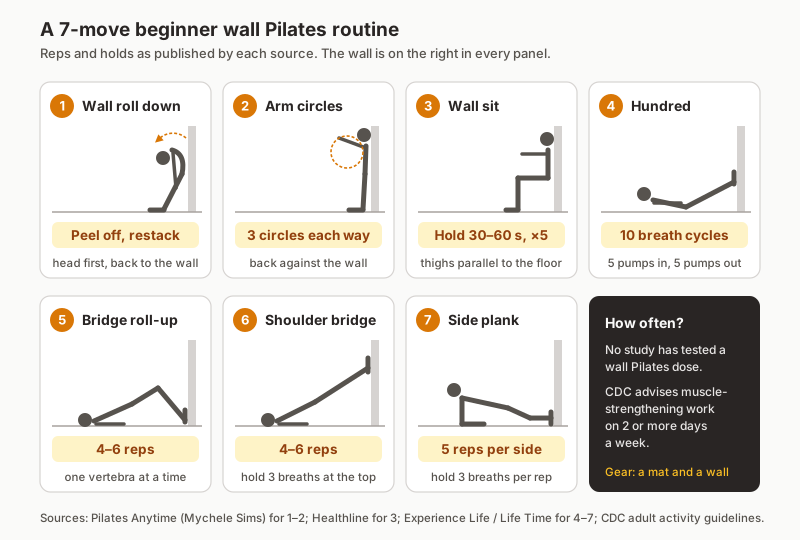
1. Wall roll down
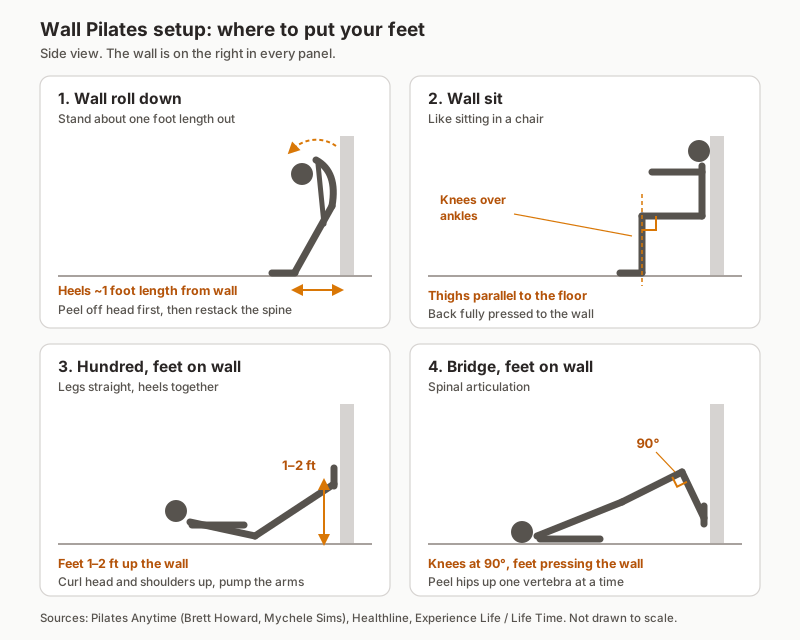
Stand with your back against the wall. Brett Howard recommends standing about one foot length away from it. Mychele Sims cues: drop your chin to your chest and "roll and peel yourself off of the wall," head first, then neck and shoulders, with your arms hanging. Restack your spine one vertebra at a time to come back up.
2. Arm circles at the wall
Keep your back against the wall and circle your arms. Sims does three circles in each direction.
3. Wall sit
Slide down the wall, "almost as if you're sitting in a chair" (Sims).
- Position: back "fully pressing to the wall," tailbone down (Sims); arms forward, head against the wall (Experience Life).
- Depth: thighs parallel to the floor, knees over ankles (Healthline).
- Hold: 30–60 seconds, 5 times (Healthline).
- Easier: don't slide as low.
4. Hundred with feet on the wall
Lie on your back with your feet on the wall 1–2 feet off the floor, legs straight and heels together. Curl your head and shoulders up and pump your arms: 5 pumps as you breathe in, 5 as you breathe out, for 10 breath cycles (Experience Life).
5. Spinal articulation bridge
Lie on your back with your feet on the wall and knees at 90 degrees. Press into the wall and peel your hips up one vertebra at a time, then roll back down. Experience Life suggests 4–6 reps.
6. Shoulder bridge with feet high
Place your feet higher on the wall with legs straight. Press into the wall, lift your hips and squeeze your inner thighs, holding for 3 breaths. Do 4–6 reps (Experience Life). TODAY's version, an "elevated hip bridge," uses 10–15 reps.
7. Side plank with feet on the wall
Lie on your side with knees slightly bent and feet pressing into the wall. Lift onto your forearm and hold for 3 breaths. Experience Life suggests 5 reps per side.
How often should you do it?
- Frequency: no wall Pilates dose has been studied. The CDC advises muscle-strengthening work on 2+ days a week.
- Timeline: give it 4–6 weeks for early gains and about 12 weeks for muscle changes (Milton, TODAY).
- Ready-made option: Healthline's 15-minute beginner wall routine (medically reviewed by Micky Lal, MA, CSCS, RYT) needs only a yoga mat, towel or blanket.
Tap the diagram to enlarge
Is wall Pilates safe?
For most people it's a low-impact workout, but a few precautions apply:
- Check with your provider first if you're injured, recovering from surgery or have a chronic condition. Cleveland Clinic recommends talking with a healthcare provider before starting a new routine.
- Pregnancy: ACOG's exercise-in-pregnancy guidance mentions modified Pilates among exercise options and advises avoiding lying flat on your back as much as possible. Many wall Pilates moves, including the Hundred and bridges above, are done on your back. If you're pregnant, ask your OB and look for a prenatal-trained instructor.
- Follow qualified teachers. Linneweber recommends sticking to videos from certified Pilates instructors.
- Modify as needed. Jardine's advice: "Take breaks and modify exercises as needed, and don't beat yourself up if it feels difficult at first."
Wall Pilates equipment: do you need a special mat?
No. Pilates Anytime says you need only "a Mat and a wall." Healthline's routine works with a yoga mat, towel or blanket. Alo Moves (a brand that sells classes) says, "All you need is a wall," and recommends a mat and optional light weights of 1–2 pounds.
There's no standard "wall Pilates mat." Products sold as wall Pilates mats appear to be ordinary yoga and exercise mats, so any comfortable mat that doesn't slide will do.
Products sold as "wall Pilates machines" or "wall mounted Pilates reformers" are usually springboards: boards with springs that bolt to the wall. They're optional, and they're a different workout from bodyweight wall Pilates. If you want spring resistance at the wall, see our best Pilates springboards.
- Mat thickness: Club Pilates master instructor Vanessa Johnson told NBC Select that mats "about three-quarters of an inch thick" work well for mat Pilates. A thicker mat can cushion your spine during rolling and bridge work. NBC Select's mat pick was the Retrospec Solana 1-inch mat.
- Grip socks or bare feet: NBC Select notes that mat Pilates can be done barefoot, that grip socks add traction, and that standard socks can be slippery. Since your feet press against a smooth wall in many moves, grip socks can help them stay put. See our best Pilates grip socks.
- Light weights: obé instructor Marcia Meade told NBC Select that weights used in Pilates class shouldn't exceed three pounds; NBC notes one to three pounds is ideal. NBC Select's pick was Bala Bangles (see our best ankle weights for Pilates).
- Bands or a small ball: since the obé blog says a wall alone won't let you progress much, one option is to add a band or a small ball to bridges and wall sits once the basic routine feels easy. Our Pilates equipment for beginners guide covers both.
What to get: if you only buy one thing, make it a cushioned mat. NBC Select's pick:
Check price on AmazonFor more options, see our best Pilates mats.
Many wall Pilates books and workout cards on Amazon are self-published, and we couldn't confirm who wrote or reviewed them.
Wall Pilates apps and 28-day challenges: are they worth it?
Challenges and apps can give you structure. For the free versions, a sample 4-week schedule and what 28 days can realistically change, see our 28-day wall Pilates challenge guide. Either way, keep these points from the sources above in mind:
- Ignore transformation promises. Rachel's Fit Pilates warns about "false claims about what you will look like after 28 days" (Coach).
- Treat 28 days as a start, not a result. Milton told TODAY that early gains take about 4–6 weeks and muscle changes about 12 weeks.
- Check who made it. Linneweber advises following only certified Pilates instructors (CBS Minnesota), so look up who designed the app or video.
Wall Pilates vs. mat and reformer Pilates
| Style | Equipment | Resistance | Best for |
|---|---|---|---|
| Wall | Mat + wall | Wall + body weight | Support, home |
| Mat | Mat | Body weight | Anywhere |
| Reformer | Machine | Springs | More load options |
Wall Pilates is essentially mat Pilates with a wall added for support and something to push against. If you'd rather skip the wall, try a beginner mat routine you can do at home. For a deeper look at the other two, see reformer vs. mat Pilates. Browse more Pilates workouts.
Should you try wall Pilates?
- Try it if you're new to exercise or Pilates and want a supported, low-impact routine at home.
- Skip it if you already do mat Pilates regularly. An obé instructor says the wall adds nothing a mat class can't.
- Don't rely on it for weight loss. Pair it with the CDC's 150 minutes a week of moderate aerobic activity.
All you need to start is a cushioned mat:
Check price on AmazonFrequently Asked Questions
Does wall Pilates actually work?
It can build core strength, balance and control, especially for beginners, but we found no published trial that tested wall Pilates itself. The evidence comes from research on Pilates in general, including a Cochrane review on low back pain and meta-analyses showing balance gains in older adults. Instructors interviewed by CBS Minnesota and Coach say results depend on how well the workout is designed.
Can you lose weight with wall Pilates?
It's unlikely to be a big calorie burner. The 2024 Compendium of Physical Activities rates general Pilates at 2.8 METs, which is light intensity, and a 2026 review found light-to-moderate intensity. Cleveland Clinic says Pilates isn't a heavy cardio workout. Pair it with the CDC's recommended 150 minutes a week of moderate aerobic activity.
How long does it take to see results from wall Pilates?
NYU Langone exercise physiologist Heather Milton told TODAY it takes about 4–6 weeks for nervous-system gains and around 12 weeks for changes in muscle size. Instructors quoted by Coach and the obé blog warn against 28-day transformation claims.
Is wall Pilates better than mat Pilates?
Not necessarily. An obé instructor (a brand source) says it offers nothing mat Pilates can't, with less room to progress. A Minneapolis studio owner told CBS Minnesota that mat Pilates can work just as well. The wall adds support and feedback, which can help beginners, according to instructors quoted by TODAY and Pilates Anytime.
Is wall Pilates good for beginners?
Instructors quoted by TODAY and Pilates Anytime say the wall's support and feedback can help beginners learn control and alignment, and Healthline publishes a 15-minute beginner wall routine. Start with the easier versions, take breaks, and follow certified instructors, as a Minneapolis studio owner advised CBS Minnesota.
Can you do wall Pilates every day?
No study has tested how often to do wall Pilates. The CDC recommends muscle-strengthening activity on at least 2 days a week alongside aerobic activity. Wall Pilates is low-moderate intensity, according to NYU Langone exercise physiologist Heather Milton (TODAY). Start with a few sessions a week, take breaks and modify moves as needed, as instructor Callie Jardine advises.
What do you need for wall Pilates?
A clear wall and a mat, towel or blanket, according to Pilates Anytime and Healthline. NBC Select notes that bare feet or grip socks work for traction, and that light weights of 1–3 pounds are ideal if you add them later. You don't need a special wall Pilates mat.
Sources
- TODAY: I tried wall Pilates and saw these 4 non-scale victories
- Healthline: Beginner wall Pilates
- CBS Minnesota: What is wall Pilates? And does it work?
- Coach: Rachel's Fit Pilates asks: is wall Pilates a waste of time?
- Pilatesology: What is wall Pilates? Does it work?
- Pilates Anytime: What is wall Pilates?
- Pilates Anytime: Wall exercises with Brett Howard
- Pilates Anytime: Wall Pilates with Mychele Sims
- Experience Life (Life Time): The wall-Pilates workout
- obé Fitness blog (brand): Does wall Pilates work?
- Alo Moves blog (brand): Best wall Pilates exercises for beginners
- ACE: From beginners to pros: why everyone is falling in love with Pilates again
- Cleveland Clinic: Pilates 101
- PubMed: search results for wall AND Pilates (title/abstract)
- Yamato et al., Cochrane Database of Systematic Reviews (2015): Pilates for low back pain
- Fernández-Rodríguez et al., JOSPT (2022): Best exercise options for reducing pain and disability in adults with chronic low back pain
- Fernández-Rodríguez et al., Physiotherapy (2021): Pilates improves physical performance and decreases risk of falls in older adults
- Sampaio et al., Healthcare (2023): The effectiveness of Pilates training interventions on older adults' balance
- Vitor et al. (2026): Metabolic intensity and energy cost of Pilates exercises
- 2024 Adult Compendium of Physical Activities: Tracking guide
- CDC: Adult activity: an overview
- ACOG: Exercise during pregnancy
- NBC Select: Pilates 101: the best Pilates apparel, equipment and apps
Update history
- : Published.
Found an error? See how we research and correct guides in our editorial policy.
Was this guide helpful?
Related Articles
How-To
28-Day Wall Pilates Challenge: A Free Schedule and What to Expect
Free 28-day wall Pilates challenge options, a 4-week schedule with rest days, 8 sourced moves, and what 28 days can realistically change.
October 7, 2026 · 16 min read
How-To
Pilates exercises at home for beginners: a 10-move mat routine
10 Pilates exercises at home for beginners, no equipment beyond a mat. Reps and easier versions from instructor guides, plus how often to practice.
October 7, 2026 · 18 min read
How-To
Wall Pilates Exercises for Beginners: A 15-Minute Routine (With Chart)
10 wall Pilates exercises for beginners from instructors and health experts, with reps, easier options, a free printable chart and what the evidence says.
October 7, 2026 · 16 min read