Pilates Mat vs. Yoga Mat: What's the Difference?
By The Pilates Verdict Team · October 5, 2026 · 13 min read
This article contains affiliate links. If you buy through them, we may earn a commission at no extra cost to you. As an Amazon Associate I earn from qualifying purchases. Learn more.
Pilates mat vs. yoga mat: they look like the same foam rectangle, but they're built for different jobs. Many people start mat Pilates on the yoga mat they already own, then wonder whether a "Pilates mat" is a real upgrade or just marketing.
How we researched this: We compared manufacturer specs from Balanced Body, Merrithew, Manduka and Gaiam, read reviews from NBC Select, Yahoo Health, OutdoorGearLab and Pilates Anytime, and checked a balance study in PLOS ONE. We did not test these mats. All sources are listed at the end.
The short answer
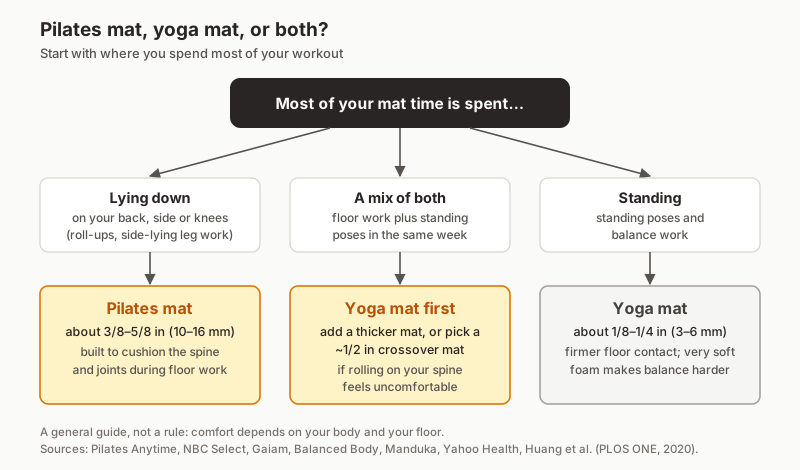
- Choose a Pilates mat if most of your workout happens on your back, side or knees: roll-ups, rolling like a ball, side-lying leg work.
- Choose a yoga mat if you mostly do standing poses and balance work and want firm contact with the floor.
- Doing both? Start with the yoga mat you have. If spine-rolling exercises are uncomfortable, add a thicker Pilates mat or a crossover mat around 1/2 inch.
Pilates Anytime sums up the difference simply: "A yoga Mat is designed to keep your feet from slipping in the poses. A Pilates Mat is designed to cushion the spine and other joints."
Tap the diagram to enlarge
If you already know which type you want, these are the mats our sources rate well for each job:
Our Top Picks
- Check price on Amazon
Pilates mat
Balanced Body EcoWise Pilates Mat
3/8-inch mat with top cushioning scores from Yahoo Health.
- Check price on Amazon
One mat for both
ProsourceFit Extra Thick Yoga and Pilates Mat (1/2 in)
1/2-inch crossover; Yahoo Health calls it budget-friendly, though some find it too thick.
- Check price on Amazon
Yoga mat
Gaiam Classic Solid Color Yoga Mat (5mm)
Affordable 5mm PVC mat with a sticky texture, per Gaiam.
Pilates mat vs. yoga mat at a glance
| Pilates mat | Yoga mat | |
|---|---|---|
| Thickness | About 3/8"–5/8" (10–16mm) | About 1/8"–1/4" (3–6mm) |
| Built for | Lying and rolling on the floor | Standing poses and grip |
| Feel | Thick, dense cushioning | Thinner, firmer floor contact |
| Grip | Varies by mat | Main design goal |
| Portability | Bulkier; some fold or hang | Rolls up; lighter (except heavy mats like the Manduka PRO) |
| Price tier | About $25–150 | About $20–150 |
Thickness and price ranges reflect the specific mats covered below, not every mat on the market.
How they differ
Thickness and cushioning
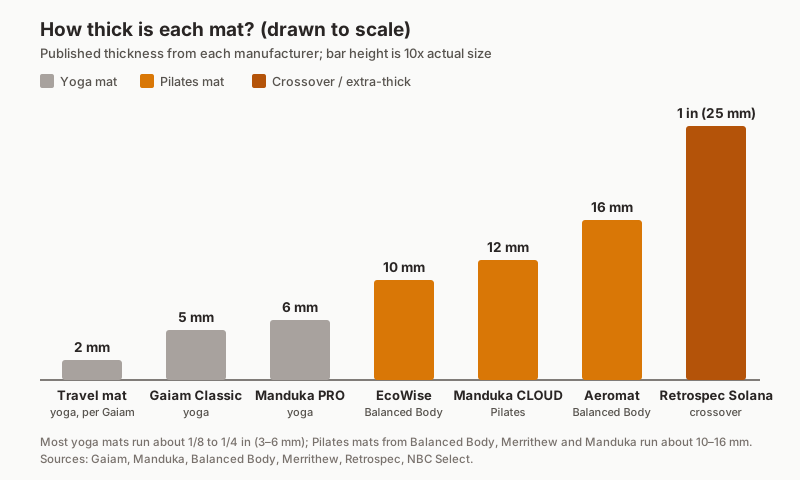
This is the main difference. Pilates mats from Pilates equipment makers and yoga brands run about 3/8" to 5/8" (10–16mm). Balanced Body's EcoWise Pilates Mat is 3/8" (1cm), its Aeromat is 5/8" (1.6cm), Merrithew's Pilates Express Mat is 10mm, and Manduka's CLOUD Pilates Mat is 12mm. That's often two or more times as thick as a typical yoga mat.
Tap the diagram to enlarge
Most yoga mats are about 1/8 to 1/4 inch (3–6mm), and travel mats are thinner.
The sources differ a little here. NBC Select's yoga mat guide says a standard yoga mat is about 2mm and can go up to 6mm, while Gaiam says "a standard yoga mat is about 1/8 inch thick, while the thickest are about 1/4 inch."
For reference, Gaiam's Classic mat is 5mm and Manduka's PRO is 6mm.
How thick should a Pilates mat be? Sources disagree:
- Pilates Anytime suggests about a half-inch. Much thicker, it says, and you "sink" into the mat.
- Vanessa Johnson, a master instructor for Club Pilates quoted by NBC Select, recommends "about three-quarters of an inch thick," which she compares to "about five yoga mats stacked on top of each other."
- Balanced Body's EcoWise is 3/8", which the brand describes as "a balance of cushioning with floor 'feel.'"
Density and stability
Thick isn't automatically better. Yahoo Health's exercise mat guide warns that a "flimsy or overly squishy" surface "can throw off your force and form." Manduka says its CLOUD Pilates Mat uses a dense base for stability in moves like the Hundred, roll-ups and side kicks. That's a brand claim, but it reflects the goal: cushioning that doesn't collapse under you.
Grip and surface texture
Yoga mats are built around grip. Gaiam says rubber mats have "the most grip" and calls PVC "the tried and true sticky mat." Some yoga mats need time to get there: OutdoorGearLab found the Manduka PRO needs a break-in period before it grips well, and it grips less when wet.
You'll see claims online that Pilates mats are always smoother and more slippery. We couldn't verify that as a rule. Balanced Body, for example, markets the EcoWise's "grippy textured surface," though Yahoo Health found it "very slippery when wet." If you slide around during mat work, grip socks are another option; see our Pilates grip socks guide.
Materials
Pilates mats are mostly closed-cell foam. Merrithew lists its Express Mat as NBR foam, ProsourceFit lists NBR foam for its 1/2" mat, NBC Select describes the Stakt as EVA foam, and Manduka says its CLOUD blends natural rubber and EVA.
Yoga mats lean toward PVC and rubber. Both yoga mats covered here are PVC: Gaiam lists the Classic as PVC, and OutdoorGearLab lists the Manduka PRO as PVC with polyester.
If you have a latex allergy, check the label. Gaiam advises people allergic to latex to avoid natural rubber mats, while Balanced Body says the EcoWise has no latex, PVC or chloride.
Durability and cleaning
Durability depends on the material. OutdoorGearLab found the Manduka PRO very durable, and Manduka and Gaiam back their PRO and Classic mats with lifetime guarantees. Softer foam can mark more easily: NBC Select found the Stakt scuffs easily and that sweat pools on top, so it needs wiping down during sweaty sessions.
Size, weight and storage
Size differences are small. Typical yoga mats are 68–71" long and 24–26" wide (Gaiam Classic 68" x 24"; Manduka PRO 71" x 26"). Pilates mats from Balanced Body and Merrithew are 72" long and 23–24" wide. If you're tall, compare length first: when you lie on your back, your head and feet should both fit on the mat.
Weight varies more by material than by type. Merrithew's foam Express Mat weighs 1.8 lb and Manduka's CLOUD weighs 4.5 lb, while OutdoorGearLab weighed the Manduka PRO yoga mat at 7.5 lb.
Thick mats are bulkier to carry. Yahoo Health calls the EcoWise less portable, though it hangs for storage. The Stakt folds into panels instead of rolling, Merrithew's Express Mat has Velcro straps, and the ProsourceFit comes with a carry sling.
Can you use a yoga mat for Pilates?
Yes. Plenty of people do, especially when starting out. The catch is spine-rolling exercises. Pilates Anytime says a thin yoga mat can be uncomfortable for exercises that roll on the spine, and found a basic Gaiam yoga mat inexpensive but uncomfortable for rolling work. NBC Select notes that you often lie on your back in mat Pilates, "so you'll want to use a thick, supportive mat."
If your yoga mat feels too thin, Pilates Anytime suggests adding a folded towel underneath; others double up two mats. Treat either as a stopgap rather than a long-term fix.
Can you use a Pilates mat for yoga?
You can, but a very soft, thick mat may make standing balance harder. Balance researchers use foam surfaces in the lab precisely because they challenge balance. A 2020 PLOS ONE study of 23 older women (Huang et al.) found that standing on foam significantly increased postural sway compared with a firm surface.
That study used 4.5cm foam, far thicker than any exercise mat, so it doesn't show that a 10–15mm Pilates mat is unsafe for yoga. It does support the general idea that softer surfaces are less stable. NBC Select's yoga mat guide likewise says thicker mats suit gentle or restorative yoga, while active styles like Vinyasa or Ashtanga suit thinner, more stable mats.
Some retailers suggest a 6–8mm "hybrid" mat for both. We found no neutral source for that number, so treat it as a judgment call rather than a rule.
Mats worth a look
Balanced Body EcoWise Pilates Mat
- Type
- Pilates
- Thickness
- 3/8" (1cm)
- Price tier
- $50–75
Merrithew STOTT PILATES Pilates Express Mat
- Type
- Pilates
- Thickness
- 10mm
- Price tier
- $25–50
Manduka CLOUD Pilates Mat 12mm
- Type
- Pilates
- Thickness
- 12mm
- Price tier
- $100–150
ProsourceFit Extra Thick Yoga and Pilates Mat (1/2 in)
- Type
- Crossover
- Thickness
- 1/2"
- Price tier
- $25–50
Retrospec Solana Yoga Mat 1"
- Type
- Crossover, extra-thick
- Thickness
- 1"
- Price tier
- $25–50
Stakt Mat
- Type
- Crossover, folding
- Thickness
- 12mm
- Price tier
- $75–100
Manduka PRO Yoga Mat 6mm
- Type
- Yoga
- Thickness
- 6mm
- Price tier
- $100–150
Gaiam Classic Solid Color Yoga Mat (5mm)
- Type
- Yoga
- Thickness
- 5mm
- Price tier
- $20–30
| Product | Type | Thickness | Price tier | |
|---|---|---|---|---|
| Balanced Body EcoWise Pilates Mat | Pilates | 3/8" (1cm) | $50–75 | View |
| Merrithew STOTT PILATES Pilates Express Mat | Pilates | 10mm | $25–50 | View |
| Manduka CLOUD Pilates Mat 12mm | Pilates | 12mm | $100–150 | View |
| ProsourceFit Extra Thick Yoga and Pilates Mat (1/2 in) | Crossover | 1/2" | $25–50 | View |
| Retrospec Solana Yoga Mat 1" | Crossover, extra-thick | 1" | $25–50 | View |
| Stakt Mat | Crossover, folding | 12mm | $75–100 | View |
| Manduka PRO Yoga Mat 6mm | Yoga | 6mm | $100–150 | View |
| Gaiam Classic Solid Color Yoga Mat (5mm) | Yoga | 5mm | $20–30 | View |
Pilates mats
- Balanced Body EcoWise Pilates Mat: Yahoo Health says it "earned some of the highest scores in our cushioning tests, making it a dream for floor-based Pilates sessions." It has a dual texture and hangs for storage. Downsides it lists: "very slippery when wet," less portable and narrower. Balanced Body says it contains no latex, PVC or chloride. Note that Balanced Body lists it at 3/8" thick, while the Amazon listing we link shows 0.5", so check the spec before you buy.
- Merrithew STOTT PILATES Pilates Express Mat: 10mm NBR closed-cell foam, 24" x 72", ribbed on one side and smooth on the other. Merrithew calls it "super-cushy, lightweight" and includes Velcro straps. We didn't find an independent review. The Amazon listing we link shows 22" x 70" rather than Merrithew's 24" x 72", so confirm the size before ordering.
- Manduka CLOUD Pilates Mat: a newer option from a well-known yoga brand. Manduka lists 12mm of natural rubber/EVA cushioning at 4.5 lb. We found brand specs only, no independent review.
Crossover and thick mats
- ProsourceFit Extra Thick Yoga and Pilates Mat (1/2"): Yahoo Health praises it as low-maintenance and budget-friendly, with a carry sling. Reviewers there said it may be "too thick for some," and one said it "feels like a pool floaty."
- Retrospec Solana 1": NBC Select's pick for "best exercise mat for Pilates" in its Pilates equipment guide. Retrospec markets it for "yoga flows, mat Pilates, somatic stretching." At a full inch, it's the thickest mat here; Yahoo Health warns that an "overly squishy" surface "can throw off your force and form," so it's better suited to floor work than standing balance.
- Stakt Mat: NBC Select's review describes 12mm EVA foam that folds into panels, "twice as thick as many popular yoga mats," with "a balance between firm and soft." Cons: it scuffs easily, and sweat pools on top, so for heated classes NBC Select suggests a mat towel (or the Stakt Mat Pro), and for sweaty sessions, wiping it down as needed. Yahoo Health adds that it's "not as grippy as some mats."
Yoga mats
- Manduka PRO 6mm: OutdoorGearLab found it very durable with firm support and a lifetime guarantee. Cons: it's heavy at 7.5 lb, needs a break-in period and grips less when wet. Pilates Anytime reviewed the older Black PRO and also found it durable but heavy, though thin yet supportive enough for rolling movements.
- Gaiam Classic 5mm: a PVC mat with what Gaiam calls a "sticky" texture and a lifetime guarantee. It's an affordable yoga mat, but expect the thin-mat trade-offs for Pilates rolling work described above.
Browse more Pilates accessories, or if you're still deciding on a format, read reformer vs. mat Pilates.
The verdict
If you mostly lie, kneel and roll on the floor, a Pilates mat in the 3/8" to 5/8" range gives your spine the cushioning a thin yoga mat lacks. If you mostly stand and balance, a yoga mat gives you firmer, grippier contact. If you do both, there's no need to replace what you own: keep your yoga mat for standing work and add a thicker mat, or try a crossover, for Pilates.
If you're buying one today, start with the Balanced Body EcoWise for Pilates (Yahoo Health gave it some of its highest cushioning scores), the 1/2-inch ProsourceFit if you want one budget mat for both, or the Gaiam Classic 5mm if you mostly do yoga.
Check price on Amazon Check price on Amazon Check price on AmazonFrequently Asked Questions
Is a Pilates mat thicker than a yoga mat?
Usually, yes. Gaiam says a standard yoga mat is about 1/8 inch and the thickest about 1/4 inch; NBC Select puts the range at about 2–6mm. Pilates mats from Balanced Body and Merrithew run 3/8 to 5/8 inch. A Club Pilates master instructor quoted by NBC Select recommends about 3/4 inch.
Can I do Pilates on a yoga mat?
Yes, but rolling exercises on the spine can be uncomfortable on a thin mat, according to Pilates Anytime's mat review. A thicker or crossover mat adds cushioning.
Can I use a Pilates mat for yoga?
You can, but very soft, thick mats can make balance harder. A lab study using thick foam found increased postural sway, and Yahoo Health notes that overly squishy mats can throw off your form. NBC Select suggests thinner, firmer mats for active yoga styles.
Is a 6mm yoga mat thick enough for Pilates?
For many people it works, but it's at the thin end. Pilates Anytime suggests about 1/2 inch (roughly 12mm), and Pilates mats from Balanced Body and Merrithew start at 3/8 inch (10mm). If rolling exercises feel hard on your spine, a thicker mat will help.
What thickness should a Pilates mat be?
Sources differ. Pilates Anytime suggests about 1/2 inch, a Club Pilates instructor quoted by NBC Select suggests about 3/4 inch, and Balanced Body's EcoWise Pilates Mat is 3/8 inch.
Is there one mat for both Pilates and yoga?
Crossover mats like the 1/2-inch ProsourceFit or the folding Stakt are sold for both. Reviewers note trade-offs: very thick foam can feel unstable, and Yahoo Health found the Stakt less grippy than some mats.
Sources
- Balanced Body: Mats collection and EcoWise Pilates Mat
- Yahoo Health: The best exercise mat for 2026 (Purdie, MacPherson; updated Apr 2026)
- NBC Select: Pilates equipment guide (Malin, Jan 2024)
- NBC Select: How to pick the best yoga mat (Zaino, updated Dec 2023)
- NBC Select: Stakt Mat review (Malin, Jan 2025)
- Pilates Anytime: A review of mats for Pilates
- Merrithew: Pilates Express Mat
- Manduka: PRO Yoga Mat 6mm and CLOUD Pilates Mat 12mm
- OutdoorGearLab: Manduka PRO review (Pitts, updated Mar 2026)
- Retrospec: Solana Yoga Mat 1"
- ProsourceFit: Extra Thick Yoga and Pilates Mat
- Gaiam: Yoga mat guide and Classic Solid Color Yoga Mat 5mm
- Huang et al., PLOS ONE, 2020: Support surface, footwear and postural sway in older women
Related Articles
Buying Guide
Best Pilates Rings (2026): 7 Magic Circles for Home and Studio
The best Pilates ring depends on size, resistance and handles. We compared 7 magic circles, from beginner foam rings to firm studio steel.
October 6, 2026 · 14 min read
Buying Guide
Best Pilates Mats (2026): Cushioned, Foldable and Budget Picks
The best Pilates mat depends on thickness, density and storage. We compared 7 mats from 6 mm to 1 inch, from budget foam to studio brands.
October 5, 2026 · 15 min read