Pilates arm workout with weights: a 10-move standing arm series
By The Pilates Verdict Team · October 12, 2026 · 18 min read
This article contains affiliate links. If you buy through them, we may earn a commission at no extra cost to you. As an Amazon Associate I earn from qualifying purchases. Learn more.
A Pilates arm workout with weights doesn't need heavy dumbbells. The classical standing arm series uses a pair of 1–3 lb weights, and Progressive Bodyworks founder Clare Dunphy Hemani says the full series "consists of ten exercises and takes about 8-10 minutes."
According to Beth of Bodies By Pilates, quoted by Tom's Guide, the moves work your shoulders, biceps, triceps and upper back while improving posture. That makes this a compact Pilates upper body workout with weights you can do at home. Hemani puts it this way: "these tiny little weights can pack a punch for our posture muscles in the arm weight series."
Below are the 10 moves in classical order, with how to do each one and the reps each source gives. After that come a no-weights version, how to use wrist weights safely, and what light arm weights can and can't do.
How we researched this:
- Moves and order: Pilatesology, Progressive Bodyworks (Clare Dunphy Hemani), Alo Moves (Victoria Batha), Pilates Anytime (Brett Howard)
- Weights: Mo Wolfe; Bodies By Pilates via Tom's Guide
- No-weights moves: Complete Pilates via Coach Web; Healthline
- Safety and research: Harvard Health, HSS, University Hospitals, ACSM, peer-reviewed studies, ACOG, Bone Health & Osteoporosis Foundation
We don't coach or test workouts. Every source is listed at the end.
Quick version:
- What you need: a pair of 1–3 lb hand weights (or water bottles) and enough room to stand with your arms out.
- Reps: 3–5 per move in the classical series, or 10 per move in Alo Moves' beginner version.
- Time: about 8–10 minutes for the classical series, per Hemani.
- Check first if: you're pregnant, have osteoporosis, or have joint problems and plan to use wrist weights.
What weight to use for Pilates arms
Go light. Hemani describes the classical series with weights of "only 1-3 pounds (or .4-1.3 kilos)." Beth of Bodies By Pilates, quoted by Tom's Guide, gives the same range: "stick to super light weights between 1 and 3 lbs because you'll be working with very little rest."
Mo Wolfe, an NCPT-certified classical teacher who owns Evolution Pilates, sets the ceiling lower. "For Pilates, you don't need anything heavier than the two-pound weights because we do a fair amount of repetitions," she says. Her reason: "Over time your arms will get fatigued and you don't want to feel that in your neck."
Wolfe also says, "Lighter weights can be just as effective as heavy ones." That's an instructor's opinion. The research section below explains where light weights do and don't match heavier ones.
No weights yet? Wolfe suggests water bottles or pantry cans, and Alo Moves says "items around your home" can stand in.
Need a pair? Amazon Basics' neoprene dumbbells come in the 1–2 lb range these teachers recommend.
Check price on AmazonFor more options, see our best hand weights for Pilates.
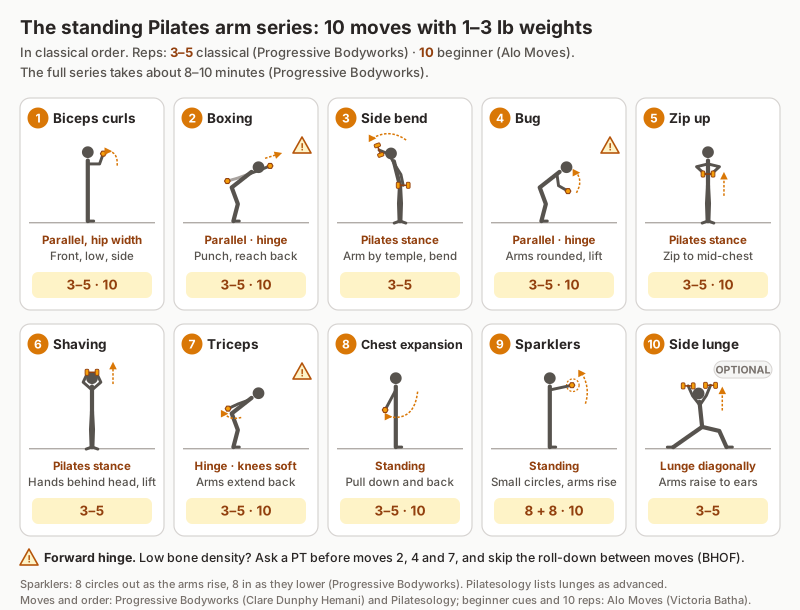
The 10-move standing Pilates arm series with weights
Hemani says to "begin the series with the feet parallel and hip width," and notes that your "weight is distributed 50/50 between both feet." Several moves then switch to Pilates stance, which means heels together and toes slightly apart.
Between moves, Hemani's series includes a spine release: let your torso fold down over your thighs, then roll up slowly one vertebra at a time. If you have low bone density, skip this roll-down (see "Who should modify" below).
Pilatesology groups the series into levels. Basic is curls at 90 degrees (front and side) and standing curls. Intermediate adds boxing, side stretch, bug, zip up and shaving. Advanced adds low curls, chest expansion, sparklers and lunges. If you're new, start with the first few moves and add the rest over time.
Tap the diagram to enlarge
1. Biceps curls (front, low, side)
Hemani describes a "biceps curl with a wrist extension at three heights: shoulder height, low, side," with the series' usual 3–5 reps. Pilatesology lists low curls as an advanced addition, so beginners can stick to the front and side heights at first.
Alo Moves' Victoria Batha cues lifted biceps curls: raise your elbows to 90 degrees in front of your face and curl without letting the arms drop. Then open the arms wide, about at the edge of your peripheral vision, and curl again. She gives 10 reps of each. This matches the "90 Degrees" front and side moves on Pilatesology's list.
2. Boxing
Hemani's setup: "The stance is parallel at hip width. Flat back hinged at the hips. Elbows bent, palms up under shoulders." Then "the right arm extends forward palm down while the left extends back palm up," and you switch sides.
Batha starts her version from a squat and does 10 reps.
3. Side bend
Stand in Pilates stance. Hemani: "Start with one arm next to the temple and the other arm down at your side. The exercise is in four counts. 1. Bend side 2. Fold the arm around the head 3. Return to center 4. Switch arms."
4. Bug
Hemani's setup: "Parallel stance. Hinge forward at the hips, keeping the spine straight and the knees slightly bent. Arms are rounded, and they both lift and lower (like the hug)."
Batha brings the weights together in front of you "while keeping your arms wide in a hugging position," then closes and opens the arms for 10 reps.
5. Zip up
Stand in Pilates stance. Hemani: "Both hands move up like a zipper to mid-chest."
Batha's cues: knuckles forward, weights touching, then "zip" them up to your chest with a slight bend in the elbows. "Make sure to keep your elbows above your wrists throughout the exercise," she says. She gives 10 reps.
6. Shaving
Stand in Pilates stance with "both hands together behind the head to lift and lower," per Hemani. Think of pressing the weights up on a diagonal and bending the elbows to bring them back behind your head.
7. Triceps kickback (or overhead press)
Hemani's setup: "Parallel stance. Hinge forward at the hips with the spine straight and the knees slightly bent. Arms hang down." Then curl the arms in and out, straighten them, extend them back and extend the wrists.
If you'd rather not hinge, Batha's overhead triceps press is an alternative. Hold the weights together overhead, bend the elbows to lower them behind your head, then straighten. She gives 10 reps.
8. Chest expansion
Hemani: "Arms at chest height. Pull down and back (inhale). Turn the head right and left (hold your breath). Return arms forward (exhale)."
Batha presses the arms straight behind you with palms facing back, holds for 3 counts and does 10 reps.
Our suggestion: if you've been told to avoid holding your breath, breathe normally through the head turns.
9. Sparklers
Hemani: "Hold the weights at the bottom. Circle outwards 8x raising the arms forward and 8x circling inwards, lowering."
Batha holds the weights vertically and draws small circles for 10 reps.
10. Side lunge with arms (optional)
Hemani: "Lunge diagonally as the arms raise to the ears. Hold that position as the arms lower to the hips and up to the ears. Then, step back in one motion. Change sides."
Pilatesology lists lunges as advanced, so treat this move as optional. If lunging isn't comfortable, stand tall in place and do the arm lift and lower without the lunge.
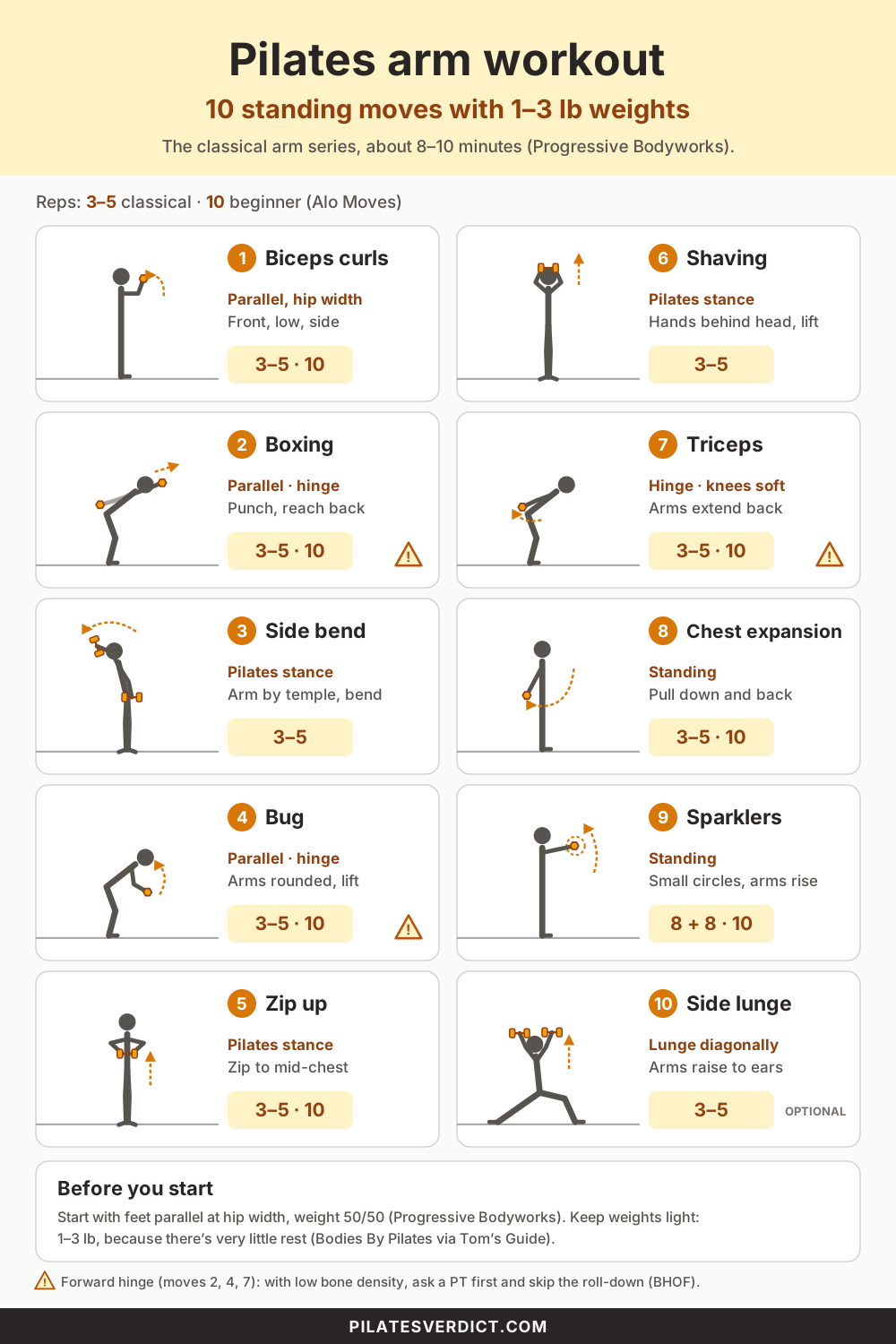
Pilates arm workout at a glance
| Move | Stance | Reps |
|---|---|---|
| 1. Biceps curls | Parallel | 3–5 per height / 10 |
| 2. Boxing | Parallel, hinge | 3–5 / 10 |
| 3. Side bend | Pilates stance | 3–5 |
| 4. Bug | Parallel, hinge | 3–5 / 10 |
| 5. Zip up | Pilates stance | 3–5 / 10 |
| 6. Shaving | Pilates stance | 3–5 |
| 7. Triceps | Parallel, hinge | 3–5 / 10 |
| 8. Chest expansion | Standing | 3–5 / 10 |
| 9. Sparklers | Standing | 8 each way / 10 |
| 10. Side lunge | Lunge | 3–5 (optional) |
The first number is Hemani's classical count; the second is Batha's Alo Moves beginner count, where she gives one. Hemani doesn't give a stance for chest expansion or sparklers, so the table just says standing.
Tap the diagram to enlarge
How often, and how to progress
US guidelines say adults need "muscle-strengthening activity, like lifting weights or doing push-ups, at least 2 days each week." The full Physical Activity Guidelines for Americans add that this work should involve "all major muscle groups on 2 or more days a week," so an arms-only routine covers only part of that.
Complete Pilates' Helen O'Leary says, "Working on your arms two to three times a week is enough to notice strength changes," with at least one recovery day between sessions. Tom's Guide's writer suggests a standing Pilates arm routine "at least twice a week, alongside your other training sessions."
For reps, the classical series stays at 3–5 per move. Alo Moves starts at 10 per move, "but feel free to add on more to suit your level."
Our suggestion: do one round first (about 8–10 minutes at classical reps, per Hemani), and repeat it only if your form holds. Two rounds make a roughly 15–20 minute session, by our arithmetic. Add reps before you add weight. You can also move through Pilatesology's basic, intermediate and advanced levels as the earlier moves get easy.
Pilates arm workout with no weights
You can train your arms with bodyweight alone. Complete Pilates physio Helen O'Leary, writing with Coach Web, programs bodyweight moves in sets of 12–15 reps, 3 sets, with 2 minutes' rest. Three of her moves:
- Leg pull: start in a high plank with your hands under your shoulders. Raise one leg while keeping your hips still, lower it slowly, do all reps on one side, then switch.
- Triceps push-up: from a high plank, bend your elbows and lower your chest toward the floor, "keeping your arms close to your body," then push back up.
- W-I-T: lie face down with your head just off the floor and lift your arms in W, I and T shapes.
Healthline's no-weight arm list isn't Pilates-specific, but three of its moves fit well here: arm circles (3 sets of 10–20 each direction), plank taps (3 sets of 10–12 per side) and triceps dips (3 sets of 10–12).
- Arm circles: arms out to the sides, small circles forward, then back.
- Plank taps: from a plank, tap one hand to the opposite shoulder and alternate.
- Triceps dips: hands on the edge of a sturdy chair, bend and straighten the elbows. Healthline also suggests doing push-ups on your knees if full ones are too hard.
For the standing series without weights, water bottles or cans work too, per Wolfe. For prop-based arm work, see our Pilates band exercises.
Pilates arm workout with wrist weights
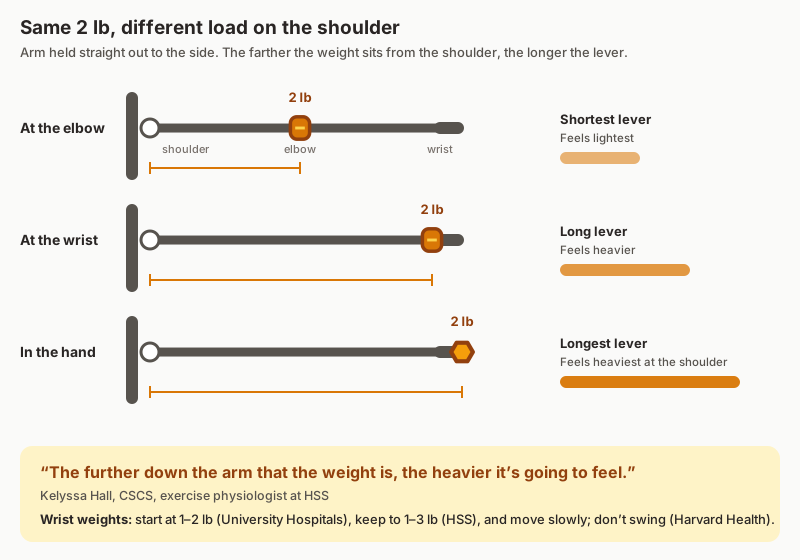
Wrist weights feel heavier than the same dumbbell. "The further down the arm that the weight is, the heavier it's going to feel," says HSS exercise physiologist Kelyssa Hall, CSCS. HSS says to keep wrist weights to 1–3 lb to avoid stressing your joints.
University Hospitals physical therapist Jonathan Morales, DPT, says, "With wrist and ankles weights, start by using one to two pounds." He advises people with arthritis, osteoporosis, joint problems or musculoskeletal injuries to check with a doctor or physical therapist first. If you're sore for more than 48 hours, he says, cut back on weight, reps or intensity.
Harvard Health warns that swinging your arms with wrist weights "can lead to muscle imbalance" and "can also cause joint and tendon injuries in the wrists, elbows, shoulders, and neck." On the other hand, "They're great for targeted exercise if you can't grip a dumbbell," says Spaulding Rehabilitation physical therapist Terry Downey, such as for biceps curls or rows.
Our reading of that advice: use wrist weights for the slow moves in the series (curls, zip up, chest expansion, sparklers) and skip them for fast boxing punches or anything that swings.
Two light options from our catalog are Bala Bangles and TheraBand's comfort-fit cuff weights.
Check price on AmazonOur best ankle weights for Pilates covers wearable weights in more detail.
Tap the diagram to enlarge
What light arm weights can and can't do
They won't burn fat from your arms
A 2022 meta-analysis in Human Movement (Ramirez-Campillo et al.) pooled 13 studies with 1,158 participants. It compared fat on a trained limb with the untrained limb and concluded that "localized muscle training had no effect on localized adipose tissue depots, i.e., there was no spot reduction."
In an earlier study (Kostek et al., Medicine & Science in Sports & Exercise, 2007), 104 people trained only their nondominant arm for 12 weeks. MRI found "a generalized subcutaneous fat loss independent of gender, supporting the notion that spot reduction does not occur as a result of resistance training."
Tom's Guide says the same: "You can't spot-reduce fat, but you can focus on fat loss overall and strength training to build muscle."
Light loads build different things than heavy ones
A 2017 meta-analysis of 21 studies (Schoenfeld et al., Journal of Strength and Conditioning Research) found that gains in maximal strength were "significantly greater in favor of high- vs. low-load training." Muscle growth, though, "can be equally achieved across a spectrum of loading ranges." In those studies, every set went to muscular failure. Pilates sets with 1–2 lb rarely do, so don't expect the same muscle growth as gym training.
The ACSM's 2026 position stand reviewed 137 systematic reviews covering more than 30,000 participants. It found that "voluntary strength was enhanced by lifting heavier loads (≥80% one-repetition maximum), through a complete range of motion, for 2-3 sets," and that muscle size improved with higher training volumes.
In short, a light Pilates arm series mostly trains muscular endurance, control and posture. For maximal strength, heavier loads do more.
Pilates and arm strength
One small randomized trial (Oliveira et al., Journal of Bodywork and Movement Therapies, 2017) assigned 30 women aged 60–70 to Pilates twice a week for 12 weeks or to a control group. The Pilates group improved elbow flexor and extensor strength and upper-limb function compared with controls. It's one small study, and from the abstract it isn't clear whether the program used hand weights, so it doesn't show that a weighted arm series specifically works.
Who should modify
- Pregnancy: ACOG lists modified Pilates among exercises experts consider safe in pregnancy, advises avoiding lying flat on your back as much as possible, and recommends talking with your ob-gyn. The standing series doesn't involve lying on your back. Ask your ob-gyn before adding the plank-based no-weights moves.
- Osteoporosis or low bone density: the Bone Health & Osteoporosis Foundation advises people with spinal bone loss not to "bend forward from the waist" and to avoid sit-ups, crunches and extreme twisting. Boxing, bug and the triceps kickback all hinge forward, and the spine release rolls down. Skip the roll-down and ask a physical therapist about the hinge moves. The overhead triceps press is an upright alternative.
- Joint problems: per Morales, check with a doctor or physical therapist before using wrist weights if you have arthritis, joint problems or a musculoskeletal injury.
Which Pilates arm workout should you do?
Our suggestions, based on the sources above:
- New, or no weights yet: start with Pilatesology's basic moves (curls at 90 degrees and standing curls) using water bottles, at Alo Moves' 10 reps per move.
- Comfortable with the basics: do the full 10-move series with 1–2 lb weights at 3–5 classical reps, which takes about 8–10 minutes per Hemani.
- Wrist or grip issues: use wrist weights for the slow moves only, following the Harvard Health and Spaulding Rehabilitation advice above.
What you need
A pair of light dumbbells and room to stand. Amazon Basics' neoprene dumbbells come in the 1–2 lb range the sources recommend.
Check price on AmazonIf you'd like a Pilates- and barre-styled set, Bala Bars come in 1–3 lb. Portzon's neoprene dumbbells are a soft-grip alternative. Our hand-weights guide (linked above) compares them.
New to Pilates overall? Start with our Pilates exercises at home for beginners, or browse more routines in Pilates workouts.
Frequently Asked Questions
What weight should I use for a Pilates arm workout?
Light: 1–3 lb per hand. Progressive Bodyworks founder Clare Dunphy Hemani describes the classical series with 1–3 lb weights, and a Bodies By Pilates instructor quoted by Tom's Guide recommends 1–3 lb because there's very little rest. Classical teacher Mo Wolfe says you don't need more than 2 lb because of the high reps.
What is the standing Pilates arm series?
It's a classical sequence done standing with light hand weights. Pilatesology lists 90-degree curls (front and side) and standing curls as basic. Intermediate adds boxing, side stretch, bug, zip up and shaving; advanced adds low curls, chest expansion, sparklers and lunges. Hemani says the full series takes about 8–10 minutes at 3–5 reps per move.
Can you do a Pilates arm workout without weights?
Yes. Use bodyweight moves such as the triceps push-up, leg pull (a plank with one leg lifted) and W-I-T lifts, which Complete Pilates' Helen O'Leary programs at 12–15 reps for 3 sets, plus arm circles, plank taps and chair dips from Healthline. Water bottles or cans also work for the standing series, per Mo Wolfe.
Are wrist weights good for Pilates arm workouts?
They can work for slow, controlled moves. A University Hospitals physical therapist advises starting at 1–2 lb, and HSS says to stay at 1–3 lb. Harvard Health warns that swinging your arms with wrist weights can cause joint and tendon injuries. Check with a doctor or physical therapist first if you have arthritis, osteoporosis or joint problems.
Will a Pilates arm workout get rid of arm fat?
Not on its own. A 2022 meta-analysis of 13 studies found that training one limb didn't reduce fat on that limb compared with the untrained one. An MRI study of 104 people who trained one arm found fat loss throughout the body rather than in the trained arm. Arm work builds muscle; fat loss happens across the whole body.
Sources
- Pilatesology: Classical arm weights series (PDF)
- Progressive Bodyworks (Clare Dunphy Hemani; studio content): Small weights pack a punch
- Pilates Anytime (Brett Howard): Standing arm weights, class 1035
- Alo Moves blog (Victoria Batha; brand content): The best Pilates exercises for your arms
- Evolution Pilates (Mo Wolfe): Pilates home setup recommendation: 2-pound weights
- Tom's Guide (Sam Hopes), via Yahoo: 15-minute standing Pilates arm workout (original)
- Coach Web (Lucy Gornall with Helen O'Leary, Complete Pilates): Build upper-body strength without weights using this Pilates workout
- Healthline (Tyler Read, CPT; reviewed by Micky Lal, CSCS): 8 arm exercises with no weights
- Harvard Health Publishing: Wearable weights: how they can help or hurt
- HSS (Kelyssa Hall, CSCS): Can wrist weights really tone your arms?
- University Hospitals (Jonathan Morales, DPT): Will wearable weights improve your fitness?
- Kostek et al., Med Sci Sports Exerc (2007): Subcutaneous fat alterations from an upper-body resistance training program
- Ramirez-Campillo et al., Human Movement (2022): Spot reduction, systematic review with meta-analysis
- Schoenfeld et al., J Strength Cond Res (2017): Low- vs. high-load resistance training, meta-analysis
- Currier et al., Med Sci Sports Exerc (2026): ACSM position stand on resistance training prescription
- ACSM: ACSM releases new position stand on resistance training
- Oliveira et al., J Bodyw Mov Ther (2017): Pilates and elbow flexor and extensor strength in older women
- HHS: Physical Activity Guidelines for Americans, 2nd edition (PDF)
- ODPHP: Physical Activity Guidelines, top 10 things to know
- ACOG: Exercise during pregnancy
- Bone Health & Osteoporosis Foundation: Protecting your spine
Update history
- : Published.
Found an error? See how we research and correct guides in our editorial policy.
Was this guide helpful?
Related Articles
How-To
Pilates board exercises for beginners: an 8-move home routine
Eight Pilates board exercises for beginners you can do at home, with form cues, reps, a 15–20 minute routine, setup checks and who should skip which moves.
October 12, 2026 · 15 min read
How-To
Pilates reformer exercises for beginners: 8 moves, springs and reps
Eight Pilates reformer exercises for beginners, in the order studios teach them, with spring settings, reps and form cues, plus how to do them at home.
October 11, 2026 · 20 min read
How-To
Pilates band exercises for beginners: a 10-move routine
10 beginner Pilates band exercises with where the band goes, reps from Merrithew and Pilates instructors, band safety tips and what the research says.
October 10, 2026 · 21 min read
How-To
Pilates bar exercises for beginners: an 8-move routine
8 Pilates bar exercises for beginners: setup, 4 standing and 4 mat moves, reps, band safety and how a bar compares with a reformer, all from named sources.
October 10, 2026 · 17 min read