Pilates ball exercises: a 10-move mini ball routine for beginners
By The Pilates Verdict Team · October 7, 2026 · 18 min read
This article contains affiliate links. If you buy through them, we may earn a commission at no extra cost to you. As an Amazon Associate I earn from qualifying purchases. Learn more.
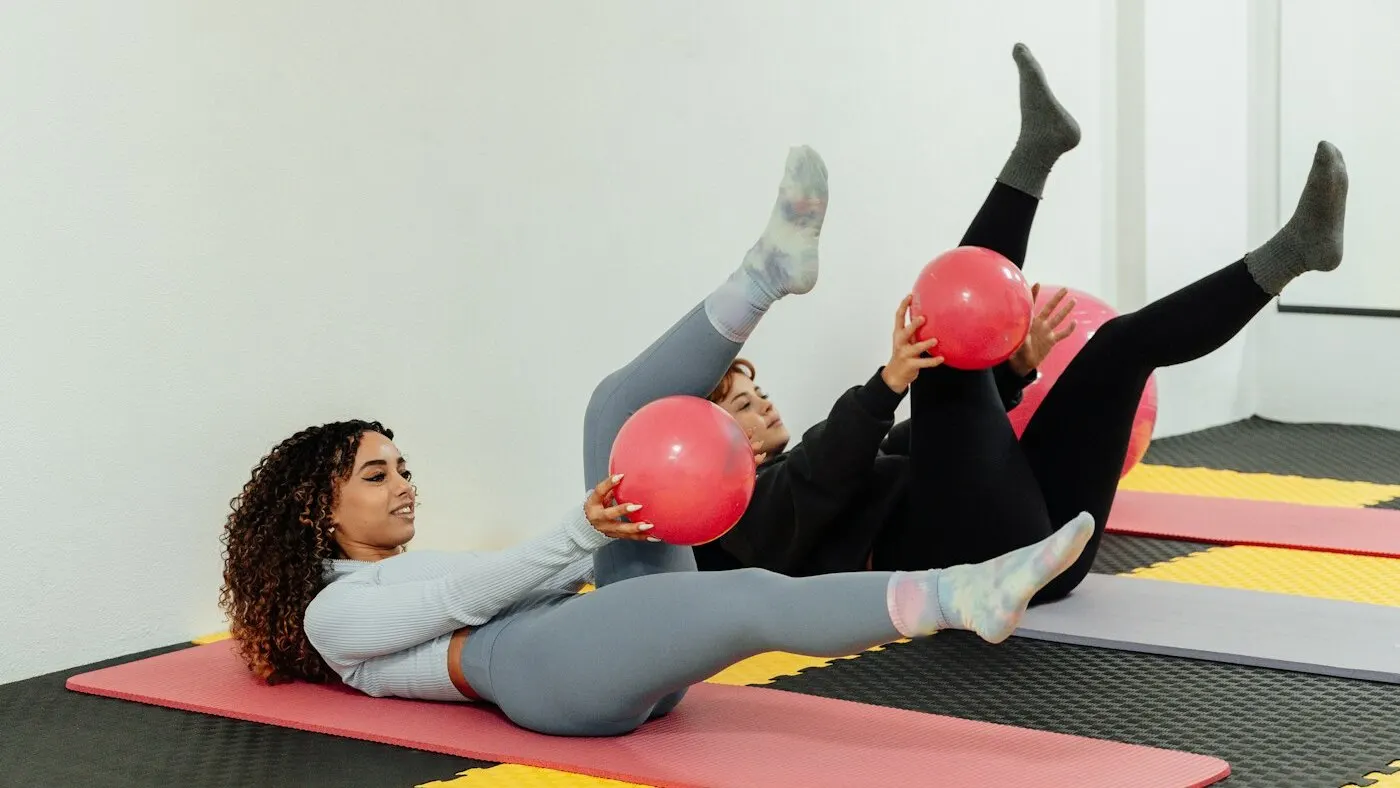
Pilates ball exercises use a small, light ball that's easy to store, and it changes how familiar mat moves feel. TODAY describes it as "a small exercise ball, typically measuring 9 to 12 inches in diameter." That's different from the large stability ball, which TODAY says runs 18–34 inches.
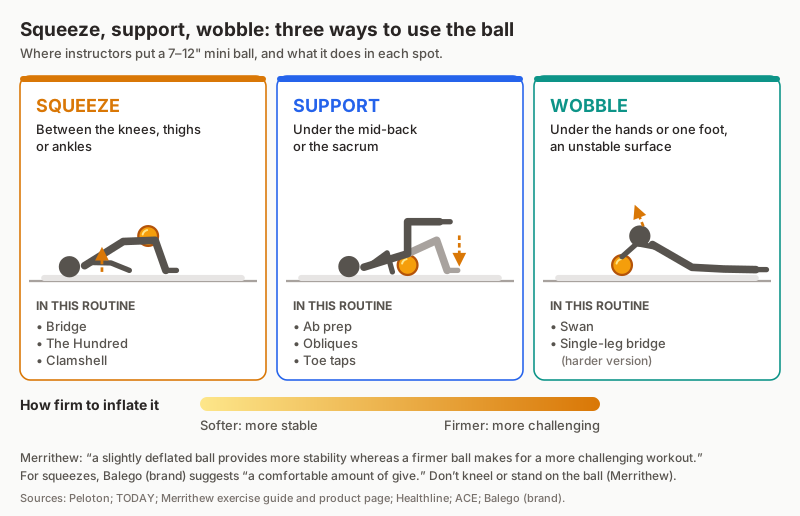
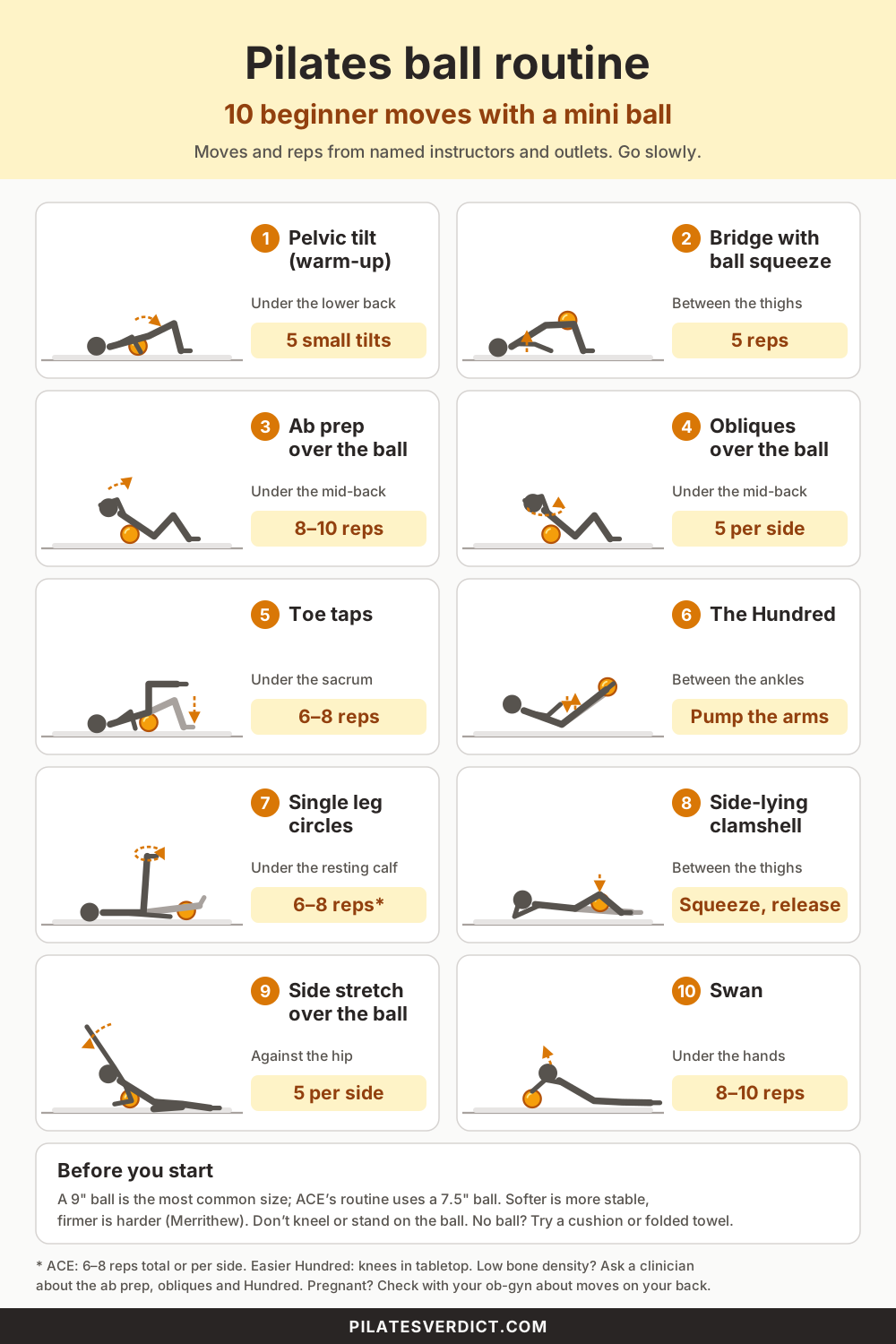
Instructors use the mini ball in three ways: you squeeze it, lean on it for support, or press on it as a wobbly surface. Below are 10 beginner Pilates ball exercises, each taken from a named instructor or outlet, with where the ball goes, the reps that source gives and an easier version.
How we researched this: We assembled this routine from overlapping instructor guides: Merrithew's Mini Stability Ball exercise guide and its lead instructor trainer Saulo Ouverney, Peloton instructor Kristin McGee, the American Council on Exercise (ACE), Healthline, TODAY, Pilates Anytime and Alo Moves. Safety notes come from the Bone Health & Osteoporosis Foundation, Healthline and ACOG, and the research section draws on small EMG studies for context. Merrithew, Balanced Body and Balego sell balls, so we label their advice as brand content. We don't coach or test workouts. Where we could read only a search snippet of a source, we say so. If you have a health condition, check with a clinician first. Every source is listed at the end.
Quick version:
- What you need: a soft 7.5–10 inch ball, inflated less than fully, and a mat. Compare options in our best Pilates balls guide.
- Reps: mostly 5–10 per move, done slowly. ACE says "six to eight repetitions in total or on each side is sufficient."
- No ball? A cushion or folded towel works for most moves.
- Check first if: you're pregnant, have osteoporosis or are recovering from an injury or birth.
Before you start
What size ball and how firm
- 9 inch: "probably the most commonly used ball" (Pilates Anytime). The same video notes that sometimes, as the balls get smaller, the exercises get more challenging.
- 7.5 inch: ACE's Elizabeth Kovar calls it "ideal for this workout" and says the ball "should not exceed 10 inches." Merrithew's mini ball workshop uses it too.
- Sizes sold: Merrithew's Mini Stability Ball comes in 7.5, 10 and 12 inch.
Don't pump the ball up hard. Merrithew says "a slightly deflated ball provides more stability whereas a firmer ball makes for a more challenging workout." Balanced Body says its ball is designed for "varying levels of inflation depending on the exercise." For squeezes, Balego (a ball seller) suggests "a comfortable amount of give rather than trying to make the ball rigid."
Peloton's Kristin McGee recommends a "soft, inflatable ball rather than anything with added weight."
Need a ball? Yahoo Health named the Trideer 9-inch its best mini ball, and 9 inches sits in the range these instructors use:
Check price on AmazonNo ball? Use a cushion or towel
Healthline's bridge allows "a pillow, block, or mini ball between your thighs." Pilates Anytime instructor Meredith Rogers says you "could use like a cushion, a folded up towel," though "nothing would be quite as good as actually having this."
Three ways to use a mini Pilates ball
- Squeeze: between the knees, thighs or ankles, as in the bridge, the Hundred and the clamshell (Peloton, ACE, Healthline).
- Support: under the mid-back, sacrum or lower back, as in Merrithew's ab prep and Peloton's toe taps. TODAY says that for leg raises, "placing the Pilates ball under the lower back can provide support and reduce strain."
- Unstable surface: under the hands or a foot, as in the swan or a single-leg bridge (Peloton, Merrithew, TODAY). Merrithew says the ball "provides an unstable base of support, designed to activate your deepest stabilizing muscles." That's brand wording, not a measured result.
Tap the diagram to enlarge
Merrithew's guide also says: "Do not try to kneel or stand on the Mini Stability Ball." Every move below keeps your knees and feet off the top of the ball, except the foot-on-ball bridge progression, where you're lying down.
The 10-move Pilates ball workout for beginners
Tap the diagram to enlarge
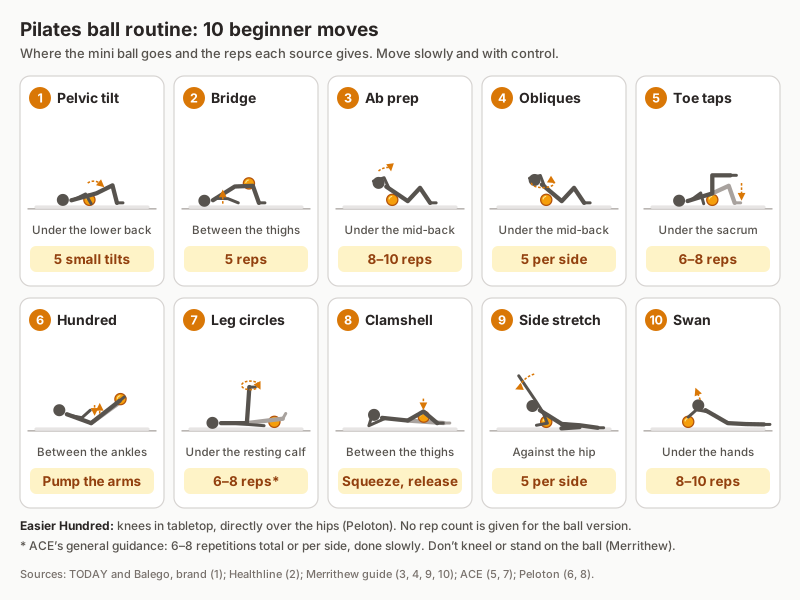
The order runs from a gentle warm-up on your back to bridging, abs, legs, side-lying and facedown work. Merrithew's guide says to "perform exercises in a slow and controlled manner, avoid excessive tension in neck and shoulders." Stop any move that causes pain.
1. Pelvic tilt over the ball (warm-up)
Lie on your back with your feet on the floor and the ball under your lower back, as TODAY describes. Gently tilt your pelvis to flatten and then slightly arch your lower back. For people healing from an injury or managing chronic pain, TODAY (citing instructor Ashley DeLeon) says placing the ball under the lower back "puts you in a slight inversion and reduces pressure in the abdomen."
- Reps: TODAY doesn't give a count. Balego's beginner guide (brand) suggests 5 small tilts.
- Easier: let some air out of the ball so it sits lower.
2. Bridge with a ball squeeze
Lie on your back with your knees bent, feet parallel and hip-width apart, and the ball between your thighs. Healthline's cue: "Exhale, gently squeeze the mini ball, push your feet into the floor, and articulate your spine off of the mat." Aim to keep your shoulders and neck relaxed and avoid overarching your back.
Merrithew's Saulo Ouverney has you hold at the top and "squeeze the ball three to five times," keeping the lower spine neutral.
- Reps: 5 (Healthline). ACE's version puts the ball between the knees with arms overhead. ACE doesn't give a count for it; its general guide is 6–8.
- Easier: lift your hips only partway.
3. Ab prep over the ball
Sit with your knees bent hip-width apart and lean back so the ball sits at your mid-back, hands behind your head. Merrithew's guide says to keep your spine "in a neutral position, neither arched nor flat." Inhale to prepare. Exhale and "release upper torso back over ball in extension." Inhale and "curl head and upper torso forward." (That's the breathing pattern as Merrithew's guide prints it.)
- Reps: 8–10 (Merrithew guide).
- Easier: keep the curl small.
- Skip if: you have spinal bone loss. See the safety section.
4. Obliques over the ball
Use the same setup as the ab prep. Per Merrithew's guide, exhale to "rotate upper torso toward one side," then inhale to return.
- Reps: 5 per side, alternating (Merrithew guide).
- Easier: rotate less far.
- Skip if: you have spinal bone loss.
5. Toe taps
Lie on your back with the ball under your sacrum (the flat bone at the base of your spine) and your knees over your hips at 90 degrees. Peloton's McGee says to "slowly tap left toes to ground without moving right leg," then alternate. ACE says to keep the pace slow.
- Reps: Peloton doesn't give a count, and neither does ACE for this move; ACE's general guide is 6–8.
- Easier: tap only partway down.
6. The Hundred with the ball
McGee's version on the Peloton blog has the ball squeezed between your ankles, legs extended and shoulders lifted. "Pump your arms up and down" while you breathe.
Her beginner modification is "bringing the knees into tabletop position: knees directly over your hips, legs at a 90-degree angle."
- Reps: Peloton doesn't give a count for the ball version. Our Pilates exercises at home for beginners routine covers the classic breath count.
- Easier: the tabletop version, with your head down if your neck strains.
- Skip the head lift if: you have osteoporosis.
7. Single leg circles
ACE puts the ball under one calf or ankle with the other leg lifted, and you circle the lifted leg clockwise, then counterclockwise. Peloton's McGee has you hold the ball between your hands instead, with your lower back flat, and reverse direction after several reps.
- Reps: ACE's general guide is 6–8 per side.
- Easier: ACE says, "If this is too challenging, bend the straight leg and place the ball underneath the foot."
8. Side-lying clamshell squeeze
Lie on your side with your head in your palm, knees bent to 90 degrees and the ball between your thighs. McGee's cue: "Squeeze the ball with your inner thighs, release, and repeat."
- Reps: Peloton doesn't give a count. ACE's 6–8 per side is a reasonable guide.
- Easier: squeeze more gently.
9. Side stretch over the ball
Sit with both legs bent to one side and the ball against your opposite hip, then rest your torso on the ball. Merrithew's guide says to inhale and "relax body all the way over ball reaching top arm overhead," then exhale to return.
- Reps: 5 per side (Merrithew guide).
- Alternative: Ouverney's side lean keeps a straight diagonal line from head to hip. "This isn't meant to be a side bend," he says.
10. Swan with the ball under the hands
Lie facedown with your legs turned out and shoulder-distance apart, arms reaching overhead with your hands on the ball. Merrithew's guide: "Keep abdominals tight and lift head and upper torso off Mat rolling ball toward body." McGee's cue on the Peloton blog: "Engage your lower abs and press into the ball to slowly lift your chest off the ground."
- Reps: 8–10 (Merrithew guide).
- Easier: make the lift smaller.
Reps and placement at a glance
| Move | Ball goes | Reps | Source |
|---|---|---|---|
| 1. Pelvic tilt | Lower back | 5 | Balego |
| 2. Bridge | Thighs | 5 | Healthline |
| 3. Ab prep | Mid-back | 8–10 | Merrithew |
| 4. Obliques | Mid-back | 5/side | Merrithew |
| 5. Toe taps | Sacrum | 6–8 | ACE (general) |
| 6. Hundred | Ankles | Not given | Peloton |
| 7. Leg circles | Calf or hands | 6–8/side | ACE (general) |
| 8. Clamshell | Thighs | 6–8/side | ACE (general) |
| 9. Side stretch | Hip and side | 5/side | Merrithew |
| 10. Swan | Hands | 8–10 | Merrithew |
Rep counts for moves 5, 7 and 8 use ACE's general guidance rather than a count given for that exact move.
Tap the diagram to enlarge
Harder Pilates ball exercises
Once the routine feels easy, the sources suggest these progressions:
- Single-leg bridge with one foot on the ball (Peloton). Inch your feet forward for an easier version. TODAY's bridge with both feet on the ball "engages the hamstrings and glutes while also challenging balance."
- Roll-up with the ball between your knees, starting from a V-sit and rolling down one vertebra at a time (ACE). ACE doesn't give a count for this move; its general guide is 6–8.
- Forearm side plank with one hand on the ball (Peloton).
- Obliques roll back: seated, one hand on the ball behind you, rotate and curve back "for three counts," 5 per side (Merrithew guide).
- Bent-knee teaser, passing the ball from your hands to your knees, 8 reps. Greatist notes this move "tends to work best with a smaller ball in general."
- Tabletop pulses, ball bicycle crunches and a glute bridge leg lift (10–15 reps per leg) from Alo Moves instructor Bianca Melas.
The roll-up, obliques roll back, teaser and bicycle crunches all bend the spine forward, so skip them if you have osteoporosis.
Standing and all-fours options
Not every ball move has you on your back. TODAY suggests two on all fours:
- Donkey kicks with the ball "in the crook of your knee," which TODAY says challenges you "to focus on precise muscle control and engagement."
- Fire hydrants with the ball "in the bend of your knee" for an added challenge.
TODAY doesn't give rep counts for either. Keep your knees on the mat, not on the ball, in line with Merrithew's no-kneeling rule.
Who should modify these exercises
Osteoporosis or low bone density
The Bone Health & Osteoporosis Foundation says people with spinal bone loss should avoid bending forward from the waist and doing sit-ups or crunches. Healthline, citing the Royal Osteoporosis Society, lists the roll-up, roll-down and curl-up among Pilates moves to avoid, and says back extension is generally safer.
In this routine, that means skipping the ab prep (3), obliques (4) and the Hundred's head lift (6), plus the roll-up and teaser progressions. Back extension like the swan is generally safer, per Healthline and BHOF. The clamshell doesn't bend the spine forward. Neither does Ouverney's version of the bridge, which lifts the hips with the lower spine neutral instead of rolling up through the spine as in Healthline's cue. Check with a physical therapist before doing either.
Pregnancy
ACOG lists modified Pilates as generally safe in pregnancy and advises avoiding lying flat on your back for long periods (search snippet only). Several moves here are done on your back, so check with your ob-gyn or midwife and ask about side-lying or seated options. The standing and all-fours options avoid lying on your back.
Postpartum, injury or rehab
Some ball sellers market mini balls for rehab, but that's marketing, not medical advice. Get clearance from a clinician first. Merrithew says to consult a physician before starting.
Stop if you notice:
- chest pain, faintness or trouble breathing (Merrithew)
- sharp pain, dizziness, numbness or increasing discomfort (Balego)
- a worn or damaged ball (Merrithew)
Don't force your knees, shoulders or back into position to fit the ball (Balego).
Does the ball make the exercises better?
We found no study that tested a mini Pilates ball routine directly. Claims that a ball builds more core strength, burns more calories or causes more weight loss than the same moves without it are unverified.
The closest evidence is on bridges with an inner-thigh squeeze:
- Jang, Kim and Oh (2013) measured muscle activity in 14 healthy women. Abdominal and glute activity "were significantly increased" when they squeezed their knees together during a bridge, compared with a plain bridge. The abstract doesn't say what was squeezed, and the study measured muscle activity, not strength gains over time.
- Hwang and colleagues (2017), in 20 healthy adults, found that a bridge with a ball squeeze raised back-extensor and oblique activity, while a bridge with a band pushing the knees apart raised glute activity more. We read only a search summary of this study, not the full paper. If glutes are your goal, a loop band may do more than a squeeze.
- Pelvic floor: ACE's article says the ball "forces exercisers to activate their pelvic floor muscles." But Amorim and colleagues (2017), in 20 healthy women without pelvic floor problems, found that adding hip adduction or abduction to a pelvic floor contraction "did not increase intra-vaginal force" and concluded such hip actions "are not justified for improving PFM strength and endurance." It measured force during the exercise; it didn't test a training program or women with symptoms. So it doesn't support using a ball squeeze to strengthen the pelvic floor. If you have symptoms, see a pelvic floor physical therapist.
Which ball works for these moves
Any soft mini ball in the 7.5–10 inch range works for this routine. A 9-inch ball is the common all-rounder (Pilates Anytime), and Yahoo Health named the Trideer 9-inch its best mini ball. The 7.5-inch size matches ACE's and Merrithew's routines. Merrithew also sells a 12-inch size, which falls within TODAY's 9–12 inch range.
Trideer 9-Inch Pilates Ball
- Best for
- 9-inch all-rounder, Yahoo Health's best mini ball
- Price tier
- Under $20
ProBody Pilates Ball Small (9")
- Best for
- Budget 9-inch ball
- Price tier
- Under $20
Merrithew Mini Stability Ball – Small (7.5")
- Best for
- 7.5-inch size used by ACE and Merrithew
- Price tier
- Under $20
Merrithew Mini Stability Ball – Large (12")
- Best for
- Largest mini size (12-inch)
- Price tier
- Under $20
| Product | Best for | Price tier | |
|---|---|---|---|
| Trideer 9-Inch Pilates Ball | 9-inch all-rounder, Yahoo Health's best mini ball | Under $20 | View |
| ProBody Pilates Ball Small (9") | Budget 9-inch ball | Under $20 | View |
| Merrithew Mini Stability Ball – Small (7.5") | 7.5-inch size used by ACE and Merrithew | Under $20 | View |
| Merrithew Mini Stability Ball – Large (12") | Largest mini size (12-inch) | Under $20 | View |
For the full comparison, see our best Pilates balls guide. Want another small prop? Try our Pilates ring exercises. Building a home setup? Start with Pilates equipment for beginners, or browse more Pilates workouts.
Frequently Asked Questions
What can you do with a mini Pilates ball?
Instructors use it three ways. You can squeeze it between your knees or ankles (bridge, Hundred), lean on it under your back or sacrum (ab prep, toe taps), or press it with your hands or a foot as an unstable surface (swan, single-leg bridge). These uses come from Peloton, TODAY and Merrithew's exercise guide.
What size Pilates ball is best for exercises?
Pilates Anytime calls the 9-inch ball the most commonly used, and TODAY puts the typical range at 9–12 inches. ACE's routine calls a 7.5-inch ball 'ideal' and says it 'should not exceed 10 inches.' Merrithew's mini ball workshop also uses the 7.5-inch ball.
How much should I inflate a Pilates ball?
For most moves, not fully. Merrithew says a slightly deflated ball gives more stability and a firmer one is more challenging. Balanced Body designs its ball to be used at varying levels of inflation depending on the exercise.
Can I do Pilates ball exercises without a ball?
Yes. Healthline allows a pillow or block between the thighs for the bridge. Pilates Anytime's Meredith Rogers suggests a cushion or folded towel, though she says 'nothing would be quite as good' as a real ball.
Do Pilates ball exercises strengthen your core or pelvic floor?
The evidence is thin. A small EMG study found that squeezing the knees together during a bridge increased abdominal and glute activity, but it measured muscle activity, not strength gains. We found no trial of mini ball routines. A 2017 study in 20 healthy women without pelvic floor problems found hip adduction didn't increase pelvic floor force during the exercise (not over a training program); it didn't test long-term training or women with symptoms. If you have pelvic symptoms, see a pelvic floor physical therapist.
Can I do Pilates exercises with a ball that's bigger, like a yoga ball?
They're different tools. TODAY describes a Pilates ball as typically 9 to 12 inches and a stability ball as 18–34 inches. ACE says the ball for its routine 'should not exceed 10 inches,' so the moves here are written for a mini ball. Our best Pilates balls guide compares sizes.
Is a mini Pilates ball worth buying?
It's optional. Healthline and Pilates Anytime's Meredith Rogers say a pillow, cushion or folded towel works for most moves, though Rogers says 'nothing would be quite as good' as a real ball. Mini balls are in the Under $20 tier.
Sources
- Peloton blog (Kells McPhillips; instructor Kristin McGee; May 8, 2024): The best Pilates ball exercises, according to a Peloton instructor
- TODAY (Sarah Jacoby; instructors Stephanie Mansour and Ashley DeLeon; July 16, 2025): 7 Pilates ball exercises
- ACE (Elizabeth Kovar, MA; Feb 22, 2023): Pilates ball core strengthening exercises
- Yahoo Health (Mar 2026): Best exercise balls
- Healthline (Roxy Menzies; reviewed by Danielle Hildreth, RN, CPT; Apr 26, 2021): 15 Pilates exercises to strengthen your core
- Alo Moves (Bianca Melas; brand content; year of publication not verified): The 8 best Pilates ball exercises
- Merrithew (brand; Saulo Ouverney; June 23, 2020): Matwork with the Mini Stability Ball
- Merrithew (brand): Mini Stability Ball exercise guide (PDF)
- Merrithew (brand): STOTT PILATES Mini Stability Ball Workout workshop
- Merrithew (brand): Mini Stability Ball – Medium
- Pilates Anytime (Meredith Rogers; Aug 5, 2020): Small Ball, Class 4161
- Pilates Anytime: Pilates Balls Overview
- Balego (brand): 5 mini Pilates ball exercises for beginners
- Balanced Body (brand): Inflatable Ball
- Greatist (Alysa Hullett; reviewed by Danielle Hildreth, RN, CPT; updated Oct 28, 2024): Pilates exercises with a ball
- Jang, Kim and Oh, J Phys Ther Sci (2013): Bridging exercise with hip adduction and trunk and hip muscle activity
- Hwang et al., Physical Therapy Rehabilitation Science (2017): doi:10.14474/ptrs.2017.6.1.14 (we read a search summary via Brookbush Institute, not the full paper)
- Amorim et al., PLoS One (2017): Hip adduction and abduction and pelvic floor muscle force
- Bone Health & Osteoporosis Foundation: Protecting your spine
- Healthline (Roxy Menzies; reviewed by Danielle Hildreth; Apr 1, 2025): Pilates for osteoporosis
- ACOG (snippet only): Exercise during pregnancy
Update history
- : Published.
Found an error? See how we research and correct guides in our editorial policy.
Was this guide helpful?
Related Articles
How-To
28-Day Wall Pilates Challenge: A Free Schedule and What to Expect
Free 28-day wall Pilates challenge options, a 4-week schedule with rest days, 8 sourced moves, and what 28 days can realistically change.
October 7, 2026 · 16 min read
How-To
Pilates exercises at home for beginners: a 10-move mat routine
10 Pilates exercises at home for beginners, no equipment beyond a mat. Reps and easier versions from instructor guides, plus how often to practice.
October 7, 2026 · 18 min read
How-To
Pilates ring exercises for beginners: a 10-move routine
10 Pilates ring exercises for beginners, with where the ring goes, how hard to squeeze and reps from named instructors, plus what the research says.
October 7, 2026 · 20 min read
How-To
Wall Pilates: What It Is, Does It Work, and a 7-Move Routine
What wall Pilates is, what the research does and doesn't say about it, a 7-move beginner routine from Pilates instructors, and the only gear you need.
October 7, 2026 · 18 min read