Travel Pilates workout: 15-minute hotel room routine + what to pack
By The Pilates Verdict Team · October 21, 2026 · 18 min read
This article contains affiliate links. If you buy through them, we may earn a commission at no extra cost to you. As an Amazon Associate I earn from qualifying purchases. Learn more.
Travel means long stretches of sitting and a hotel room with about a towel's worth of floor. A travel Pilates workout doesn't need to be a full class to help you feel better. Instructor Tugce Irtem puts it simply on Balanced Body's blog: "it's not about doing everything, it's about doing something."
This travel Pilates workout is built for that. It's a 10-move hotel room routine on a towel (about 15 minutes), a 10-minute standing option for floors you'd rather not lie on, a few seat moves for long flights, and a short list of what's worth packing.
How we researched this:
- Routines: Pilates instructors Rebecca Dadoun (via Women's Fitness), Tugce Irtem (Balanced Body's The Core blog), Robin Long (Lindywell), Alison Manheim (Pilates Anytime), Erica Breen (Uncharted Wellness) and The Pilates Room NYC, plus Pilatesology
- Travel health: the CDC's travel blood clot page and the CDC Yellow Book chapter on jet lag
- Activity guidance and research: HHS Physical Activity Guidelines and a 2019 study on exercise timing and the body clock
- Safety: ACOG and the Bone Health & Osteoporosis Foundation
- Gear: manufacturer specs from Manduka and Gaiam, and reviews from Pack Hacker, Healthline and OutdoorGearLab
We don't coach or test workouts or products. Every source is listed at the end.
Quick version:
- Time: about 15 minutes for one round of the hotel room routine (our estimate).
- Space: a towel-sized patch of floor. Robin Long says a hotel towel can stand in for a mat.
- Which routine? (our suggestion)
- Just landed and stiff? The standing routine, or moves 1–4.
- Normal hotel day? The full 15-minute routine.
- Only 5 minutes? Do the express version.
- Floor looks questionable? The standing routine.
- Only a chair? Use it as a barre for the standing routine (Irtem).
- On the plane: the CDC suggests moving your legs often and working your calf muscles on trips longer than 4 hours.
- Pack: loop bands first, then a long band. Everything else is optional (see the travel kit).
Why a short routine is enough
Federal guidance backs the "something beats nothing" approach. According to HHS, "Any amount of physical activity has some health benefits," and adults can benefit from small amounts of moderate-to-vigorous physical activity throughout the day. The second edition of the guidelines dropped the old rule that activity had to come in bouts of at least 10 minutes.
Pilates instructors agree. Rebecca Dadoun, founder of Pilates Prescription, told Women's Fitness that "the aim is simply to counteract long periods of sitting and get your body moving well again."
No study has tested a "travel Pilates" routine, so we don't claim it prevents jet lag, swelling or back pain.
Set up your space
- Use a towel. The Pilates Room NYC's 10-minute travel routine needs only "a small towel and a little bit of space." Robin Long, founder of Lindywell: "You can even use a hotel towel for your mat if it's all you have available."
- Add padding on hard floors. Pack Hacker suggests using a thin travel mat on "a carpeted hotel floor or on grass" because it has little padding. Our suggestion: on tile or wood, fold the towel double or lay the spare blanket or duvet under your spine and knees.
- Use the room. Irtem: "A chair becomes a barre. A kettle adds weight." Pilatesology suggests water bottles as light weights.
The 15-minute travel Pilates workout for a hotel room
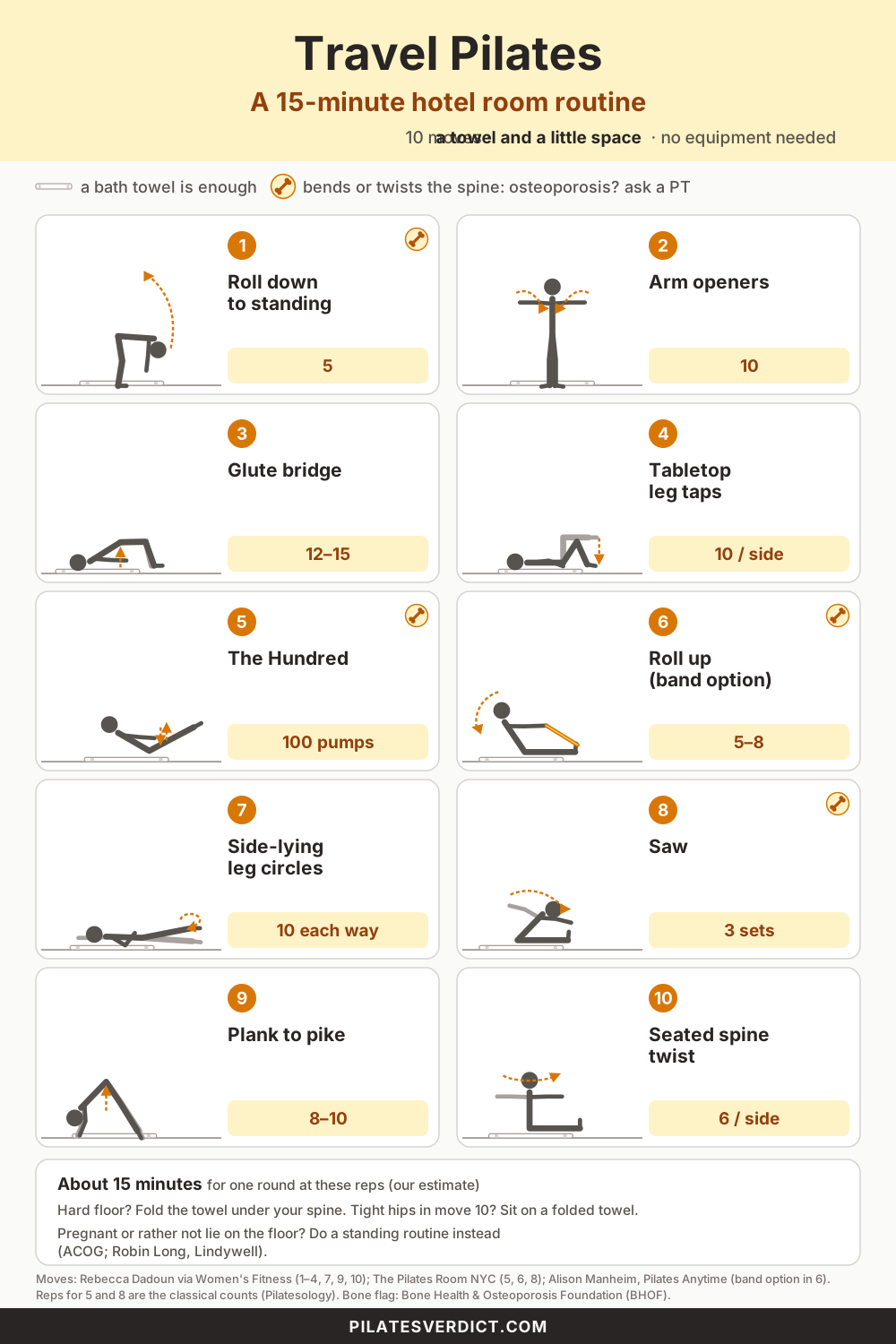
The spine of this routine is Rebecca Dadoun's seven travel moves (via Women's Fitness). We added three classical moves from The Pilates Room NYC's travel video and band versions from Alison Manheim's Pilates Anytime vacation routine. One round at Dadoun's reps takes about 15 minutes (our estimate).
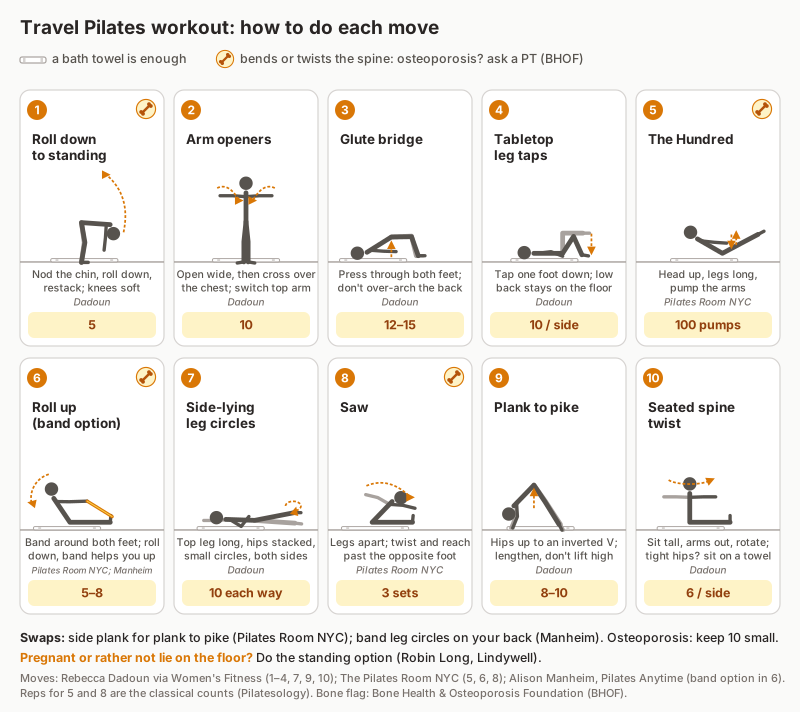
Tap the diagram to enlarge
Moves marked Osteoporosis involve bending forward or twisting; see who should modify before you start.
1. Roll down to standing
Stand with feet hip-width apart, nod your chin and roll down through your spine, then restack to standing. Dadoun's cue: "Keep your knees soft and engage your core as you roll back up." She suggests 5 reps. Long's travel warm-up uses 4–5 roll downs too.
Osteoporosis: this is forward bending.
2. Arm openers
Inhale and open your arms wide, then exhale and cross them over your chest, alternating which arm is on top. Dadoun suggests 10 reps, with an optional gentle twist.
3. Glute bridge
Lie on your back, knees bent, and lift your hips. Dadoun: "Press evenly through both feet and avoid over-arching your back." She suggests 12–15 reps. The Pilates Room NYC's routine includes hip bridges too.
4. Tabletop leg taps
Lift both legs to tabletop (knees over hips, shins parallel to the floor) and tap one foot down at a time. Dadoun's cue: "don't let your lower back lift from the floor." 10 per side.
5. The Hundred
The Hundred is in The Pilates Room NYC's travel routine. Their page doesn't list reps, so we use the classical count: 100 pumps, per Pilatesology's chart of the classical mat order. Step-by-step cues are in our classical Pilates mat exercises guide, and a beginner version with your head down is in Pilates exercises at home for beginners.
Osteoporosis: the head lift is spinal flexion.
6. Roll up (or band-assisted roll up)
The roll up is also in The Pilates Room NYC's routine. If it's hard to roll up without momentum, Manheim's band version helps: loop a long band around both feet and "choke up" until there's tension. Roll down bone by bone and use the band to help you roll back up. She suggests 5–8 reps.
Osteoporosis: this is forward flexion.
7. Leg circles
Dadoun's version is side-lying: top leg long, small circles. "Keep your hips stacked and the circles small." Do 10 each way, on both sides.
Band version (Manheim): lie on your back with a band around one foot and circle the leg 5 times in each direction, keeping your hips anchored. More band moves are in our Pilates band exercises.
8. Saw
The Saw, a seated twist with a forward reach, is the third classical move from The Pilates Room NYC's travel video. Their page doesn't print the steps or reps, so we use the classical count of 3 sets, per Pilatesology. The classical guide linked above has step-by-step cues. Skip it if you're new to Pilates.
Osteoporosis: this combines twisting and forward bending. Skip it.
9. Plank to pike
From a plank, lift your hips into an upside-down V, then return to plank. Dadoun: "Focus on lengthening through your spine rather than lifting your hips as high as possible." 8–10 reps.
Swap: The Pilates Room NYC uses a side plank with variations instead.
10. Seated spine twist
Sit tall with your arms out to the sides and rotate side to side, 6 per side. Dadoun: "If your hips feel tight, sit on a folded towel or cushion."
Osteoporosis: keep the twist small.
Short on time: a 5-minute version
Do moves 1, 3, 4, 9 and 10 once at the low end of the reps. This is our selection from Dadoun's sequence and takes about 5 minutes (our estimate).
Hotel room Pilates at a glance
| Move | Reps | Easier option |
|---|---|---|
| 1. Roll down | 5 | Smaller range |
| 2. Arm openers | 10 | No twist |
| 3. Glute bridge | 12–15 | Lower hips |
| 4. Tabletop leg taps | 10 per side | Smaller taps |
| 5. The Hundred | 100 pumps (classical count) | Head down |
| 6. Roll up | 5–8 | Long band assist |
| 7. Leg circles | 10 each way | Smaller circles |
| 8. Saw | 3 sets (classical count) | Skip |
| 9. Plank to pike | 8–10 | Side plank or knees down |
| 10. Seated spine twist | 6 per side | Sit on a folded towel |
Reps: Rebecca Dadoun via Women's Fitness (1–4, 7, 9, 10), Alison Manheim via Pilates Anytime (6) and Pilatesology's classical counts (5, 8). Moves 5, 6, 8 and the side plank swap come from The Pilates Room NYC, which doesn't publish counts. The "easier option" column is our suggestion unless a source is named above.
Want a printable version? Download the PDF or open the chart on its own page.
No-floor option: 10-minute standing travel Pilates
Pilatesology asks: "Don't want to get down on the hotel room or Airbnb floor?" Its answer is standing classes with no equipment. Robin Long also likes standing workouts for travel because they need little space and no equipment. Her roughly 10-minute sequence:
- Breath and roll downs: a few breaths, then 4–5 roll downs (osteoporosis: forward bending).
- Calf raises: 6–7 reps.
- Marching: keep your core steady as the knees alternate.
- Standing hip circles: 10 per leg.
- Squats with pulses: pulse for a count of 10, then stand. Do 4 rounds, adding "swimming" arms (10 pulses) on the last round.
- Plié squat with side bends: 10 reps.
- Plié squat with spine twist: 10 reps (keep the twist small with osteoporosis).
Need balance support? Irtem uses the room's chair as a barre. For more moves, see our standing Pilates exercises. If you'd rather stay on the mattress, bed Pilates is another floor-free option, though it's gentler.
On the plane or at the gate
The CDC says "Anyone traveling more than 4 hours, whether by air, car, bus, or train, can be at risk for blood clots." Its advice: "Move your legs frequently when on long trips and exercise your calf muscles."
The CDC's travel page describes two seat moves:
- Ankle flexes: extend your legs and flex your ankles, pulling your toes toward you.
- Knee hugs (which the CDC notes some airlines suggest): pull each knee toward your chest and hold it for 15 seconds, up to 10 times.
At the gate or in the aisle, add a slow standing roll down (Dadoun, Long) and a few calf raises (Long). Pilatesology says its limited-space classes can even work in quiet airport corners. These are general movement suggestions, not a way to prevent clots.
The CDC lists these higher-risk groups:
- Over 40
- Obesity
- Surgery or injury in the past 3 months
- Estrogen-containing birth control or hormone therapy
- Pregnancy and the 3 months after birth
- A past clot or clotting disorder
- Active cancer
- Some heart or lung conditions, or diabetes
- Limited mobility
- Varicose veins
If that's you, talk to your doctor before a long trip.
Get medical help for leg swelling, unexplained leg pain, warm or red skin, trouble breathing or chest pain (CDC).
Pilates on vacation: when to fit it in
Short and frequent works. Irtem's routine is 7 minutes, Long's and The Pilates Room NYC's about 10, and Pilatesology says even 10 minutes helps. HHS says short bouts count.
Jet lag: keep expectations modest. The CDC Yellow Book's jet lag chapter notes that daytime exercise "boosts alertness through 'feel good' endorphins." For short trips of less than 2 days, it suggests not adapting at all: "Keep sleep, activity, eating schedule to your 'home' time zone."
Timing may matter a little:
- Flew east: a morning or early afternoon session may help you adjust.
- Flew west: an evening session may help.
This is based on a 2019 Journal of Physiology study of 99 adults doing an hour of treadmill exercise, not Pilates, so treat it as a nudge, not a jet lag cure. The researchers (Youngstedt, Elliott and Kripke) found exercise at 7 a.m. or between 1 and 4 p.m. shifted the body clock earlier, and exercise between 7 and 10 p.m. shifted it later.
What to pack: a light travel Pilates kit
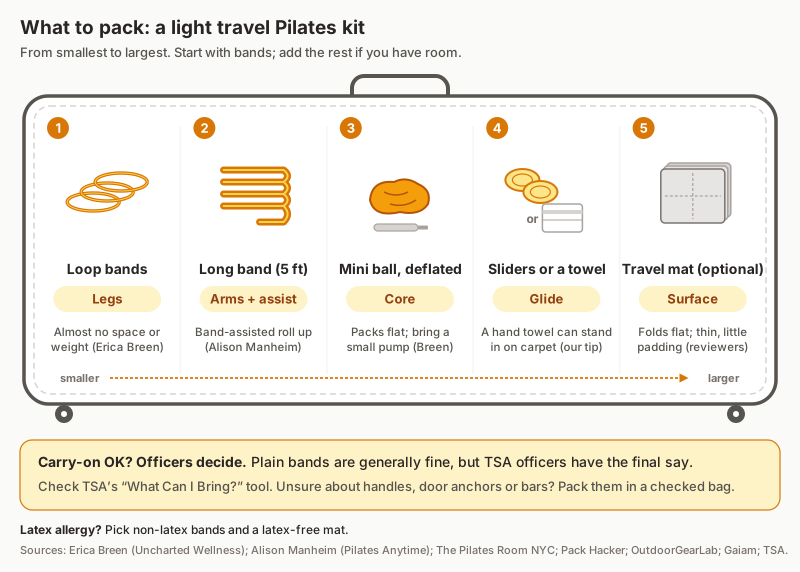
Tap the diagram to enlarge
Ranked from most to least useful per ounce (our ranking, based on what the instructors pack):
- Loop bands. Instructor Erica Breen writes in her Uncharted Wellness newsletter that loop bands "are a very good place to start." They take up almost no space and weigh almost nothing, she says, and can "completely change an otherwise familiar mat workout."
- A long band. Manheim recommends "a long Theraband (not the short loop kind)," about five feet, and says it "weighs less than your skimpiest bathing suit." Breen uses a long band for "upper-body work, mobility, stretching, and exercises where I want to anchor or hold the band in different ways." Compare options in our best resistance bands for Pilates.
- A mini ball, deflated. Breen packs a small Pilates ball flat with a small pump. See our best Pilates balls.
- Sliders or a hand towel. On carpet, a hand towel can do the job of sliders (our suggestion), so these are optional. Our best Pilates sliders covers dual-sided pairs that work on carpet and hard floors.
- Light weights, or water bottles. Breen packs Bala Bangles; Pilatesology suggests water bottles instead. More options in our best hand weights for Pilates.
- A travel mat (optional). Breen sometimes skips the mat and brings a microfiber towel to create "a designated little space." If you want a mat, see below.
Fit Simplify Resistance Loop Exercise Bands (set of 5)
- Best for
- Loop bands, lightest to pack (latex)
- Price tier
- Under $15
THERABAND Non-Latex Resistance Band Beginner Kit (Yellow, Red, Green)
- Best for
- Long band, latex-free
- Price tier
- $15–30
Trideer 9-Inch Pilates Ball
- Best for
- Mini ball that packs flat
- Price tier
- Under $20
Synergee Core Sliders (2-pack, 7 in)
- Best for
- Optional sliders, dual-sided
- Price tier
- Under $15
| Product | Best for | Price tier | |
|---|---|---|---|
| Fit Simplify Resistance Loop Exercise Bands (set of 5) | Loop bands, lightest to pack (latex) | Under $15 | View |
| THERABAND Non-Latex Resistance Band Beginner Kit (Yellow, Red, Green) | Long band, latex-free | $15–30 | View |
| Trideer 9-Inch Pilates Ball | Mini ball that packs flat | Under $20 | View |
| Synergee Core Sliders (2-pack, 7 in) | Optional sliders, dual-sided | Under $15 | View |
Latex allergy? Pack the THERABAND non-latex kit instead.
If your hotel floor is slick, grip socks help too (our suggestion); see our best Pilates grip socks.
Travel mats: thin and light, with little padding
Foldable travel mats pack small but trade away cushioning. Two common picks:
Manduka eKO SuperLite Travel Yoga Mat 1.5mm
- Thickness
- 1.5 mm
- Material
- Natural rubber
- Padding
- Minimal (Pack Hacker, Healthline)
- Price tier
- $40–60
Gaiam Foldable Yoga Mat (2mm)
- Thickness
- 2 mm
- Material
- Latex-free PVC
- Padding
- Minimal (OutdoorGearLab)
- Price tier
- $20–30
- Manduka eKO SuperLite: Pack Hacker says it folds into a travel bag and is "Very slip resistant," but "Can develop scratches fairly easy" and has "Not much padding to it." Healthline called it "absorbent, grippy, and easy to clean" but noted it "doesn't offer much padding." It's natural rubber, so skip it if you have a latex allergy.
- Gaiam Foldable Yoga Mat (2mm): Gaiam says it's 68 x 24 in, latex-free PVC, folds into a 10 x 12 in square and has a lifetime guarantee. OutdoorGearLab scored it 10/10 for portability and 2/10 for comfort, and found its wet traction lower than the JadeYoga Voyager's. Listed weights vary by source (1–3 lb); reviewers call it lightweight.
Rolling moves like the roll up and the Hundred can feel hard on a 1.5–2 mm mat over a hard floor. Fold a towel under your spine (our suggestion).
Which to pack: the Gaiam if you need latex-free or a lower price tier; the Manduka if grip matters most and you don't have a latex allergy (Pack Hacker, Healthline). Want more cushioning? See our best travel Pilates mats.
Check price on AmazonFlying with bands and a ball
We couldn't find a TSA entry for resistance bands specifically. TSA's guidance (as shown in search results; we couldn't open tsa.gov) says officers make the final call at the checkpoint and items that could be used as a bludgeon belong in checked bags.
Our take: plain bands are generally fine in a carry-on, but officers have the final say, so check TSA's What Can I Bring? tool. If you're unsure about handles, door anchors or bars, put them in checked luggage.
Who should modify or skip
- Pregnancy: ACOG advises avoiding lying flat on your back as much as possible after the first trimester. The standing routine is a better fit; talk with your ob-gyn. The CDC also lists pregnancy and the 3 months after birth as a higher-risk time for travel blood clots.
- Osteoporosis or low bone density: the Bone Health & Osteoporosis Foundation advises avoiding bending forward from the waist, sit-ups and crunches, and extreme twisting. Skip or modify moves 1, 5, 6 and 8 of the hotel room routine, and keep move 10 small. A physical therapist can help you choose safe moves.
- Blood clot risk factors or symptoms: follow the CDC's advice above and talk to your doctor.
- Latex allergy: choose non-latex bands and a latex-free mat such as the Gaiam.
More routines live in our Pilates workouts section.
Frequently Asked Questions
Can you do Pilates in a hotel room?
Yes. Instructors design short travel routines for small rooms, and Robin Long says a hotel towel can stand in for a mat. Tugce Irtem says even 5–10 minutes in a hotel room can help release travel tension. If you'd rather not lie on the floor, a standing routine needs no mat at all.
How long should a travel Pilates workout be?
About 10 minutes is common for instructor travel routines: Robin Long's and The Pilates Room NYC's run about 10, and Tugce Irtem's is 7. Our hotel room routine takes about 15 (our estimate). HHS guidelines say any amount of physical activity has some health benefits, and short bouts count.
What Pilates equipment should I pack for travel?
Start with loop bands, which instructor Erica Breen says take up almost no space, then add a long band for more exercise options. A mini ball can travel deflated with a small pump. A thin foldable mat is optional; reviewers note these mats grip well but have little padding.
Can I bring resistance bands in my carry-on?
Usually, but there's no TSA entry for bands specifically and officers have the final say. Check TSA's What Can I Bring? tool, and pack metal handles or bars in checked luggage.
Does exercise help with jet lag?
It may help a little. The CDC Yellow Book notes daytime exercise boosts alertness, and a 2019 study found morning or afternoon exercise shifted the body clock earlier while evening exercise shifted it later. That study used an hour of treadmill exercise, not Pilates, so treat it as a nudge rather than a fix.
What can I do on a long flight?
The CDC suggests moving your legs often on trips longer than 4 hours. Its travel page describes flexing your ankles by pulling your toes toward you, and notes that some airlines suggest hugging each knee toward your chest for 15 seconds. People with blood clot risk factors should talk to their doctor before a long trip.
Can you do Pilates for travel without a mat?
Yes. The Pilates Room NYC's travel routine needs only a small towel, and Robin Long says a hotel towel can stand in for a mat. On tile or wood, fold the towel double or add a blanket under your spine and knees. Or skip the floor and do a standing routine.
Sources
- Balanced Body, The Core (Tugce Irtem): Hotel room Pilates: 7-minute travel workout
- The Pilates Room NYC: 10-minute Pilates travel routine, no equipment required
- Women's Fitness (Rebecca Dadoun): Seven Pilates moves you can do anywhere to ease travel stiffness
- Lindywell (Robin Long): Pilates travel workout
- Pilatesology: Classical Pilates mat: basic, intermediate and advanced order and repetitions (PDF)
- Pilatesology: Glow on the go with travel-friendly Pilates workouts
- Pilates Anytime (Alison Manheim): 5 Pilates Theraband exercises to bring on your next vacation
- Uncharted Wellness (Erica Breen): The Pilates equipment that actually comes with me when I travel
- CDC: Understanding your risk for blood clots with travel
- CDC Yellow Book 2026 (Riedy, Williams): Jet lag disorder
- Youngstedt, Elliott and Kripke, J Physiol (2019): Human circadian phase–response curves for exercise
- ODPHP (HHS): Top 10 things to know about the second edition of the Physical Activity Guidelines for Americans
- Pack Hacker: Manduka eKO SuperLite yoga mat review
- Healthline: Workout mats
- Manduka: eKO SuperLite travel yoga mat
- Gaiam: Foldable yoga mat (2mm)
- OutdoorGearLab: Gaiam Foldable review
- TSA (search preview only; page didn't open): What can I bring? Sporting and camping
- ACOG: Exercise during pregnancy
- Bone Health & Osteoporosis Foundation: Protecting your spine
Update history
- : Published.
Found an error? See how we research and correct guides in our editorial policy.
Was this guide helpful?
Related Articles
How-To
Chair Pilates: a 10-move seated workout for beginners and seniors
Chair Pilates for beginners and seniors: 10 seated moves with a printable chart, free videos, safety tips and what the research says about benefits.
October 21, 2026 · 21 min read
How-To
Bed Pilates: 10 gentle exercises for beginners (with chart)
Bed Pilates for beginners: 10 gentle exercises on your mattress, a bedtime version, a printable chart and what research says about the benefits.
October 16, 2026 · 16 min read
How-To
Pilates block exercises: 10 beginner moves with a yoga block
10 Pilates block exercises for beginners: where the yoga block goes in each move, reps from named instructors, easier and harder options, and safety notes.
October 16, 2026 · 22 min read
How-To
Classical Pilates mat exercises: all 34 in order (+ printable chart)
All 34 classical Pilates mat exercises in Joseph Pilates' original order, with modern names, reps, a printable chart and a beginner sequence.
October 15, 2026 · 20 min read