Pilates workout plan: 2–5 day weekly schedules (plus lifting)
By The Pilates Verdict Team · Updated November 20, 2026 · 27 min read
This article contains affiliate links. If you buy through them, we may earn a commission at no extra cost to you. As an Amazon Associate I earn from qualifying purchases. Read our affiliate disclosure.
A good Pilates workout plan is a weekly rhythm you can keep: which days are Pilates days, what each session covers, and where walks and rest go. This one works at home with just a mat.
You don't need much to begin. "The only equipment you really need to start a Pilates practice is a mat and, if you wish, a small towel to wipe off any sweat," Healthline says.
Below are four example weekly schedules, for 2, 3, 4 or 5 days a week. Pick the one that matches the days you actually have, not the days you wish you had. If you also lift weights, the strength training section has sample weekly splits, including the 3-2-8 method.
Quick answer:
- Which plan: new to Pilates? Start with the 2-day plan. Most people: the 3-day plan (Mon/Wed/Fri). Already active and recovering well: 4 days.
- Days: 2–3 non-consecutive days a week is a solid base for any Pilates workout plan.
- Length: 20–30 minutes on a mat.
- Around it: walks or other aerobic activity, plus at least one full rest day.
- If you lift: at least 2 lifting days (CDC), lift first on shared days (ISSA), and 48 hours between hard sessions for the same muscles (sample splits).
- Next step: add a day or 10 minutes after a month if you're recovering well.
- Gear: just a mat. See what you need for a main pick and a budget pick.
How we researched this:
- How often: Healthline (medically reviewed), Cleveland Clinic, the US Physical Activity Guidelines (HHS), CDC and the ACSM position stand on exercise
- Evidence on frequency and session length: a 2018 randomized trial in the British Journal of Sports Medicine, a 2019 follow-up analysis, a 2024 Sports Health scoping review and a 2024 randomized trial in Healthcare
- Brand guidance: Club Pilates and Balanced Body, labeled as brand claims
- Combining Pilates with lifting: the 2026 ACSM resistance-training position stand and its 2009 progression model, the NHS, systematic reviews on Pilates and strength (Cruz-Ferreira, Oliveira, Vitor), a meta-analysis on concurrent training (Schumann), and trainer guidance from SELF, ISSA, Fortune Well, REP Fitness (brand) and Balanced Body
- History: Joseph Pilates' own recommendation, as quoted by Flow Pilates & Wellness
The schedules and splits are our editorial examples, built from that guidance. They aren't an expert-designed program, and we didn't test them. Every source is listed at the end.
How many days a week should you do Pilates?
Named sources agree more than they disagree:
| Source | Suggested days a week |
|---|---|
| Healthline | 1–2 to start, then up to 4 |
| Cleveland Clinic | 3–5, with cardio and strength work |
| Club Pilates (brand) | 2–3 for beginners, 4 for strength |
| Joseph Pilates | 4 |
- Healthline: "Start with 1 to 2 days weekly to see how you feel and whether you enjoy it. Then, you can go up to 4 times weekly."
- Cleveland Clinic: Judi Bar, its lead yoga therapist, says doing Pilates "three to five times a week is great," as long as you also make time for strength work and aerobic exercise such as cycling. "Pilates should still be part of a well-balanced exercise program."
- Club Pilates (a studio chain): "If you're new to Pilates, aim for 2 to 3 sessions per week," and "to build strength and muscle tone, 4 sessions per week are an effective target."
- Joseph Pilates: in Return to Life Through Contrology, as quoted by Flow Pilates & Wellness, he asked readers to do the exercises "only four times a week for just three months." His promise that your body would then approach "the ideal" is a 1940s claim, not a tested result. Flow Pilates' Lorissa Gilmore herself recommends two to three times a week.
The research points the same way. In a 2018 British Journal of Sports Medicine trial, 296 adults with chronic low back pain got an advice booklet alone or the booklet plus one-hour supervised Pilates sessions once, twice or three times a week for six weeks.
- All Pilates groups did better than advice alone on pain and disability.
- Twice a week beat once a week.
- Three times a week added no further benefit for pain and disability, though the cost analysis favored three.
A 2019 follow-up analysis of the same patients found that different weekly frequencies "did not accelerate the improvement of pain intensity."
A 2024 Sports Health scoping review of Pilates in musculoskeletal rehab found 2–3 sessions a week was the most common frequency.
Both caveats matter: these studies looked at people with back pain and other musculoskeletal conditions, mostly in supervised sessions, not general fitness at home. Still, they support the idea that 2–3 days is a solid base, and more days are optional, not required.
The 4 session types in this plan
Each schedule mixes four session types. The move lists are our picks from common beginner mat exercises. For step-by-step how-tos, see our Pilates exercises at home for beginners.
How to run a session (our editorial example): start with 2–3 minutes of breathing and pelvic tilts as a warm-up. Then do each move for 5–10 controlled reps (or about 1 minute), rest briefly, and repeat the circuit 2–3 times. For session D, hold or repeat each stretch for about a minute.
A: Full-body mat (20–30 min)
- Pelvic curl: roll the spine up and down one segment at a time.
- Hundred: pump the arms while breathing in and out for five counts each.
- Single-leg stretch: switch knees toward the chest with the head lifted.
- Leg circles: keep the pelvis still while one leg draws small circles.
- Side kicks: lie on your side and swing the top leg forward and back.
- Swimming: lie face down and flutter opposite arms and legs.
B: Core, back and arms (20–30 min)
- Chest lift: curl the head and shoulders up, then lower slowly. Add criss-cross later.
- Swan prep: lie face down and lift the chest a little off the mat.
- Swimming: keep the reach long rather than high.
- Plank or leg pull front prep: hold a straight line from head to heels, or from head to knees.
- Push-up prep or modified push-up: from your knees, lower the chest with control. For more, see our Pilates arm workout.
C: Lower body and props (20–30 min)
- Bridge: press through the feet to lift the hips.
- Side-lying series: leg lifts and small circles on each side.
- Clamshell with a band: open the top knee against the band.
- Ball squeeze or ring squeeze: press a small ball or Pilates ring between the knees or thighs during bridges.
Props are optional in month 1. Our Pilates equipment for beginners explains which ones help.
D: Mobility and stretch (10–20 min)
- Cat-cow: on all fours, round and arch the spine.
- Spine twist: sit tall and rotate the upper body.
- Mermaid: a seated side stretch.
- Saw: add it later, once twisting while sitting tall feels easy.
Session D can be done daily. The ACSM position stand recommends flexibility work at least 2–3 days a week and says "greater gains will be attained if done daily," according to a summary by Len Kravitz, PhD, of the University of New Mexico.
Walk days
Walk days count toward aerobic activity. US guidelines say adults need "at least 150 to 300 minutes of moderate-intensity aerobic activity, like brisk walking or fast dancing, each week."
Your Pilates workout plan: weekly schedules for 2–5 days
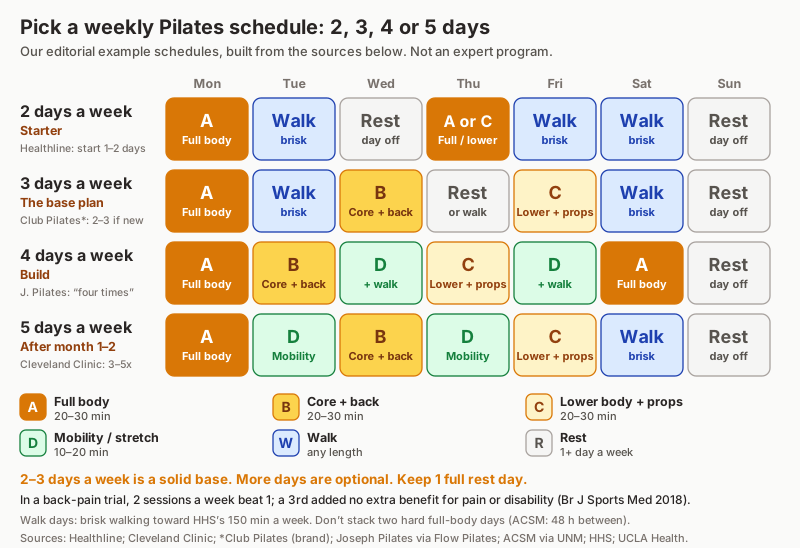
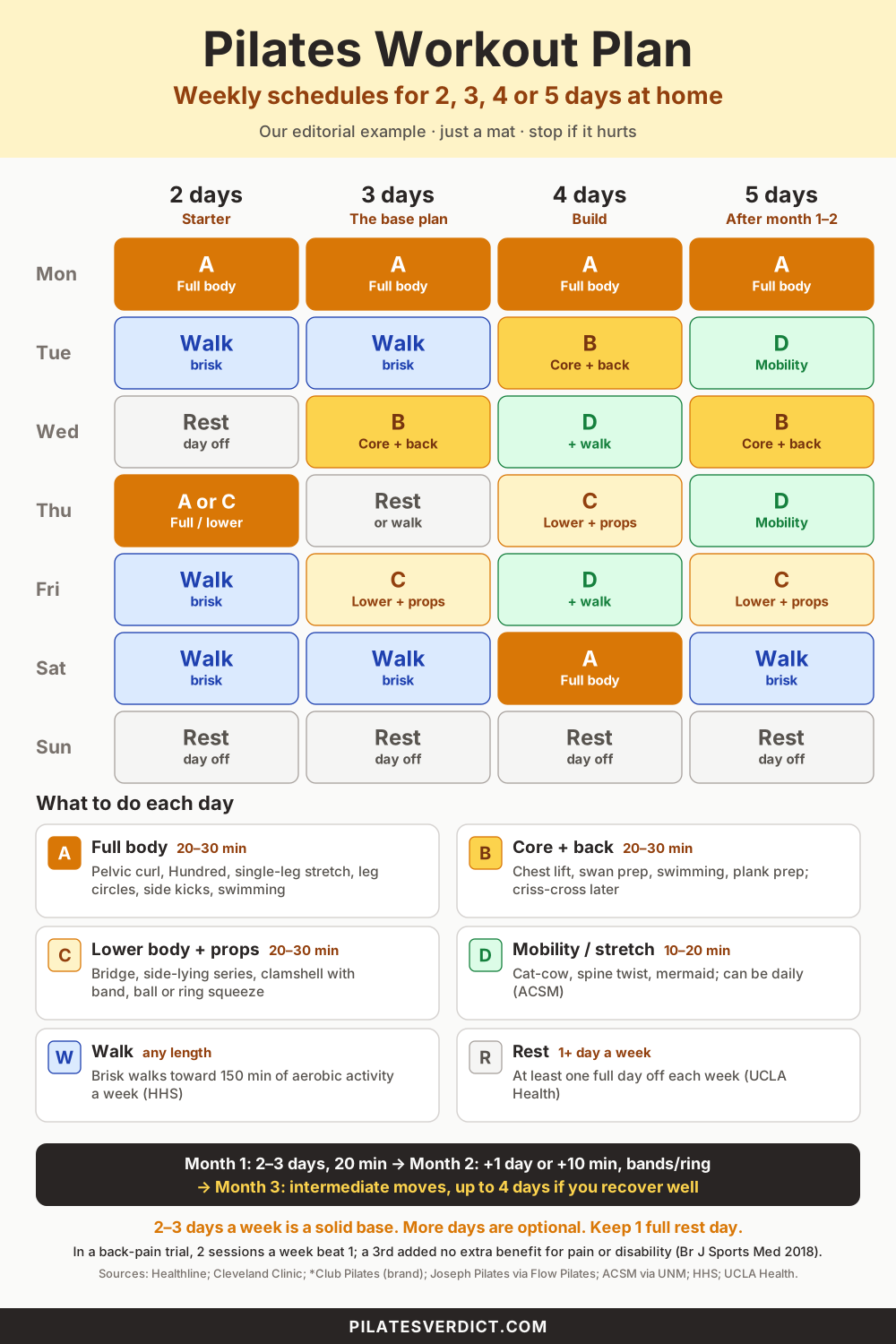
These are our example schedules. Shift the days to suit your week, but keep the spacing. Save or print the chart at the end of this section to keep on your fridge.
| Plan | Pilates days | Best for |
|---|---|---|
| 2 days | Mon, Thu | Starting out |
| 3 days | Mon, Wed, Fri | Most people |
| 4 days | Mon, Tue, Thu, Sat | Building strength |
| 5 days | Mon–Fri (Tue/Thu = D) | After 1–2 months |
Tap the diagram to enlarge
2 days a week (starter)
Do session A on Monday and session A or C on Thursday. Walk on three or more other days, and keep one or two full rest days.
This matches Healthline's 1–2-day starting point, and two trials saw improvements at twice a week:
- 2018 back pain trial: twice a week beat once.
- 2024 Healthcare trial: 40 sedentary women (19 per group at analysis) did 45-minute mat Pilates twice a week for 8 weeks; Zoom and studio groups both improved on curl-up, push-up, flexibility, plank and balance tests.
- Caveat: it tested only twice a week and had no non-exercise control group.
3 days a week (the base plan)
Do session A on Monday, B on Wednesday and C on Friday. Walk on Tuesday and Saturday, take Thursday as a rest or easy-walk day, and rest on Sunday.
The days are non-consecutive, so each session has a recovery day after it. This fits Club Pilates' 2–3 sessions for beginners and Gilmore's two to three times a week.
4 days a week
Do session A on Monday, B on Tuesday, C on Thursday and A again on Saturday. On Wednesday and Friday, walk and do a short session D. Rest on Sunday.
Four days matches Joseph Pilates' recommendation, Healthline's upper limit for beginners and Club Pilates' strength target. Monday and Tuesday are back to back, and both A and B work the abdominals and back. ACSM recommends 48 hours of rest between resistance sessions for the same muscle groups, so keep Tuesday's B session easy: fewer reps, one circuit, and skip it for D if you're still sore. Don't do two hard full-body days in a row.
5 days a week (with mobility days)
Do session A on Monday, D on Tuesday, B on Wednesday, D on Thursday and C on Friday. Walk on Saturday and rest on Sunday. The three harder sessions stay on non-consecutive days.
Five days sits at the top of Cleveland Clinic's 3–5 range. Try it only after a month or two on a smaller plan, and only if you're recovering well.
Tap the diagram to enlarge
Where cardio, strength and rest fit
Cardio. Pilates doesn't replace aerobic activity. Cleveland Clinic says "it's not necessarily a stand-alone exercise." Aim for the 150–300 weekly minutes of moderate activity in the US guidelines. HHS also notes that "any amount of physical activity has some health benefits," so short walks count.
Strength. US guidelines say adults need muscle-strengthening activity "at least 2 days each week," and CDC says it should work "all major muscle groups (legs, hips, back, abdomen, chest, shoulders, and arms)." Pilates sessions that work all major muscle groups against resistance (bodyweight, bands or weights) may help toward this. CDC's list of what counts doesn't mention Pilates specifically. If you also lift, see combining Pilates with strength training below for sample weekly splits.
Rest. UCLA Health advises taking "at least one day off from your daily workout routine each week." Its warning signs that you need rest include "feeling excessively tired before you even begin your workout," soreness that lasts more than a couple of days and disrupted sleep. Club Pilates (brand) lists similar signs of doing too much: persistent soreness, worse performance, disrupted sleep and loss of motivation.
Active recovery. Easy days don't have to be empty. Cleveland Clinic's Lauren Wichman, MD, lists walking, stretching, yoga, foam rolling and Pilates as low-intensity active recovery.
Combining Pilates with strength training
Pilates and lifting do different jobs, so many people do both. The trick is fitting them into one week without stacking hard days on top of each other.
Why do both?
- Lifting builds maximal strength. The 2026 American College of Sports Medicine (ACSM) position stand, an overview of 137 systematic reviews, found strength improves most with "lifting heavier loads (≥80% one-repetition maximum), through a complete range of motion, for 2-3 sets, at the beginning of training sessions, and ≥2 sessions/wk."
- Pilates is strongest on flexibility, balance and endurance. A 2011 systematic review of 16 trials in healthy people (Cruz-Ferreira et al.) found "strong evidence" for flexibility and dynamic balance and "moderate evidence" for muscular endurance. Strength wasn't among the well-supported outcomes. A 2024 meta-analysis of 24 trials in adults over 60 (Oliveira et al.) found "low quality evidence that Pilates did not significantly improve muscle strength" compared with no exercise.
- Pilates is usually lighter work. A 2026 review of six studies (Vitor et al.) called a typical session "light-to-moderate metabolic intensity," so it fits well between lifting days.
Physical therapist Laurence Agénor, DPT, told SELF that Pilates "can pair really well with a more traditional weightlifting routine." Balanced Body (brand) puts it this way: "Strength training should be used to build capacity, while Pilates can be used to build control, stability, mobility, and endurance."
Does Pilates count as strength training? Partly. The NHS lists Pilates among its muscle-strengthening activities. The CDC asks that strength work hit "all major muscle groups (legs, hips, back, abdomen, chest, shoulders, and arms)," and its examples don't name Pilates, so whether a given class counts toward the US guideline is unclear. For light weights inside your Pilates moves, see Pilates with weights.
How many days of each
- Lifting: at least 2 days a week (CDC, ACSM 2026). ACSM's 2009 progression model suggests 2–3 days for novices and 3–4 for intermediate lifters.
- Pilates: Balanced Body's three sample weeks pair 2–3 Pilates days with 2–3 strength days and at least one rest or recovery day.
- Spacing: ACSM recommends 48 hours between sessions that train the same muscle groups (as summarized by Len Kravitz, PhD).
Sample Pilates and strength training schedules
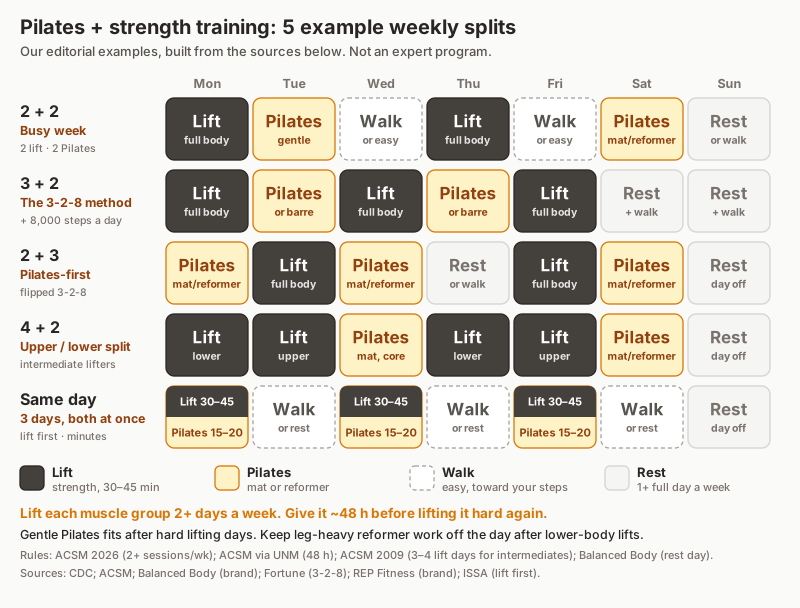
These are our editorial examples built from the guidance above, not expert programs. Each hits every muscle group with lifting at least twice a week, avoids hard lifting for the same muscles on back-to-back days and keeps a rest day. On Pilates days, use sessions A–D from this plan.
| Day | 2 + 2 | 3 + 2 (3-2-8) | 2 + 3 |
|---|---|---|---|
| Mon | Full-body lift | Full-body lift | Pilates |
| Tue | Pilates | Pilates | Full-body lift |
| Wed | Walk | Full-body lift | Pilates |
| Thu | Full-body lift | Pilates | Walk |
| Fri | Walk | Full-body lift | Full-body lift |
| Sat | Pilates | Rest + walk | Pilates |
| Sun | Rest | Rest + walk | Rest |
- 2 + 2 (busy week): meets the 2-day strength minimum and matches Balanced Body's first sample week. The easiest place to start.
- 3 + 2 (the 3-2-8 method): REP Fitness's sample 3-2-8 week uses this layout, with 30–45 minute strength sessions. Prefer a split? Make Monday lower body, Wednesday upper body and Friday full body.
- 2 + 3 (Pilates-first): for when Pilates is your main practice. Balanced Body's second sample week is 3 Pilates, 2 strength and 1 rest day.
- 4 + 2 (intermediate lifters): lower-body lift Mon/Thu, upper-body lift Tue/Fri, Pilates Wed/Sat, rest Sun. Our tip, based on the 48-hour rule: keep leg-heavy reformer work off the day after a lower-body lift.
- Only 3 free days: lift for 30–45 minutes (REP Fitness), then do 15–20 minutes of mat Pilates, three times a week.
Tap the diagram to enlarge
On lifting days, train every major muscle group (CDC) and put big multi-joint moves before small ones (ACSM 2009). Our examples: a squat, a hinge such as a deadlift, a row, a press and a lunge. For novices, ACSM's 2009 model recommends loads you can lift about 8–12 times with good form, building up over time.
What is the 3-2-8 method?
It's a weekly framework: 3 days of strength training, 2 days of low-impact Pilates or barre, and 8,000 steps every day. Fortune Well credits UK barre and Pilates instructor Natalie Rose with popularizing it on TikTok. Rose says results come within three months; that's her claim, not a tested result.
- What trainers like: Kristie Larson, CSCS, told Fortune Well, "It's such a nice balance."
- Caveats: five workouts a week may not fit everyone, and if the Pilates days are for recovery, Fortune Well suggests traditional Pilates over high-intensity boutique classes. REP Fitness's Rachel MacPherson, CSCS, notes there's no dedicated moderate cardio and that you need "progressive overload on your strength days."
- The 8,000 steps: a 2022 meta-analysis of 15 cohorts (Paluch et al., Lancet Public Health) found mortality risk leveled off at about 6,000–8,000 daily steps in adults 60 and older and 8,000–10,000 in adults under 60. That's observational research, not fitness results.
- Unproven extras: some 3-2-8 content makes hormone or cycle claims. We found no research backing those for this plan.
Pilates and lifting on the same day
- Lift first if strength is the goal. ISSA's advice: "do your weight lifting first, then transition to Pilates." The 2026 ACSM stand also puts heavy lifts "at the beginning of training sessions." No study has compared the two orders for Pilates, so treat this as trainer advice.
- A short Pilates warm-up is fine. Just don't do a hard Pilates class right before heavy lifts.
- Space them out if you can. In a 2022 meta-analysis of 43 studies on cardio plus lifting (Schumann et al., Sports Medicine), explosive strength was blunted mainly when both were done in the same session; with at least 3 hours between them, there was no significant effect. That covered aerobic training, not Pilates, but a morning lift and evening Pilates is a simple way to follow it.
- Count hard reformer classes as training. Springs add resistance, so a demanding reformer class the day after a lower-body lift isn't an easy day (our planning tip). Balanced Body notes that "both require recovery, especially when you are working the same muscle groups."
Gear for lifting days: the 1–3 lb weights used in Pilates are too light for most lifting, given ACSM's load guidance. The Amazon Basics neoprene set with a stand includes 3, 5 and 8 lb pairs, which suits upper-body moves and beginners. Most people will outgrow 8 lb for squats and hinges, so plan to add a heavier pair, such as the Amazon Basics 10 lb pair.
Check price on AmazonHow long should each session be?
Shorter than many people think:
- Healthline: its Fit It In Pilates series uses four 22-minute routines (including one for beginners).
- Joseph Pilates: "Make up your mind that you will perform your Contrology exercise ten minutes without fail," as quoted by Flow Pilates. Gilmore says even ten-minute workouts count.
- The 2024 Healthcare trial: 45-minute mat sessions, twice a week.
- Balanced Body (brand, reformer): "30-60 mins on a regular basis."
- Rehab studies: the Sports Health review found 50–60 minutes was the most common session length in clinical trials.
At home, 20–30 minutes is a realistic target for sessions A–C, with 10–20 minutes for session D. If you only have ten minutes, do ten.
How to progress month by month
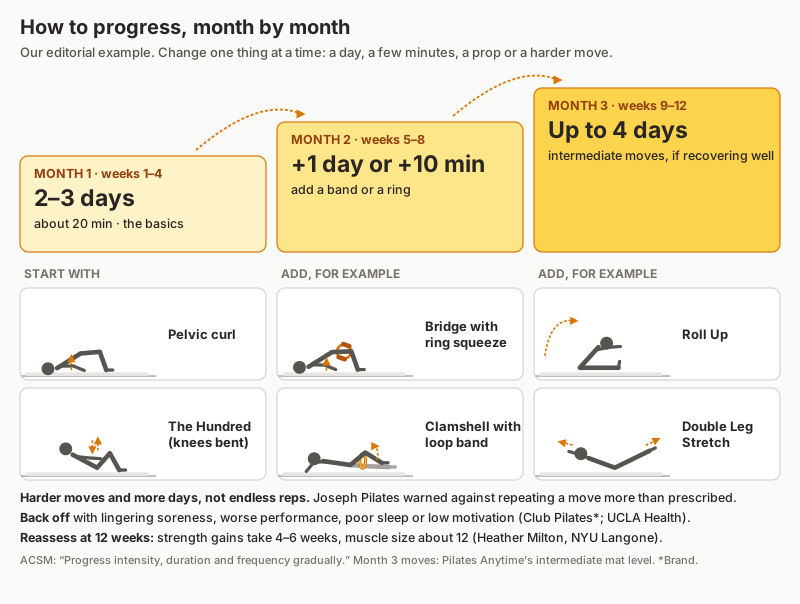
ACSM's advice is to "progress intensity, duration and frequency gradually." Our example progression:
- Month 1: 2–3 days a week, about 20 minutes, basic moves only.
- Month 2: add one day or 10 minutes per session (not both at once), and bring in a band or ring for session C.
- Month 3: try intermediate moves, such as the Roll Up, Double Leg Stretch, Spine Stretch and Saw, which Pilates Anytime lists among its mat progressions. Move to 4 days only if you're recovering well.
Progress by harder variations and more days, not endless reps. Joseph Pilates warned, as quoted by Flow Pilates, to "be sure NEVER TO REPEAT THE SELECTED EXERCISE(S) MORE THAN THE PRESCRIBED NUMBER OF TIMES."
Watch for the warning signs above. If they show up, drop back a step for a week.
Tap the diagram to enlarge
What to expect
- Strength: "Strength gains take 4-6 weeks for the nervous system to improve the efficiency of activating muscle, and more like 12 weeks to actually see changes in the muscle size itself," Heather A. Milton, an exercise physiologist at NYU Langone, told TODAY. Reassess your plan at about 12 weeks.
- Habit: Dr. Pippa Lally's research found new habits took 66 days on average to become automatic, with a range of 18 to 254 days. She suggests planning when and where you'll do them, which is why each schedule above has fixed days.
- Weight: a 2021 meta-analysis in Frontiers in Physiology (11 trials, 393 adults with overweight or obesity) found Pilates reduced body weight and BMI but not waist circumference. The effect was significant in programs longer than 10 weeks, and the evidence was rated low to moderate quality. Don't count on Pilates alone for weight loss. Pair it with the aerobic activity in the US guidelines.
Cleveland Clinic also notes that most Pilates studies have "a small number of participants" and short follow-up, so treat any results timeline as rough.
Curious what a first month can change? See our 28-day Pilates challenge results.
Studio or reformer days
If you take studio classes, swap one A or B session for a class. Balanced Body (brand) recommends reformer Pilates "2-3 times per week" for 30–60 minutes. Keep the rest of the week as written, with at least one full rest day.
Not sure which to choose? Our reformer vs. mat Pilates comparison covers the differences. Starting on a reformer instead? Try our 28-day reformer Pilates challenge.
Who should check with a professional first
- New to exercise, injured or with limited mobility: Healthline advises talking to a healthcare professional first "if you're new to exercising in general, are pregnant, are recovering from an injury, or have more limited mobility."
- Pregnant: ACOG advises avoiding lying flat on your back as much as possible during exercise and lists modified Pilates among options. Many moves in sessions A–C are done lying on your back, so ask your provider how to adapt them.
- Osteoporosis or low bone density: the Bone Health & Osteoporosis Foundation advises avoiding bending forward from the waist, sit-ups or crunches, toe-touches, and twisting or bending at the torso to an extreme. In this plan, that includes, but isn't limited to, the Roll Up, Spine Stretch and Saw, the head lift in the Hundred and the single-leg stretch, chest lifts, criss-cross, rounding the back in cat-cow and deep spine twists. Ask a physical therapist which moves to swap.
Want a day-by-day start?
If a weekly plan feels too open, do a 28-day challenge first, then move to the 3-day plan above:
- 28-day Pilates challenge, with a free day-by-day tracker
- Other formats: wall or bed challenges
More routines are in Pilates workouts.
What you need
A mat is enough, Healthline says. Below are two options from our catalog: the Balanced Body EcoWise mat and the Gaiam Classic 5mm as a budget pick.
Main pick: Balanced Body EcoWise mat on Amazon Budget pick: Gaiam Classic 5mm on AmazonFrom month 2, a few light props add variety to session C. A short book of 15-minute workouts can help on busy days.
Balanced Body EcoWise Pilates Mat
- Role in this plan
- Main mat
- Price tier
- $50–100
Gaiam Classic Solid Color Yoga Mat (5mm)
- Role in this plan
- Budget mat
- Price tier
- $20–30
THERABAND Non-Latex Resistance Band Beginner Kit (Yellow, Red, Green)
- Role in this plan
- Bands for session C
- Price tier
- $15–30
Balanced Body Ultra-Fit Circle (15")
- Role in this plan
- Ring squeezes in session C
- Price tier
- $20–40
Trideer 9-Inch Pilates Ball
- Role in this plan
- Small ball for bridges
- Price tier
- Under $20
15-Minute Pilates (Alycea Ungaro, DK)
- Role in this plan
- Short-session ideas
- Price tier
- $10–20
Amazon Basics Neoprene Dumbbell Set with Stand (3, 5, 8 lb pairs)
- Role in this plan
- Dumbbells for lifting days
- Price tier
- $30–50
| Product | Role in this plan | Price tier | |
|---|---|---|---|
| Balanced Body EcoWise Pilates Mat | Main mat | $50–100 | View Balanced Body EcoWise Pilates Mat |
| Gaiam Classic Solid Color Yoga Mat (5mm) | Budget mat | $20–30 | View Gaiam Classic Solid Color Yoga Mat (5mm) |
| THERABAND Non-Latex Resistance Band Beginner Kit (Yellow, Red, Green) | Bands for session C | $15–30 | View THERABAND Non-Latex Resistance Band Beginner Kit (Yellow, Red, Green) |
| Balanced Body Ultra-Fit Circle (15") | Ring squeezes in session C | $20–40 | View Balanced Body Ultra-Fit Circle (15") |
| Trideer 9-Inch Pilates Ball | Small ball for bridges | Under $20 | View Trideer 9-Inch Pilates Ball |
| 15-Minute Pilates (Alycea Ungaro, DK) | Short-session ideas | $10–20 | View 15-Minute Pilates (Alycea Ungaro, DK) |
| Amazon Basics Neoprene Dumbbell Set with Stand (3, 5, 8 lb pairs) | Dumbbells for lifting days | $30–50 | View Amazon Basics Neoprene Dumbbell Set with Stand (3, 5, 8 lb pairs) |
Our best Pilates mats compares more mats.
Frequently Asked Questions
How many days a week should I do Pilates?
Two to three non-consecutive days is a solid start. Healthline suggests beginning with 1–2 days and building to 4, and Cleveland Clinic suggests 3–5 alongside cardio and strength work. In a trial of people with chronic low back pain, two sessions a week beat one, but three added no further benefit for pain and disability.
Is 3 days a week of Pilates enough?
For most people, yes. Club Pilates (a studio chain) suggests 2–3 sessions a week for beginners and 4 to build strength, and Pilates dosage research most often used 2–3 sessions a week. Add walking toward the 150 minutes of weekly aerobic activity in the US Physical Activity Guidelines.
Can I do Pilates every day?
Short, gentle sessions can be daily, and the ACSM position stand notes stretching gains are greater when done daily. But UCLA Health advises at least one day off from your routine each week, and backing off if you're tired before you start, sore for days or sleeping badly.
How long should a Pilates workout be?
20–30 minutes works at home. Healthline's Fit It In Pilates routines run about 22 minutes, one study used 45-minute sessions twice a week, and Joseph Pilates urged at least ten minutes "without fail." Balanced Body recommends 30–60-minute reformer sessions.
Can a Pilates workout plan help with weight loss?
Possibly, but not on its own. A 2021 meta-analysis in Frontiers in Physiology found Pilates reduced body weight and BMI in adults with overweight or obesity, mostly in programs longer than 10 weeks, and rated the evidence low to moderate quality. Pair Pilates with the 150–300 weekly minutes of aerobic activity in the US guidelines.
Can I do Pilates and weight training on the same day?
Yes. ISSA advises "do your weight lifting first, then transition to Pilates," and ACSM's 2026 guidance puts heavy lifts at the start of a session for strength. In research on cardio plus lifting, explosive power was blunted mainly when both were done back to back, not when they were at least 3 hours apart. Pilates itself hasn't been studied this way.
What is the 3-2-8 method?
A weekly framework popularized on TikTok by UK barre and Pilates instructor Natalie Rose: 3 strength days, 2 Pilates or barre days, and 8,000 steps a day, according to Fortune Well. Trainers like the balance, but it's a social-media plan, not a tested program, and five workouts a week won't suit everyone.
Does Pilates count as strength training?
Partly. The NHS lists Pilates as a muscle-strengthening activity, and a physical therapist quoted by SELF says it builds muscular endurance more than maximal strength. Reviews find good evidence for flexibility, balance and endurance but weak evidence for strength gains. If strength is your goal, add lifting with heavier loads, as ACSM recommends.
How many days a week should I lift if I also do Pilates?
At least 2. The CDC and ACSM call for muscle-strengthening work for all major muscle groups on 2 or more days a week, and ACSM suggests 2–3 days for beginners. Balanced Body's sample weeks pair 2–3 strength days with 2–3 Pilates days and at least one rest or recovery day.
How long until I see results from a Pilates plan?
NYU Langone exercise physiologist Heather A. Milton told TODAY that strength gains take 4–6 weeks and visible muscle changes about 12 weeks. In one small study, twice-weekly mat Pilates improved curl-up and push-up test scores over 8 weeks.
Sources
- Healthline (Roxy Menzies; medically reviewed by Danielle Hildreth, RN, CPT): Pilates for beginners
- Cleveland Clinic (Judi Bar): Pilates 101
- Club Pilates (brand blog): How often should you do Pilates?
- Balanced Body (brand): Everything you need to know about Reformer Pilates
- Flow Pilates & Wellness (Lorissa Gilmore), quoting Return to Life Through Contrology: How often should I do Pilates?
- Miyamoto et al., Br J Sports Med (2018): Different doses of Pilates-based exercise therapy for chronic low back pain
- Silva et al., Braz J Phys Ther (2019): Different weekly frequencies of Pilates did not accelerate pain improvement
- Sivrika et al., Sports Health (2024): Pilates dosage in rehabilitation of patients with musculoskeletal conditions
- Len Kravitz, PhD (University of New Mexico), summarizing Garber et al., Med Sci Sports Exerc (2011): ACSM publishes updated exercise guidelines (PDF)
- HHS ODPHP: Top 10 things to know about the Physical Activity Guidelines for Americans
- CDC: Adult activity: an overview
- CDC: What counts as physical activity for adults
- UCLA Health: How often should you take a rest day?
- Cleveland Clinic (Lauren Wichman, MD): Active recovery
- TODAY (Heather A. Milton, NYU Langone): Wall Pilates exercises
- University of Surrey (Dr. Pippa Lally): Does it really take 66 days to form a habit?
- Wang et al., Front Physiol (2021): Pilates for overweight or obesity: a meta-analysis
- Lazarowitz Zanzuri et al., Healthcare (2024): Remote Pilates training is effective in improving physical fitness in healthy women
- Pilates Anytime (Amanda Altman): Mat sequences for every level
- Currier et al., Med Sci Sports Exerc (2026): ACSM position stand on resistance training prescription
- ACSM, Med Sci Sports Exerc (2009): Progression models in resistance training for healthy adults
- NHS: Physical activity guidelines for adults aged 19 to 64
- Cruz-Ferreira et al., Arch Phys Med Rehabil (2011): Systematic review of the effects of Pilates in healthy people
- Oliveira et al., J Bodyw Mov Ther (2024): Effects of Pilates on strength, endurance and muscle power in older adults
- Vitor et al., Systematic Reviews (2026): Metabolic intensity and energy cost of Pilates exercises
- SELF via Yahoo: Does Pilates "count" as strength training?
- Balanced Body, The Core (brand content): Combining Pilates and strength training: a programming guide
- ISSA: Should you add Pilates to your workout?
- Schumann et al., Sports Med (2022): Compatibility of concurrent aerobic and strength training
- Fortune Well: What is the 3-2-8 method workout?
- REP Fitness (brand content): What is the 3-2-8 method?
- Paluch et al., Lancet Public Health (2022): Daily steps and all-cause mortality
- ACOG: Exercise during pregnancy
- Bone Health & Osteoporosis Foundation: Protecting your spine
Update history
- : Updated.
- : Published.
Found an error? See how we research and correct guides in our editorial policy.
Was this guide helpful?
Related Articles

How-To
28-day bed Pilates challenge: a free plan and printable calendar
A free 28-day bed Pilates challenge with a printable calendar: 10 gentle moves, a week-by-week plan, no app needed, and what 28 days can realistically do.
October 23, 2026 · 16 min read
How-To
Pilates with weights for beginners: 9-move dumbbell routine
Pilates with weights for beginners: a 9-move full-body dumbbell routine, how heavy to go, what light weights can and can't do, and who should modify.
October 14, 2026 · 20 min read
How-To
Pilates exercises at home for beginners: a 10-move mat routine
10 Pilates exercises at home for beginners, no equipment beyond a mat. Reps and easier versions from instructor guides, plus how often to practice.
October 7, 2026 · 19 min read
How-To
28-day Pilates challenge: free plan, calendar and what to expect
A free 28-day Pilates challenge: a week-by-week mat plan, printable calendar, a 7-day starter week, a gentler somatic version and realistic results.
November 20, 2026 · 34 min read