Chair Pilates: a 10-move seated workout for beginners and seniors
By The Pilates Verdict Team · October 21, 2026 · 21 min read
This article contains affiliate links. If you buy through them, we may earn a commission at no extra cost to you. As an Amazon Associate I earn from qualifying purchases. Learn more.
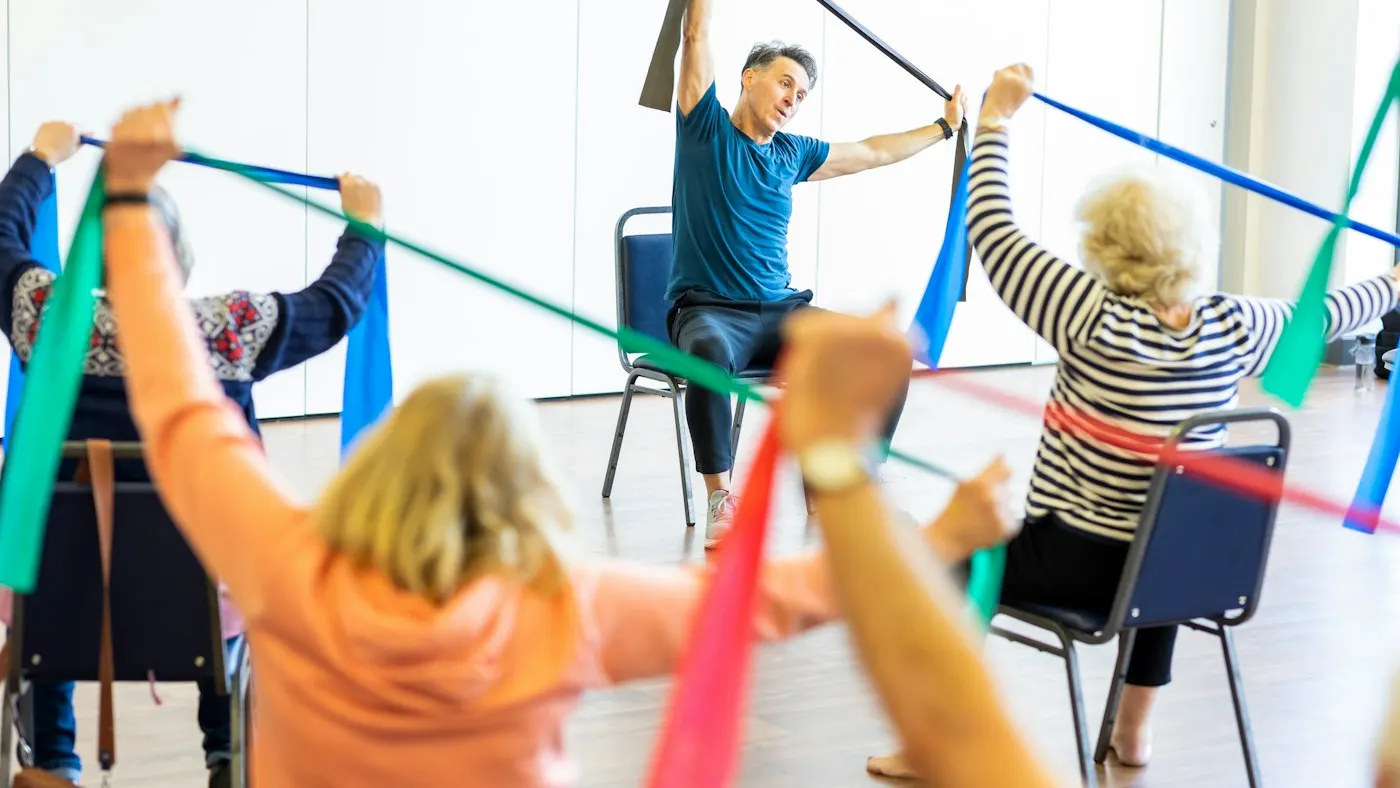
Chair Pilates is Pilates done sitting in an ordinary chair. Healthline's guide to Pilates for older adults defines it as "practicing Pilates while sitting in a chair," and Pilates Anytime describes it as using a regular kitchen or dining room chair.
Looking for the spring-loaded studio machine called a Pilates chair? See our Wunda Chair exercises and best Pilates chairs instead.
It's aimed at people who find it hard to get down to the floor, older adults and anyone working at a desk. The same Healthline guide says it "allows you to get a workout in if you don't have much space or are working at a desk."
Below is a 10-move seated routine, with a named source and reps for each move, plus one optional sit-to-stand finisher. After that: how to build up, safety notes, what the research says and free videos to follow.
How we researched this:
- Moves and cues: Pilates Anytime, Merrithew (STOTT PILATES), University of Melbourne Sport's "Chair Pilates for Home" sheet, Cleveland Clinic physical therapist Tobi Jevnikar, the NHS and Oxford University Hospitals' seated exercise program
- Benefits: peer-reviewed studies and reviews, plus CDC activity guidelines
- Safety: the NHS, Oxford University Hospitals, Cleveland Clinic, the Bone Health & Osteoporosis Foundation (BHOF) and ACOG
We don't coach or test workouts. Every source is listed at the end.
Quick version:
- Chair: sturdy, firm seat, no wheels, ideally no arms (NHS, Cleveland Clinic).
- Time: about 10–15 minutes for one slow round (our estimate).
- Reps: 5–8 slow reps per move to start (our suggestion), building toward Cleveland Clinic's 10 reps × 2–3 sets.
- How often: at least twice a week (NHS).
- Osteoporosis: keep move 7 small and swap move 10 (BHOF).
- Stop if anything hurts or you feel dizzy or unwell (NHS, Oxford University Hospitals).
What is chair Pilates?
Chair Pilates keeps the Pilates basics, such as breathing, posture and core control, and moves them onto a seat. University of Melbourne Sport's chair Pilates sheet, by instructor Ange La Scala, says it "is designed to focus on strength, core stability, flexibility, muscle control, posture and breathing." The chair acts as "a support base" for people "who find it difficult to go up and down onto the floor."
The NHS Fitness Studio's free chair-based Pilates video makes a similar point. It says some exercises are "solely chair-based which is suitable for people unable to stand."
Major Pilates brands teach it too. Merrithew (STOTT PILATES) sells a beginner "Armchair Pilates with Handweights" program that works first seated in a chair, then standing with support.
It's not the same as Pilates on a Wunda Chair or Stability Chair. Those are spring-loaded studio machines, and Healthline says apparatus work like that should be done under a certified instructor.
Before you start: chair and setup
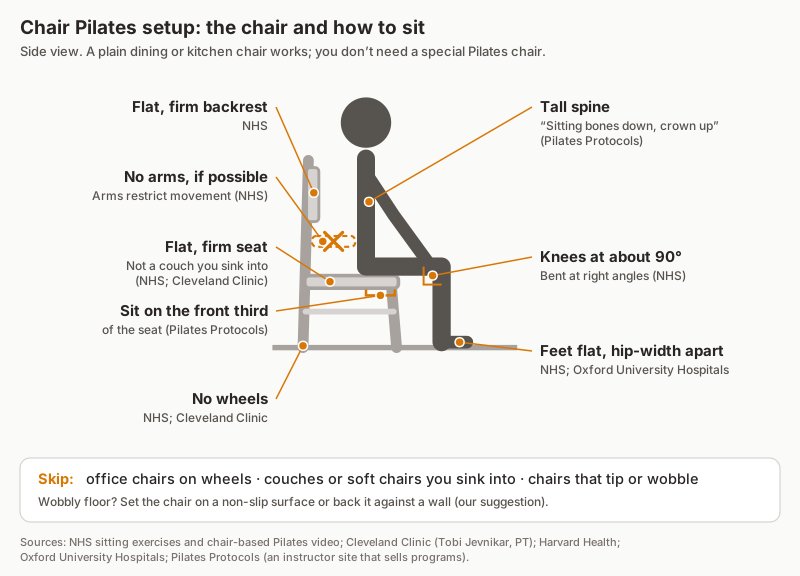
- Pick a steady chair. Cleveland Clinic's Jevnikar: "Sit in a steady chair with a back and a firm bottom. Not a couch or other chair that you sink into. And nothing on wheels."
- Skip the arms if you can. The NHS says to "avoid chairs with arms, as these will restrict your movement." Harvard Health also suggests a sturdy chair without arms.
- Firm seat and back. The NHS chair Pilates video: "Use a chair with a flat, firm backrest and a flat, firm seat."
- Set your feet. The NHS: "feet flat on the floor and knees bent at right angles."
- Scoot forward and sit tall. Oxford University Hospitals' seated program: "Move your bottom forwards a small distance from the back of the chair. Your feet should be flat on the floor, hip width apart. Sit up tall from your lower back, lifting your chest up."
- Steady the chair. A dining chair on a non-slip floor, or with its back against a wall, works well (our suggestion).
A wheeled office chair isn't a good fit for this routine, per both the NHS and Cleveland Clinic.
Tap the diagram to enlarge
Chair Pilates exercises: a 10-move seated workout
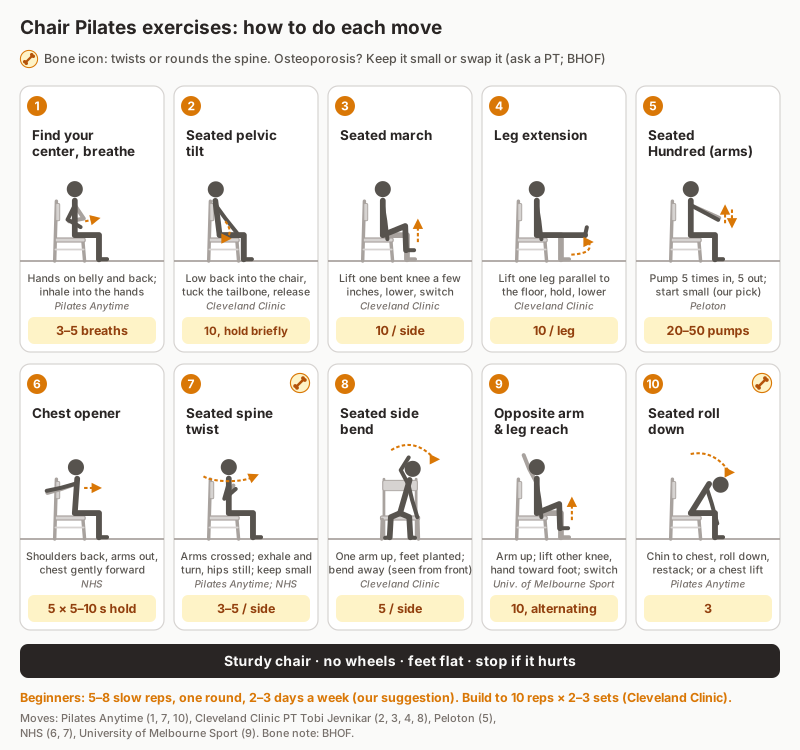
Do the moves in order, slowly, breathing throughout. Rep counts come from each source; for a first session, 5–8 slow reps is plenty (our suggestion).
Tap the diagram to enlarge
1. Find your center and breathe
Pilates Anytime's belly breathing: "Sit tall with your shoulders over your sitz bones. Place one hand on the lowest part of your belly and one on your back. Inhale through the nose and inflate the belly into your hands."
Then try lateral breathing: put your hands on the sides of your ribs and feel them widen as you breathe in. Pilates Anytime suggests 3–5 breaths of each.
University of Melbourne Sport's cue: "Breathe in through the nose not too deeply, laterally into the ribs, breath out through the mouth," gently drawing in your lower belly as you exhale. Oxford University Hospitals adds that this tummy draw-in should be "only a small amount."
2. Seated pelvic tilt
Cleveland Clinic: sit with your back against the chair and your feet on the floor. Engage your buttocks and abdominal muscles to push your lower back into the chair, tucking your tailbone. Hold briefly, then release. Aim for 10 reps.
Pilates instructor Sophie Mercer (Pilates Protocols) frames it as rocking between a slight round and a slight arch, then settling in "the neutral middle," for 8–10 reps.
3. Seated march
Cleveland Clinic: shuffle forward on the seat, hold the sides of the chair if you need to, and lift one bent knee a few inches. Lower it and switch. Do 10 per side.
Oxford University Hospitals says to march "at an even and controlled pace" for up to 2 minutes, adding an arm swing to make it harder. The NHS hip march starts with 5 lifts per leg. Mercer's Pilates cue: don't lean or tip your pelvis as the leg lifts.
4. Leg extension and heel taps
Leg extension (Cleveland Clinic): with your back straight, slowly lift one leg until it's parallel to the floor, hold briefly and lower. Do 10 per leg.
Heel taps (Oxford University Hospitals): step one foot forward to tap the heel on the floor, then alternate, for 2 sets of 10 per leg. Their advice if that's a lot: "Too much? Reduce the number of repetitions."
5. Seated Hundred (arms only, optional)
This is a seated take on the mat Hundred, not a standard move. Peloton's guide to the Hundred (written by Erin Bunch with instructor Kristen McGee) describes the breath pattern: pump straight arms from the shoulders "five times on an inhale and five times on an exhale."
Sit tall, reach your arms long by your sides and pump them in small beats with that breath. Start with 20–50 pumps rather than the full 100 (our suggestion).
6. Chest opener
The NHS chest stretch: sit upright, pull your shoulders back, extend your arms out to the sides and gently push your chest forward. "Hold for 5 to 10 seconds and repeat 5 times."
Band option: Sherri Betz's chair class on Pilates Anytime uses a Theraband. Holding a light band in front of you and gently pulling it apart is one way to add it (our suggestion).
7. Seated spine twist
Pilates Anytime: sit upright with your hands behind your head or crossed over your chest. "Inhale to lift the waist and exhale as you slowly rotate your torso to one side." Keep your hips still. Do 3 per direction.
Merrithew's Lynda Nwaizu gives the same breath: "Inhale to lengthen through the spine, then exhale as you gently rotate your torso to one side." The NHS upper-body twist suggests 5 on each side.
Osteoporosis: keep the twist small. BHOF advises avoiding extreme twisting, and Pilates Anytime warns older adults against "excessive twisting."
8. Seated side bend
Cleveland Clinic: raise your right arm overhead, keep your feet planted and your seat firm on the chair, and bend to the left as far as is comfortable. Do 5 per side.
University of Melbourne Sport's breath cue: "breathe out as you lean over and in when you centre," for 10 reps. Merrithew and Pilates Anytime include side bends in their desk routines too.
9. Opposite arm and leg reach
University of Melbourne Sport's sheet lists "Opposite Hand to Foot (breathe in when you lift your arm and out when you lower)" for 10 reps. Its harder cousin is the "Seated Alternate Arm & Leg extension (breathe out as you bring arm & leg up and in on the way down)."
Following the sheet's photos: lift one arm, then lift the opposite knee and reach that hand toward the foot as you lower the arm. Then switch sides. Keep it slow and controlled; it's a coordination and core move (our description).
For more challenge, try the harder version: reach one arm up and the opposite leg forward together, then switch.
10. Seated roll down (or chest lift)
Pilates Anytime: "Inhale to prepare, and as you exhale, roll the chin towards the chest and continue to roll down," then stack your spine back up one bone at a time. Do 3 reps.
Osteoporosis: this rounds the spine forward, which BHOF advises avoiding. Swap in the seated chest lift from Pilates Anytime's desk routine (our suggestion as a swap): one hand under your chest ribs, "reach the top of your head to the ceiling," and lift into a slight upper-back arch. A physical therapist can confirm it suits you.
Optional finisher: sit-to-stand
The CDC lists "standing from a sitting position" as a balance activity for older adults. Mercer's version: hinge forward, stand up without pushing off with your hands, then lower for a count of three, 8–10 reps. University of Melbourne Sport's sheet includes a similar chair squat: "breathe in on the way down and out on the way up."
Put the chair against a wall first, and skip this one if you can't stand safely.
Cool-down
Oxford University Hospitals' ankle exercise: heels down and lift your toes, then lift your heels, 2 sets of 10. Finish with University of Melbourne Sport's "Rest, centre and breath": three slow breaths.
Printable chair Pilates chart
Tap the diagram to enlarge
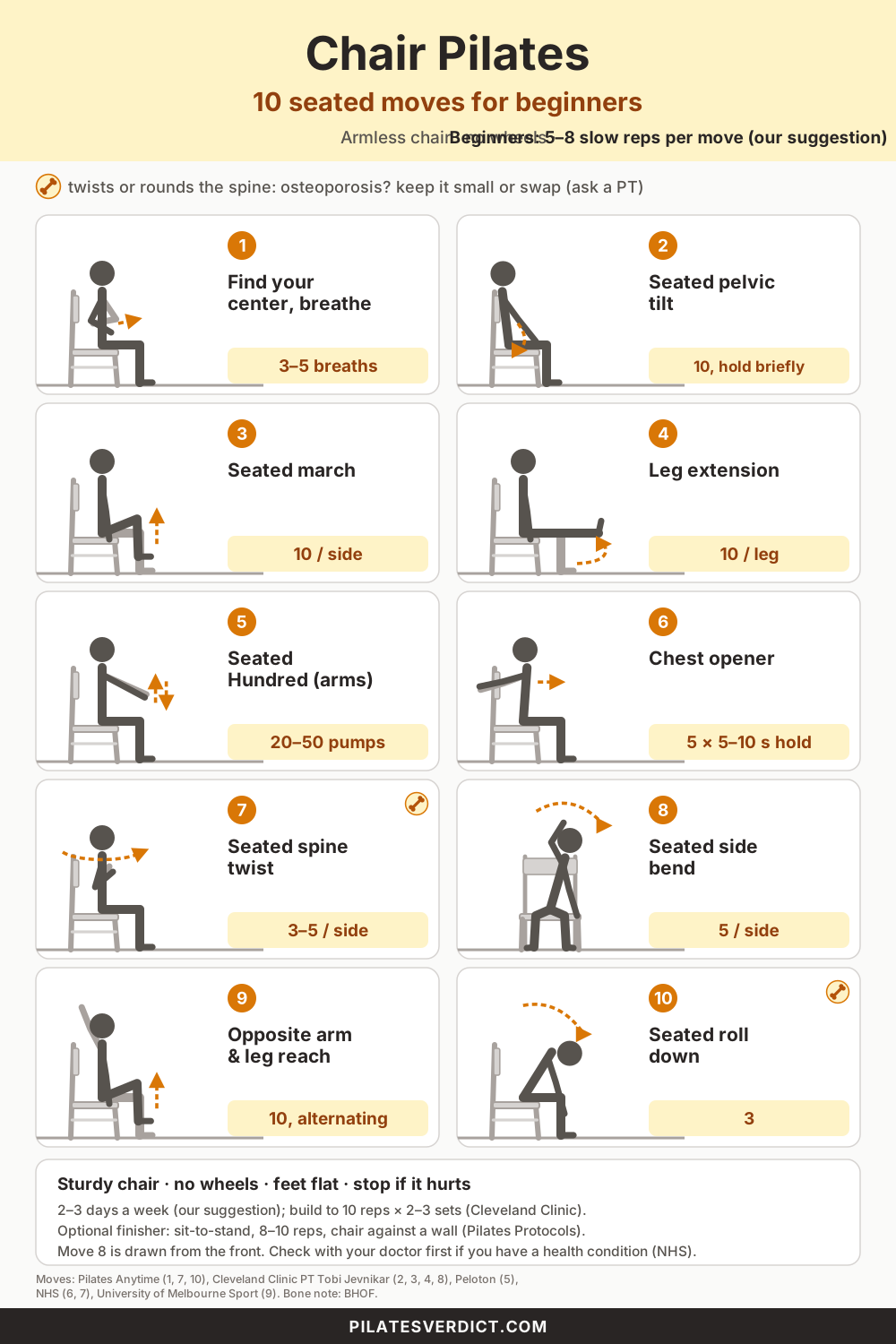
Download the printable chair Pilates chart (PDF) or open the chart on its own page to print it. Keep it next to your chair. The table below is a text version.
| Move | Reps | Easier option |
|---|---|---|
| 1. Center and breathe | 3–5 each | Hands on belly only |
| 2. Pelvic tilt | 8–10 | Smaller range |
| 3. Seated march | 10 per side | Hold the chair |
| 4. Leg extension / heel taps | 10 per leg | Heel taps only |
| 5. Seated Hundred | 20–50 pumps | Skip |
| 6. Chest opener | 5 × 5–10 sec | Hands on hips |
| 7. Spine twist | 3–5 per side | Smaller twist |
| 8. Side bend | 5 per side | Hand on shoulder |
| 9. Opposite arm and leg reach | 10 | Arm only |
| 10. Roll down / chest lift | 3 | Chest lift |
Reps: Pilates Anytime (1, 7, 10), Pilates Protocols (2), Cleveland Clinic (2–4, 8), Oxford University Hospitals (3, 4), the NHS (6, 7) and University of Melbourne Sport (8, 9). The Hundred count and the easier options are our suggestions.
Chair Pilates for beginners: how to build up
Start with one round of 5–8 slow reps per move, about 10–15 minutes (our suggestion). Cleveland Clinic suggests starting with one set of 10 reps and working up to 2–3 sets, pushing until your muscles feel engaged, not to pain or exhaustion.
How often? The NHS suggests seated exercises at least twice a week, built up gradually. Oxford University Hospitals says "ideally you should practise these exercises every day," and that it's fine to split arms and legs into separate sessions. "The most important thing is to start small and build up gradually."
When the routine feels easy, you can:
- Add a light prop: a band, a mini ball or soft hand weights (see below).
- Try standing work: our standing Pilates exercises use a chair for balance.
- Lie down instead: bed Pilates on a firm mattress, or the mat moves in our Pilates exercises at home for beginners.
Chair Pilates for seniors: safety notes
Chair exercise is often a starting point for older adults. Cleveland Clinic's Jevnikar says: "We typically recommend chair exercises to people starting around age 65 or older, as well as for people who use assistive devices like walkers or wheelchairs."
Pilates Anytime advises starting with "small and gentle movements" and avoiding "excessive twisting or too much flexion."
- Check first: the NHS (its sitting exercises page and chair Pilates video) advises talking to a doctor or physical therapist first if you have health problems, an injury, a recent illness or surgery, or are pregnant. Harvard Health says to check with your doctor if you have concerns or have been told to limit activity.
- Stop signs: the NHS video says to "stop the exercise immediately if you feel any pain or become unwell." Oxford University Hospitals: "Dizziness, sickness or excessive tiredness are signals to stop exercising." Seek urgent help for "blacking out, chest pain, or excessive shortness of breath."
- Joint pain: Cleveland Clinic: "If you experience any joint pain doing exercises or if your pain doesn't resolve, that's your body telling you to back off."
- Osteoporosis or low bone density: BHOF advises avoiding bending forward from the waist, sit-ups and crunches, and extreme twisting. Keep move 7 small and swap move 10 for the chest lift. BHOF says a physical therapist can help you choose safe exercises. Sherri Betz's chair class on Pilates Anytime is tagged "Osteoporosis Safe."
- Pregnancy: ACOG lists modified Pilates among exercises generally considered safe and advises avoiding lying flat on your back as much as possible. Seated work avoids lying flat, but we found no source that recommends chair Pilates for pregnancy specifically, so talk with your ob-gyn.
- Balance concerns: do the sit-to-stand with the chair against a wall, or skip it.
Chair Pilates benefits: what the research says
Short version: there's good expert support and small studies in specific groups, but no randomized trial of chair Pilates in general older adults. None of the evidence below proves chair Pilates works on its own.
Seated Pilates in multiple sclerosis
van der Linden et al. (2014, Disability and Rehabilitation) followed 15 wheelchair users with MS through 12 weeks of Pilates, with no control group. They reported better sitting stability and posture and less shoulder and back pain.
Adamson et al. (2025, Adapted Physical Activity Quarterly) ran 12 weeks of virtual seated Pilates; 16 of 22 participants finished. They concluded it is feasible and may help balance in people with MS. Both studies are small and specific to MS.
Chair-based exercise in nursing homes
Cordes et al. (2021, Experimental Gerontology) randomized 52 nursing home residents who couldn't walk (mean age 81) to 16 weeks of twice-weekly seated training or a wait-list. The training group improved grip strength, manual dexterity, cognition and depression scores, while the control group declined. This was general seated training, not Pilates.
A separate systematic review by Cordes et al. (2021, JAMDA) of 10 studies with 511 nursing home residents concluded that chair-based exercise "appears to be feasible and safe."
Pilates and balance in older adults
Sampaio et al. (2023, Healthcare) pooled 20 randomized trials with 930 older adults and found improvements in both dynamic and static balance. The authors noted varied measures, some poor-quality trials and mostly female participants. None of the trials were described as chair-based.
Falls: unclear
Whether Pilates reduces actual falls is unclear. Fernández-Rodríguez et al. (2021, Physiotherapy) reported a lower fall risk, while a meta-analysis by de Campos Júnior et al. (2024, Complementary Therapies in Clinical Practice) found better balance but concluded Pilates can't be recommended to reduce the number of falls or the fear of falling.
Gabizon et al. (2016, Journal of Aging and Physical Activity), a randomized trial of group Pilates in 88 older adults, found no balance improvement over controls.
What experts say
These are expert views, not studies. The NHS says "regular pilates practice can help improve posture, muscle tone, balance and joint mobility, as well as relieve stress and tension." Healthline lists feedback on pelvis and spine position, posture and core strength. Cleveland Clinic says chair exercises support strength, balance and walking.
How it fits the guidelines: the CDC recommends that older adults get at least 150 minutes of moderate aerobic activity a week, plus muscle strengthening on at least 2 days and balance activities. It adds: "If you have trouble meeting these recommendations, be as physically active as your abilities and conditions allow." Chair Pilates can cover part of the strength, balance and mobility work, not the whole weekly target (our view).
Weight loss: we found no study of chair Pilates for weight loss. Treat app ads promising fast results with caution.
Add a prop (optional)
You don't need any gear beyond a chair. If you want more challenge later, the prop types below come from established chair programs. Where to place them is our suggestion.
If you only add one, a light band is the most flexible pick: it works for the chest opener and arm moves (our view).
Light resistance band
Sherri Betz's Pilates Anytime chair class uses a Theraband. Try it for the chest opener (move 6). See our best resistance bands for Pilates.
Mini ball
Betz's class lists an 8-inch inflatable ball; a 7–9 inch mini ball works similarly (our suggestion). Gently squeezing one between your knees during the pelvic tilt or march is one option. See our best Pilates balls.
Check price on AmazonSoft hand weights
Merrithew's Armchair Pilates program uses "soft, light weights." Hold them for the seated Hundred or the chest opener. See our best hand weights for Pilates.
Check price on AmazonFree chair Pilates videos and printable sheets
- NHS Fitness Studio: a free chair-based Pilates video of about 30 minutes, made by InstructorLive.
- University of Melbourne Sport: a free "Chair Pilates for Home" PDF with photos of each exercise.
- Healthline's Fit It In series: four free 22-minute Pilates videos, including one for older adults focused on "balance, strength, mobility, and proprioception." The page doesn't say whether it's seated, so check before you start.
- Pilates Anytime: Sherri Betz's 65-minute "Chair Exercises for Seniors" class, rated Beginner. It needs a subscription, with a 15-day free trial.
More routines live in our Pilates workouts section.
Bottom line
If getting to the floor is hard, start with moves 1–4 and 6–8 at least twice a week, as the NHS suggests for seated exercise, then add the rest (the order is our suggestion). If you have osteoporosis, use the chest lift instead of the roll down, since BHOF advises avoiding forward bends. Once seated work feels easy, try standing Pilates exercises with the chair for balance (our suggestion). If you want one prop, start with a light resistance band.
Check price on AmazonFrequently Asked Questions
Is chair Pilates real Pilates?
Yes. It adapts Pilates principles, such as breathing, posture and core control, to a seated position. Pilates Anytime, Merrithew (STOTT PILATES) and the NHS all publish chair-based Pilates workouts. It's different from Pilates on the Wunda Chair, a spring-loaded studio machine.
Is chair Pilates good for seniors?
It's designed for people who find it hard to get down to the floor, and the NHS says some chair routines suit people who can't stand. A review of Pilates in older adults found improved balance, though those trials weren't seated and the effect on falls is less clear. Check with your doctor first if you have a health condition.
Can chair Pilates help you lose weight?
We found no study that tested chair Pilates for weight loss, so treat app promises of fast results with caution. For general health, the CDC recommends weekly aerobic activity plus muscle-strengthening and balance work for older adults. Chair Pilates can cover part of that.
How often should you do chair Pilates?
The NHS suggests seated exercises at least twice a week, and Oxford University Hospitals' seated program says daily practice is ideal if you build up gradually. Cleveland Clinic's physical therapist suggests starting with one set of 10 reps and working up to 2–3 sets.
What kind of chair is best for chair Pilates?
A sturdy chair with a firm, flat seat and back, no wheels and ideally no arms, per the NHS and Cleveland Clinic. Sit with your feet flat and your knees at about a right angle.
How long is a chair Pilates workout?
One slow round of the 10 moves takes about 10–15 minutes (our estimate). The free NHS chair-based Pilates video runs about 30 minutes.
Can you do chair Pilates from a wheelchair?
The NHS says some chair-based Pilates exercises suit people unable to stand, and small studies of seated Pilates involved wheelchair users with MS. Lock the wheels (our suggestion) and check with your doctor or physical therapist first.
Does chair Pilates actually work?
The NHS says regular Pilates can help posture, muscle tone, balance and joint mobility, and Cleveland Clinic says chair exercises support strength and balance. Research on chair Pilates specifically is limited to small studies, mostly in people with MS. See the research section above.
Sources
- Healthline (Roxy Menzies; reviewed by Courtney L. Gilbert, PT, DPT): Pilates for older adults: benefits, considerations, and more
- Healthline: Pilates for men
- Pilates Anytime (Marchel Ackler): Chair Pilates for seniors
- Pilates Anytime (Roxy Menzies): Pilates at your desk
- Pilates Anytime (Sherri Betz): Chair exercises for seniors, class 1499
- Merrithew (Lynda Nwaizu): Exercises for desk workers to fix posture and ease back pain
- Merrithew: Armchair Pilates with Handweights
- NHS: Chair-based pilates video workout
- NHS: Sitting exercises
- Cleveland Clinic (Tobi Jevnikar, PT): Chair exercises for seniors
- Harvard Health Publishing (Sarah Klein; reviewed by Robert H. Shmerling, MD): Chair exercises for seniors
- University of Melbourne Sport (Ange La Scala): Chair Pilates for home (PDF)
- Oxford University Hospitals NHS FT: Seated exercise programme (PDF)
- Pilates Protocols (Sophie Mercer; sells paid programs): Chair Pilates exercises: 10 seated and standing
- Peloton (Erin Bunch, with instructor Kristen McGee): Pilates Hundred: how to do it
- Healthline: Fit It In video series: Pilates
- Sampaio et al., Healthcare (2023): The effectiveness of Pilates training interventions on older adults' balance
- de Campos Júnior et al., Complement Ther Clin Pract (2024): Effects of Pilates exercises on postural balance and reduced risk of falls in older adults
- Fernández-Rodríguez et al., Physiotherapy (2021): Pilates improves physical performance and decreases risk of falls in older adults
- Gabizon et al., J Aging Phys Act (2016): The effects of Pilates training on balance control and self-reported health status in community-dwelling older adults: a randomized controlled trial
- van der Linden et al., Disabil Rehabil (2014): Pilates for people with multiple sclerosis who use a wheelchair
- Adamson et al., Adapt Phys Activ Q (2025): Evaluating the impact of seated Pilates on functional outcomes in multiple sclerosis
- Cordes et al., Exp Gerontol (2021): Multicomponent exercise for nursing home residents who are unable to walk
- Cordes et al., J Am Med Dir Assoc (2021): Chair-based exercise interventions for nursing home residents: a systematic review
- CDC: Physical activity guidelines for older adults
- ACOG: Exercise during pregnancy
- Bone Health & Osteoporosis Foundation: Protecting your spine
- Bone Health & Osteoporosis Foundation: Be bone strong: exercise to stay healthy
Update history
- : Published.
Found an error? See how we research and correct guides in our editorial policy.
Was this guide helpful?
Related Articles
How-To
Travel Pilates workout: 15-minute hotel room routine + what to pack
A no-equipment travel Pilates workout for hotel rooms: 10 moves on a towel, a standing no-floor option, seat moves for flights and a light packing list.
October 21, 2026 · 18 min read
How-To
Bed Pilates: 10 gentle exercises for beginners (with chart)
Bed Pilates for beginners: 10 gentle exercises on your mattress, a bedtime version, a printable chart and what research says about the benefits.
October 16, 2026 · 16 min read
How-To
Pilates block exercises: 10 beginner moves with a yoga block
10 Pilates block exercises for beginners: where the yoga block goes in each move, reps from named instructors, easier and harder options, and safety notes.
October 16, 2026 · 22 min read
How-To
Classical Pilates mat exercises: all 34 in order (+ printable chart)
All 34 classical Pilates mat exercises in Joseph Pilates' original order, with modern names, reps, a printable chart and a beginner sequence.
October 15, 2026 · 20 min read