28-day Pilates challenge: free plan, calendar and what to expect
By The Pilates Verdict Team · Updated November 20, 2026 · 34 min read
This article contains affiliate links. If you buy through them, we may earn a commission at no extra cost to you. As an Amazon Associate I earn from qualifying purchases. Read our affiliate disclosure.
A 28-day Pilates challenge means doing a short workout most days for four weeks. Many of the best-known versions are wall Pilates programs, but you'll also see mat versions on YouTube and in app ads. Many of them push you toward a paid app, but you don't need one. Healthline says the only equipment you really need for Pilates is a mat.
This post is a free 28-day mat plan: the free video challenges that already exist, a week-by-week schedule and a calendar you can print. It also covers a 7-day starter week if four weeks feels like a lot, a gentler somatic version, and what results to expect by day 28. The plan is built from the 10 moves in our Pilates exercises at home for beginners guide, which has full step-by-step instructions for each one.
Quick version:
- What you need: a mat and a bit of floor space. A small towel is optional, per Healthline.
- How long: about 10–25 minutes on Pilates days (our estimate).
- How many days: 4 Pilates days, 2 easy walk or stretch days and 1 full rest day each week. New to exercise? Start with 2–3 Pilates days a week. See the 28-day plan or grab the free printable calendar (PDF), no sign-up needed.
- Only want one week? Do the 7-day starter week, which is week 1 of the plan spelled out day by day.
- Want it slower and gentler? Try the somatic version.
- What to expect: better core endurance, flexibility and control, plus the start of a habit. Not visible muscle change or meaningful weight loss. See results.
- Check first if: you're pregnant, have osteoporosis, are recovering from an injury or are new to exercise. See who should modify.
Prefer to tick days off on your phone? Open the free 28-day mat Pilates challenge tracker. It shows each day's moves and reps with a session timer and saves your progress in your browser. No app or sign-up.
How we researched this: we drew on instructor, medical and research sources, and we haven't followed this plan, the somatic plan or any video program as a test.
- Moves and reps: Pilates Anytime, BASI Pilates, TODAY and Healthline. Somatic moves come from Cleveland Clinic (exercise physiologist David Creel, PhD), Healthline, Harvard Health Publishing and TODAY (with Mayo Clinic's Dr. Mary Jurisson), with reps from Lesley Logan (OnlinePilatesClasses.com).
- Frequency and recovery: Healthline, Cleveland Clinic, UCLA Health and HHS.
- Results: an NYU Langone exercise physiologist (via TODAY), Garage Gym Reviews and obé (a brand), five peer-reviewed Pilates trials and a meta-analysis that measured results at 4–24 weeks, and Cleveland Clinic, Healthline and Allina Health on tracking progress.
- Starting and sticking with it: Management Science, PLOS ONE and the University of Surrey.
- Safety: ACOG, the Bone Health & Osteoporosis Foundation and Cleveland Clinic.
- Challenges reviewed: Rachel's Fit Pilates, Blogilates, Lindywell, Rachel Lawrence Pilates, PILATESBODY by Kayla, Greatist's written 30-day plan, and the somatic programs from JustFit and BetterMe.
No study we found has tested a 28-day (or 7-day) Pilates challenge. Both schedules below are our editorial examples, not expert-designed programs. Every source is listed at the end.
What you need
Healthline says the only equipment you really need for Pilates is a mat. Any basic mat works; if you want a dedicated Pilates mat, these are two picks from our best Pilates mats guide:
Best overall mat
Balanced Body EcoWise Pilates Mat
A Pilates-brand mat that Yahoo Health's testers found supportive for rolling and supine work.
Budget pick
ProsourceFit Extra Thick Yoga and Pilates Mat (1/2 in)
Thick, inexpensive NBR foam that a fitness expert said supports her back and hips. Our Pilates mat vs. yoga mat guide explains when a thicker mat helps.
Free 28-day Pilates challenges (and 30-day ones)
Many of the best-known 28-day challenges are wall Pilates programs. Garage Gym Reviews describes the wall Pilates version as following one program's workout every day for 28 days, each "between 10 and 30 minutes long." Mat versions from YouTube creators use the same daily-video idea. Options we found (mostly free):
- Rachel's Fit Pilates (YouTube): has a playlist titled "28 Day Beginner Pilates Challenge for Weight Loss + Strength" and an intermediate "28 Day Pilates x Strength Challenge." Her sign-up page offers the beginner challenge free. According to search listings, you enter your email to get a PDF calendar that links to each day's video. We couldn't open the playlist or the full sign-up page, so check the details there.
- Blogilates (Cassey Ho): "A 28-Day Workout Calendar for Beginners!" is a free downloadable calendar of her POP Pilates mat workouts. "You won't need any equipment for this calendar," she writes. It includes rest and stretch days, and one commenter on the post noted the first week is "relatively short videos."
- Rachel Lawrence Pilates: a "30 Day Pilates Challenge" playlist of daily workouts with a downloadable PDF wall chart to tick off each class. Her site has separate free and paid classes, so check whether this challenge is free or members-only.
- Lindywell (YouTube): a free "28 Days of Pilates Challenge (5-10 minutes per day)" playlist from Robin Long's channel. Its description says to "complete 28 days of 5-10 minute workouts" or mix and match them.
- Greatist's 30-day program (written, not video): Anna Lee Beyer's "Pilates for Beginners: A 30-Day Program," reviewed by trainer Jake Tipane, CPT, adds new moves each week and recommends doing it "3 or 4 days a week." It was the closest thing to an editorial (non-creator) month-long plan we found.
These are creator programs, so their claims about results are marketing, not evidence. Many other results for the term are paid app pages and wall Pilates programs. If you'd rather work against a wall or stay in bed, see our 28-day wall Pilates challenge and 28-day bed Pilates challenge.
28-day vs. 30-day Pilates challenge
No source we found says one length works better. Twenty-eight days is four even weeks, so it maps neatly onto a weekly schedule. A 30-day plan just adds two days. Want 30? Repeat days 27 and 28 of the plan below.
Before day 1
- Get a mat. Healthline: "The only equipment you really need ... is a mat and, if you wish, a small towel." Any basic mat works; our Pilates mat vs. yoga mat guide explains when a thicker one helps.
- Clear a space about the length of your mat, plus room to stretch your arms and legs.
- Learn the basics first. Our beginners guide covers breath, center and control, and the easier version of each move. BASI instructor CJ Kelly: "Please be patient. If you stick to the basics, strength will come in order to add variety."
- Stop if something hurts. Easier versions are always an option.
- Pick a start date. Research on the "fresh start effect" (Dai, Milkman and Riis, Management Science, 2014) found that gym visits and goal commitments "all increase following temporal landmarks," such as the start of a new week, month or year. January works, but so does any Monday.
The 28-day mat Pilates plan for beginners
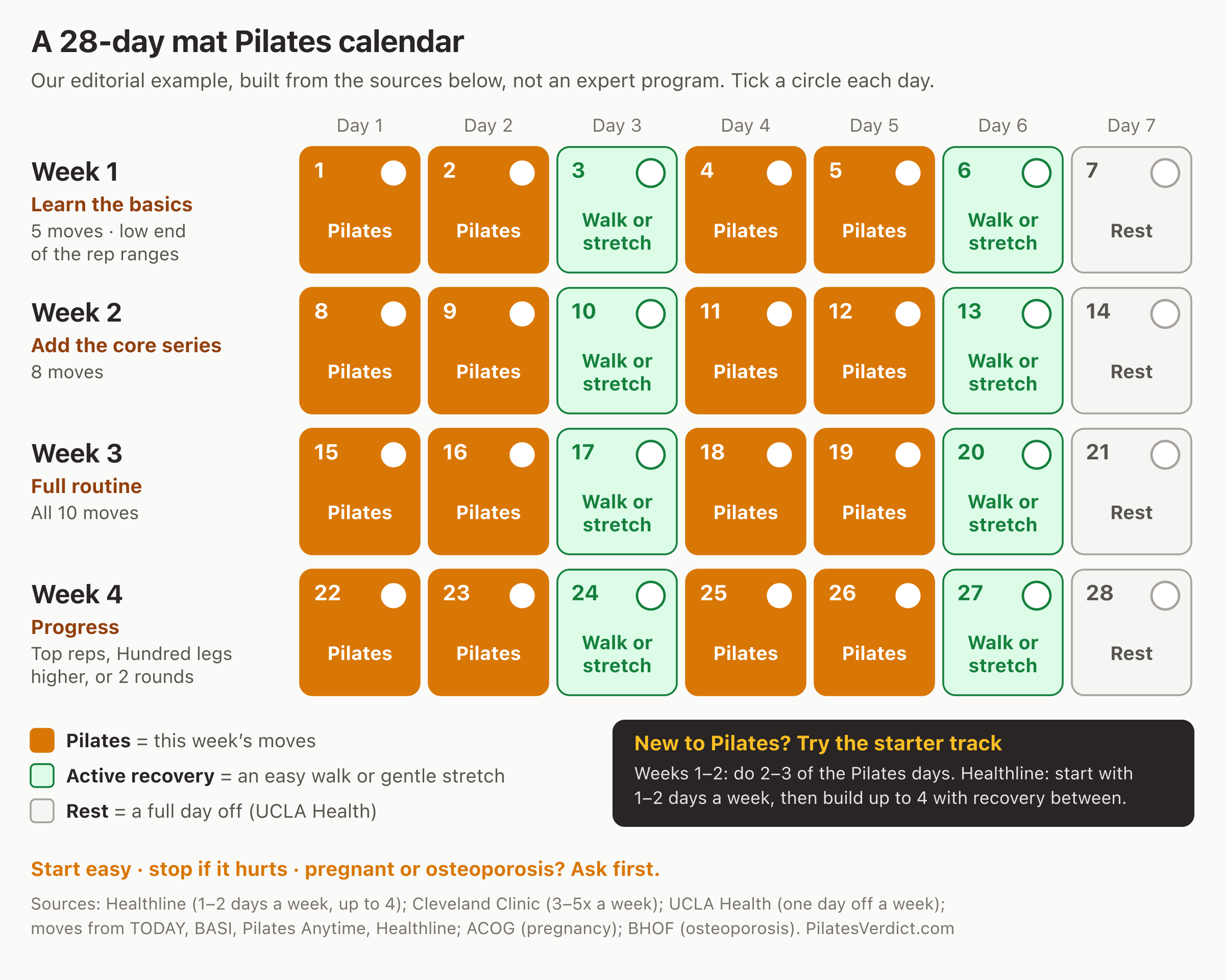
Each week has 4 Pilates days, 2 active-recovery days and 1 full rest day. In the calendar, that's Pilates on the 1st, 2nd, 4th and 5th day of each week, easy days on the 3rd and 6th, and rest on the 7th.
Why this mix? Healthline suggests beginners start with 1–2 days a week and work up to 4. Cleveland Clinic suggests Pilates three to five times a week alongside cardio and strength work, and UCLA Health recommends at least one day off each week. Four Pilates days sits inside both ranges, and the easy days keep a daily streak going for people who want the challenge feel.
This schedule is our editorial example, not an expert program. Repeat a week whenever you need to.
Missed a day? Pick up where you left off. Don't double up sessions or skip a rest day to catch up (our suggestion).
Starter option: if you're new to exercise, do only 2–3 Pilates days in weeks 1 and 2 (for example, days 1, 4 and 5, then 8, 11 and 12) and walk on the others. That's closer to Healthline's 1–2 days a week start.
Week 1: learn the basics (days 1–7)
Five moves, low end of the rep range, about 10 minutes (our estimate):
- Breathing and pelvic tilt: 10 reps
- Pelvic curl (shoulder bridge): 6 reps
- The Hundred, knees bent: 5 breath cycles (half of the 10 that Pilates Anytime and TODAY list)
- Single leg circles: 5 each way, each leg
- Side kick or clamshell: 5–10 per side. Healthline's mat routine lists 15 clamshells for 3–5 sets per side; we start much lower (our editorial choice).
Week 2: add the core series (days 8–14)
Keep the week 1 moves and add three, for 8 moves:
- Chest lift: a few reps, per BASI
- Single leg stretch: 8 total to start (BASI lists 8–10)
- Swan prep (6 reps) and swimming (10 counts)
Week 3: the full 10-move routine (days 15–21)
Add the last two moves:
- Supine spine twist: a few per side, per BASI
- Half roll down or rolling like a ball: 6 reps. Pick one.
Week 4: progress (days 22–28)
Pick one or two ways to make it harder:
- Top of the rep ranges: for example, 10 pelvic curls, 10 leg circles each way, 10 single leg stretches per side and 20 counts of swimming.
- A harder Hundred: 10 full breath cycles with your legs lifted to about 45 degrees, as in Pilates Anytime's beginner sequence, if your lower back stays steady.
- Two rounds of the full routine.
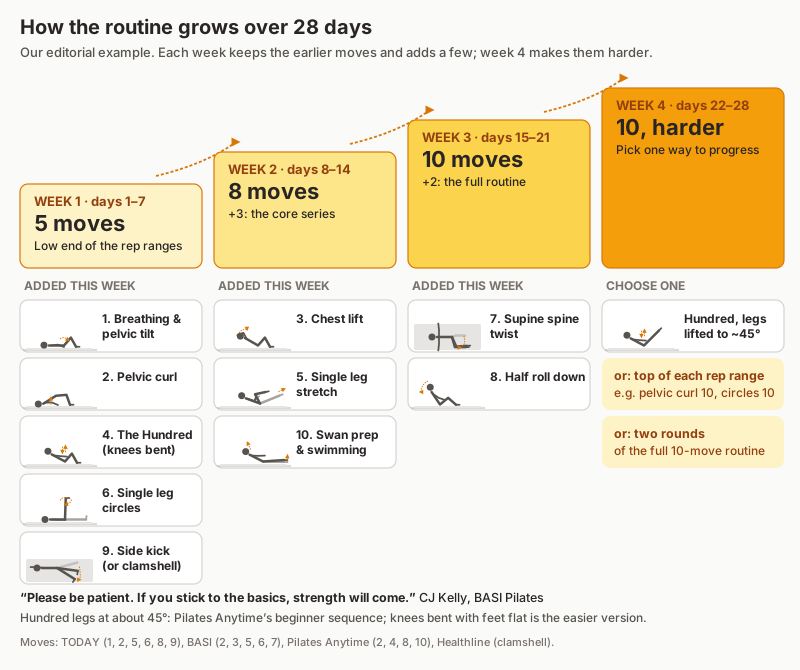
Tap the diagram to enlarge
Active-recovery and rest days
Active recovery should "feel like you are taking a day off, but with moderate movement mixed in," according to UCLA Health. It suggests stretching, walking or yoga. Cleveland Clinic sports medicine physician Lauren Wichman, MD, also lists walking, stretching, yoga and foam rolling. A brisk walk on these days also counts toward HHS's call for "at least 150 to 300 minutes of moderate-intensity aerobic activity" a week.
Take a full rest day instead if you're injured, sick, short on sleep or don't feel up to it, Wichman advises. UCLA Health's signs you need rest include "feeling excessively tired before you even begin your workout," soreness that lasts more than a couple of days and disrupted sleep.
Day by day: days 1–28
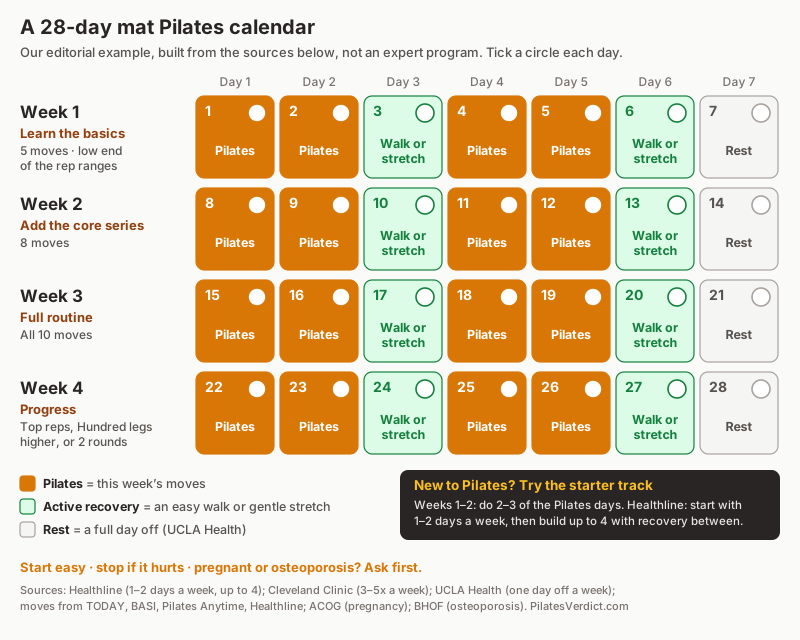
Tap the diagram to enlarge
Download the printable calendar (PDF). Session times below are our estimates.
- Week 1 (days 1–7): Pilates days 1, 2, 4, 5 (5 moves, about 10 minutes); walk or stretch days 3, 6; rest day 7
- Week 2 (days 8–14): Pilates days 8, 9, 11, 12 (8 moves, about 15 minutes); walk or stretch days 10, 13; rest day 14
- Week 3 (days 15–21): Pilates days 15, 16, 18, 19 (all 10 moves, about 15–20 minutes); walk or stretch days 17, 20; rest day 21
- Week 4 (days 22–28): Pilates days 22, 23, 25, 26 (10 moves at top reps, a harder Hundred or two rounds, about 20–25 minutes); walk or stretch days 24, 27; rest day 28
The moves at a glance
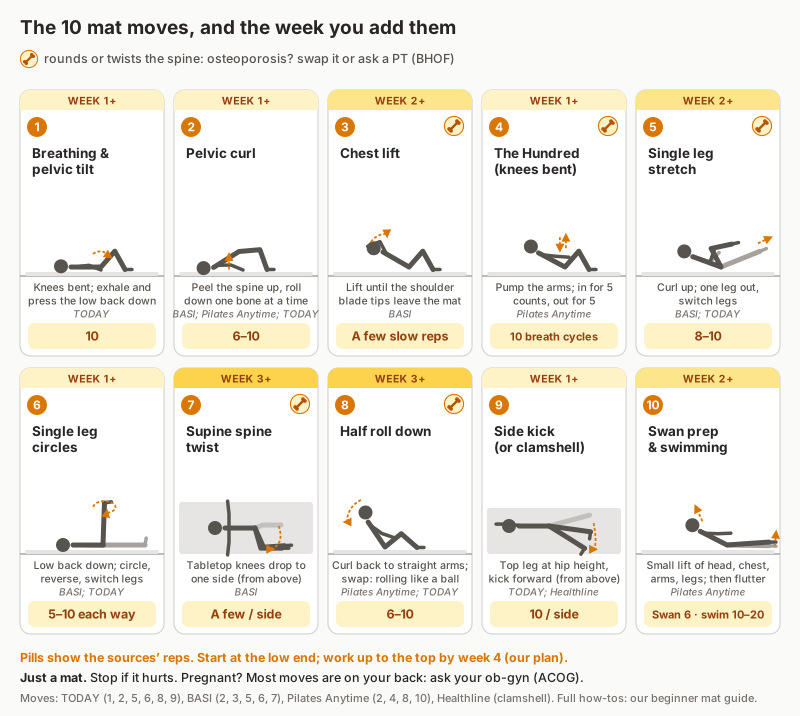
Tap the diagram to enlarge
| Move | Week | Plan reps | Easier option |
|---|---|---|---|
| Pelvic tilt | 1 | 10 | Smaller tilt |
| Pelvic curl | 1 | 6 → 10 | Lift hips less |
| The Hundred | 1 | 5 → 10 breaths | Knees bent, head down |
| Leg circles | 1 | 5 → 10 each way | Bend the knee |
| Side kick / clamshell | 1 | 5 → 10/side | Clamshell |
| Chest lift | 2 | A few | Smaller lift |
| Single leg stretch | 2 | 8 → 10/side | Head down |
| Swan prep / swimming | 2 | 6 / 10 → 20 | Swan prep only |
| Spine twist | 3 | A few/side | Smaller twist |
| Roll down / rolling | 3 | 6 → 10 | Half roll down |
Rep ranges come from Pilates Anytime, BASI and TODAY, with the clamshell from Healthline's mat exercises routine, as collected in our beginners guide. Where we start lower, that's our editorial choice. The guide has full how-tos, easier versions and the source for each move.
Short on time: a 7-day starter week
Not ready to commit to four weeks? Do week 1 on its own as a 7-day Pilates challenge. You'll find out how your body responds before you sign up for more. Finish day 7, then carry on at day 8 or repeat the week.
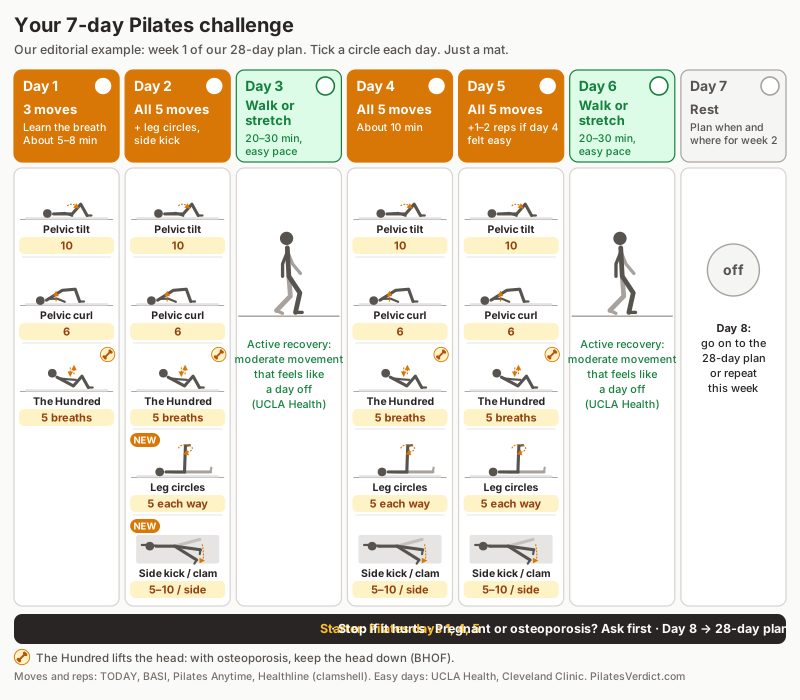
Tap the diagram to enlarge
Session times are our estimates:
- Day 1 (about 5–8 minutes): breathing and pelvic tilt (10), pelvic curl (6) and the Hundred with knees bent (5 breath cycles). Keep your head down if your neck strains.
- Day 2 (about 10 minutes): day 1's moves plus single leg circles (5 each way, each leg) and side kick or clamshell (5–10 per side).
- Days 3 and 6: a 20–30 minute walk or gentle stretching.
- Days 4 and 5: all five moves. On day 5, add 1–2 reps to each if day 4 felt easy.
- Day 7: rest, and pick the times for next week's sessions. Habit researcher Dr. Pippa Lally notes that planning when and where you'll act helps, according to the University of Surrey.
New to exercise? Do Pilates on days 1, 4 and 5 only and walk on the others. Download the printable 7-day chart (PDF), with the week's check-off strip and all five moves on one page. The challenge tracker also works for one week: stop after day 7 or keep going.
Expect some soreness. Cleveland Clinic says "Muscle soreness after exercising is completely normal, especially if you're starting a new exercise for the very first time." Its sports medicine physician Dominic King, DO, adds: "A certain low level of soreness is acceptable, but you should not push through pain while exercising." A week won't change how you look, and no study we found has tested a 7-day Pilates program.
Phrase the goal as something to start. In a study of 1,066 people (Oscarsson et al., PLOS ONE, 2020), approach goals ("I will start...") succeeded more often than avoidance goals ("I will stop...") at one year, 58.9% vs. 47.1%. So "do four short Pilates sessions this week" beats "stop being lazy."
Prefer a video? Rachel Lawrence Pilates' 7 Day Beginner Pilates Challenge asks you to "dedicate 20 minutes a day for 7 days," with no equipment and a downloadable wall chart, according to her beginners page. It's a creator program, so treat any claims about results as marketing. Want something even easier? See lazy girl Pilates.
Do you have to do Pilates every day?
No. The viral 28-day format is daily, per Garage Gym Reviews, but the health sources we checked suggest fewer sessions:
- Healthline: "Start with 1 to 2 days weekly to see how you feel ... Then, you can go up to 4 times weekly, remembering to allow enough time to recover between sessions."
- Cleveland Clinic: three to five times a week. Judi Bar adds, "It's not necessarily a stand-alone exercise," so pair it with cardio and strength work.
- Greatist's 30-day plan: "3 or 4 days a week."
- UCLA Health: take "at least one day off from your daily workout routine each week."
Even the creator calendars build in breaks. Blogilates includes rest and stretch days. If you want to move every day, make some of those days easy ones, as our plan does.
Gentler option: the somatic version
Somatic Pilates uses familiar mat moves, done slowly, with your attention on breath and sensation. According to Cleveland Clinic, it blends traditional Pilates with "somatics," an intentional movement theory. Exercise physiologist David Creel, PhD, says it "downplays the importance of form, strength and flexibility" and "focuses on body awareness and mindful connection instead." Harvard Health puts it simply: "Somatic exercises involve paying attention to internal sensations and responses during physical movements."
Slower isn't the same as easier. "A somatic Pilates class may move slower than a standard class. But slow doesn't mean easy," Creel told Cleveland Clinic, and he still counts it as strength training. Pick it if you want a gentle way back into movement, not a faster strength progression.
Most 28-day somatic plans you'll see are paid or behind a sign-up, such as JustFit's app challenge, which mixes "yoga, chair exercises, and wall Pilates that are low-intensity," per its own page. Cleveland Clinic, Harvard Health and Healthline explain the method but don't publish a 28-day schedule, so we built one from their guidance.
How to do any move somatically
- Breathe first. TODAY's somatic basics start with diaphragmatic breathing (one hand on your chest, one under your ribcage), and Mayo Clinic's Jurisson advises you to "pay attention to how it feels."
- Move slowly. TODAY describes "super slow" bodyweight moves done "twice as slowly" as usual.
- Notice. Harvard Health's beginner move asks you to notice the sensations through your pelvis, spine, ribs and shoulders.
- Rest and compare. Harvard's version ends by resting and noticing what changed.
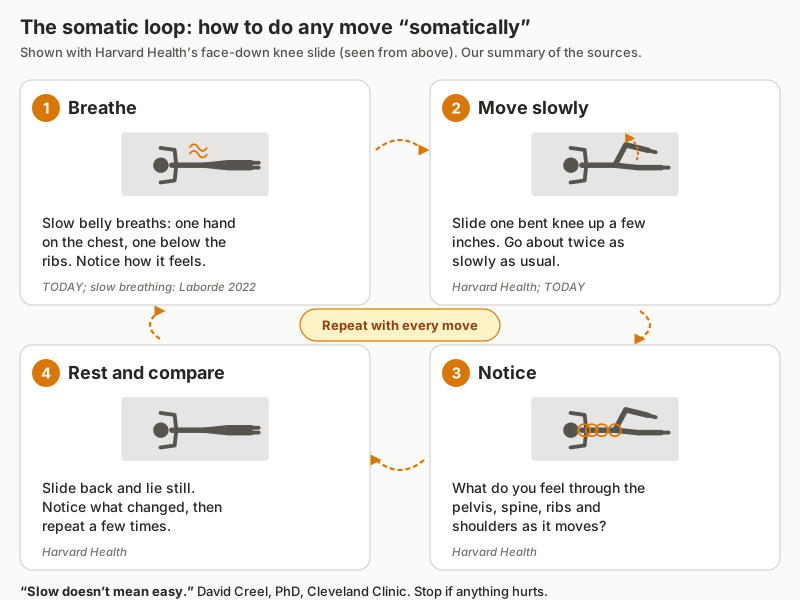
Tap the diagram to enlarge
Follow it as a 4-week plan
No source gives reps or a frequency for somatic Pilates, so our plan borrows Pilates teacher Lesley Logan's general guidance from OnlinePilatesClasses.com: 3–5 slow reps, up to 10. Each week has 5 somatic days, 1 breath-only day (days 4, 11, 18 and 25: breathing and the knee slide only) and 1 rest day (days 7, 14, 21 and 28). Moves carry over from week to week. This is our editorial example, not an expert-designed program.
| Week | Moves added | Time |
|---|---|---|
| 1 (days 1–7) | Breathing, knee slide, pelvic curl | ~10 min |
| 2 (days 8–14) | Single leg stretch, bird dog | 10–15 min |
| 3 (days 15–21) | Spine stretch, saw, superman | ~15 min |
| 4 (days 22–28) | Rolling like a ball, wall roll down | 15–20 min |
Session times are our estimates. The breathing comes from TODAY, the knee slide from Harvard Health, the pelvic curl, spine stretch forward and saw from Healthline, and the rest from Cleveland Clinic. A few notes from those sources:
- Single leg stretch: with neck pain, Cleveland Clinic suggests you "place your hands behind your head for extra support." Our suggestion if that's still too much: keep your head down and simply draw one knee in.
- Bird dog and superman: easier versions move one limb at a time (Cleveland Clinic).
- Wall roll down: roll down "vertebra by vertebra," then up slowly to avoid lightheadedness. Cleveland Clinic says to skip it if you have balance issues, glaucoma or POTS.
Tick the days off in the free 28-day somatic Pilates challenge tracker, which shows each day's moves with a session timer and saves progress in your browser. Prefer paper? Download the somatic calendar (PDF) or the move chart (PDF). Prefer fewer sessions? Use the same order three to five days a week, as Cleveland Clinic's Judi Bar suggests for Pilates in general.
What the somatic evidence shows
It's thin. No study has tested somatic Pilates or a 28-day somatic challenge. A 2022 retrospective study of Hanna Somatic Education (Huang et al.) found lower neck and back pain scores after one-to-one clinic sessions, but it had no control group, and the authors were "unable to exclude nonspecific effects such as placebo effects." A 2022 meta-analysis (Laborde et al.) supports voluntary slow breathing as "a low-tech and low-cost technique," based on short-term heart rate changes, not symptoms. On weight, even BetterMe, which sells somatic programs, says "fat loss occurs through creating a caloric deficit."
What results to expect after 28 days
Heather A. Milton, an exercise physiologist supervisor at NYU Langone Health's Sports Performance Center, told TODAY: "When starting from nothing, yes, you can see improved strength or balance. However, if you are an already active person and decide to change your workout to this, I predict you will not see much improvement in one month."
- Likely by day 28: better core endurance, flexibility and control, especially if you were inactive, plus the start of a habit.
- Unlikely by day 28: visible muscle change, meaningful weight loss or a smaller waist.
What experts say
Milton, speaking about wall Pilates, said: "Strength gains take 4-6 weeks for the nervous system to improve the efficiency of activating muscle, and more like 12 weeks to actually see changes in the muscle size itself." She calls wall Pilates "a low-moderate intensity exercise," so it "will not provide the same benefits as moderate or vigorous exercise in terms of body composition improvements and cardiovascular health."
Garage Gym Reviews (Ravi Davda, CPT) says you should see "some results by the end of the program" if you're consistent. obé, a brand that sells online classes, is blunter. Its in-house Pilates expert, Mary W., says: "There's really nothing that will drastically change your physique in 28 days." The article says visible muscle tone typically takes "at least a 12-week commitment."
A realistic timeline
No study has tested a 28-day Pilates challenge. The closest evidence comes from small mat Pilates trials that used 2–3 sessions of 45–60 minutes a week, not daily short sessions. They suggest what's possible; they don't prove a 28-day challenge does the same. The timeline below is our summary, not a guarantee.
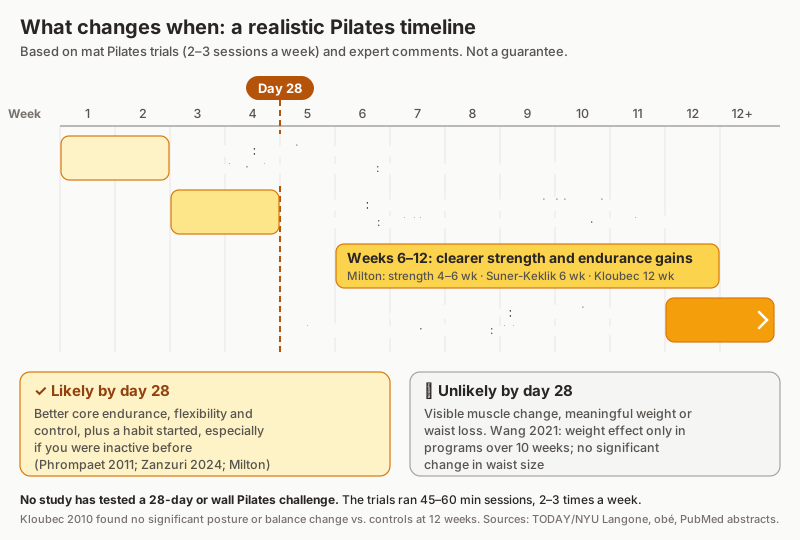
Tap the diagram to enlarge
- Weeks 1–2, learning the moves: Milton's point that early strength gains come from the nervous system fits here. Moves may feel easier because you're doing them more efficiently, not because muscles have grown (our interpretation).
- 4 weeks: in Phrompaet et al. (Asian Journal of Sports Medicine, 2011), 40 healthy volunteers did 45-minute mat sessions twice a week. Sit-and-reach flexibility improved more than in the control group at 4 weeks, and 65% of the Pilates group passed a lumbo-pelvic stability test at 4 weeks (85% at 8). In Lazarowitz Zanzuri et al. (Healthcare, 2024), 40 sedentary women (38 completed) did mat Pilates twice a week for 8 weeks; average curl-up and push-up scores were already higher at the 4-week check, though the study had no non-exercise comparison group.
- 6 weeks: in Suner-Keklik et al. (Irish Journal of Medical Science, 2022), 33 people aged 18–25 did online mat Pilates "3 days a week for 6 weeks, 1 h a day." Trunk proprioception and all core endurance tests improved.
- 12 weeks: Kloubec (Journal of Strength and Conditioning Research, 2010) found "two 60-minute sessions per week" were "enough to promote statistically significant increases in abdominal endurance, hamstring flexibility, and upper-body muscular endurance." About 12 weeks is also Milton's estimate for visible muscle-size change.
Cleveland Clinic notes that Pilates studies often have few participants and short follow-up.
You may see a line attributed to Joseph Pilates: in 10 sessions you'll feel the difference, in 20 you'll see it, and in 30 you'll have a new body. We couldn't trace it to his books or any dated document, and the studies above don't support "a new body" in a month.
What 28 days probably won't do
- Meaningful weight loss. A 2021 meta-analysis (Wang et al., Frontiers in Physiology; 11 trials, 393 adults with overweight or obesity) found Pilates reduced body weight by about 5.3 lb (2.4 kg) on average. But the trials lasted 8–24 weeks, programs of 10 weeks or less showed no significant weight effect, and the authors wrote, "Given the low to moderate overall quality of the evidence, we are still unable to draw a definite conclusion." Garage Gym Reviews is direct: "to lose weight, you need to be in a calorie deficit."
- A flatter belly. The same meta-analysis found "no significant effect on waist circumference."
- Replace cardio. HHS guidelines call for "at least 150 to 300 minutes of moderate-intensity aerobic activity" a week plus muscle-strengthening "at least 2 days each week." Pilates helps with the second part. HHS also says "any amount of physical activity has some health benefits."
How to track your results without the scale
Do these checks on day 1 and again on day 28, at a similar time of day. It's our checklist, modeled on the tests in the studies above, not a validated test battery.
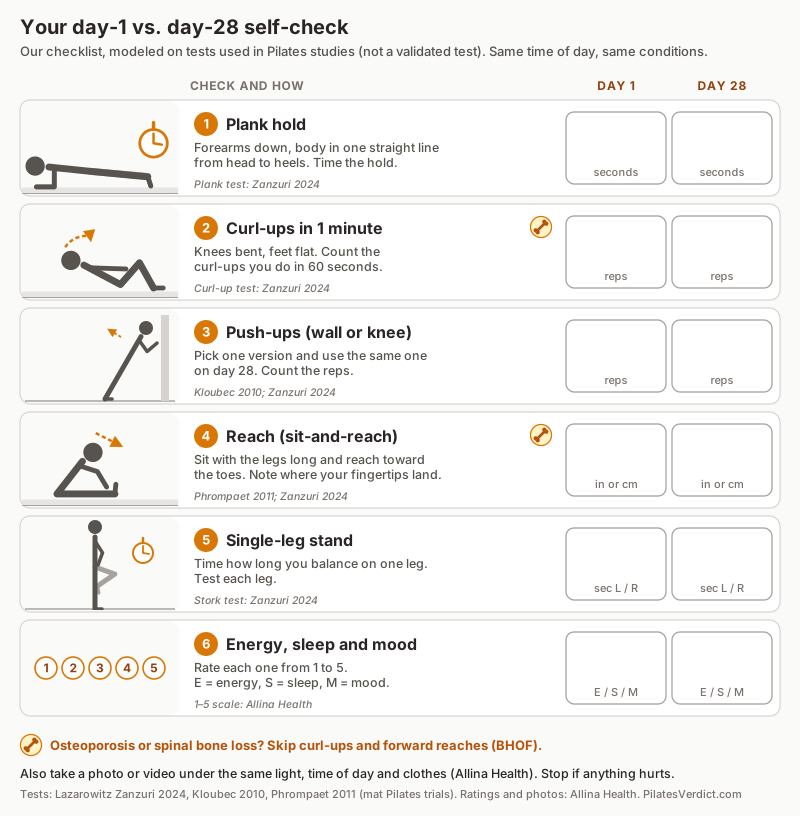
Tap the diagram to enlarge
Download the day-1 vs. day-28 results chart (PDF): the timeline and the scorecard on one US Letter page. Have osteoporosis or spinal bone loss? Skip the curl-ups and toe-touch reach (see who should modify).
Why not just weigh yourself? For people at a healthy weight, Cleveland Clinic says "the average fluctuation is a window of about 5 to 6 pounds per day (2 to 3 lbs in either direction)," mostly from water, so a single day-1 vs. day-28 weigh-in can easily be noise. Healthline's non-scale victories include "Your clothes fit better than they used to" and "You have more energy," and Allina Health notes that "Non-scale victories often occur before weight changes." If you take photos, keep the time, spot, clothes and posture the same.
Who should modify or check first
- New to exercise, injured or limited mobility: Healthline advises talking to a healthcare professional first "if you're new to exercising in general, are pregnant, are recovering from an injury, or have more limited mobility." Cleveland Clinic also advises building difficulty slowly, and recommends checking with your provider before starting somatic Pilates. Older adults can find gentler options in our Pilates for seniors guide.
- Pregnancy: ACOG advises avoiding lying flat on your back as much as possible during exercise and lists modified Pilates among exercise options. Most moves in both plans are done on your back, and the somatic knee slide and superman are done face down, so check with your ob-gyn. PILATESBODY by Kayla runs a separate free 28-day prenatal Pilates challenge (a creator program).
- Osteoporosis or low bone density: the Bone Health & Osteoporosis Foundation advises against bending forward from the waist and doing "sit-ups or abdominal crunches." That flags the chest lift, the head lift in the Hundred, the single leg stretch, the roll down or rolling like a ball, the somatic spine stretch forward, and the curl-ups and toe-touch reach in the self-check. BHOF also advises against twisting the torso to an extreme, so keep the spine twist and saw small; a physical therapist can suggest swaps.
- Balance issues, glaucoma or POTS: skip the somatic wall roll down (Cleveland Clinic).
Some soreness is normal, but Cleveland Clinic says to see a provider for sharp pain that limits movement, pain in a previously injured area, pain that doesn't improve after several days of rest, or pain with bruising, fever or chills.
Free printable 28-day Pilates calendar
Download the printable 28-day Pilates calendar (PDF): one US Letter page with a circle to tick each day (also as a PNG image). Want the moves too? Download the move chart (PDF), with the calendar and all 10 moves on one page. Both are free, with no email sign-up. Pin it where you'll see it. Rather tick it off on your phone? Use the challenge tracker.
The calendar's footer repeats the basics: start easy, stop if it hurts, and ask your clinician first if you're pregnant or have osteoporosis.
After day 28
Twenty-eight days is a start, not a finish line. In Dr. Pippa Lally's habit research, forming a habit took 66 days on average, with a range of 18 to 254 days, according to the University of Surrey. She notes that planning when and where you'll act helps, so keep a fixed time for your sessions. The trials with clearer results ran 6–12 weeks, so the simplest next step is to keep going three to five times a week, as Cleveland Clinic suggests, and build on it:
- Add resistance: ankle weights or bands make the same moves harder (Garage Gym Reviews). See how heavy to go, or switch to a plan with built-in resistance, like the 28-day Pilates bar challenge.
- New mat moves: Pilates Anytime's intermediate list adds the Roll Up, Double Leg Stretch, Spine Stretch and Saw. Greatist's weeks 3 and 4 add criss-cross, saw and double-leg lower lift. Our classical Pilates mat exercises guide is the natural next step.
- A different 4-week plan: the 28-day wall or bed Pilates challenges linked above, or the 28-day chair Pilates challenge. Standing Pilates exercises are another option if getting down to the floor is hard.
- Small props: try our Pilates band exercises or Pilates ball exercises. See what equipment beginners actually need before buying.
- Add cardio: brisk walking or cycling covers the aerobic part of the HHS guidelines that Pilates doesn't.
- Retest at week 8 or 12 with the same self-check and compare with day 1.
For the "add resistance" step, light ankle weights are the simplest upgrade:
Check price on AmazonIf you're still on a thin or slippery mat, a dedicated Pilates mat is the other upgrade worth considering; the mats guide linked above includes budget picks. More routines are in our Pilates workouts section.
Frequently Asked Questions
Is there a free 28-day Pilates challenge?
Yes. Rachel's Fit Pilates has 28-day beginner and intermediate challenge playlists on YouTube (check the playlists for details); according to search listings, her PDF calendar comes after an email sign-up. Blogilates offers a free downloadable 28-day beginner calendar of mat workouts. The plan in this post is another free option with no sign-up.
Can a beginner do a 28-day Pilates challenge?
Yes, if it starts easy. Healthline suggests beginners start with 1–2 days a week and build to 4, and BASI's CJ Kelly advises sticking to the basics first. Pick a plan with rest days and easier versions of each move, or start with the 7-day starter week.
Should you do Pilates every day for 28 days?
The viral format is daily, per Garage Gym Reviews, but Cleveland Clinic suggests 3–5 Pilates sessions a week alongside cardio and strength work, and UCLA Health recommends at least one day off a week. Gentle active-recovery days, such as walking or stretching, keep a daily streak without daily hard sessions.
What results can you expect after 28 days of Pilates?
Mostly better core endurance, flexibility and control, plus the start of a habit. In small trials, flexibility and core scores had already improved by week 4 of twice-weekly mat Pilates. An NYU Langone exercise physiologist told TODAY that strength gains take 4–6 weeks and visible muscle-size changes about 12 weeks.
Will a 28-day Pilates challenge help you lose weight or flatten your stomach?
Don't count on it. A meta-analysis of 11 trials found Pilates reduced body weight by about 5.3 lb (2.4 kg) on average in adults with overweight or obesity, but the trials ran 8–24 weeks, programs of 10 weeks or less showed no significant effect, waist circumference didn't change significantly, and the authors called the evidence low to moderate quality. Pair Pilates with aerobic activity, as HHS guidelines suggest.
How do you know if your Pilates challenge is working?
Retest simple things you did on day 1: plank time, curl-ups, push-ups, reach and balance, the kinds of tests used in Pilates studies. Also track energy, sleep, mood and how your clothes fit. Allina Health notes that non-scale victories often occur before weight changes.
Is there a 7-day Pilates challenge for beginners?
Yes. Week 1 of this plan works as a 7-day starter: 4 short Pilates days, 2 walk-or-stretch days and 1 rest day, with a free printable chart. Rachel Lawrence Pilates also has a free 7 Day Beginner Pilates Challenge of about 20 minutes a day with no equipment.
What is somatic Pilates, and is it easier?
It's Pilates done slowly, with attention on how each move feels rather than how it looks. Cleveland Clinic says it "focuses on body awareness and mindful connection." It's slower, but Cleveland Clinic exercise physiologist David Creel says "slow doesn't mean easy." No study has tested somatic Pilates or a 28-day somatic challenge.
What if I miss a day of the 28-day challenge?
Just resume the next day. Don't double up or give up a rest day; repeating a week is fine.
What's the difference between a 28-day and 30-day Pilates challenge?
Just two days. No source we found says either length works better. A 28-day plan fits four even weeks, which makes it easy to schedule.
Sources
Challenges and programs
- Garage Gym Reviews (Ravi Davda, CPT): An expert guide to the 28-day wall Pilates challenge
- Rachel's Fit Pilates (YouTube; creator): 28 Day Beginner Pilates Challenge for Weight Loss + Strength
- Rachel's Fit Pilates (YouTube; creator): 28 Day Pilates x Strength Challenge (Intermediate)
- Rachel's Fit Pilates (creator): 28 Day Free Pilates for Weight Loss Challenge sign-up page
- Blogilates (Cassey Ho; creator): A 28-day workout calendar for beginners!
- Lindywell (Robin Long; YouTube; creator): 28 Days of Pilates Challenge (5-10 minutes per day)
- Rachel Lawrence Pilates (creator): 30 Day Pilates Challenge
- Rachel Lawrence Pilates (creator): Free beginner Pilates workouts (7 Day Beginner Pilates Challenge)
- PILATESBODY by Kayla (creator): Pilates challenges
- Greatist (Anna Lee Beyer; reviewed by Jake Tipane, CPT): Pilates for beginners: a 30-day program
- JustFit (app): 28-Day Somatic Workout Challenge
- BetterMe (app company): 28-Day Somatic Yoga Challenge
Moves, frequency and recovery
- Healthline (Roxy Menzies; reviewed by Danielle Hildreth, RN, CPT): Pilates for beginners
- Healthline (Anisha Mansuri; reviewed by Micky Lal, MA, CSCS, RYT): Pilates mat exercises
- TODAY (Stephanie Mansour): 20 Pilates exercises for beginners
- BASI Pilates (CJ Kelly, NCPT): 10 essential Pilates exercises for beginners
- Pilates Anytime (Amanda Altman): Mat sequences for every level
- Cleveland Clinic (Judi Bar): Pilates 101
- UCLA Health: How often should you take a rest day?
- Cleveland Clinic (Lauren Wichman, MD): Active recovery: workouts and exercises to try
- Cleveland Clinic (Dominic King, DO): If you're sore after a workout, should you be concerned?
- HHS ODPHP: Top 10 things to know about the Physical Activity Guidelines
Somatic Pilates
- Cleveland Clinic (David Creel, PhD): What is somatic Pilates and its benefits?
- Healthline (reviewed by Danielle Hildreth, RN, CPT): Somatic Pilates: benefits, risks, and exercises
- Harvard Health Publishing (Maureen Salamon; reviewed by Mercedes von Deck, MD): What are somatic workouts?
- TODAY (Dr. Mary Jurisson, Mayo Clinic; Scott Lyons, PhD): What is a somatic workout?
- OnlinePilatesClasses.com (Lesley Logan): How to do Pilates in bed
- Huang et al., Saudi J Med Med Sci (2022): Effect of Hanna Somatic Education on low back and neck pain levels
- Laborde et al., Neurosci Biobehav Rev (2022): Effects of voluntary slow breathing on heart rate and heart rate variability
Results and tracking
- TODAY (Heather A. Milton, NYU Langone Health): Wall Pilates exercises
- obé Fitness (brand blog): Does wall Pilates work?
- Phrompaet et al., Asian J Sports Med (2011): Effects of Pilates training on lumbo-pelvic stability and flexibility
- Lazarowitz Zanzuri et al., Healthcare (2024): Remote Pilates training is effective in improving physical fitness in healthy women: a randomized controlled study
- Suner-Keklik et al., Ir J Med Sci (2022): An online Pilates exercise program is effective on proprioception and core muscle endurance in a randomized controlled trial
- Kloubec, J Strength Cond Res (2010): Pilates for improvement of muscle endurance, flexibility, balance, and posture
- Wang et al., Front Physiol (2021): Pilates for overweight or obesity: a meta-analysis
- Cleveland Clinic: Why does my weight fluctuate so much?
- Healthline (Rebecca Joy Stanborough, MFA; reviewed by Daniel Bubnis, MS, NASM-CPT): Non-scale victories
- Allina Health (Parvathi Theerthakarai, MD): Non-scale victories: signs your health journey is working
Habits and goals
- Dai, Milkman and Riis, Management Science (2014): The fresh start effect: temporal landmarks motivate aspirational behavior
- Oscarsson et al., PLOS ONE (2020): A large-scale experiment on New Year's resolutions
- University of Surrey: Does it really take 66 days to form a habit? (Dr Pippa Lally)
Safety
- ACOG: Exercise during pregnancy
- Bone Health & Osteoporosis Foundation: Protecting your spine
Update history
- : Updated.
- : Published.
Found an error? See how we research and correct guides in our editorial policy.
Was this guide helpful?
Related Articles
How-To
28-day chair Pilates challenge: free plan + printable calendar
A free 28-day chair Pilates challenge with a printable calendar: a week-by-week seated plan, how to progress safely, and what 28 days can realistically change.
October 26, 2026 · 18 min read

How-To
28-day bed Pilates challenge: a free plan and printable calendar
A free 28-day bed Pilates challenge with a printable calendar: 10 gentle moves, a week-by-week plan, no app needed, and what 28 days can realistically do.
October 23, 2026 · 16 min read
How-To
28-Day Wall Pilates Challenge: A Free Schedule and What to Expect
Free 28-day wall Pilates challenge options, a 4-week schedule with rest days, 8 sourced moves, and what 28 days can realistically change.
October 7, 2026 · 16 min read
How-To
Pilates bar exercises for beginners: 8 moves and a 28-day plan
8 Pilates bar exercises for beginners: setup, 4 standing and 4 mat moves, reps, band safety and a free 28-day bar challenge plan, all from named sources.
November 20, 2026 · 24 min read