Pilates for seniors: 10 gentle exercises for beginners at home
By The Pilates Verdict Team · November 7, 2026 · 21 min read
This article contains affiliate links. If you buy through them, we may earn a commission at no extra cost to you. As an Amazon Associate I earn from qualifying purchases. Read our affiliate disclosure.
Pilates for seniors is less about fancy moves and more about doing a few simple ones well. Harvard Health calls Pilates "a low-impact form of exercise, meaning it may be more comfortable and accessible for people with joint pain or mobility concerns." It also comes in many formats, from mat and chair classes to reformer, wall and "gentle Pilates."
The research is encouraging but modest. Reviews of randomized trials find Pilates improves balance in older adults. Whether it reduces actual falls, or builds bone, hasn't been shown.
Below: what the evidence says, the safety checks to make first (especially with osteoporosis or a joint replacement), and a short 10-move beginner routine in three stages. You sit, then stand at a counter, then move to the mat only if you want to.
How we researched this:
- The routine: moves and cues from a Leicestershire Partnership NHS Trust physiotherapy Pilates leaflet, plus a seated march from Cleveland Clinic physical therapist Tobi Jevnikar
- Safety: the Bone Health & Osteoporosis Foundation (BHOF), AAOS OrthoInfo, the Chartered Society of Physiotherapy, Pilates Anytime, Merrithew, UCLA Health, Harvard Health and Healthline (medically reviewed)
- Evidence: peer-reviewed systematic reviews and a randomized trial on older adults, and the CDC's activity guidelines
We don't coach or test workouts, and this isn't medical advice. Every source is listed at the end.
Quick version:
- Check first: talk to your doctor before starting, and stop if anything hurts.
- Routine: 2 seated moves, 3 standing moves at a counter, and 5 optional mat moves.
- Dose: one round of 8–12 reps per move, 2–3 days a week to start (our suggestion, based on the NHS leaflet and CDC guidelines). One round takes roughly 15–20 minutes at a slow pace (our estimate).
- Can't get to the floor? Do stages 1 and 2 only, then try our chair Pilates or standing Pilates routines.
Is Pilates good for seniors?
Short answer: yes for balance, probably for strength, unproven for falls and bones. Here's what the research on older adults shows:
- Balance: likely yes. Sampaio et al. (2023) pooled 20 randomized trials with 930 older adults, mean ages 63 to 79. Most programs ran 1–3 sessions a week for about 12 weeks. The authors concluded Pilates has "potential... as a valuable intervention to enhance balance in the elderly population," while noting small samples and inconsistent protocols. A 2024 review by de Campos Júnior et al. (39 studies, 1,770 participants) also found Pilates "significantly superior to control groups" for static and dynamic balance.
- Strength and function: probably helps. Fernández-Rodríguez et al. (2021), a review of 39 trials in adults 60 and older, found moderate effects on balance, strength, flexibility and functionality. Certainty was low for some of those outcomes.
- Falls: unclear. The same 2021 review reported a large effect on fall risk. But the 2024 review's authors concluded Pilates can be recommended for balance "but not to reduce the number of falls or the fear of falling." And not every trial is positive: Gabizon et al. (2016), a randomized trial of 88 older adults, found no balance improvement versus controls.
- Bones: not shown. A 2022 meta-analysis in postmenopausal women (de Oliveira et al.) found Pilates "did not offer significant effects" on bone density at the spine or hip. Only three trials qualified, and the authors call for better studies. Healthline's summary is similar: a 2021 review suggests Pilates "doesn't worsen bone mineral density during the postmenopausal years."
Health organizations are broadly positive. UCLA Health lists four benefits for older adults: fall-risk factors, posture, chronic disease risk factors and emotional health. Healthline's medically reviewed guide lists possible benefits including bone health, posture, balance and gait, mental health, cognition and back pain, each based on a single study or review. Pilates Anytime says "seniors will benefit from both Mat Pilates and Reformer Pilates sessions."
It's also popular. Harvard Health reports "nearly 12 million Americans tried Pilates in 2023, 15% more than during the previous year."
One honest note from the NHS physiotherapy leaflet: "there is no strong evidence to suggest that Pilates is superior to any other exercise in reducing pain. It is essential that you choose something that you enjoy."
Where it fits: the CDC recommends older adults get at least 150 minutes a week of moderate aerobic activity, muscle-strengthening activity on at least 2 days, and balance activities. Pilates is a way to cover the strength and balance part. It doesn't replace walking or other aerobic activity (our reading of the guidelines). And the CDC adds: "some physical activity is better than none at all."
Before you start: safety checks
Talk to your doctor first
Harvard Health: "It's generally a good idea to check with your doctor before trying any new kind of exercise." UCLA Health also advises consulting your primary care physician first. That matters most if you have a health condition, have had recent surgery or are new to exercise.
Pilates Anytime's chair Pilates guide (Marchel Ackler) advises: "start slow with small and gentle movements and build up from there," and "if it hurts, stop doing it right away." Merrithew instructor trainer Yoko Yasui adds that seniors "should take their time to warm up and control their exercise intensity to avoid getting too tired."
If you have osteoporosis
This is where Pilates for seniors needs the most care, because many classical mat moves curl or twist the spine.
- BHOF: with spinal bone loss, avoid bending forward from the waist, twisting the trunk "to an extreme," and toe-touches, sit-ups or crunches. BHOF notes that "backward bending or leaning back however reduces stress on the front of the spine."
- Pilates Anytime: a traditional mat class "is ill-advised." "The Roll Up, Roll Over, Jack Knife, Spine Twist, and Saw should not be practiced." Look for "a Pilates teacher who has knowledge of the do's and don'ts of Pilates for osteoporosis."
- Healthline: avoid excessive twisting, crunches and rolling on the back, including Rolling Like a Ball.
- UCLA Health: modify by avoiding exercises with "deep twists, putting pressure on your rib cage and rounding or flexing your spine."
In our routine: there's no roll down, knee hug or seated forward reach. For the bridge (move 8), lift with a flat back instead of peeling up through the spine. That swap is our suggestion based on BHOF's guidance; have a physical therapist confirm it for you.
After a hip or knee replacement
AAOS OrthoInfo's hip replacement exercise guide says to "be sure to check with your therapist or surgeon before trying any of these exercises." Precautions vary by person and surgery, so follow your surgeon's or therapist's instructions over any general routine, including this one.
Balance and getting to the floor
Do every standing move next to a sturdy chair, kitchen counter or wall (our suggestion; Cleveland Clinic's standing march uses the back of a chair for support). Clear the space first: the NHS falls-prevention page warns against "too much clutter at home, or things you could trip on such as loose wires or rugs."
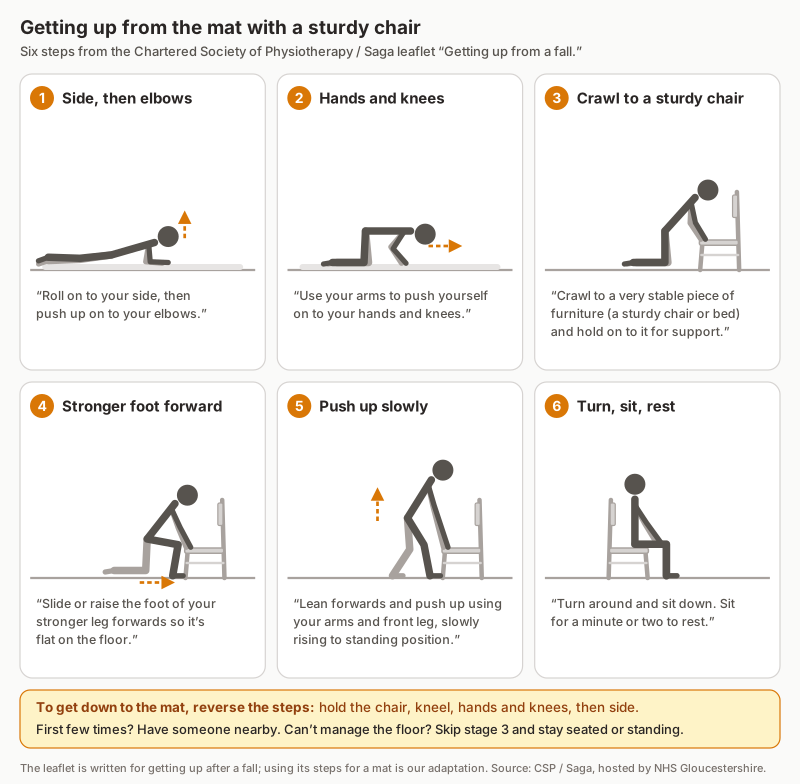
If you'll use the mat, plan how you'll get down and back up. The Chartered Society of Physiotherapy and Saga publish these steps for getting up from the floor:
- "Roll on to your side, then push up on to your elbows."
- "Use your arms to push yourself on to your hands and knees."
- "Crawl to a very stable piece of furniture (a sturdy chair or bed) and hold on to it for support."
- "Slide or raise the foot of your stronger leg forwards so it's flat on the floor."
- "Lean forwards and push up using your arms and front leg, slowly rising to standing position."
- "Turn around and sit down. Sit for a minute or two to rest."
Tap the diagram to enlarge
That leaflet is written for getting up after a fall. Using the same steps to get off your mat, and in reverse to get down, is our adaptation. Put the mat next to a sturdy chair, and try it the first time with someone nearby (our suggestion).
If the floor isn't practical, skip stage 3. Healthline points to chair Pilates for people who can't do weight-bearing exercise, and our bed Pilates routine does similar lying-down moves on a mattress.
10 beginner Pilates exercises for seniors (seated, standing and mat)
Tap the diagram to enlarge
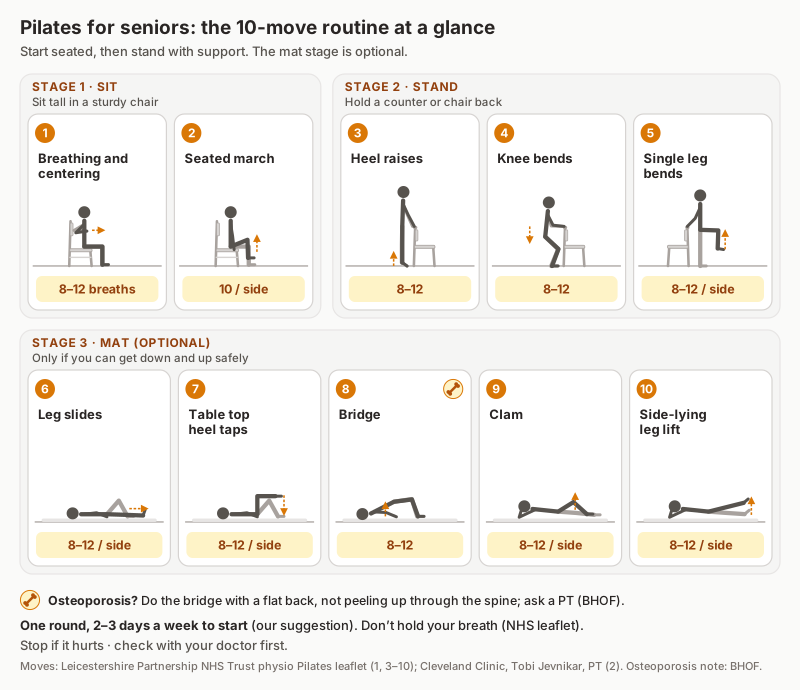
How much: the NHS leaflet says to "repeat the exercises 8 - 12 times," "make sure you are not breath holding," and "always work at a level that feels comfortable for you." That leaflet is a physio home plan done 2 or 3 times a day. For a general start, we suggest one round of 8–12 reps per move on 2–3 days a week, which lines up with the CDC's 2+ strength days and the 1–3 weekly sessions used in most trials. One round takes roughly 15–20 minutes at a slow pace (our estimate).
Tap the diagram to enlarge
Stage 1: seated warm-up
Sit tall toward the front of a sturdy chair without wheels, feet flat.
1. Breathing and centering
From the NHS leaflet: "When you inhale through the nose you should allow your ribs to expand and when you breath [sic] out through the mouth, you should allow your ribcage to sink inwards and downwards." In Pilates, it says, "we inhale during the relaxation part of the exercise and we exhale during the movement part."
Then set your shoulders: "Slowly lower your shoulder blades downwards and inwards, creating the 'V shape.'" Take 8–12 slow breaths (our suggestion).
2. Seated march
Cleveland Clinic physical therapist Tobi Jevnikar's version: shuffle forward in the chair and hold the sides if you need to. Lift one bent knee a few inches, lower it, and switch. Do 10 per side.
Stage 2: standing with support
Stand facing a counter or the back of a sturdy chair, both hands resting on it.
3. Heel raises
NHS leaflet: "Stand upright with your feet parallel. Lift your heels off the floor, pushing yourself up onto your tiptoes." Lower slowly. The leaflet's version lifts the arms forward to shoulder height and asks you to "maintain your pelvis neutral and still." Keep both hands on the support until you feel steady (our suggestion).
4. Knee bends
NHS leaflet: "Stand upright with your feet and legs parallel. The legs are straight and not locked. Bend your knees into a ½ squat position," then straighten. The leaflet lifts the arms forward as you bend; keep holding on if you need to.
Easier option: sit-to-stand from your chair. The CDC lists "standing from a sitting position" as a balance activity.
5. Single leg bends
NHS leaflet: "Stand on one leg, keep the pelvis at neutral position, and simultaneously bend the opposite knee, lifting the knee to hip height. Lower the leg down and repeat the same onto the other leg." Hold the support, and only lift as high as feels steady.
Yasui stresses leg strength for staying independent and suggests standing and single-leg work for balance, which is why this stage is all legs. This routine is mostly legs and core. For arms, add the seated arm moves from our chair Pilates routine (linked above).
Stage 3: on the mat (optional)
Use the get-down steps above in reverse. The NHS leaflet's photos show a folded towel under the head when lying on your back or side. A thick mat helps on hard floors (our suggestion); see what you need.
6. Leg slides
Start in what the leaflet calls "crook lying": on your back, knees bent, feet hip-width apart, arms by your sides, palms down. "Slide one leg forward, away from your hips, keeping the heel in contact with the floor. Gently slide the leg back to starting position." Alternate legs.
7. Table top heel taps
NHS leaflet: "Slide the right foot towards your sitting bones and then float this leg into the table top position, then slowly lower the right leg back to the mat. Continue alternating." Leg Slides and Thigh Folds are both on Pilates Anytime's list of suitable exercises for seniors.
8. Bridge
From crook lying, the NHS leaflet says: "Lift your spine off the floor, peeling each segment off the mat until you are resting on your shoulder blades." Lower the same way.
Osteoporosis swap: lift and lower your hips with a flat back instead of peeling through the spine (our suggestion, based on BHOF's avoid-flexion guidance; confirm with a physical therapist).
9. Clam
Lie on your side and "bend your knees approximately 90 degrees. Lift the top leg, maintaining the feet together." Lower slowly. Switch sides. Clam is on Pilates Anytime's senior list.
10. Side-lying leg lift
Still on your side, straighten the top leg. "In a controlled manner lift your leg hip height, maintaining the knee in a straight position. Slowly lower your leg back down." This is part of what Pilates Anytime calls the Side-Lying Series.
Optional extra: the leaflet's swan dive prep. Lie face down, forehead resting on a towel, arms in an L shape, then "lift the breast bone away from the floor... Hold for approximately 2 seconds and slowly lower." BHOF says backward bending reduces stress on the front of the spine, but lying face down isn't comfortable for everyone, so skip it if it isn't.
Cool-down: take a few slow breaths in crook lying, then use the get-up steps. The leaflet's stretches include cat and camel, knee hugs, knee rolls and a seated hamstring stretch, which curl or twist the spine; skip those if you have osteoporosis.
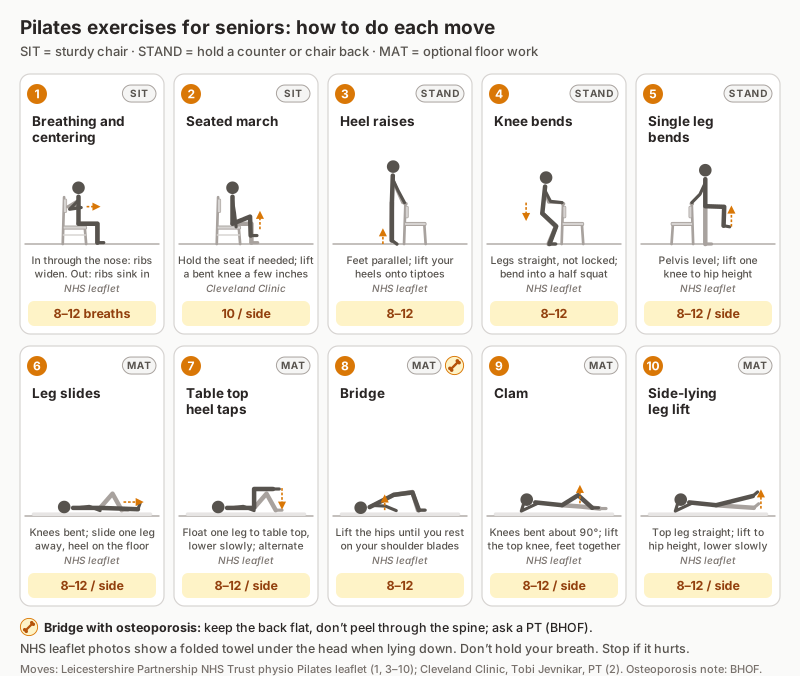
Routine at a glance
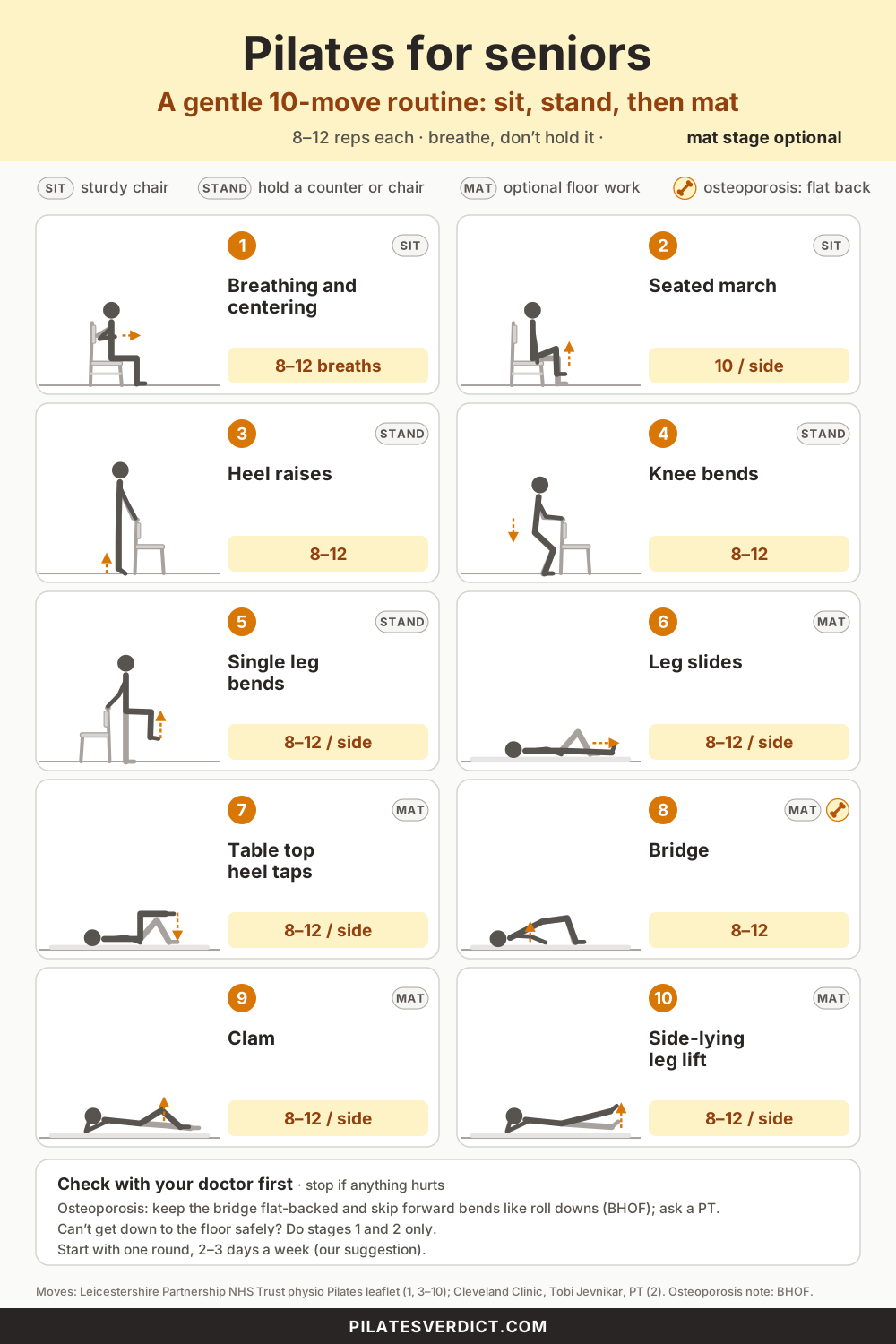
Tap the diagram to enlarge
Download the printable chart (PDF) or open it on its own page. The table below is a text version.
| Move | Reps | Easier option |
|---|---|---|
| 1. Breathing (seated) | 8–12 breaths | Hands on ribs |
| 2. Seated march | 10 per side | Hold chair sides |
| 3. Heel raises | 8–12 | Both hands on counter |
| 4. Knee bends | 8–12 | Sit-to-stand from chair |
| 5. Single leg bends | 8–12 per side | Lower knee lift |
| 6. Leg slides | 8–12 per side | Shorter slide |
| 7. Table top heel taps | 8–12 per side | Leg slides only |
| 8. Bridge | 8–12 | Flat-back lift (osteoporosis) |
| 9. Clam | 8–12 per side | Smaller lift |
| 10. Side-lying leg lift | 8–12 per side | Bend bottom knee |
Reps come from the NHS leaflet (moves 3–10) and Cleveland Clinic (move 2); the breath count for move 1 is our suggestion. The easier options are our suggestions unless noted above.
Pilates for seniors at home vs. in a class
Start with an instructor if you can. Healthline recommends one-on-one sessions with a qualified instructor at first, and notes groups "led by specially trained instructors geared toward active older adults." Harvard Health suggests looking for studio or community-center classes labeled "Pilates for older adults or Pilates for beginners," and arriving early to talk with the instructor about your concerns. With osteoporosis, Pilates Anytime says to find a teacher who knows the do's and don'ts.
Which type of Pilates is best for seniors?
| Type | Good if | Source |
|---|---|---|
| Chair | You can't get to the floor | Healthline, NHS video |
| Standing or wall | You want balance practice with support | Merrithew (Yasui) |
| Mat | You want classes that are "often more available and less expensive" | Pilates Anytime |
| Reformer | The raised carriage helps if the floor is hard | Merrithew |
For more no-floor options, see our standing Pilates routine (linked above) and wall Pilates for beginners. Healthline suggests spring-resisted apparatus work if bone density is a goal, though the reviews above haven't shown a bone benefit.
UCLA Health says to choose based on preference. If you're unsure, a simple way to decide (our suggestion): if getting up from the floor is hard, start with chair Pilates. If you can stand steadily with a hand on a counter, add standing or wall work. Move to a mat or reformer class once you can get down and up safely, ideally with an instructor.
Free and low-cost options
At home, free options exist:
- The NHS Fitness Studio has a free chair-based Pilates video, about 30 minutes.
- Healthline's free "Fit It In" Pilates video series includes a 22-minute class for older adults.
- Pilates Anytime (subscription) has a "Pilates for Seniors" class category.
Medicare: Healthline notes Original Medicare doesn't include fitness benefits, but some Medicare Advantage plans offer programs like SilverSneakers, which provides "access to live online and in-person fitness classes, including chair Pilates, mat Pilates, and other strength and balance exercises." Check your own plan for what it covers.
What you need
- A sturdy chair without wheels, for stages 1 and 2 (NHS leaflet, Cleveland Clinic).
- A counter, chair back or wall to hold during standing moves.
- A mat and a folded towel for stage 3, as shown in the NHS leaflet. A thicker mat is kinder on knees and hips (our suggestion).
- Optional: a light resistance band. Yasui suggests a band when equipment springs feel too hard. See our resistance bands for Pilates picks.
- Optional: grip socks if you'll stand on a smooth floor (our suggestion). See our Pilates grip socks guide.
If you only buy one thing, make it a thick mat (our suggestion). One option is the ProsourceFit Extra Thick mat, which the manufacturer sells in a 1/2-inch version:
Check price on AmazonMore mat options are in our best Pilates mats roundup, and our Pilates equipment for beginners guide covers what else is worth buying (and what isn't).
How to progress
Once one round feels easy:
- Add reps or a second round, staying within the leaflet's 8–12 rep range (our suggestion).
- Use less hand support in stage 2, moving from two hands to one, as long as you feel steady.
- Try the NHS leaflet's progressions: both legs in table top together (move 7), lifting the feet as well as the knee in the clam (move 9), and a small leg circle before lowering in the side-lying lift (move 10).
When you're ready for more, the 28-day chair Pilates challenge builds a daily habit, and Pilates exercises at home for beginners is the next step on the mat. Browse everything in our Pilates workouts section.
Frequently Asked Questions
Is Pilates safe for seniors?
For most older adults it's a low-impact option, and Harvard Health notes it may be more comfortable for people with joint pain or mobility concerns. Check with your doctor first, especially with a health condition or recent surgery (Harvard Health, UCLA Health), and stop right away if anything hurts (Pilates Anytime).
What Pilates exercises should seniors with osteoporosis avoid?
The Bone Health & Osteoporosis Foundation advises avoiding bending forward from the waist, extreme twisting, sit-ups and crunches. Pilates Anytime lists the Roll Up, Roll Over, Jack Knife, Spine Twist and Saw as moves not to practice, and Healthline adds Rolling Like a Ball. A teacher who knows osteoporosis precautions can adapt the rest.
Does Pilates help prevent falls in older adults?
Reviews of randomized trials find it improves balance. Whether it reduces actual falls is unclear: a 2024 review (de Campos Júnior et al.) found no effect on the number of falls or fear of falling, while a 2021 review (Fernández-Rodríguez et al.) reported a large effect on fall risk.
What type of Pilates is best for seniors?
It depends on you. Chair Pilates suits people who can't get to the floor (Healthline), standing or wall work adds balance practice with support (Merrithew instructor trainer Yoko Yasui suggests standing and single-leg balance work), mat classes are often more available and less expensive (Pilates Anytime), and raised reformer carriages can help people who find getting to the floor hard (Merrithew). UCLA Health says to choose based on preference.
How often should seniors do Pilates?
Most trials in older adults used 1–3 sessions a week, usually for about 12 weeks (Sampaio et al.). The CDC recommends muscle-strengthening activity on at least 2 days a week plus balance activities. Pilates Anytime says practicing a few times a week will improve your health and body awareness.
Can seniors do Pilates at home without getting on the floor?
Yes. Seated and standing versions exist. Healthline mentions chair Pilates for people who can't do weight-bearing exercise, and the NHS has a free chair-based Pilates video. Do stages 1 and 2 of the routine above, or try our chair and standing Pilates routines.
Is it too late to start Pilates at 70 or older?
Trials in older adults have included groups with mean ages up to 79 (Sampaio et al.). Start with seated and supported moves, check with your doctor first (Harvard Health), and consider a few sessions with an instructor (Healthline).
Is Pilates better than yoga or other exercise for seniors?
Not necessarily. The NHS physiotherapy leaflet says there's no strong evidence Pilates is superior to other exercise for pain, and to choose something you enjoy. The CDC's guidelines call for aerobic, strength and balance activity, and Pilates covers the last two.
Does Pilates build bone density?
That hasn't been shown. A 2022 meta-analysis in postmenopausal women (de Oliveira et al.) found no significant effect on spine or hip bone density, though only three trials qualified. Healthline notes a 2021 review suggesting Pilates doesn't worsen bone density after menopause.
Sources
- Healthline (Roxy Menzies; medically reviewed by Courtney L. Gilbert, PT, DPT): Pilates for older adults: benefits, considerations, and more
- Harvard Health Publishing (Sarah Klein; reviewed by Lauren Elson, MD): Pilates: a good option for older adults?
- UCLA Health: 4 benefits of Pilates for older adults
- Pilates Anytime: Beginner Pilates for seniors
- Pilates Anytime (Marchel Ackler): Chair Pilates for seniors
- Pilates Anytime: Pilates for seniors classes
- Merrithew (Yoko Yasui; brand blog): Programming tips for active aging clients
- Merrithew (brand blog): Reformer series: STOTT PILATES for active aging
- Leicestershire Partnership NHS Trust: Your guide to physiotherapy based Pilates (PDF)
- Chartered Society of Physiotherapy / Saga, via NHS Gloucestershire: Getting up from a fall (PDF)
- NHS: How to prevent falls
- CDC: Physical activity guidelines for older adults
- Cleveland Clinic (Tobi Jevnikar, PT): Chair exercises for seniors
- Bone Health & Osteoporosis Foundation: Protecting your spine
- AAOS OrthoInfo (Matthew Edward Deren, MD): Total hip replacement exercise guide
- NHS: Chair-based Pilates video workout
- Healthline: Fit It In video series: Pilates
- Sampaio et al., Healthcare (Basel) (2023): The effectiveness of Pilates training interventions on older adults' balance
- de Campos Júnior et al., Complement Ther Clin Pract (2024): Effects of Pilates exercises on postural balance and reduced risk of falls in older adults
- Fernández-Rodríguez et al., Physiotherapy (2021): Pilates improves physical performance and decreases risk of falls in older adults
- Gabizon et al., J Aging Phys Act (2016): The effects of Pilates training on balance control and self-reported health status in community-dwelling older adults
- de Oliveira et al., J Geriatr Phys Ther (2022): Effects of Pilates exercise on bone mineral density in postmenopausal women
Update history
- : Published.
Found an error? See how we research and correct guides in our editorial policy.
Was this guide helpful?
Related Articles
How-To
Chair Pilates: a 10-move seated workout for beginners and seniors
Chair Pilates for beginners and seniors: 10 seated moves with a printable chart, free videos, safety tips and what the research says about benefits.
October 21, 2026 · 21 min read
How-To
Wall Pilates: Does It Work? Plus 10 Exercises for Beginners
What wall Pilates is, what the research says, a 15-minute routine of 10 beginner wall Pilates exercises with a printable chart, and the only gear you need.
November 20, 2026 · 25 min read
How-To
Standing Pilates exercises: a 10-move routine without the floor
10 standing Pilates exercises for beginners and seniors: footwork, leg and balance moves with chair support, reps, a printable chart and what research says.
November 21, 2026 · 18 min read
How-To
Pilates exercises at home for beginners: a 10-move mat routine
10 Pilates exercises at home for beginners, no equipment beyond a mat. Reps and easier versions from instructor guides, plus how often to practice.
October 7, 2026 · 19 min read