Standing Pilates exercises: a 10-move routine without the floor
By The Pilates Verdict Team · October 15, 2026 · 20 min read
This article contains affiliate links. If you buy through them, we may earn a commission at no extra cost to you. As an Amazon Associate I earn from qualifying purchases. Learn more.
Standing Pilates exercises take the method's focus on core control and mindful movement off the mat and onto your feet. Instructor Allie Ryle told Woman & Home that "not everyone can access the 34 classical mat exercises, myself included at times." Woman & Home adds that it's a good alternative if lying down puts pressure on your back. It also helps if you have no mat, little space or knees that don't love the floor.
It isn't a new invention. Classical teachers already finish Mat and Reformer classes with a standing sequence, and Pilates Anytime's Adrianne Crawford teaches the Reformer's footwork standing up, at a wall.
Below is a 10-move standing Pilates routine, in order: a spine warm-up, feet and legs, hips, then a balance finisher. Each move has a named source, reps and a support option. After that: how to add light weights, what the research says about balance and who should modify.
How we researched this:
- Move cues: Pilates Anytime classes (Adrianne Crawford, Kathryn Ross-Nash, Gia Calhoun, Amy Havens), Lesley Logan's OnlinePilatesClasses, goPhysio's physio-led Pilates team, and instructors quoted in Woman & Home (Rachel Lawrence, Allie Ryle) and Fit&Well (Nico Gonzalez)
- Balance evidence: three peer-reviewed meta-analyses and a registered clinical trial
- Safety: the Bone Health & Osteoporosis Foundation, ACOG, Cleveland Clinic and the US Physical Activity Guidelines
We don't coach or test workouts. Every source is listed at the end.
Quick version:
- Time: about 15 minutes, the length of Rachel Lawrence's and Lesley Logan's standing routines. Short on time? Do moves 2, 3, 6, 9 and 10 only, for about 10 minutes (our suggestion).
- Support: a sturdy chair, kitchen counter or wall within reach for every move.
- Reps: one round of 6 per move to start, building to 10 or a second round (our suggestion).
- Skip or modify: the roll down and big twists if you have osteoporosis (BHOF).
What is standing Pilates?
Standing Pilates is Pilates done on your feet: footwork, leg work, side bends and balance moves, with the same attention to control and alignment as mat work. Pilates Anytime lists it as its own class category. That category mixes no-equipment standing classes with Reformer and Tower classes that include standing work. One example, Courtney Miller's "Mat Sculpt," is described as "50% Standing Pilates and 50% Matwork."
Two classical ideas show up again and again:
- Standing footwork. This is the Reformer's footwork series done on your feet. Crawford's Pilates Anytime tutorial says: "Strengthen your ankles and feet... These quick exercises can help anyone who has had foot injuries or who wants to improve their balance." She does the first set at the wall and the second without it.
- The standing ending. Kathryn Ross-Nash's "Basic Standing Ending" on Pilates Anytime is "a basic class that can be used as an ending to a traditional Reformer or Mat class." It includes chest expansion, boxing, side splits, arm circles, front splits, side bends and "door opening and closing," with a towel and hand weights.
Standing vs. mat Pilates
- No floor needed. Standing work keeps you off your back, which helps if lying down puts pressure on your back (Woman & Home). Amy Havens' standing class on Pilates Anytime needs no mat at all.
- Balance and stability. T3's 15-minute standing workout from instructor Lotty Campbell Bird focuses on the core muscles and leg strength to build stability.
- Mat work still has its place. Classical teachers treat standing work as a complement, not a replacement: Kathryn Ross-Nash's standing ending on Pilates Anytime is meant to finish a traditional Mat or Reformer class.
Joan Breibart, who founded the PhysicalMind Institute in 1991, wrote a book called Standing Pilates in 2005, according to the institute's bio of her.
Before you start: set up for balance
Put a sturdy chair, a kitchen counter or a wall within arm's reach. Every source here says some version of this:
- Lesley Logan (OnlinePilatesClasses): "If you struggle with balance, be near a wall or chair."
- Allie Ryle (mat and reformer Pilates instructor, The Fitness Group, via Woman & Home): start small and make stability the priority. Use a wall, countertop or chair while you learn to balance, and "focus on good alignment and slow, controlled movement before adding the more exciting variations."
- Cleveland Clinic exercise physiologist Katie Lawton: use a wall or sturdy chair when you start balance exercises. With practice, "you may find you don't need to use them as much."
- Tom's Guide (Eleni Fit's standing class): stand near "a sturdy table or chair to lean on if required" and "take extra breaks if required."
Ryle also says "consistency is far more important than complexity," and that "standing variations often recruit more muscle groups at once." That second point is her view as an instructor, not a measured finding.
On a slick wood or tile floor, socks can slide, so we'd suggest bare feet or grip socks. See our best Pilates grip socks if you need a pair; our top pick there is:
Check price on AmazonAnd one rule from Logan for the whole routine: "If any of the exercises are outside of your level or ability today, when in doubt, please leave it out."
10 standing Pilates exercises, in order
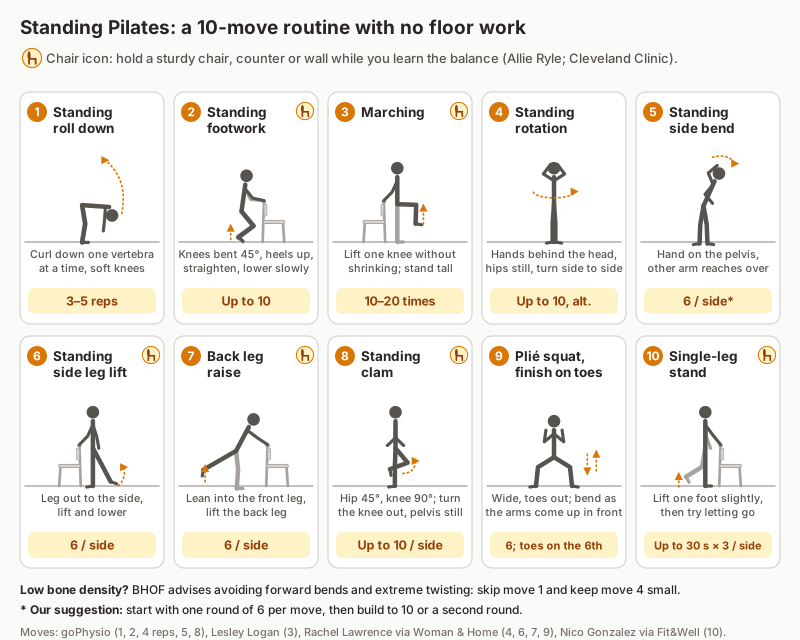
Rep counts come from each source, and they vary: 3–5 for the roll down, 6 per side in Rachel Lawrence's routine, up to 10 in goPhysio's and 10–20 for Logan's marching. Our suggestion for beginners is one round of 6 per move, then build to 10 or add a second round.
Tap the diagram to enlarge
1. Standing roll down
goPhysio, a physio-led Pilates studio in the UK, starts from a tall, engaged stand. Exhale to "lengthen the back of the neck and curl the head and neck forwards," then roll down one vertebra at a time with soft knees, head and arms relaxed. Exhale to "wheel the pelvis upwards" and roll back up. "Repeat 3–5 times."
Gia Calhoun's beginner standing class on Pilates Anytime also opens with standing roll downs.
Osteoporosis: this is spinal flexion. The Bone Health & Osteoporosis Foundation (BHOF) advises people with spinal bone loss to avoid bending forward from the waist. Skip it, or keep it to a small head nod with your hands on your thighs, and ask a physical therapist before doing the full version.
2. Standing footwork (heel raises)
goPhysio's "Foot Series": "Exhale, bend your hips and knees 45 degrees. Inhale, peel the heels off the floor, keeping the hips and knees bent. Exhale, straighten your hips and knees, keeping the heels lifted. Inhale, lower the heels." Do it up to 10 times, then reverse the order.
Their watch points: keep a neutral back, rise "largely on the vertical plane only," "keep your big toe on the floor," lower slowly and don't lock the knees.
Pilates V version: Logan's "Tendon Stretch" puts the heels together, toes apart and hands behind the head. Lift the heels and lower them without letting them separate, straight up and down, 5–10 times.
Support: Crawford teaches standing footwork at the wall first. Cleveland Clinic's similar "Rise Up" exercise has you hold the tiptoe position for 3 seconds, 5–20 reps.
3. Marching
Logan lists this as intermediate. Stand tall with your arms layered at shoulder level. "Pick up one knee as high as possible from center without shrinking in height." Switch legs, 10–20 times. Her cue: "Stand evenly through all four corners of your feet and lift tall!" Don't lean into one hip.
Beginner version: Rachel Lawrence's knee raises for Woman & Home. Arms out, palms up: "Lift your knee up and bring it back down," 6 per side. Hold the chair with one hand if you wobble.
4. Standing rotation
Lawrence: interlink your hands behind your head and press your head back into them. Then, "slow and controlled, keeping your hips still, rotate from one side to the other."
goPhysio's "Arm Openings" is a gentler start. Reach your arms forward at shoulder height. "Inhale, rotate the thoracic spine, head and neck to the right, keeping the pelvis still," then exhale back to center. Alternate sides, up to 10 times.
Osteoporosis: BHOF advises against movements that "twist and bend at the torso (trunk) to an extreme." Keep the turn small.
5. Standing side bend
goPhysio: feet slightly wider than hip distance, hands on the pelvis. Inhale the left arm overhead, then exhale and "lengthen the curve of the spine to the right while maintaining the neutral position." Return on the inhale and switch sides. Keep the pelvis level throughout. goPhysio doesn't give a rep count; 6 per side matches the rest of the routine (our suggestion).
Ross-Nash's standing ending and Calhoun's beginner class both include standing side bends.
6. Standing side leg lift
goPhysio's "Side Leg Lift Level 1" starts in a right lunge with the left leg extended to the side, big toe on the floor, "trunk hinged forwards from the hips at around 45 degrees. Hands on waist." Then: "Exhale, reach your left toes away and then lift your left leg horizontally up." Keep the pelvis stable, lower, and repeat up to 10 times per side.
Simpler version: Lawrence keeps you upright. "Bring a leg out to the side, lift and lower," 6 per side. Hold a chair or counter with the hand nearest it.
7. Back leg raise
Lawrence: turn sideways with one leg behind you. "Arms forward, palms up, lean into your front leg. Bring your back leg up, lift and lower," 6 per side.
Support: hold the counter with both hands instead of reaching your arms forward.
8. Standing clam
goPhysio's "Clam Level 3": stand, bend the right hip to 45 degrees and the knee to 90 degrees, hands on your waist. "Exhale, rotate your right hip outwards, keeping your pelvis stable." Inhale back to center. Up to 10 per side.
Support: a hand on a chair back makes this far easier while you learn it.
9. Plié squat, finish on toes
Lawrence: legs wider than hip-width, feet slightly turned out. "Bend your knees, bringing your arms up in front of you simultaneously. Push back up." Repeat 6 times; on the sixth, lift onto your toes at the top.
Optional add-on: her reverse lunge. "Bring one leg back and come down into a lunge by bending both legs. Push up and return to standing," 6 reps plus 10 pulses.
Knees: keep the plié and lunge shallow, or skip the lunge.
10. Balance finisher
Nico Gonzalez, founder of Pocket Pilates and an instructor for Balanced Body, gave Fit&Well three standing balance moves. Pick one or more:
- Single-leg stand: stand behind a sturdy chair, lift one foot slightly and try letting go. Hold up to 30 seconds, 3 sets per side. "When we can balance on one leg, we're able to walk better and stay upright," Gonzalez says.
- Single-leg clocking: lift one knee to hip height, then tap the foot in front, to the side and behind. That's one rep. Do 3 sets of 10 per side, next to a chair or wall.
- Tightrope walk: step heel-to-toe forward, then toe-to-heel backward, alternating. 6 per side. "This mimics movements that happen in everyday life," he says.
Gonzalez also says "regular balance training can reduce the risk of falls." That's his statement. The Pilates-specific falls data is weaker, as the evidence section below explains.
Standing Pilates workout at a glance
| Move | Reps | Support option |
|---|---|---|
| 1. Roll down | 3–5 | Hands on thighs, small range |
| 2. Footwork / heel raises | Up to 10 | Wall |
| 3. Marching | 6 per side (beginner); 10–20 total | Chair, one hand |
| 4. Rotation | Up to 10 alternating | Arms forward version |
| 5. Side bend | 6 per side (our suggestion) | None needed |
| 6. Side leg lift | 6–10 per side | Chair or counter |
| 7. Back leg raise | 6 per side | Counter, both hands |
| 8. Standing clam | Up to 10 per side | Chair back |
| 9. Plié squat, finish on toes | 6 (heel raise on the last) | Chair |
| 10. Balance finisher | Up to 30 s holds; 3×10; 6 | Chair or wall |
Moves and reps: goPhysio (1, 2, 4–6, 8), Lesley Logan (2, 3), Rachel Lawrence via Woman & Home (3, 4, 6, 7, 9) and Nico Gonzalez via Fit&Well (10).
Standing Pilates for beginners: how to build up
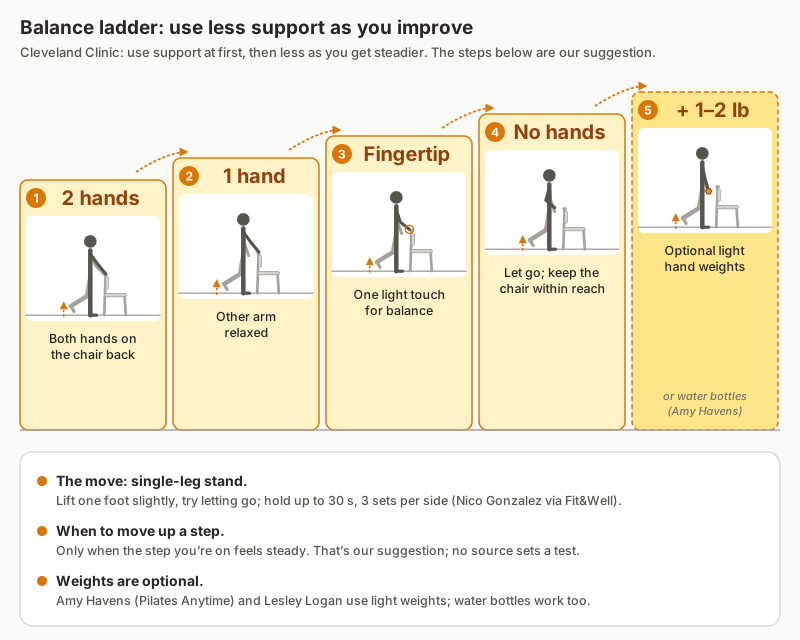
Start with support and use less of it over time. Cleveland Clinic's advice is to begin balance work holding a wall or chair and to rely on it less as you improve. Gonzalez's single-leg stand follows the same idea: hold the chair, then try letting go.
A reasonable progression, in our view:
- Both hands on the chair or counter.
- One hand.
- Fingertips only.
- No hands, with the support still within reach.
If your hips hike or you start wobbling, go back a step.
Tap the diagram to enlarge
How long? Lawrence's and Logan's standing routines each run 15 minutes, and Calhoun's beginner standing class on Pilates Anytime runs 25. Prefer intervals? Eleni Fit's class for Tom's Guide works 40 seconds on, 10 seconds rest.
How often? The US Physical Activity Guidelines say adults need muscle-strengthening activity at least 2 days a week. Standing Pilates can be part of that. For a floor-based beginner routine to alternate with, see our Pilates exercises at home for beginners.
Standing Pilates workout with weights
Light hand weights turn the same routine into more of an upper-body and endurance workout. Pilates Anytime's Amy Havens uses them in her 20-minute "Quick Standing Workout" (intermediate) to "increase intensity and challenge endurance," with balance work for stabilization. No mat is needed, and "even water bottles can substitute." Her class includes:
- Standing footwork with arm patterns and relevé
- Lunges with arm variations
- Triceps work and chest expansion
- Side bends and single-leg balance
Lesley Logan's 15-minute standing workout mixes standing versions of the Hundred and marching with the classical arm-weight series (boxing, arm circles, shave, hug, butterfly, bat, fencing, zipper and more) using light weights or water bottles.
We cover those arm moves step by step in our Pilates arm workout, and how heavy to go in Pilates with weights. Short version: the teachers cited there mostly use 1–2 lb.
A basic neoprene pair is enough. NBC Select calls the Amazon Basics set budget-friendly with no noticeable odor:
Check price on AmazonWant something more Pilates-styled? Women's Health names Bala Bars its best dumbbell for yoga and Pilates.
Check price on AmazonFor more picks, see our best hand weights for Pilates. If gripping is hard, wrist weights such as Bala Bangles are an option. For the leg lifts (moves 6 and 7), see our ankle weight Pilates exercises.
Is standing Pilates good for balance?
Pilates in general seems to help balance in older adults. Whether it prevents falls is less clear, and there's no published research on standing Pilates specifically.
- Sampaio et al. (2023) pooled 20 randomized trials with 930 participants, mean age 63 to 79. The authors report "robust evidence about the efficacy of Pilates intervention programs in improving older adults' balance." In the pooled analysis, 8 of 15 interventions showed a significant effect. Programs were mat, Reformer or both, mostly 2–3 sessions a week, lasting 4–18 weeks.
- de Campos Júnior et al. (2024) reviewed 39 studies with 1,770 participants. Pilates was "significantly superior to control groups" for dynamic, static and general balance. But it showed no effect on falls or fear of falling, and no outcome reached high certainty.
- Barker, Bird and Talevski (2015) found, across 6 studies, that Pilates improved balance compared with inactive controls. They noted limited study quality and that best-practice fall-prevention recommendations were rarely followed.
What about standing work specifically? A registered trial at Pontifícia Universidade Católica do Rio Grande do Sul (NCT03526757) compared Pilates with an emphasis on standing exercises against a standard sequence in 36 women aged 60 and over. It's listed as completed, but no results are posted on the registry page. We found no published study showing standing Pilates beats regular Pilates for balance.
Broader guidance supports staying active. For older adults, the US Physical Activity Guidelines say physical activity "lowers the risk of falls and injuries from falls." Cleveland Clinic notes that falls are the leading cause of injury-related death for adults 65 and older.
On bones, BHOF lists yoga and Pilates as able to "improve strength, balance and flexibility." No source we found shows standing Pilates builds bone density.
Who should modify or skip
- Balance problems: keep a sturdy chair, counter or wall within reach for every move, as Logan, Ryle, Gonzalez and Cleveland Clinic all advise.
- Osteoporosis or low bone density: BHOF advises avoiding bending forward from the waist, sit-ups, crunches and extreme twisting. Skip or modify the roll down (move 1) and keep rotations small (move 4). BHOF suggests a physical therapist can help you pick safe moves.
- Pregnancy: ACOG lists modified Pilates among exercises considered safe and advises avoiding lying flat on your back as much as possible. Standing work avoids that position, but talk with your ob-gyn first, and keep support nearby in case your balance feels different.
- Knee issues: use a shallow plié and lunge, or skip the lunge.
- Anyone: "when in doubt, please leave it out" (Logan).
Printable standing Pilates routine
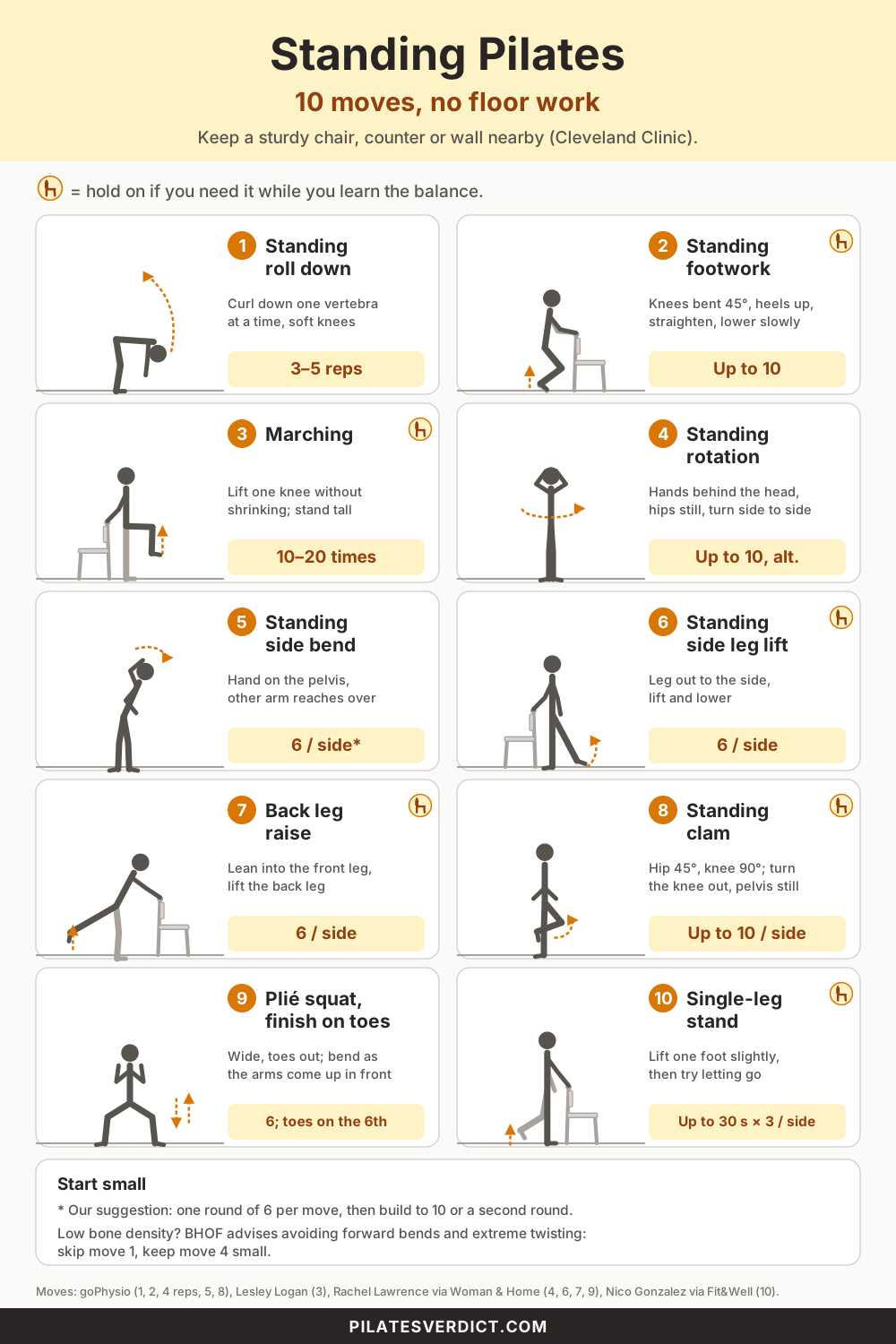
Looking for a standing Pilates exercises PDF? Use the printable chart below. Download the PDF or open the chart on its own page to print it. It lists all 10 moves, the reps and a support option for each.
Tap the diagram to enlarge
More routines live in our Pilates workouts section.
Frequently Asked Questions
What is standing Pilates?
It's Pilates done on your feet: footwork, leg work, side bends and balance moves that keep Pilates' focus on control and core engagement in an upright position, per Woman & Home. Classical teachers use standing footwork and a 'standing ending' to finish Mat or Reformer classes, and Pilates Anytime lists it as its own class category.
Is standing Pilates good for beginners?
It can be. Pilates Anytime has beginner standing classes, and instructor Allie Ryle suggests starting with a wall, counter or chair for support and slow, controlled moves before harder variations. Lesley Logan's rule: 'when in doubt, please leave it out.'
Does standing Pilates improve balance?
Reviews of randomized trials find Pilates in general improves balance in older adults. The largest review, de Campos Júnior et al. (2024), found no effect on falls. We found no published study showing standing-focused Pilates works better than a regular Pilates sequence.
Can you do standing Pilates with weights?
Yes. Pilates Anytime's Amy Havens uses hand weights in a 20-minute standing class to add intensity and endurance, and says water bottles work too. Lesley Logan's standing workout adds the classical arm-weight series with light weights or water bottles.
How long should a standing Pilates workout be?
Rachel Lawrence's and Lesley Logan's standing routines run 15 minutes, Amy Havens' weighted class on Pilates Anytime runs 20, and Gia Calhoun's beginner class runs 25. Fifteen minutes is a reasonable start.
Is standing Pilates as good as mat Pilates?
It's a complement rather than a replacement. Classical teachers such as Kathryn Ross-Nash use a standing sequence to finish a Mat or Reformer class. Standing work keeps you off the floor, which helps if lying down puts pressure on your back (Woman & Home). We found no study comparing the two directly.
Is standing Pilates good for seniors?
It can be a good fit. The balance reviews cited above mostly studied older adults (mean age 63 to 79 in Sampaio et al.) and found Pilates improved balance, though de Campos Júnior et al. found no effect on falls. Instructor Nico Gonzalez's standing balance moves for Fit&Well are aimed at people over 60. Keep a sturdy chair or wall within reach, as Cleveland Clinic advises, and check with your doctor if you've had a recent fall.
Is standing Pilates safe with osteoporosis?
Ask a physical therapist first. The Bone Health & Osteoporosis Foundation advises people with spinal bone loss to avoid bending forward from the waist and extreme twisting, so skip or modify the standing roll down and keep rotations small.
Sources
- OnlinePilatesClasses (Lesley Logan): 15 minute standing Pilates workout
- OnlinePilatesClasses (Lesley Logan): Standing exercises on the mat
- goPhysio (studio content): Top 3 Pilates standing exercises
- goPhysio (studio content): More Pilates exercises in standing
- Woman & Home (Rachel Lawrence, Allie Ryle): This expert instructor's 15-minute standing Pilates workout
- T3 (Lotty Campbell Bird): A Pilates expert says these 7 standing exercises build core strength, balance and stability
- Fit&Well via Yahoo (Nico Gonzalez): A Pilates instructor says these three standing moves are key for improving balance over 60
- Pilates Anytime (Amy Havens): Quick standing workout
- Pilates Anytime (Gia Calhoun): Full-body standing mat
- Pilates Anytime (Adrianne Crawford): Footwork, standing (tutorial)
- Pilates Anytime (Adrianne Crawford): Standing footwork (class)
- Pilates Anytime (Kathryn Ross-Nash): Basic standing ending
- Pilates Anytime: Standing Pilates classes
- PhysicalMind Institute: Joan Breibart
- Tom's Guide (Eleni Fit): This 30-minute standing Pilates workout builds deep strength throughout your whole body
- Sampaio et al., Healthcare (Basel) (2023): The effectiveness of Pilates training interventions on older adults' balance
- de Campos Júnior et al., Complement Ther Clin Pract (2024): Effects of Pilates exercises on postural balance and reduced risk of falls in older adults
- Barker, Bird and Talevski, Arch Phys Med Rehabil (2015): Effect of Pilates exercise for improving balance in older adults
- ClinicalTrials.gov: NCT03526757, Effects of Pilates standing exercises on walking mobility and postural balance
- Cleveland Clinic (Katie Lawton, MEd): Balance exercises to improve stability
- ODPHP: Physical Activity Guidelines, top 10 things to know
- ACOG: Exercise during pregnancy
- Bone Health & Osteoporosis Foundation: Protecting your spine
- Bone Health & Osteoporosis Foundation: Be bone strong: exercise to stay healthy
- NBC Select: Best dumbbells
- Women's Health: Best dumbbells
Update history
- : Published.
Found an error? See how we research and correct guides in our editorial policy.
Was this guide helpful?
Related Articles
How-To
Classical Pilates mat exercises: all 34 in order (+ printable chart)
All 34 classical Pilates mat exercises in Joseph Pilates' original order, with modern names, reps, a printable chart and a beginner sequence.
October 15, 2026 · 20 min read
How-To
Pilates jump board exercises for beginners: an 8-step progression
Eight Pilates jump board exercises for beginners in a safe order, plus what a reformer jump board is, spring tips and what the evidence says on benefits.
October 14, 2026 · 20 min read
How-To
Pilates with weights for beginners: 9-move full-body dumbbell routine
Pilates with weights for beginners: a 9-move full-body dumbbell routine, how heavy to go, what light weights can and can't do, and who should modify.
October 14, 2026 · 20 min read
How-To
Ankle weight Pilates exercises: an 8-move mat routine
Ankle weight Pilates exercises: an 8-move mat routine with reps, how heavy to go, the real benefits of Pilates with ankle weights and who should skip them.
October 13, 2026 · 19 min read