Pilates bar exercises for beginners: an 8-move routine
By The Pilates Verdict Team · October 10, 2026 · 17 min read
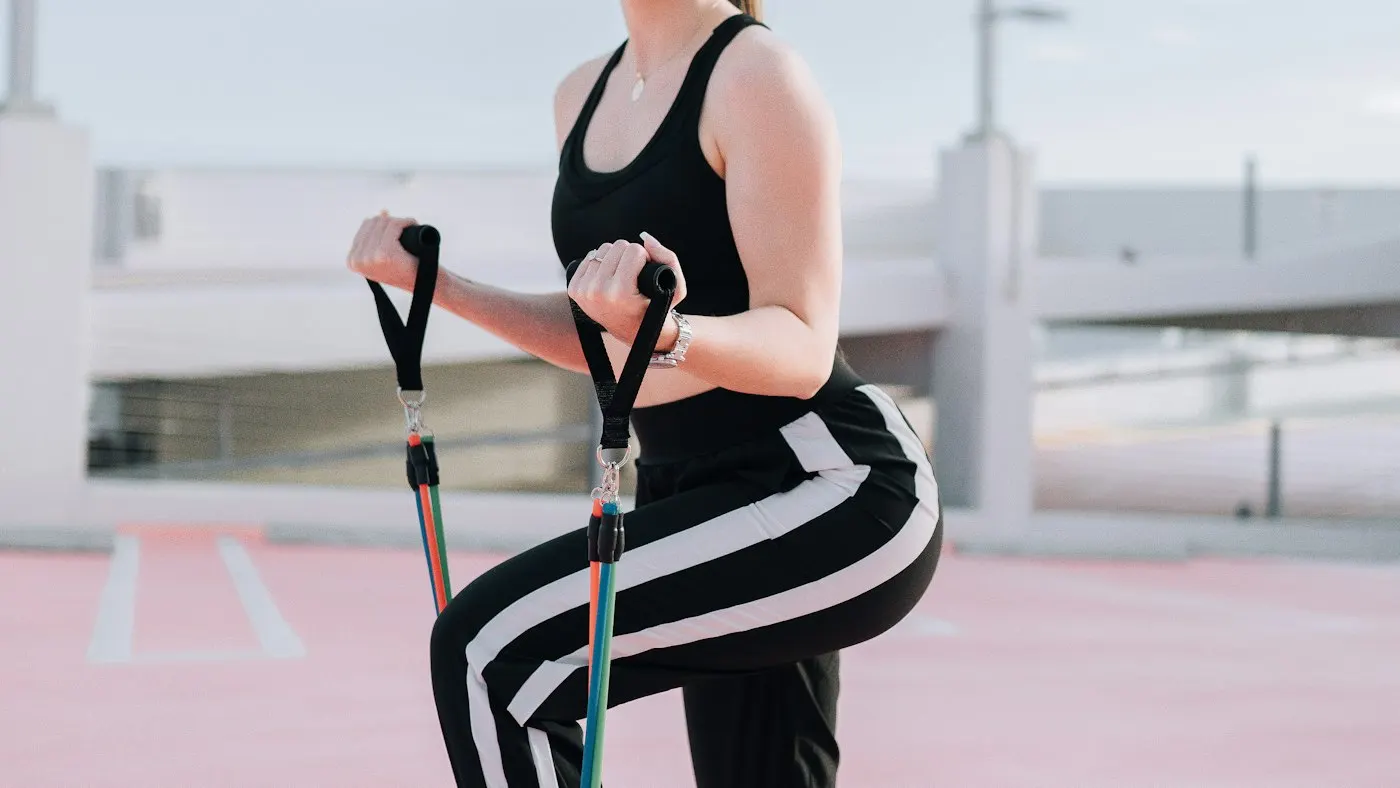
This article contains affiliate links. If you buy through them, we may earn a commission at no extra cost to you. As an Amazon Associate I earn from qualifying purchases. Learn more.
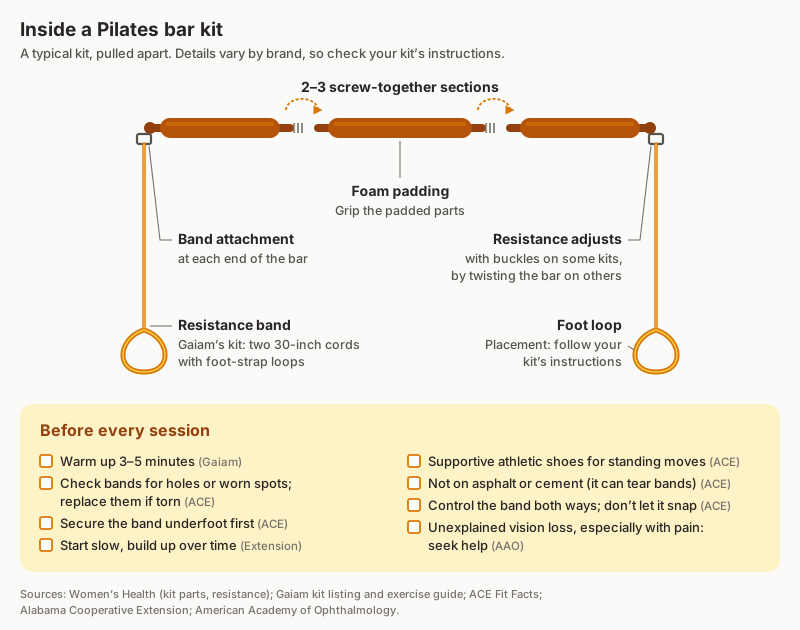
Pilates bar exercises add band resistance to squats, presses and classic mat moves. A typical kit is a light, padded bar, often in three screw-together sections, with resistance bands and foot loops attached. Below is an 8-move beginner routine (four standing moves, four mat moves, about 20 minutes by our estimate), plus setup, band safety and what to do with a plain Pilates stick.
A bar isn't a reformer, and the experts below say so plainly. It still gives your hands and feet something to push and pull against.
Looking for Pilates barre, the ballet-barre class? That's a different workout; this guide covers the portable bar with resistance bands.
How we researched this: The mat moves come from Gaiam's Pilates Bar Exercise Guide (a brand document). The standing moves adapt resistance-band guidance from the American Council on Exercise (ACE) and Alabama Cooperative Extension, holding the bar where the handles would be. Safety and research notes come from AAO, ACOG, ODPHP, the Bone Health & Osteoporosis Foundation and peer-reviewed studies; we don't coach or test workouts or products. All sources are listed at the end.
Quick version:
- What you need: a Pilates bar kit (see best Pilates bar kits), a mat and athletic shoes for the standing moves.
- Reps: one set of 12–15 reps for standing moves (ACE's beginner advice); at least 30 seconds per mat move (Gaiam).
- How often: at least 3 times a week with 24–48 hours between sessions (Gaiam).
- Before every session: check the bands for nicks or worn spots and secure them underfoot (ACE).
- Check first if: you're pregnant, have osteoporosis or low bone density, or have pain or an injury.
What a Pilates bar does (and doesn't do)
Amanda Jane, founder of Studio X Pilates, tells Women's Health that a bar can create "a push/pull opposition which creates resistance beyond body weight." Women's Health lists the core, glutes, legs, back and arms as target areas.
Joan Breibart of the Physical Mind Institute says a bar "can be useful for squats, presses, arm work, leg work and roll-down exercises." She also lists the limits: it "does not create the whole-body feedback of a Reformer. Most exercises remain linear, and the user must continually manage the loose cords and anchors." Jane adds that bars "don't provide as much support as other pilates props."
How to use a Pilates bar: setup and pre-workout checks
Tap the diagram to enlarge
- Assemble the bar following your kit's instructions.
- Inspect the bands. ACE advises checking tubing for holes or worn spots and replacing it if you see tears. A 2026 case report in Case Reports in Ophthalmology recommends routine inspection and replacing damaged bands.
- Set the resistance. Women's Health says some bars adjust with buckles and others by twisting the bar to shorten the bands.
- Secure the bands before you pull. ACE: "Make sure the tubing is secured underfoot or on an anchor before you begin each exercise." For where the foot loops sit, follow your kit's instructions.
- Pick your surface and shoes. ACE says to wear supportive athletic shoes and not to work out on asphalt or cement, because rough surfaces can tear the tubing. Do the mat moves on a Pilates mat.
- Warm up. Gaiam's guide says 3–5 minutes; ACE says 5–10 minutes.
No kit yet? Gaiam's Restore kit includes a bar, two 30-inch cords with foot-strap loops and the exercise guide the mat moves come from:
Check price on Amazon8 Pilates bar exercises for beginners (a 20-minute workout)
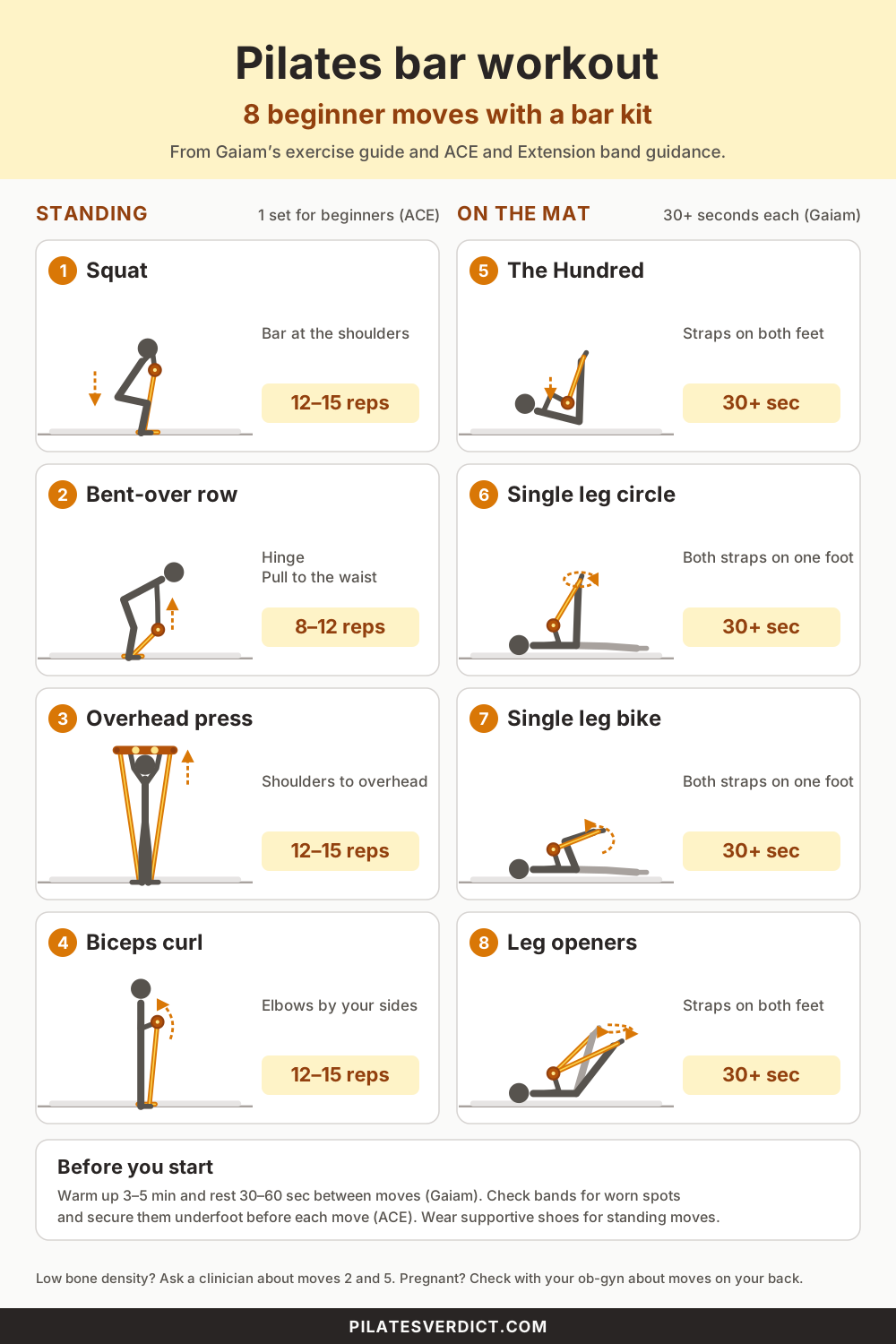
Do the four standing moves first, then lie down for the four mat moves. Move "in a safe and controlled manner," as Gaiam's guide puts it, and rest about 30–60 seconds between moves.
Standing moves
ACE recommends that beginners do one set of 12–15 reps of each strength move (Alabama Extension's row range is lower; see below). Stand on the bands or foot loops and hold the bar where a band's handles would be. These setups are our adaptation of band guidance, not instructions from a single bar-specific source.
1. Squat
Stand on the bands with your feet about shoulder-width apart (ACE) or hip-width apart (Alabama Extension), holding the bar. ACE's cue: "bend as if you are going to sit in a chair," then return to standing, and "keep a flat back and contract your abdominal muscles." Alabama Extension says to lower "as far as comfortable" and come back up slowly.
- Bar position: at the shoulders. Anderson's tip in Marie Claire is to "place the bar across your shoulders and slip your feet into the loops for added resistance."
- Works: legs and glutes (target areas per Women's Health).
- Reps: 12–15 (ACE); Alabama Extension gives 12–16.
2. Bent-over row
With the bands under both feet, hinge forward at the hips with a straight back and slightly bent knees (Alabama Extension). Pull the bar toward your waist, squeezing your shoulder blades together, then lower slowly. Alabama Extension's tip: "Keep your core engaged to protect your lower back."
- Reps: 8–12 (Alabama Extension); ACE's general beginner advice is 12–15.
- Skip or modify if: you have spinal bone loss. The Bone Health & Osteoporosis Foundation advises against bending forward from the waist (see who should modify).
3. Overhead press
Stand on the center of the bands, feet shoulder-width apart, with the bar at your shoulders and palms facing forward. ACE says to press straight up "while keeping your back straight (do not arch your back)," then lower slowly.
- Reps: 12–15 (ACE).
4. Biceps curl
Stand on the bands and hold the bar with palms facing forward (ACE) or up (Alabama Extension), elbows by your sides. Bend only at the elbows and keep your wrists straight.
- Reps: 12–15 for beginners (ACE); Alabama Extension gives 8–12.
- Note: ACE says standing on the center of the tubing to work both arms at once suits light resistance. Start with your lightest setting.
Mat moves
These four come from Gaiam's exercise guide, which gives no rep counts. It's time- and fatigue-based: aim for at least 30 seconds per move. If you can't last 30 seconds, Gaiam says to go more slowly or rest longer. If the move doesn't tire you, go faster or rest less.
5. The Hundred (Pilates 100)
Lie on your back with the foot straps on both feet, legs raised as shown in Gaiam's exercise guide, arms extended by your sides holding the bar. Lift your head and shoulders and pump your arms while you breathe; Gaiam's guide says "inhaling and exhaling through nose."
- Time: at least 30 seconds (Gaiam).
6. Single leg circle
Lie on your back with one leg in the air and the other extended on the floor, both straps on the raised foot. Circle the raised leg in both directions, then switch sides (Gaiam).
- Time: at least 30 seconds (Gaiam).
7. Single leg bike
Keep both straps on one foot with that leg in the air, and move it in a bicycle-pedaling motion (Gaiam). Switch legs.
- Time: at least 30 seconds (Gaiam).
8. Leg openers
With the straps on your feet, extend your legs together with toes turned out. Open and close your legs in a controlled motion, squeezing as you close (Gaiam).
- Time: at least 30 seconds (Gaiam).
Next steps: roll up, double leg stretch, leg circles, hip lifts
Gaiam's guide lists four more mat moves you can add once the routine feels easy:
- Roll ups: lie with legs extended, toes pointed and the bar overhead, abs contracted. Roll up to sitting, bringing the bar toward your feet.
- Double leg stretch: curl into a ball with straps on both feet, knees to chest and head lifted. Extend your arms and legs ("inhale and lengthen"), then exhale and pull back in.
- Leg circles: head lifted, legs extended together with straps on both feet. Open the legs, lower them and circle in a controlled motion.
- Controlled hip lifts: lie on your back with the bar on the floor under your hips and thighs, gripped by your hands, arms to the sides and legs in the air. Use the bar for support, reach with your arms and lift your hips.
The roll up and double leg stretch involve curling the spine forward, as does the Hundred. People with osteoporosis should check with a professional first (see below).
Pilates bar workout at a glance
| Move | Setup | Dose | Source |
|---|---|---|---|
| Squat | Bands underfoot, bar at shoulders | 12–15 reps | ACE |
| Bent-over row | Bands underfoot, hinge | 8–12 reps | Extension |
| Overhead press | Bands underfoot | 12–15 reps | ACE |
| Biceps curl | Bands underfoot | 12–15 reps | ACE |
| Hundred | Straps on both feet | 30+ sec | Gaiam |
| Single leg circle | Both straps, one foot | 30+ sec | Gaiam |
| Single leg bike | Both straps, one foot | 30+ sec | Gaiam |
| Leg openers | Straps on feet | 30+ sec | Gaiam |
Tap the diagram to enlarge
How often to do it, and how to progress
- Frequency: Gaiam's guide says to train at least three times a week, with 24–48 hours of rest between sessions. US Physical Activity Guidelines from ODPHP call for muscle-strengthening activity on at least two days a week, alongside 150–300 minutes of moderate aerobic activity. A bar routine can count toward the strength part.
- Sets: ACE suggests one set of 12–15 reps for beginners, 1–2 sets for people with up to three months of lifting experience, and 2–3 sets after that.
- Pace: Alabama Extension's advice is to "start slow, and build up strength over time."
- Resistance: move to a heavier band setting only once you can finish your sets with good form. That's our suggestion, in line with ACE's slow-and-controlled guidance.
- Stretch: ACE suggests stretching after each set and at the end.
10-minute Pilates bar workout
Short on time? Do one set of the four standing moves (squat, bent-over row, overhead press, biceps curl), then two mat moves: the Hundred and leg openers. That's about 10 minutes by our estimate. Keep the warm-up.
Band safety
Resistance bands can snap. ACE frames its tubing tips as a way to keep "the tube from snapping into your face":
- Check for holes or worn spots before each session, and replace tubing with tears.
- Don't work out on asphalt or cement.
- Wear supportive athletic shoes.
- Secure the tubing underfoot or on an anchor before each exercise.
- Move slowly and with control in both directions.
The American Academy of Ophthalmology describes a flight attendant who lost vision in one eye after a resistance band snapped back. Its advice: "any unexplained loss of vision, especially coupled with pain, means it's time to seek help." A 2026 case report by Chen and colleagues recommends that bands "undergo routine inspection for damage and be replaced if compromised."
Some kits advertise fabric sleeves over the bands to limit snap-back. That's a brand claim; we found no independent test of it.
Pilates stick exercises with a pole or dowel
Some people searching for Pilates stick exercises mean a plain pole, not a bar kit. Roxy Menzies writes on the Pilates Anytime blog that "Poles are used on the Reformer and incorporated into Mat group classes as well as private sessions. Poles provide feedback and stability for those with a balance weakness and add challenge to the advanced practitioner."
- Substitutes: Menzies says "A 4-foot dowel or a broomstick are the best alternatives." Use a broomstick without rubber ends only on carpet.
- Uses: Alison Manheim, also on Pilates Anytime, says "Short, weighted poles can stand in for the Cadillac's Roll Back Bar in exercises such as Breathing and Thigh Stretch." She adds that holding a pole during the roll up adds resistance on the way up and deepens the forward stretch.
- Hip hinge: Sherri Betz (Polestar Pilates) uses a dowel to teach the hip hinge in her "Osteoporosis Safe" Bone Building class on Pilates Anytime.
- Studio version: Balanced Body's Gondola Pole is 5 feet long and 1.25 inches thick, made of solid maple with rubberized ends, per the brand. It's sold as a balance aid for standing reformer work and arm and core exercises, and priced through a local rep.
What the research says
We found no studies of Pilates bar kits themselves, so we can't point to results for this routine.
The closest evidence is one small study. Castro and colleagues (Pain Management, 2022) randomized 22 postmenopausal women with chronic low back pain to Pilates with or without elastic resistance, twice a week for 8 weeks. "Both groups had lower pain intensity and functional disability and increased lumbar strength," the authors report. The elastic-resistance group showed better responses on some blood markers. No bar was used, and the group was small and specific, so don't read much into it for your own workouts.
For Pilates in general, a 2016 meta-analysis of 9 randomized trials in healthy adults (Campos and colleagues) found that mat or apparatus Pilates 2–3 times a week for 5–12 weeks improved abdominal muscular endurance compared with no exercise.
Who should modify
- Osteoporosis or low bone density: the Bone Health & Osteoporosis Foundation says people with spinal bone loss should not "bend forward from the waist," "twist and bend at the torso (trunk) to an extreme," or "do toe-touches, sit-ups or abdominal crunches." That affects the Hundred, roll up and double leg stretch (spinal flexion) and the bent-over row (forward hinge). Ask a physical therapist which moves suit you.
- Pregnancy: ACOG lists modified Pilates as generally safe and advises avoiding lying flat on your back as much as possible (we could read only a snippet of its FAQ). Four of the eight moves here are done on your back. Get clearance from your provider, and favor the standing moves.
- Pain or injury: Alabama Extension says "If any exercise causes sharp pain or doesn't work for your body because of an injury, skip it or modify it for safety." Gaiam's guide says to consult your health care professional before starting any exercise program.
Should you get a Pilates bar kit for this routine?
Bottom line: a bar kit is a cheap way to add resistance to mat Pilates, not a reformer substitute. Skip it if you want reformer-style support or you're tall enough that the bands run short; see reformer vs Pilates board instead.
Any kit with foot loops and adjustable bands can do this routine. The main thing to check is height. The one kit with a listed range we found, COFOF, gives about 5'2" to 5'8" in its Amazon listing (we saw only a snippet), and no kit we researched publishes a verified fit for taller users. If you're over about 5'8", check the listing's height range or bar length before you buy.
Gaiam's Restore kit pairs its bar with two 30-inch cords with foot-strap loops, and its exercise guide is where the mat moves above come from:
Check price on AmazonFor padded, heavier-band and multi-band options, see our best Pilates bar kits. New to Pilates? Our Pilates exercises at home for beginners routine covers the bodyweight basics, and best resistance bands for Pilates covers bands without a bar. More routines live in our Pilates workouts section.
Frequently Asked Questions
How do you use a Pilates bar for beginners?
Secure the bands under your feet or in the foot loops, check them for wear, and start with light resistance and slow, controlled reps, as ACE advises for tubing. Gaiam's guide recommends a 3–5 minute warm-up, 30–60 seconds of rest between moves, and at least three sessions a week with 24–48 hours between them. ACE suggests beginners do one set of 12–15 reps of each strength move.
What exercises can you do with a Pilates bar?
The Physical Mind Institute lists squats, presses, arm work, leg work and roll-downs. Gaiam's exercise guide adds mat moves with the foot straps: the Hundred, single leg circle, single leg bike, double leg stretch, leg circles, leg openers, roll ups and hip lifts.
Can a Pilates bar replace a reformer?
No. A bar gives your hands and feet something to push and pull against, but the Physical Mind Institute says it "does not create the whole-body feedback of a Reformer," and most moves stay linear. An instructor quoted by Women's Health notes bars offer less support than other Pilates props.
Are Pilates bar resistance bands safe?
Generally, if you inspect them and use them carefully. ACE advises checking for holes or worn spots, replacing torn tubing and securing it underfoot before each exercise. The American Academy of Ophthalmology describes a serious eye injury from a band that snapped back, and advises getting help for any unexplained vision loss, especially with pain.
Is a Pilates bar good for beginners?
Women's Health says bars suit beginners as well as regular practitioners working out between classes. Rachel Lawrence ("The Girl With The Pilates Mat") tells Marie Claire UK it's important to build your mat foundation with consistent practice before adding props. Start with the lightest band setting and one set per move (ACE).
Is a Pilates bar worth it?
It can be, if you want portable resistance for mat work. Women's Health says bars suit beginners as well as regular practitioners. The Physical Mind Institute says a bar is useful for squats, presses, arm work, leg work and roll-downs, but it doesn't give the whole-body feedback of a reformer, most moves stay linear and you have to manage loose cords. Check height fit too: the one listed range we found (COFOF, from an Amazon listing snippet) is about 5'2" to 5'8".
How often should I do a Pilates bar workout?
Gaiam's guide says at least three times a week with 24–48 hours of rest between sessions. US Physical Activity Guidelines call for muscle-strengthening activity on at least two days a week. Studies of general Pilates have used 2–3 sessions a week.
Sources
- Gaiam (brand): Pilates Bar Exercise Guide (PDF) and downloadable guides
- American Council on Exercise, Fit Facts, 2002 (excerpted from Suzanne Schlosberg, Fitness for Travelers): Resistance tubing workout (PDF)
- Alabama Cooperative Extension System (Erin Reznicek): Stronger every move: resistance-band exercises
- Physical Mind Institute (Joan Breibart): Pilates reformer alternatives
- Women's Health via Yahoo Shopping (Korin Miller; expert Amanda Jane): The best at-home Pilates bars
- Marie Claire UK (Lottie Anderson, Rachel Lawrence; search snippet only): 7 Pilates bar exercises
- Pilates Anytime (Roxy Menzies): Easy Pilates prop alternatives you can find at home
- Pilates Anytime (Alison Manheim): Top 10 Pilates props and accessories for mat classes
- Pilates Anytime (Sherri Betz): Bone Building class
- Balanced Body (brand): Gondola Pole
- Castro et al., Pain Management (2022): Pilates with and without elastic resistance in postmenopausal women with low back pain
- Campos et al., J Sports Med Phys Fitness (2016): Pilates and physical conditioning in healthy adults, meta-analysis
- American Academy of Ophthalmology (Jennifer Churchill; reviewed by Jeff H. Pettey, MD): Exercise band causes blinding eye injury
- Chen et al., Case Rep Ophthalmol (2026): Giant retinal hole and retinal detachment following exercise band injury
- ODPHP: Physical Activity Guidelines, top 10 things to know
- Bone Health & Osteoporosis Foundation: Protecting your spine
- ACOG (search snippet only): Exercise during pregnancy
Update history
- : Published.
Found an error? See how we research and correct guides in our editorial policy.
Was this guide helpful?
Related Articles
How-To
Pilates band exercises for beginners: a 10-move routine
10 beginner Pilates band exercises with where the band goes, reps from Merrithew and Pilates instructors, band safety tips and what the research says.
October 10, 2026 · 21 min read
How-To
Pilates foam roller exercises: 10 beginner moves + printable chart
10 Pilates foam roller exercises for beginners: where the roller goes, reps and easier versions from Merrithew and Pilates Anytime, plus a printable chart.
October 10, 2026 · 17 min read
How-To
28-Day Wall Pilates Challenge: A Free Schedule and What to Expect
Free 28-day wall Pilates challenge options, a 4-week schedule with rest days, 8 sourced moves, and what 28 days can realistically change.
October 7, 2026 · 16 min read
How-To
Pilates ball exercises: a 10-move mini ball routine for beginners
10 Pilates ball exercises for beginners, with where the mini ball goes, reps and easier versions from named instructors, plus size, inflation and safety tips.
October 7, 2026 · 18 min read