Pilates band exercises for beginners: a 10-move routine
By The Pilates Verdict Team · October 10, 2026 · 21 min read
This article contains affiliate links. If you buy through them, we may earn a commission at no extra cost to you. As an Amazon Associate I earn from qualifying purchases. Learn more.
Pilates band exercises bring some reformer-style resistance to mat work, and doing Pilates with resistance bands needs only a mat and a band. Merrithew, the company behind STOTT PILATES, says its Flex-Band lets you "add upper-and lower-body resistance training into your Matwork routines."
A band doesn't only make moves harder. It can also help you through moves you can't do on your own yet, like the roll-up. Beginners should learn both uses.
Below is a beginner resistance band Pilates routine of 10 moves from Merrithew's official band guide and Pilates instructors, with where the band goes and the reps each source gives. The whole routine takes roughly 20 minutes (our estimate).
How we researched this: The moves and reps come from Merrithew's official Flex-Band exercise guide, Pilates Anytime (instructor Alison Manheim), Complete Pilates (clinical Pilates instructor Lily Holt) and Woman & Home (Pilates instructors Noemi Nagy-Bhavsar and Lottie Anderson), plus Peloton for the bridge. Band-safety advice comes from the manufacturer TheraBand and its parent company, Performance Health, and the grip tip from Tom's Guide. The research section draws on peer-reviewed studies, and the safety notes on ACOG and the Bone Health & Osteoporosis Foundation. We don't coach or test workouts. Every source is listed at the end.
Quick version:
- What you need: a long, flat, light or medium band (about 5 ft or longer), a mat, and a loop band if you want to add move 10 or the clamshell.
- Reps: as given for each move. Start with one round.
- How often: US guidelines call for muscle-strengthening activity on at least 2 days a week. This routine can be one of them.
- Check first if: you're pregnant, have osteoporosis, or are allergic to latex.
What a band adds to Pilates
Resistance or assistance
A band works two ways:
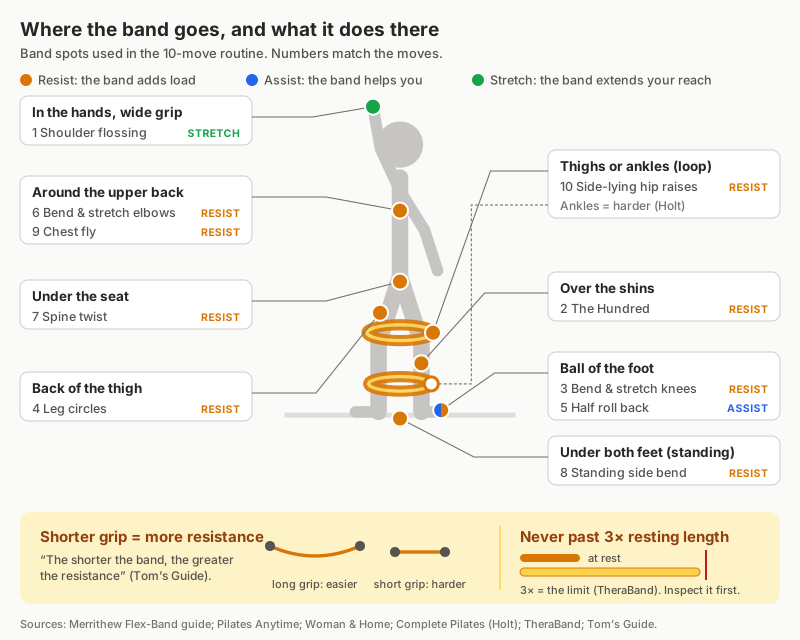
- Resistance: you press or pull against it. Merrithew's footwork-style leg presses and arm work use the band this way.
- Assistance: it supports you through a move. Pilates Anytime's Alison Manheim uses a five-foot band to help with the roll-up, and says you progress by relying less on the band and more on your core. Merrithew's Half Roll Back also tells you to "use Flex-Band exerciser for support."
Lily Holt, a clinical Pilates instructor at Complete Pilates in the UK, says bands "can encourage proper form and increase body awareness" and are "a great prop to use in addition to any mat session when you're at home or travelling."
Long band or loop
Most of this routine uses a long, flat band. Manheim's routine calls for a five-foot band, and Merrithew's guide uses its long Flex-Band throughout (200 cm, or about 6.5 ft, per Merrithew). Loop bands are for leg moves: Holt loops one around the thighs or ankles for side-lying work.
Is it a mini reformer?
Not quite. Merrithew says the band can "simulate the flexibility and resistance exercises performed on the Reformer." That's a brand claim, and it says simulate, not replace.
Pick your band strength first
Holt says: "A light or medium resistance band is usually the best place to start. It provides enough challenge to build strength while allowing you to maintain good posture and technique."
NBC Select's Pilates-certified trainer Stephanie Mansour goes lighter still. She suggests starting with "the lowest strength band," one you "can stretch completely to the end of a move."
Band strengths go up in steps. TheraBand's parent company, Performance Health, says its "first six color-coded levels all increase 25% in resistance from the previous level at 100% elongation." Merrithew sells its Flex-Band as a two-pack because "the upper and lower-body often require different levels of resistance."
You can also change the load with your grip. Tom's Guide puts it simply: "The shorter the band, the greater the resistance." When the band is assisting you, a shorter grip gives more help instead. For her assisted roll-up, Manheim says to "choke up on the band until you feel some tension" and use it to help you back up. For the one-leg teaser, she says you "can hold the band lower if you don't need as much help."
How to hold it
Merrithew's guide gives two rules:
- "Keep the wrist and finger joints as neutral as possible. Avoid wrapping the band around the hands or bending the wrists."
- "When placing the band around the feet, spread it out to keep it from rolling into a thin cord." Manheim agrees: "Keep the band as wide as possible" so it doesn't slip.
Need a band? Merrithew's Flex-Band two-pack is the one used in most of this routine, with a lighter band for arms and a stronger one for legs.
Check price on AmazonFor more options, see our best resistance bands for Pilates.
Tap the diagram to enlarge
10 Pilates band exercises for beginners
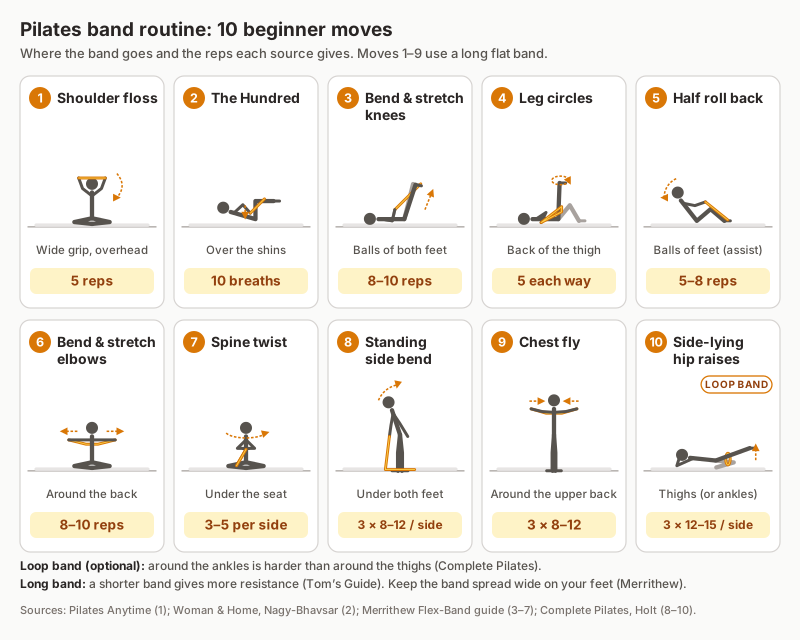
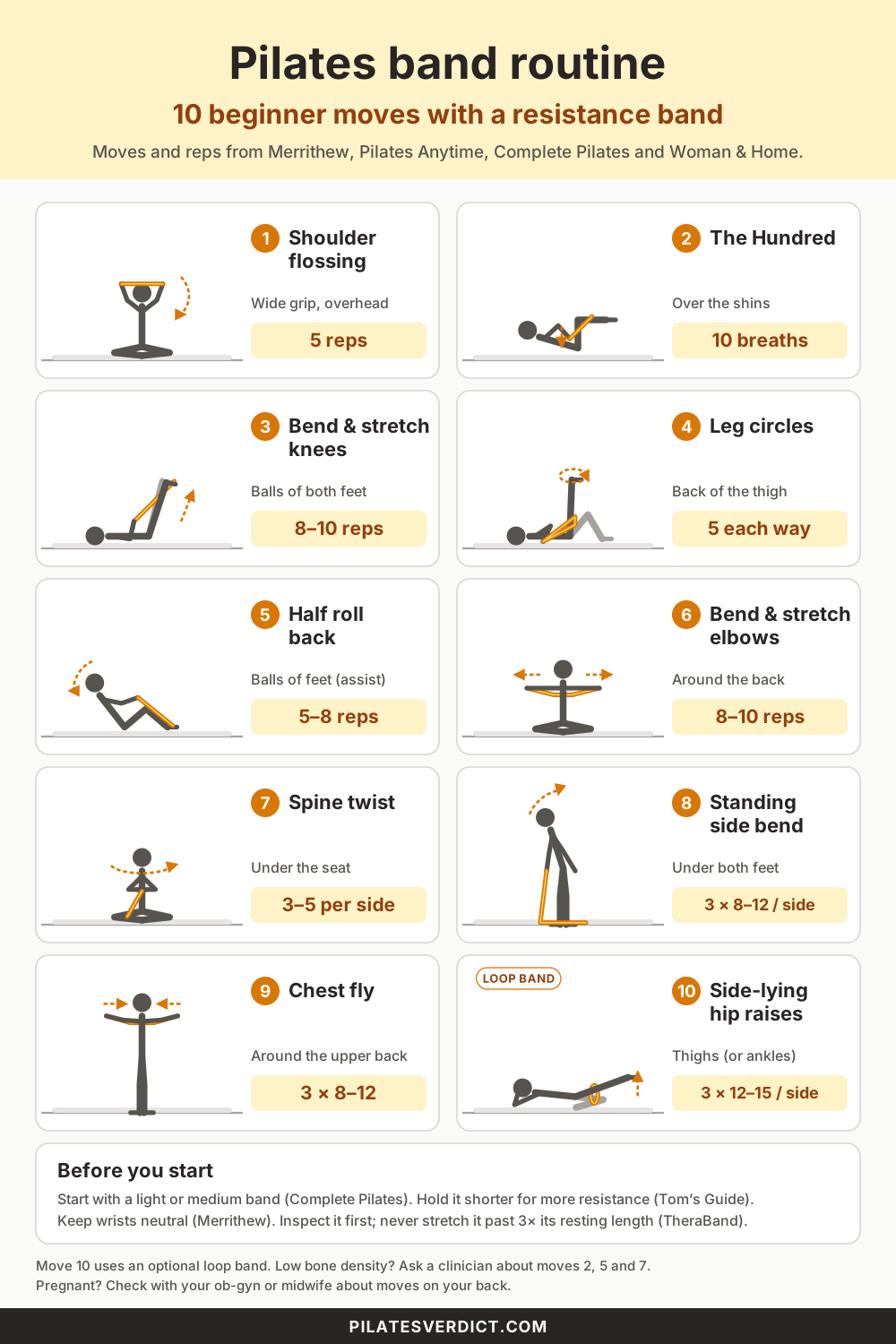
The routine starts seated, moves to lying on your back, then back up to sitting and standing, and finishes with one optional loop-band move. Move slowly, and stop any move that causes pain.
Tap the diagram to enlarge
1. Shoulder flossing (warm-up)
Sit cross-legged and hold the band a little wider than shoulder width. Inhale and reach forward, then overhead. Exhale and lower the band behind your head and shoulders, "only as far as is comfortable." Inhale back overhead and exhale back to the start. If you can't get the band behind you, widen your grip.
- Band: in both hands.
- Reps: 5 (Pilates Anytime).
- What you should feel: "Your shoulders should feel more open" (Manheim).
2. The Hundred
Woman & Home's version comes from Pilates instructor Noemi Nagy-Bhavsar, founder of Beyond Move Studio. Lie on your back with your legs lifted in what Woman & Home calls a "reverse tabletop" position. Place the band over your shins and hold one end in each hand. As you exhale, curl your head, neck and shoulders off the mat and press your shins into the band. Hold that shape while you pump your arms quickly up and down, breathing in for a count of five and out for a count of five.
- Band: over the shins, one end in each hand.
- Reps: 10 rounds of that five-in, five-out breath (Woman & Home).
- Why the band: Nagy-Bhavsar says pressing the shins "slightly into the band" helps "'switch off' overactive hip flexors," so your deep abdominals do more of the work.
- Skip if: you have osteoporosis. The curl-up is a crunch-like move. See the safety section.
3. Bend and stretch knees
This is Merrithew's footwork-style move. Lie on your back with your lower back flattened toward the mat. Lift both legs with your knees bent, the band around the balls of your feet and your elbows bent at your sides. Exhale and straighten your legs toward the ceiling, and "do not let back arch up off mat." Inhale and bend.
- Band: balls of both feet.
- Reps: 8–10 (Merrithew).
- Works: abs and legs (Merrithew).
- Easier: use a lighter band or a longer grip.
4. Leg circles
Lie on your back with one foot lifted. Merrithew wraps the band around the back of that thigh and crosses it in front, with your arms out to the side. Circle the leg out and away, then across your midline and back up, "keeping torso, and especially pelvis, still."
- Band: around the back of the thigh, crossed in front.
- Reps: 5 circles each direction, both legs (Merrithew).
- Alternative: Manheim puts the band around the sole of the foot with your elbows at your sides and cues "tracing a Magic Circle on the ceiling," 5 each way.
- Easier: make the circles smaller.
5. Half roll back (band-assisted)
Sit tall with your knees bent, feet hip-width apart and the band around the balls of your feet. Exhale, curve your spine and roll back "as far as possible while keeping feet on mat. Use Flex-Band exerciser for support." In Merrithew's version, you bend and straighten your elbows 3 times at the bottom, then inhale and roll back up. If that's too much at first, our suggestion is to leave out the elbow bends until the roll back feels steady.
- Band: balls of both feet, as support.
- Reps: 5–8 (Merrithew).
- Works: abs and arms (Merrithew).
- Skip if: you have osteoporosis. See the safety section.
6. Bend and stretch elbows
Sit tall with your legs crossed. If that's hard, Merrithew suggests sitting on a pillow, a large book or a chair. Put the band around your back and hold the ends with your elbows bent at your sides. Exhale and reach your arms out to the sides, palms up, keeping your torso still. Inhale and bend.
- Band: around your upper back.
- Reps: 8–10 (Merrithew).
- Works: arms (Merrithew).
7. Spine twist
Sit tall with your legs crossed, sitting on one end of the band. Hold the other end with your arms "forming a circle in front of body," starting rotated toward the band side. Exhale and rotate toward the opposite leg, hands in front of your breastbone. Inhale and return.
- Band: under your seat, other end in your hands.
- Reps: 3–5 per side (Merrithew).
- Works: obliques (Merrithew).
- Skip or ask a PT if: you have osteoporosis. It's a twisting move.
8. Standing side bend
Stand on the band with both feet and hold the other end in one hand with some tension. Keep your hips still, bend slowly to the side, then come back up, pulling with a straight arm.
- Band: under both feet, end in one hand.
- Reps: 3 sets of 8–12 per side (Complete Pilates).
- Cue: Merrithew's blog, describing a kneeling version, advises: "Keep your spine long and avoid collapsing into the movement."
9. Chest fly
Kneel or stand. Holt suggests a split stance, dominant leg behind, if you want a more stable base when standing. Loop the long band behind your upper back, across your shoulder blades, and hold one end in each hand, either looped around your thumbs or gripped in a fist. Start with your arms reaching out to the sides at shoulder height, with some tension on the band. Keeping your elbows soft, draw your arms together without bending your elbows further, then slowly bring them back out, controlling the band.
- Band: around the upper back, ends in your hands.
- Reps: 3 sets of 8–12 (Complete Pilates).
10. Side-lying hip raises (loop band, optional)
Loop the band around your thighs or ankles. Lie on your side with your bottom leg bent. Lift and lower your top leg with control, keeping your pelvis and trunk steady.
- Band: loop around the thighs (easier) or ankles ("more difficult," per Holt).
- Reps: 3 sets of 12–15 per side (Complete Pilates).
Pilates band workout at a glance
| Move | Band placement | Reps | Source |
|---|---|---|---|
| 1. Shoulder flossing | Hands | 5 | Pilates Anytime |
| 2. The Hundred | Over shins | 10 breaths | Woman & Home |
| 3. Bend and stretch knees | Balls of feet | 8–10 | Merrithew |
| 4. Leg circles | Back of thigh | 5 each way | Merrithew |
| 5. Half roll back | Balls of feet | 5–8 | Merrithew |
| 6. Bend and stretch elbows | Around back | 8–10 | Merrithew |
| 7. Spine twist | Under seat | 3–5/side | Merrithew |
| 8. Side bend | Under feet | 3 × 8–12/side | Complete Pilates |
| 9. Chest fly | Around back | 3 × 8–12 | Complete Pilates |
| 10. Hip raises | Loop, thighs | 3 × 12–15/side | Complete Pilates |
Tap the diagram to enlarge
More Pilates band exercises to try
Once the routine feels familiar, these three moves fill gaps it leaves: two glute moves and one upper-back pull.
Clamshell with a loop band
Woman & Home's version comes from Lottie Anderson, founder of Bondi Rise. Place a band around your thighs just above the knees. Lie on your side with your knees bent and hips stacked, propped on your elbow with your other hand on your hip. Keeping your feet together, rotate your top hip to point the knee up, then lower.
- Band: loop around the thighs, just above the knees.
- Reps: the article doesn't give a number. Our suggestion is to match move 10.
- Why the band: Anderson says it "provides immediate feedback if [for instance] your hips start to roll backwards."
Banded glute bridge
Peloton's version: lie on your back with your feet flat on the floor. Loop a band over your hips, holding the ends in your hands and pressing your palms into the floor. Squeeze your glutes and slowly lift your hips, pushing your legs against the band.
- Band: across the hips, ends pinned under your palms.
- Reps: hold for 20–30 seconds (Peloton). Peloton says you can also lift and lower for reps.
- Skip or modify if: you're pregnant. It's done on your back.
Bent-over shoulder fly
This one comes from Complete Pilates. Hold a long band at each end. Bend your knees into a quarter squat and lean forward from your hips with a straight back. Start with your arms reaching ahead at the midline, then pull the band out to the sides with both hands. Control it on the way back.
- Band: in both hands.
- Reps: 3 sets of 8–12 (Complete Pilates).
- Ask a PT if: you have osteoporosis. It's a forward-leaning move.
Which resistance band to use for Pilates
Short answer: get a long, flat, light or medium band. That covers moves 1–9. Merrithew's Flex-Band two-pack is the band behind most of this routine. It comes with a regular and an extra-strength band, so you can use the lighter one for arms and the heavier one for legs.
Check price on AmazonIf you're allergic to latex, pick a latex-free band. For move 10 and the clamshell, add a set of loop bands.
Merrithew STOTT PILATES Flex-Band Two-Pack (Regular + Extra Strength)
- Best for
- Main pick: two strengths, used in Merrithew's guide
- Price tier
- $10–30
THERABAND Non-Latex Resistance Band Beginner Kit (Yellow, Red, Green)
- Best for
- Latex-free set of three strengths
- Price tier
- $15–30
Merrithew STOTT PILATES Non-Latex Flex-Band
- Best for
- Latex-free single band from Merrithew
- Price tier
- $10–20
Fit Simplify Resistance Loop Exercise Bands (set of 5)
- Best for
- Budget loops for move 10 and the clamshell
- Price tier
- Under $15
BetterMe Pilates Loop Bands (set of 3)
- Best for
- Fabric loops that stay put
- Price tier
- $25–50
| Product | Best for | Price tier | |
|---|---|---|---|
| Merrithew STOTT PILATES Flex-Band Two-Pack (Regular + Extra Strength) | Main pick: two strengths, used in Merrithew's guide | $10–30 | View |
| THERABAND Non-Latex Resistance Band Beginner Kit (Yellow, Red, Green) | Latex-free set of three strengths | $15–30 | View |
| Merrithew STOTT PILATES Non-Latex Flex-Band | Latex-free single band from Merrithew | $10–20 | View |
| Fit Simplify Resistance Loop Exercise Bands (set of 5) | Budget loops for move 10 and the clamshell | Under $15 | View |
| BetterMe Pilates Loop Bands (set of 3) | Fabric loops that stay put | $25–50 | View |
Need a mat too? See our best Pilates mats. Browse more routines in Pilates workouts.
How often to do it, and how to progress
US guidelines from ODPHP recommend muscle-strengthening activity on at least 2 days a week, plus 150–300 minutes of moderate aerobic activity. A band routine can be one of those strength days, but it isn't a whole program.
The sources give different rep ranges: Merrithew 3–10 per move, Pilates Anytime 5–8, and Complete Pilates mostly 3 sets. Our suggestion is to start with one round of everything and add rounds or sets as the moves get easier.
When the routine feels easy, the sources suggest these next steps:
- Shorter grip or stronger band: a shorter band means more resistance (Tom's Guide), and Merrithew's two-pack gives you a stronger second band.
- Full roll-up with assist: Manheim rolls all the way down until your head rests on the mat, 5–8 reps.
- Leg lift and lowers: Holt keeps the band around the feet, 3 sets of 5–8, lowering only "as far as you can before your back wants to arch."
- The Hundred with an anchored band: Holt anchors a long band to a sturdy post, 3 sets of 5–8.
- One-leg teaser with assist: 5 per leg (Manheim).
For more mat routines, try Pilates ring exercises or Pilates ball exercises.
Band safety
Bands are simple, but they can snap. The manufacturers' advice:
- Check it every time. TheraBand says: "Inspect the product for damage before and after each use… Do not use if torn, punctured or nicked." Merrithew says not to use the Flex-Band "if it appears worn, or damaged."
- Don't over-stretch. TheraBand's care page says not to stretch a band "more than 3 times its length at rest."
- Keep it away from your face. TheraBand: "Do not use the band in any way that may cause it to snap towards the head and cause injury to the eyes." Don't let go of a band while it's under tension.
- Anchor securely. If you try an anchored progression, TheraBand says to make sure the band "is securely anchored to a sturdy object."
- Move slowly. Merrithew says to "perform exercises in a slow and controlled manner, avoid excessive tension in neck and shoulders." It says to stop if you have chest pain, feel faint, have trouble breathing or feel musculoskeletal discomfort.
- Store and replace. TheraBand says to "store in a cool, dry place, out of direct sunlight." Performance Health says a band "should last for many months" but to "replace it if there are any signs of wear, including cracks, small tears, or abrasions."
- Latex. Many long flat bands, including TheraBand's Professional bands and Merrithew's standard Flex-Band, are natural rubber latex. The American College of Allergy, Asthma and Immunology (ACAAI) says synthetic rubber doesn't trigger natural-latex allergy, and that severe latex reactions can cause anaphylaxis. Latex-free bands are listed below.
Who should modify
Pregnancy
ACOG lists "modified yoga and modified Pilates" among the exercises it says "experts agree" are safest in pregnancy. It also says to "avoid standing still or lying flat on your back as much as possible," and to avoid poses that have you "lie on your back for long periods." Moves 2–5 and the bridge are done on your back. ACOG also says to discuss exercise with your ob-gyn. Get their OK, and ask whether to stick to the seated, kneeling and standing moves (1, 6, 8 and 9).
Osteoporosis or low bone density
The Bone Health & Osteoporosis Foundation says people with spinal bone loss should not "bend forward from the waist" or do sit-ups or crunches, and should avoid extreme twisting. In this routine, that means the Hundred (2), the half roll back (5) and the spine twist (7), plus the roll-up progression. Ask a physical therapist for alternatives.
Pain or loss of form
Holt says: "If you experience pain, loss of form or difficulty maintaining alignment, reduce the resistance or modify the movement."
What the research says
There's little research on band Pilates specifically. Here's what we found.
Bands vs. weights for strength
Lopes and colleagues (SAGE Open Medicine, 2019) pooled 7 randomized trials comparing elastic resistance, such as tubes and Thera-Bands, with weight machines and dumbbells. They found "no superiority between the methods" for lower-limb strength (SMD −0.11, 95% CI −0.40 to 0.19) or upper-limb strength (SMD 0.09, 95% CI −0.18 to 0.35), and concluded that elastic training "is able to promote similar strength gains." A 2020 corrigendum swapped the upper- and lower-limb labels back, fixed a typo in one effect size (−0.011 should have been −0.11) and corrected the study count from 8 to 7. The figures here are the corrected ones.
These were general strength-training studies, not Pilates. And no significant difference across 7 small trials doesn't prove the two methods are equal.
Pilates with bands in older women
Carrasco-Poyatos and colleagues (PeerJ, 2019) randomized 60 women aged 60–80 to Pilates, muscular resistance training or no exercise, twice a week for 18 weeks; 49 finished. The Pilates program added light, then moderate, elastic bands from week 7, for moves such as pelvic curls and assisted roll-ups. The Pilates group's hip extension strength improved more than the control group's, and both exercise groups improved on a balance test (Timed Up and Go) with moderate effect sizes.
It's one small trial, and the bands were only part of the program, so their own effect can't be separated out.
Back pain
In a small randomized trial of 22 postmenopausal women with chronic low back pain (Castro et al., Pain Management, 2022), Pilates with and without elastic resistance both reduced pain and disability. That doesn't show bands treat back pain. If you have back pain, check with a clinician first.
General Pilates
A 2016 meta-analysis of 9 randomized trials in healthy adults (Campos et al.) found that Pilates 2–3 times a week for 5–12 weeks improved abdominal muscular endurance compared with no exercise.
Frequently Asked Questions
What resistance band is best for Pilates beginners?
A light or medium band. Complete Pilates' Lily Holt says that gives 'enough challenge to build strength while allowing you to maintain good posture and technique.' NBC Select's Pilates-certified trainer Stephanie Mansour suggests the lowest strength band, one you can stretch fully through the move. Most mat routines use a long flat band about 5 ft or longer.
Can you do Pilates with just a resistance band?
Yes. A long band covers footwork-style leg presses, leg circles, assisted roll-backs and arm work. Merrithew's official guide builds a routine from those moves, and Pilates Anytime has a five-move routine with one five-foot band. Merrithew says the band can 'simulate' reformer exercises, not that it replaces the machine.
Are resistance band exercises as effective as weights?
For strength, a 2019 meta-analysis of 7 randomized trials found no significant difference between elastic bands and conventional weights for upper- or lower-body strength gains. Those studies weren't Pilates-specific, and the analysis was small.
How many times a week should I do a Pilates band workout?
US guidelines recommend muscle-strengthening activity on at least 2 days a week. In one small trial, older women did Pilates with elastic bands twice a week for 18 weeks and improved hip extension strength compared with a control group.
Is it safe to use a resistance band for Pilates?
Generally, if you check the band and control it. TheraBand says to inspect it before each use, not to stretch it beyond 3 times its resting length, and never to use it in a way that could snap it toward your head. Avoid latex bands if you have a latex allergy. If you're pregnant or have osteoporosis, check with your clinician about moves done on your back and forward-bending or twisting moves.
Sources
- Merrithew (brand): Flex-Band Exerciser exercise guide (PDF)
- Merrithew (brand): Flex-Band Regular Strength
- Merrithew (brand): Flex-Band Two-Pack
- Merrithew blog (Riham Osman; brand): Exercise of the month: side bend with the Flex-Band
- Pilates Anytime (Alison Manheim): 5 Pilates Theraband exercises to bring on your next vacation
- Complete Pilates (Lily Holt; studio content): Pilates resistance band exercises
- Woman & Home (Kerry Law, with instructors Noemi Nagy-Bhavsar and Lottie Anderson): Pilates with resistance bands
- Peloton (Team Peloton and Renee Cherry; brand): Resistance band exercises
- Tom's Guide (Lucy Miller): 5 Pilates exercises you can do with just a resistance band
- NBC Select (Stephanie Mansour): One-month resistance band workout
- TheraBand (manufacturer): Care and safety
- Performance Health (Morgan Callard; manufacturer): What THERABAND resistance band should I buy?
- Lopes et al., SAGE Open Med (2019): Elastic vs. conventional resistance training and muscular strength, meta-analysis and 2020 corrigendum
- Carrasco-Poyatos et al., PeerJ (2019): Pilates versus resistance training in older women
- Castro et al., Pain Manag (2022): Pilates with and without elastic resistance for low back pain
- Campos et al., J Sports Med Phys Fitness (2016): Pilates and physical conditioning in healthy adults, meta-analysis
- ODPHP: Physical Activity Guidelines, top 10 things to know
- ACAAI: Latex allergy
- ACOG: Exercise during pregnancy
- Bone Health & Osteoporosis Foundation: Protecting your spine
Update history
- : Published.
Found an error? See how we research and correct guides in our editorial policy.
Was this guide helpful?
Related Articles
How-To
Pilates bar exercises for beginners: an 8-move routine
8 Pilates bar exercises for beginners: setup, 4 standing and 4 mat moves, reps, band safety and how a bar compares with a reformer, all from named sources.
October 10, 2026 · 17 min read
How-To
Pilates foam roller exercises: 10 beginner moves + printable chart
10 Pilates foam roller exercises for beginners: where the roller goes, reps and easier versions from Merrithew and Pilates Anytime, plus a printable chart.
October 10, 2026 · 17 min read
How-To
28-Day Wall Pilates Challenge: A Free Schedule and What to Expect
Free 28-day wall Pilates challenge options, a 4-week schedule with rest days, 8 sourced moves, and what 28 days can realistically change.
October 7, 2026 · 16 min read
How-To
Pilates ball exercises: a 10-move mini ball routine for beginners
10 Pilates ball exercises for beginners, with where the mini ball goes, reps and easier versions from named instructors, plus size, inflation and safety tips.
October 7, 2026 · 18 min read