28-day chair Pilates challenge: free plan + printable calendar
By The Pilates Verdict Team · October 26, 2026 · 18 min read
This article contains affiliate links. If you buy through them, we may earn a commission at no extra cost to you. As an Amazon Associate I earn from qualifying purchases. Read our affiliate disclosure.
This free 28-day chair Pilates challenge needs no app, subscription or equipment, just a sturdy chair and about 10–20 minutes a day. App ads push paid versions and Pinterest is full of charts, but you don't need either. The moves are standard seated Pilates and physical therapy moves, published for free by Cleveland Clinic, the NHS and Pilates instructors.
This post is the 28-day plan: a week-by-week schedule, a day-by-day calendar, how to progress, and what 28 days can realistically change. For step-by-step instructions on each move, see our chair Pilates guide. Looking for the spring-loaded studio machine instead? See our Wunda Chair exercises.
Quick version:
- Cost: free. No app or equipment, just a steady chair without wheels.
- Time and who it's for: about 10–20 minutes a day (our estimate). It's built for beginners and older adults who want to stay off the floor; check with your doctor first if you have a health condition.
- The plan: 5 chair Pilates days and 2 gentle days a week. Start with 5 moves at 5 reps and build to 10 moves and 2 rounds. See the 28-day plan or grab the free printable calendar (PDF) and move chart (PDF). Prefer fewer sessions? Use the 3-days-a-week track. Want to follow along? The NHS has a free chair-based Pilates video of about 30 minutes.
- What to expect: a habit and better body awareness, not a new body. We found no study of a 28-day chair Pilates challenge.
Prefer to tick days off on your phone? Open the free 28-day chair Pilates challenge tracker. It shows each day's moves and reps with a session timer and saves your progress in your browser. No app or sign-up.
How we researched this: Moves and reps come from Cleveland Clinic physical therapist Tobi Jevnikar, the NHS and Oxford University Hospitals seated exercise programs, Pilates Anytime instructors and University of Melbourne Sport's chair Pilates sheet. Frequency guidance comes from the NHS, the CDC and Cleveland Clinic. Expectations come from an NYU Langone exercise physiologist (via TODAY) and peer-reviewed studies. Safety notes come from the Bone Health & Osteoporosis Foundation and ACOG. We also reviewed the chair challenges that already exist, including app pages and BetterMe's 4-week plan. The 28-day schedule is our editorial example, not an expert-designed program, and we haven't followed it as a test. Every source is listed at the end.
What you need
Just a steady chair without wheels or arms, per Cleveland Clinic and the NHS. Two small props are optional for week 4 and beyond:
For the chest opener
THERABAND Non-Latex Resistance Band Beginner Kit (Yellow, Red, Green)
Sherri Betz's Pilates Anytime chair class uses a Theraband. A light band is one of the week 4 progression options. More picks are in our best resistance bands for Pilates.
For knee squeezes
THERABAND Mini Ball (9")
A 9-inch soft ball squeezed gently between your knees in pelvic tilts and marches (our suggestion, not from the sources). See our best Pilates balls.
Is there a free 28-day chair Pilates challenge?
Not from a credentialed instructor or a reputable health outlet, as far as our research found. Searches for a free version mostly return 28-day wall Pilates plans, 28-day chair yoga PDFs, YouTube "28-day chair workout" challenges for seniors (often pitched for weight loss, and not Pilates-specific), and Pinterest idea boards.
The 28-day format comes from the wall Pilates trend. Garage Gym Reviews describes it as following one program's workout every day for 28 days, each 10–30 minutes long. Our 28-day wall Pilates challenge covers that version.
What we did find:
- Lasta (an app) has a chair Pilates feature page listing seated toning and core moves such as "seated twists and pelvic tilts." It shows no fixed 28-day plan, and it pairs chair Pilates with fasting and calorie tracking.
- Wall Pilates Challenge & Fit (an iOS app by Tropic Innovation) bundles a 28-day wall Pilates program with a 30-day chair yoga challenge. It's free to download with in-app purchases, and its listing says the subscription "automatically renews unless auto-renew is turned off at least 24 hours before the end of the current period."
- BetterMe (an app company) publishes a written 4-week chair Pilates plan for seniors, reviewed by Garett Reid, MSc, CSCS. It isn't daily: it builds from 2–3 sessions in week 1 to 4 sessions in week 4, and it says to "rest at least one day between sessions, especially in the first two weeks."
Several apps advertise chair Pilates or chair yoga challenges. If you sign up for one, check the subscription and cancellation terms first. The plan below is free and built from named physical therapist, NHS and Pilates instructor sources.
Before day 1: chair and setup
- The chair. Jevnikar, for Cleveland Clinic: "Sit in a steady chair with a back and a firm bottom. Not a couch or other chair that you sink into. And nothing on wheels." The NHS chair Pilates video asks for "a flat, firm backrest and a flat, firm seat."
- Your position. The NHS says to sit with your feet flat and knees at right angles, and to avoid chairs with arms.
- Start small. Oxford University Hospitals (OUH) says to "start small and build up gradually." Pilates Anytime's Marchel Ackler suggests "small and gentle movements" and avoiding "excessive twisting or too much flexion."
- Stop signs. The NHS: "Stop the exercise immediately if you feel any pain or become unwell." OUH lists "dizziness, sickness or excessive tiredness" as reasons to stop, and says to seek urgent help for "blacking out, chest pain, or excessive shortness of breath."
The 28-day chair Pilates plan
The sources disagree on how often to do it. The viral 28-day format is daily. OUH says that "ideally you should practise these exercises every day" for its gentle seated program. The NHS suggests seated exercise at least twice a week, and BetterMe's plan builds from 2–3 to 4 sessions a week.
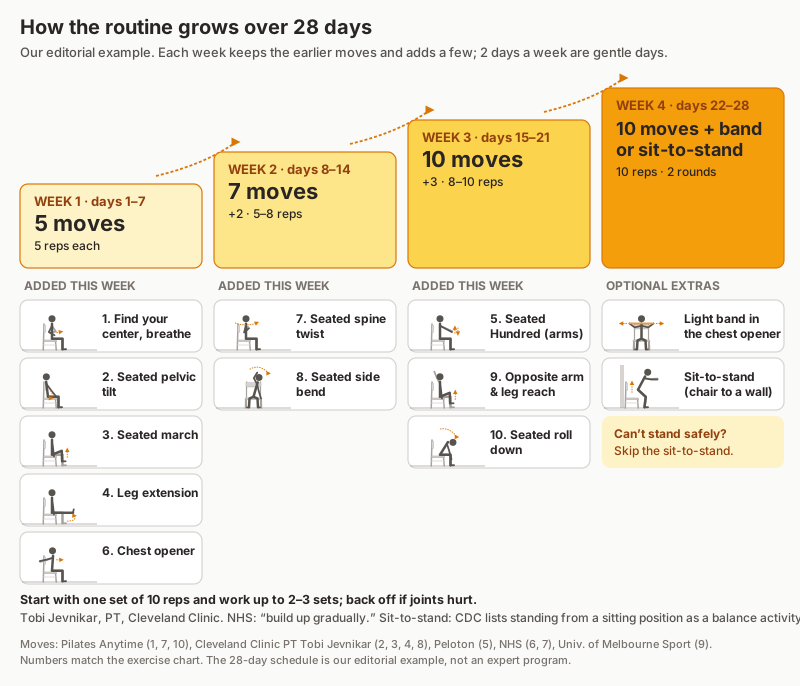
Our plan sits in the middle: 5 chair Pilates days and 2 gentle days each week (the 4th and 7th day of each week). That keeps a daily habit without asking for full sessions every day.
Reps start at 5 and build toward Cleveland Clinic's guidance: Jevnikar suggests starting with one set of 10 reps and working up to 2–3 sets, and backing off if your joints hurt.
This schedule is our editorial example. Slow it down or repeat a week whenever you need to.
Week 1: learn the basics (days 1–7)
Five moves, 5 slow reps each (or 3–5 breaths for move 1), about 10 minutes (our estimate). Moves keep the same numbers as the move chart, so some numbers are skipped for now. Move 5 (the seated Hundred) joins in week 3.
- Move 1: breathing (find your center)
- Move 2: seated pelvic tilt
- Move 3: seated march
- Move 4: leg extension or heel taps
- Move 6: chest opener
BetterMe's week 1 has a similar goal: "Learn the moves and build a routine you can keep."
Week 2: add a twist and side bend (days 8–14)
Keep the week 1 moves at 5–8 reps and add two:
- Move 7: seated spine twist
- Move 8: seated side bend
Keep the twist small. Ackler warns against "excessive twisting," and the Bone Health & Osteoporosis Foundation (BHOF) advises people with osteoporosis to avoid extreme twisting.
Week 3: the full 10-move routine (days 15–21)
Add the last three moves and build toward 8–10 reps, in line with Cleveland Clinic's 10 reps and Melbourne Sport's 10-rep reach:
- Move 5: Seated Hundred (arms only)
- Move 9: opposite hand to foot (arm-and-leg reach)
- Move 10: seated roll down, or the seated chest lift if you have osteoporosis
Week 4: progress (days 22–28)
Pick one or two ways to make it harder:
- Two rounds of the full routine at 10 reps, a step toward Jevnikar's 2–3 sets.
- A light band for the chest opener. Sherri Betz's Pilates Anytime chair class uses a Theraband; see our best resistance bands for Pilates.
- Sit-to-stand as a finisher. The CDC lists "standing from a sitting position" as a balance activity for older adults. Put the chair against a wall, or skip it if you can't stand safely (our suggestion).
- A mini ball squeezed gently between your knees in pelvic tilts or marches (our suggestion, not from the sources). See our best Pilates balls.
Tap the diagram to enlarge
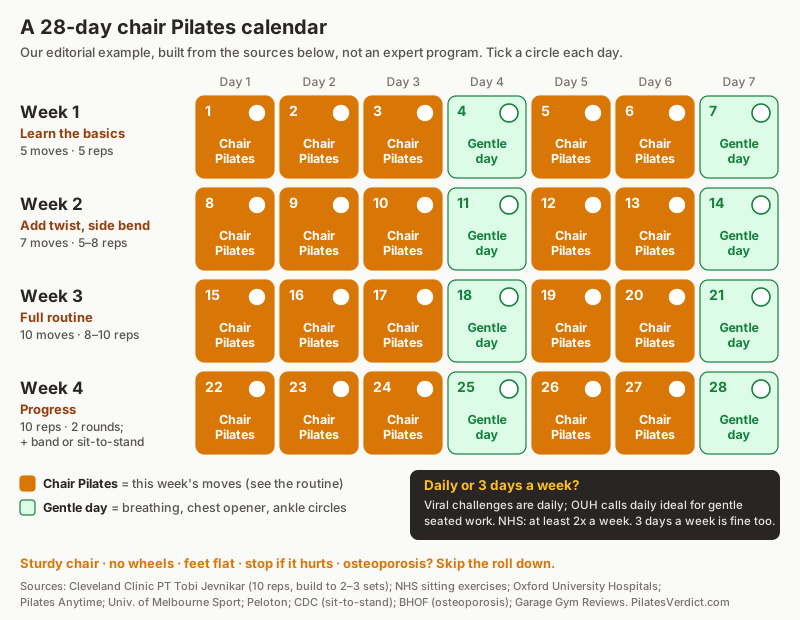
Gentle days: days 4, 7, 11, 14, 18, 21, 25 and 28
Do breathing, the chest opener and slow ankle circles (our selection), or rest completely. These days keep the habit going without a full session.
Day by day: days 1–28
Tap the diagram to enlarge
Download the printable 28-day chair Pilates calendar (PDF): one US Letter page with a circle to tick each day. Want the moves too? Download the move chart (PDF). Rather tick it off on your phone? Use the challenge tracker.
Session times are our estimates.
- Days 1–3, 5–6: moves 1–4 and 6, 5 reps (about 10 minutes)
- Days 4, 7: gentle
- Days 8–10, 12–13: moves 1–4 and 6–8, 5–8 reps (about 12–15 minutes)
- Days 11, 14: gentle
- Days 15–17, 19–20: all 10 moves, 8–10 reps (about 15 minutes)
- Days 18, 21: gentle
- Days 22–24, 26–27: all 10 moves at 10 reps, 1–2 rounds; optional band or sit-to-stand (about 15–20 minutes)
- Days 25, 28: gentle
Prefer 3 days a week?
The NHS suggests at least twice a week for seated exercise, and BetterMe's plan uses 2–4 sessions with rest days between. If daily feels like too much, do 3 sessions a week (for example Monday, Wednesday and Friday) and follow the same weekly steps. You'll do 12 sessions over 28 days instead of 20.
The moves at a glance
Tap the diagram to enlarge
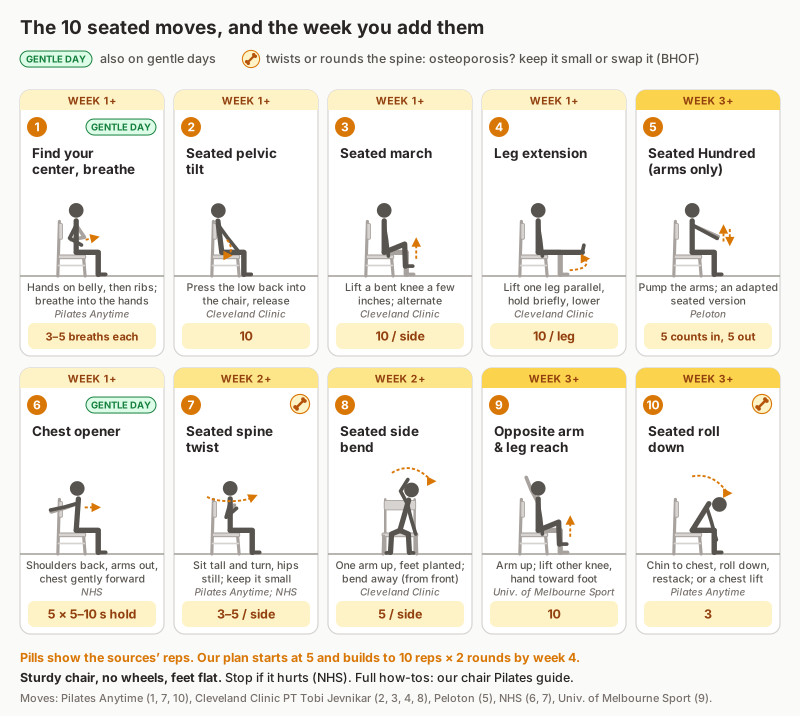
Reps below are what each source publishes. Our plan starts lower. Full how-tos are in our chair Pilates guide.
| Move | Week | Source reps | Easier option |
|---|---|---|---|
| 1. Breathing | 1 | 3–5 breaths | Fewer breaths |
| 2. Pelvic tilt | 1 | 10 | Smaller tilt |
| 3. Seated march | 1 | 10/side | Lower lift |
| 4. Leg extension | 1 | 10/leg | Heel taps |
| 6. Chest opener | 1 | 5 (5–10 s hold) | Shorter hold |
| 7. Spine twist | 2 | 3–5/side | Smaller twist |
| 8. Side bend | 2 | 5/side | Smaller bend |
| 5. Seated Hundred | 3 | 5 in, 5 out | Fewer pumps |
| 9. Hand to foot | 3 | 10 | Reach to knee |
| 10. Roll down | 3 | 3 | Chest lift |
Where the numbers come from:
- Breathing: Roxy Menzies on Pilates Anytime has you place your hands on your belly, then your ribs.
- Pelvic tilt, march, leg extension and side bend: Cleveland Clinic (Jevnikar). OUH adds marching for up to 2 minutes at an even pace, and heel taps for 2 sets of 10.
- Chest opener: the NHS, holding 5–10 seconds, 5 times.
- Spine twist: 3 per direction from Pilates Anytime, 5 per side from the NHS.
- Seated Hundred: Peloton describes pumping the arms for five counts in and five out. The seated, arms-only version is an adaptation.
- Hand to foot: University of Melbourne Sport.
- Roll down: Pilates Anytime (Menzies), which also gives the chest lift.
What 28 days of chair Pilates can (and can't) do
Strength takes longer than 28 days. Heather A. Milton, an exercise physiologist at NYU Langone, told TODAY (about wall Pilates): "Strength gains take 4-6 weeks for the nervous system to improve the efficiency of activating muscle, and more like 12 weeks to actually see changes in the muscle size itself." She adds that this applies when you work the muscles at about 60% of their maximum or more. Seated routines are gentler, so it's reasonable to expect less (our inference).
No one has studied a 28-day chair challenge. We found no trial of one, and no randomized trial of chair Pilates in general older adults. The closest evidence:
- Small studies of seated Pilates in people with multiple sclerosis ran 12 weeks and reported improved sitting stability or balance.
- A review of 20 randomized trials found Pilates (not seated) improved balance in older adults overall, though only about half of the individual programs (8 of 15) showed a significant effect, and a few studies were rated poor quality.
The MS studies ran 12 weeks, and most programs in the review ran about 12 weeks (range 4–18), usually 2–3 sessions a week.
Will a 28-day chair challenge help you lose weight?
Not on current evidence. No source we found tested chair Pilates for weight loss, so we make no calorie, belly-fat or "28-day results" claims. Be wary of app ads that pair chair workouts with fast weight loss.
It covers part of what the CDC recommends. For older adults, the CDC advises at least 150 minutes of moderate aerobic activity a week, muscle strengthening on at least 2 days, and balance activities. Chair Pilates helps with the strength, balance and mobility parts, not the aerobic target. The CDC adds: "If you have trouble meeting these recommendations, be as physically active as your abilities and conditions allow."
For a deeper look at what changes by day 28 and how to measure it, see 28-day Pilates challenge results.
Who should modify the chair Pilates challenge or check first
- Health conditions, recent surgery or illness: check with your doctor or physical therapist first, as the NHS and BetterMe advise. BetterMe specifically mentions recent joint, back or spinal surgery. It also lists stop signs: "sudden, sharp, or shooting discomfort," "numbness or tingling," "dizziness, lightheadedness, or difficulty breathing," or "unusual fatigue or feelings of pressure in the chest."
- Osteoporosis or low bone density: BHOF advises avoiding bending forward from the waist, sit-ups or crunches, and extreme twisting. Swap the roll down (move 10) for the chest lift and keep the twist (move 7) small.
- Pregnancy: ACOG lists modified Pilates among exercises generally considered safe and advises avoiding lying flat on your back as much as possible. Seated work avoids lying flat, but talk with your ob-gyn before starting.
- Balance concerns: do the sit-to-stand with the chair against a wall, or skip it.
After day 28
Twenty-eight days is a start, not a finish line. Research by Dr Pippa Lally found that forming a daily habit took 66 days on average, with a range of 18 to 254 days. Planning when and where you'll do it helps, she says, so pick a set time and chair.
Cleveland Clinic's Judi Bar recommends Pilates three to five times a week and says "It's not necessarily a stand-alone exercise." Pair it with walking or other aerobic activity.
Ways to keep going:
- Repeat week 4, adding a light band if you haven't yet.
- Once seated work feels easy, try standing Pilates exercises, using the chair for balance (our suggestion).
- If you can get down to the floor, move on to Pilates exercises at home for beginners.
- Want another 4-week plan? Try the 28-day bed Pilates challenge or the 28-day wall Pilates challenge.
If you want one prop for month two, a 9-inch soft ball for gentle knee squeezes in pelvic tilts and marches is the easiest add.
Check price on AmazonMore routines live in our Pilates workouts section.
Free printable calendar, videos and sheets
- Our printable calendar and move chart: 28-day chair Pilates calendar (PDF) and move chart (PDF).
- NHS Fitness Studio: a free chair-based Pilates video of about 30 minutes.
- University of Melbourne Sport: a free "Chair Pilates for Home" PDF with photos of each exercise.
Frequently Asked Questions
Is there a free 28-day chair Pilates challenge?
We didn't find one from a well-known instructor or health organization. Most results are app programs, Pinterest boards, chair yoga challenges or shorter plans like BetterMe's 4-week chair Pilates program. You can follow a free plan built from standard seated moves from Cleveland Clinic, the NHS and Pilates Anytime, like the calendar in this post, plus the free NHS chair Pilates video.
Can you see results from 28 days of chair Pilates?
Expect a habit and better body awareness, not a new body. NYU Langone exercise physiologist Heather Milton told TODAY that early strength gains take 4–6 weeks and changes in muscle size about 12 weeks. The seated Pilates studies we found in people with multiple sclerosis ran 12 weeks.
Can chair Pilates help you lose weight?
We found no study that tested chair Pilates for weight loss, so be wary of challenges and app ads that promise fast results. The CDC recommends weekly aerobic activity plus strength and balance work for older adults; chair Pilates covers part of that.
Should you do chair Pilates every day?
Oxford University Hospitals says daily practice is ideal for its gentle seated program, if you build up gradually. The NHS suggests at least twice a week, and BetterMe's plan builds from 2–3 to 4 sessions a week with rest days.
Is chair Pilates good for seniors?
It's a common way for older adults to start. Cleveland Clinic and the NHS publish seated routines for this group, and a review of 20 trials found (non-seated) Pilates programs, mostly about 12 weeks long, improved balance in older adults on average. Check with your doctor first if you have a health condition.
What chair should you use for chair Pilates?
A sturdy chair with a firm, flat seat and back, no wheels and ideally no arms, per Cleveland Clinic and the NHS. Sit with your feet flat and knees at about a right angle.
Sources
- Cleveland Clinic (Tobi Jevnikar, PT): Chair exercises for seniors
- NHS: Sitting exercises
- NHS: Chair-based Pilates video workout
- Oxford University Hospitals NHS FT: Seated exercise programme (PDF)
- Pilates Anytime (Marchel Ackler): Chair Pilates for seniors
- Pilates Anytime (Roxy Menzies): Pilates at your desk
- Pilates Anytime (Sherri Betz): Chair exercises for seniors, class 1499
- Peloton (Erin Bunch): Pilates Hundred: how to do it, benefits, and variations
- University of Melbourne Sport (Ange La Scala): Chair Pilates for home (PDF)
- BetterMe (brand; Zindzy Gracia, reviewed by Garett Reid, MSc, CSCS): Chair Pilates for seniors
- Lasta (brand): Chair Pilates feature page
- Apple App Store (Tropic Innovation; brand listing): Wall Pilates Challenge & Fit
- Garage Gym Reviews (Ravi Davda, CPT): An expert guide to the 28-day wall Pilates challenge
- CDC: Physical activity guidelines for older adults
- Cleveland Clinic (Judi Bar): Pilates 101
- TODAY (Heather A. Milton): Wall Pilates exercises
- van der Linden et al., Disabil Rehabil (2014): Seated Pilates in multiple sclerosis
- Adamson et al., Adapt Phys Activ Q (2025): Seated Pilates in multiple sclerosis
- Sampaio et al., Healthcare (Basel) (2023): Pilates and balance in older adults
- University of Surrey: Does it really take 66 days to form a habit? (Dr Pippa Lally)
- Bone Health & Osteoporosis Foundation: Protecting your spine
- ACOG: Exercise during pregnancy
Update history
- : Published.
Found an error? See how we research and correct guides in our editorial policy.
Was this guide helpful?
Related Articles
How-To
28-day Pilates challenge: free plan, calendar and what to expect
A free 28-day Pilates challenge: a week-by-week mat plan, printable calendar, a 7-day starter week, a gentler somatic version and realistic results.
November 20, 2026 · 34 min read

How-To
28-day bed Pilates challenge: a free plan and printable calendar
A free 28-day bed Pilates challenge with a printable calendar: 10 gentle moves, a week-by-week plan, no app needed, and what 28 days can realistically do.
October 23, 2026 · 16 min read
How-To
28-Day Wall Pilates Challenge: A Free Schedule and What to Expect
Free 28-day wall Pilates challenge options, a 4-week schedule with rest days, 8 sourced moves, and what 28 days can realistically change.
October 7, 2026 · 16 min read
How-To
Chair Pilates: a 10-move seated workout for beginners and seniors
Chair Pilates for beginners and seniors: 10 seated moves with a printable chart, free videos, safety tips and what the research says about benefits.
October 21, 2026 · 21 min read