Classical Pilates mat exercises: all 34 in order (+ printable chart)
By The Pilates Verdict Team · October 15, 2026 · 20 min read
This article contains affiliate links. If you buy through them, we may earn a commission at no extra cost to you. As an Amazon Associate I earn from qualifying purchases. Learn more.
In 1945, Joseph Pilates (with William John Miller) published the 34 classical Pilates mat exercises, in a set order, in his book Return to Life Through Contrology. According to Pilates Anytime, that sequence "forms the bedrock of classical Pilates Mat work."
Below is the full list of classical Pilates mat exercises in book order, with the original names, the names most teachers use today and the rep counts from Pilatesology's summary of the book. After that: the moves teachers added later, where beginners should start and who should modify or skip which exercises.
How we researched this: We cross-checked the order of the 34 exercises across six classical sources: Pilatesology's Return to Life order sheets, BASI Pilates, Pilates Anytime, EasyVigour, OnlinePilatesClasses (Lesley Logan) and Ridgway Pilates. All six give the same order. Publication details come from the Internet Archive's bibliographic record. Classical vs. contemporary differences come from Power Pilates and Fit&Well, and the one-line exercise cues come from Pilates Anytime. Safety guidance comes from the Bone Health & Osteoporosis Foundation, ACOG, Pilatesology, Pilates Anytime, OnlinePilatesClasses and Peloton, and the research section uses two peer-reviewed reviews. We don't teach classes or test workouts. Where we could read only a search snippet of a source, we say so. Every source is listed at the end.
Quick version:
- What it is: 34 mat exercises from Joseph Pilates' 1945 book, done in a fixed order.
- Where to start: Pilatesology's seven-move basic order, from the Hundred to Spine Stretch Forward.
- Leave for later: inversions like the Roll Over and Jack Knife.
- Check first if: you have osteoporosis, neck, shoulder or back problems, or are pregnant.
Classical vs. contemporary Pilates mat
Return to Life Through Contrology is by Joseph H. Pilates and William John Miller. The Internet Archive's record lists the original publication as 1945 by J.J. Augustin, plus a 2010 reprint edited by Judd Robbins and Lin Van Heuit-Robbins. You'll see other dates online (1954, even "the 1920s"), but they don't match the bibliographic record.
Joseph Pilates (born in Germany in 1883, died 1967, per Pilates Anytime) called his method Contrology. Pilates Anytime paraphrases his definition as "the complete coordination of body, mind, and spirit, achieved through conscious control over every movement." The book presents each exercise with photos and written instructions.
"Classical" Pilates sticks to that original material. Power Pilates, a classical training school, describes classical exercise order as a "fixed, systematic sequence established by Joseph Pilates." In contemporary Pilates, the order is "variable; instructor selects based on client needs and program design." Fit&Well adds that contemporary styles usually teach a neutral pelvis rather than a flattened lower back (snippet only).
The 34 classical Pilates mat exercises, in order
Book names come first, with the common modern name where it differs. Reps follow Pilatesology's "Return to Life Mat – Order & Repetitions" chart. We couldn't open the book's text ourselves, so treat the counts as Pilatesology's summary.
| # | Book name | Modern name | Reps |
|---|---|---|---|
| 1 | The Hundred | Hundred | 100 |
| 2 | The Roll Up | Roll Up | 3x |
| 3 | The Roll Over | Roll Over | 5 sets |
| 4 | The One Leg Circle | Single Leg Circles | 5x each way |
| 5 | Rolling Back | Rolling Like a Ball | 6x |
| 6 | The One Leg Stretch | Single Leg Stretch | 5–12x |
| 7 | The Double Leg Stretch | Double Leg Stretch | 5–12x |
| 8 | The Spine Stretch | Spine Stretch Forward | 3x |
| 9 | Rocker with Open Legs | Open Leg Rocker | 6x |
| 10 | The Cork-Screw | Corkscrew | 3 sets |
| 11 | The Saw | Saw | 3 sets |
| 12 | The Swan-Dive | Swan | 6x |
| 13 | The One Leg Kick | Single Leg Kick | 6 sets |
| 14 | The Double Kick | Double Leg Kick | 5x |
| 15 | The Neck Pull | Neck Pull | 3x |
| 16 | The Scissors | High Scissors | 6 sets |
| 17 | The Bicycle | High Bicycle | 5 sets |
| 18 | The Shoulder Bridge | Shoulder Bridge | 3 sets |
| 19 | The Spine Twist | Spine Twist | 3 sets |
| 20 | The Jack Knife | Jackknife | 3x |
| 21 | The Side Kick | Side Kick Series | 3x each |
| 22 | The Teaser | Teaser | 3x |
| 23 | Hip Twist with Stretched Arms | Hip Circles | 3 sets |
| 24 | Swimming | Swimming | 20x |
| 25 | The Leg-Pull – Front | Leg Pull Front | 3 sets |
| 26 | The Leg-Pull | Leg Pull Back | 3 sets |
| 27 | The Side Kick Kneeling | Kneeling Side Kicks | 4x each |
| 28 | The Side Bend | Side Bend | 3x each |
| 29 | The Boomerang | Boomerang | 6x |
| 30 | The Seal | Seal | 6x |
| 31 | The Crab | Crab | 6x |
| 32 | The Rocking | Rocking | 5x |
| 33 | The Control Balance | Balance Control | 6x |
| 34 | The Push Up | Push Up | 3x |
Sources: Pilatesology (order and reps), BASI Pilates and EasyVigour (book names), cross-checked against Pilates Anytime, OnlinePilatesClasses and Ridgway Pilates. EasyVigour notes the Roll Over is done with legs spread, both ways.
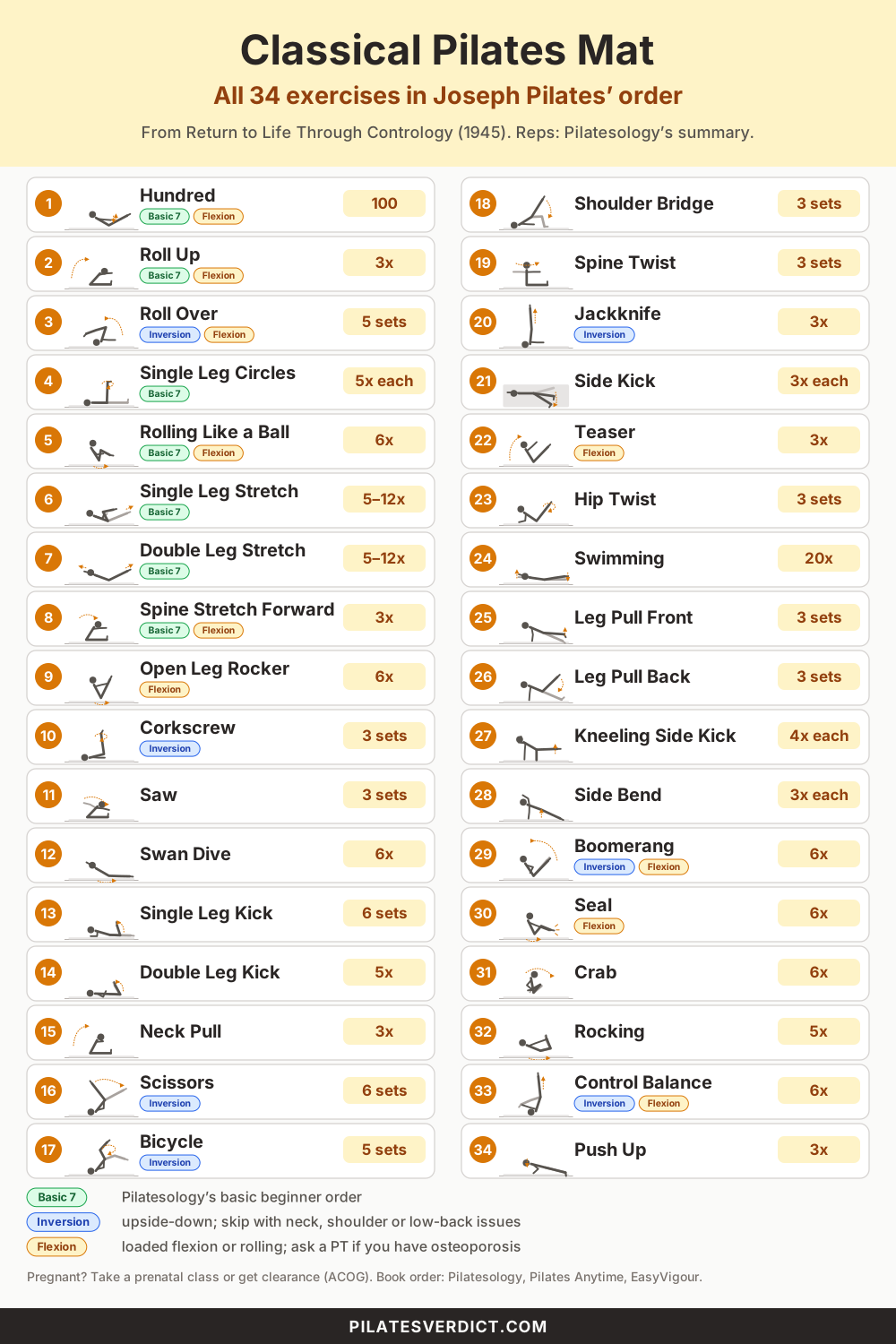
Printable version: download our chart of all 34 exercises (PDF), one US Letter page, or open it as an image. It's our own diagram, not a scan of the book. Pilatesology also publishes a free PDF of the basic, intermediate and advanced orders.
Want the original photos and instructions? The book is still in print; check the edition before you buy.
Check price on Amazon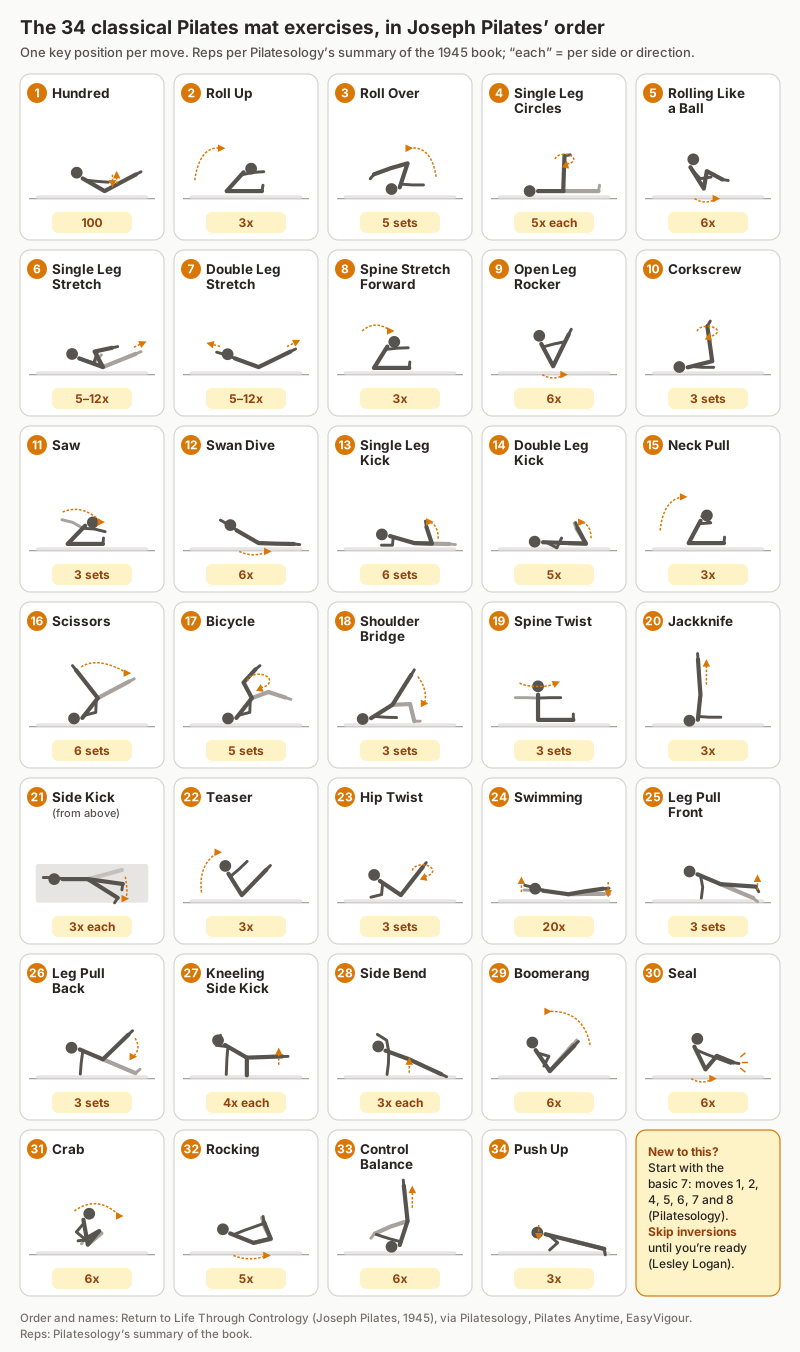
Tap the diagram to enlarge
Power Pilates says classical teachers keep this fixed sequence. Lesley Logan of OnlinePilatesClasses gives a practical reason to learn it: once the order is in your body, you can do a personal practice anywhere, even without a video or internet access.
The one-line cues below are condensed from Pilates Anytime's exercise-by-exercise guide to the 34 moves. They're reminders, not full instructions. Learn anything new from a qualified teacher or a full tutorial.
Warm-up and rolling: 1–9
The sequence opens on your back with the Hundred and the Roll Up, then works through leg circles, rolling and the two leg stretches. Spine Stretch and Open Leg Rocker close the group. Most of these moves curl the spine forward, which matters for the safety notes below.
- Hundred: lie on your back, curl your head and shoulders up, float your legs to about 45 degrees and pump straight arms, five pumps per inhale and five per exhale.
- Roll Up: start on your back with arms overhead and roll up using your breath and abdominals, not momentum.
- Roll Over: lift your legs to 90 degrees, reach them up and over into a C curve, open and flex the feet, then roll down through the spine. Don't roll past your shoulder blades.
- Single Leg Circles: one leg long on the mat, the other pointed at the ceiling; circle it across, down and around five times each way while your pelvis stays still.
- Rolling Like a Ball: sit hugging your shins, balance with your feet off the mat, roll back to your shoulder blades and up again. Your head and neck shouldn't touch the mat.
- Single Leg Stretch: with head and shoulders curled up, pull one knee in with both hands on the shin while the other leg extends, then switch.
- Double Leg Stretch: from knees-to-chest with your head up, reach arms and legs out on a diagonal as you inhale, then circle the arms and hug the knees back in as you exhale.
- Spine Stretch Forward: sit tall with straight legs about shoulder-width apart, feet flexed and arms forward; exhale to roll forward through the spine, inhale to stack back up.
- Open Leg Rocker: balance holding your ankles with straight legs apart, roll back to your shoulder blades and back up without rolling onto your head and neck.
Twists, extensions and inversions: 10–20
The middle of the list mixes twisting (Corkscrew, Saw, Spine Twist), facedown back extensions (Swan, Single and Double Leg Kick) and moves that take your hips over your head (Scissors, Bicycle, Jackknife). Pilates Anytime warns that "the later exercises on this list may be a challenge" for beginners.
- Corkscrew: take straight legs over until they're parallel to the floor, roll down through one side of your back, circle the legs and roll over through the other side; then reverse.
- Saw: sit with legs a little wider than your hips and arms out to the sides; twist, then dive forward to reach toward the outside of the opposite foot while your hips stay anchored.
- Swan: Pilates Anytime teaches a Swan prep first (lifting the chest from your stomach) and says not to try the full Swan Dive, which rocks forward and back in an arc, until you've practiced the prep.
- Single Leg Kick: lie facedown propped on your forearms, kick one heel toward your seat twice, then switch legs.
- Double Leg Kick: lie facedown with one cheek on the mat and hands clasped high on your back, kick both heels three times, then straighten your legs and reach your hands toward your feet as your chest lifts.
- Neck Pull: on your back with hands at the base of your neck, roll up toward your knees, stack to sitting, hinge back and round down. Don't yank on your neck.
- Scissors: roll your legs overhead, support your back with your hands, then split straight legs, pulsing the top leg toward you twice before you switch.
- Bicycle: from the same lifted position, cycle the legs five times in each direction.
- Shoulder Bridge: with knees bent, peel your spine up into a bridge, extend one leg to the ceiling, lower and lift it, then switch legs.
- Spine Twist: sit tall with legs together, feet flexed and arms out; twist and pulse twice to each side while your hips stay still.
- Jackknife: roll straight legs over until they're almost parallel to the floor, reach them up to the ceiling with your hips lifted, then roll down through the spine. Pilates Anytime says you should be able to do the Roll Over first.
Side work, Teaser and the finishers: 21–34
The last third adds side-lying and kneeling leg work, the Teaser, Leg Pulls and the Side Bend. It ends with rolling and balance moves (Boomerang, Seal, Crab, Rocking, Control Balance) and the Push Up.
- Side Kick: lie on your side with your head propped and legs slightly forward; kick the top leg forward twice, then sweep it back without moving your pelvis.
- Teaser: from legs at 45 degrees, roll up until your arms are parallel to your legs, then roll down while the legs stay put.
- Hip Circles (Hip Twist): sit with hands behind you, lift your legs to a Teaser position and circle both legs each way. Pilates Anytime calls it advanced and says to get the Corkscrew first.
- Swimming: lie facedown, float your arms and legs, and lift opposite arm and leg, speeding up to a flutter.
- Leg Pull Front: from a plank, lift one straight leg at a time.
- Leg Pull Back: sit with hands behind you, fingers toward your heels, lift your hips into a straight line, and lift one leg at a time without locking your elbows or knees.
- Kneeling Side Kicks: kneel on one knee with the same-side hand under your shoulder and the other hand behind your head, then kick the top leg forward and back.
- Side Bend: sit sideways and press into your hand to lift your hips into a rainbow shape, then lower and lift.
- Boomerang: with ankles crossed, roll over and switch the cross, roll up to a Teaser, clasp your hands behind you as the legs lower, then circle your arms forward to sit tall.
- Seal: hold your ankles from the inside, clap your feet three times, roll back to your shoulder blades, clap again and roll up.
- Crab: sitting cross-legged and holding your feet, roll back to your shoulder blades, switch the cross, then roll forward onto your knees with the top of your head to the mat.
- Rocking: lie facedown holding your ankles, lift your chest and knees, and rock forward and back. Pilates Anytime says to be able to do the Swan and Swan Dive first.
- Control Balance: with your legs overhead, hold one ankle, lift the other leg to the ceiling and switch.
- Push Up: from standing, roll down, walk your hands out four steps to a plank, do three to five triceps push-ups, then walk back and roll up.
Exercises added to the classical mat sequence after the book
If you take a classical mat class today, you'll probably do more than 34 moves. Lesley Logan of OnlinePilatesClasses, a second-generation certified teacher, says the book has only the Single and Double Leg Stretch in what's now called the abdominal series. Teachers who studied with Pilates added more exercises there.
Logan's classical mat order runs to 38 exercises. She says it follows the order in Return to Life and the classical mat order that Jay Grimes and many other classical Pilates teachers use. She also lists Thigh Stretch among the later additions.
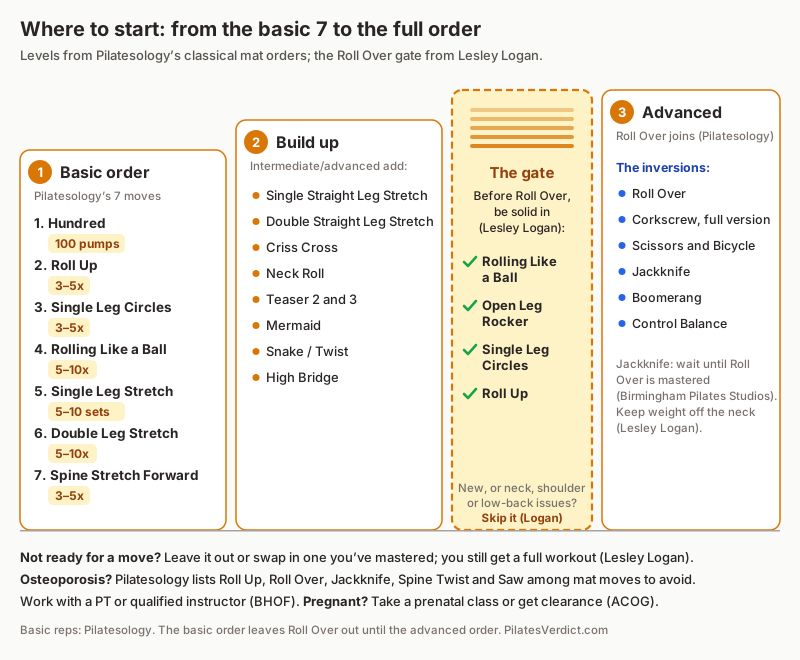
Pilatesology's intermediate and advanced orders add:
- Single Straight Leg Stretch, Double Straight Leg Stretch and Criss Cross, after the Double Leg Stretch
- Neck Roll
- Teaser 2 and 3
- Mermaid
- Snake/Twist
- High Bridge
Which teacher added which move isn't something we could verify, so we haven't credited specific additions to anyone.
A beginner classical mat sequence (the basic 7)
Pilatesology's basic classical mat order is seven moves:
- The Hundred (100 pumps)
- Roll Up (3–5x)
- Single Leg Circles (3–5x)
- Rolling Like a Ball (5–10x)
- Single Leg Stretch (5–10 sets)
- Double Leg Stretch (5–10x)
- Spine Stretch Forward (3–5x)
Tap the diagram to enlarge
The Roll Over, number 3 in the book, is left out until Pilatesology's advanced order.
You don't have to do every move to get a full session. Logan says you can leave out exercises your body isn't ready for and still get a complete workout, and suggests swapping a hard move for one you've already mastered. Classical teachers keep the book's order, per Power Pilates, so a shortened session still runs in sequence.
New to mat work in general? Our Pilates exercises at home for beginners routine is a gentler starting point.
The Hundred, step by step
Peloton instructor Kristin McGee teaches the count this way: inhale for five arm pumps, exhale for five, and repeat 10 rounds for 100. Peloton's breath cue is in through the nose, out through the mouth.
McGee's modifications:
- Legs: lift them higher (up to 90 degrees), or keep them in tabletop or on the floor.
- Lower back lifting off the mat: raise your legs.
- Neck strain: use a block under your head, keep one hand behind your head, or keep your head down.
Rolling Like a Ball and the Roll Over prerequisites
Logan lists four moves to get solid before the Roll Over: Rolling Like a Ball, Open Leg Rocker, Single Leg Circles and the Roll Up. Her caution: "If you are new to Pilates, if you have neck, shoulder, or lower back issues, if you have fear around going upside down, you may want to just skip it." She also warns that swinging the legs can take you "too far over onto your neck."
Rolling moves feel very different on a thin mat over a hard floor. A thicker Pilates mat helps here. The Merrithew Deluxe mat is 15 mm (see the comparison below), or see our best Pilates mats guide.
Check price on AmazonWho should modify or skip moves
Osteoporosis or spinal bone loss
The Bone Health & Osteoporosis Foundation (BHOF) says people with spinal bone loss should not "bend forward from the waist," "twist and bend at the torso (trunk) to an extreme," or "do toe-touches, sit-ups or abdominal crunches."
Pilatesology says, "Mat exercises to avoid include: Roll Up, Roll Over, Jackknife, Spine Twist, Saw, among others." It suggests Single Leg Kick, the side-lying series, Leg Pull and head-down pre-Pilates moves instead.
Much of the classical list involves forward flexion or rolling: the Hundred, Roll Up, Roll Over, Rolling Back, Spine Stretch, Open Leg Rocker, Teaser, Boomerang, Seal and Control Balance. If you have osteoporosis or low bone density, work with a physical therapist or a qualified instructor before trying the sequence.
Neck, shoulder or back problems (inversions)
Several moves take your weight toward your shoulders: the Roll Over, the full Corkscrew, Jackknife, Boomerang, Control Balance, and Scissors and Bicycle. Logan gives her skip-it advice and her warning about going too far over onto your neck for the Roll Over. Pilates Anytime's guide says to avoid the Jackknife and Boomerang if you have neck or spine injuries, and to avoid the Crab after a neck or spine injury. It also says the Control Balance may not suit people with a shoulder or neck injury. If you have neck, shoulder or low-back issues, check with an instructor or clinician before trying any of them.
Pregnancy
ACOG lists "modified yoga and modified Pilates" among the safest exercises in pregnancy and advises, "Avoid standing still or lying flat on your back as much as possible." It adds that you "should avoid poses that require you to be still or lie on your back for long periods." Peloton says the Hundred should be avoided after the first trimester, or whenever a bump is present, and skipped if you have pelvic floor issues.
The classical sequence is done mostly on your back or front, so it isn't a natural fit for pregnancy. Take a prenatal class or get clearance from your ob-gyn or midwife first.
What the research says
No study we found tested the classical 34-move sequence itself. The research below looked at Pilates programs in general.
- Low back pain: a Cochrane review, republished in Spine in 2016 (Yamato et al.), found "low- to moderate-quality evidence that Pilates is more effective than minimal intervention," mostly with medium effect sizes. It found "no conclusive evidence that Pilates is superior to other forms of exercises."
- Healthy adults: a 2016 meta-analysis (Campos et al.), pooling nine small randomized trials in healthy adults, found that mat or apparatus Pilates done 2–3 times a week for 5–12 weeks improved abdominal muscular endurance compared with no exercise, by about 10 more curl-ups in a 1-minute test. It found no difference in flexibility.
Get the original book (and a mat for rolling)
If you want the source, Return to Life Through Contrology is still in print. Several editions exist, including the original Miller text and separate revised editions by Judd Robbins, so check the edition and photos on the listing before you buy.
HathiTrust lists a digitized copy of a 1960 reprint (snippet only). We couldn't open it, so we can't promise a free download. Avoid unofficial re-uploads of the book.
Return to Life Through Contrology (Joseph Pilates)
- Best for
- The original 34 exercises (check the edition)
- Price tier
- $10–20
The Pilates Body, Revised and Expanded Edition (Brooke Siler, 2025)
- Best for
- A newer mat book with beginner modifications
- Price tier
- $10–20
Balanced Body EcoWise Pilates Mat
- Best for
- Rolling and back-lying work
- Price tier
- $50–100
Merrithew STOTT PILATES Deluxe Pilates Mat (15 mm)
- Best for
- Extra cushioning (15 mm)
- Price tier
- $50–100
| Product | Best for | Price tier | |
|---|---|---|---|
| Return to Life Through Contrology (Joseph Pilates) | The original 34 exercises (check the edition) | $10–20 | View |
| The Pilates Body, Revised and Expanded Edition (Brooke Siler, 2025) | A newer mat book with beginner modifications | $10–20 | View |
| Balanced Body EcoWise Pilates Mat | Rolling and back-lying work | $50–100 | View |
| Merrithew STOTT PILATES Deluxe Pilates Mat (15 mm) | Extra cushioning (15 mm) | $50–100 | View |
Brooke Siler's book and other options are compared in our best Pilates books guide. For more routines, browse our Pilates workouts.
Frequently Asked Questions
What are the 34 classical Pilates exercises?
They're the mat exercises Joseph Pilates published in Return to Life Through Contrology in 1945. The list runs from The Hundred, Roll Up and Roll Over to The Rocking, Control Balance and Push Up, per Pilatesology and Pilates Anytime. The full list is in the table above.
What order are the classical Pilates mat exercises done in?
The book's order starts Hundred, Roll Up, Roll Over, One Leg Circle, Rolling Back, One Leg Stretch, Double Leg Stretch and Spine Stretch, and ends with Seal, Crab, Rocking, Control Balance and Push Up, per Pilatesology and EasyVigour. Power Pilates says classical teachers keep that fixed sequence. Beginners often do a shortened version, such as Pilatesology's seven-move basic order.
Is there a classical Pilates mat exercises PDF?
Pilatesology publishes a free PDF of basic, intermediate and advanced orders with reps, and our own printable chart of all 34 is in the list above. HathiTrust lists a digitized 1960 reprint of the book (snippet only; we couldn't open it). Avoid unofficial re-uploads.
Can beginners do classical mat Pilates?
Yes, if they start with a shortened order. Pilates Anytime notes the later exercises 'may be a challenge' for beginners, and Lesley Logan suggests skipping inversions like the Roll Over if you're new or have neck, shoulder or low-back issues. Check with a clinician first if you have osteoporosis or are pregnant.
How many reps of each classical exercise?
Per Pilatesology's summary of the book, most moves are 3–6 reps or sets. The Hundred is 100 pumps and Swimming is 20. Pilatesology's beginner order uses ranges like 3–5x.
Sources
- Pilatesology: Classical Pilates mat: basic, intermediate and advanced order and repetitions (PDF)
- Pilatesology: Mat, Joseph Pilates Return to Life (PDF)
- Pilates Anytime (Marchel Ackler): The 34 Pilates mat exercises
- Pilates Anytime (Chanda Hinman): Unpacking the Pilates legacy
- BASI Pilates: The classical Pilates mat exercises listed
- EasyVigour: Joseph Pilates' original 34 poses
- Internet Archive: Pilates' Return to Life Through Contrology
- HathiTrust: Return to life through contrology (1960 reprint)
- OnlinePilatesClasses (Lesley Logan): The complete guide to Joseph Pilates' 34 mat exercises, The classical Pilates mat sequence and order and Pilates Roll Over exercise
- Ridgway Pilates: The classical Pilates mat sequence
- Power Pilates: Classical vs. contemporary Pilates
- Fit&Well: What is classical Pilates?
- Peloton blog (Erin Bunch; instructor Kristin McGee; brand content): Pilates Hundred
- Pilatesology: Can I do Pilates with osteoporosis?
- Bone Health & Osteoporosis Foundation: Protecting your spine
- ACOG: Exercise during pregnancy
- Yamato et al., Spine (2016): Pilates for low back pain, Cochrane review
- Campos et al., J Sports Med Phys Fitness (2016): Pilates and physical conditioning in healthy adults, meta-analysis
Update history
- : Published.
Found an error? See how we research and correct guides in our editorial policy.
Was this guide helpful?
Related Articles
How-To
Standing Pilates exercises: a 10-move routine without the floor
10 standing Pilates exercises for beginners, with chair support options, reps, a printable chart, a light-weights version and what research says about balance.
October 15, 2026 · 20 min read
How-To
Pilates jump board exercises for beginners: an 8-step progression
Eight Pilates jump board exercises for beginners in a safe order, plus what a reformer jump board is, spring tips and what the evidence says on benefits.
October 14, 2026 · 20 min read
How-To
Pilates with weights for beginners: 9-move full-body dumbbell routine
Pilates with weights for beginners: a 9-move full-body dumbbell routine, how heavy to go, what light weights can and can't do, and who should modify.
October 14, 2026 · 20 min read
How-To
Ankle weight Pilates exercises: an 8-move mat routine
Ankle weight Pilates exercises: an 8-move mat routine with reps, how heavy to go, the real benefits of Pilates with ankle weights and who should skip them.
October 13, 2026 · 19 min read