Pilates reformer exercises for beginners: 8 moves, springs and reps
By The Pilates Verdict Team · October 11, 2026 · 20 min read
This article contains affiliate links. If you buy through them, we may earn a commission at no extra cost to you. As an Amazon Associate I earn from qualifying purchases. Learn more.
The best Pilates reformer exercises for beginners are a short list, not 50 moves. A reformer has springs, straps and a sliding carriage, and at first it can look like it needs a manual. Instructor-training programs and studios start new students with overlapping short lists, usually Footwork and the Hundred, plus some mix of feet-in-straps, arm and stretching moves.
Below are eight Pilates reformer exercises for beginners, in the order studios usually teach them, with a starting spring setting and rep count for each. The routine takes roughly 20–30 minutes (our estimate). There's also a section on doing it safely on a home reformer, whether yours has springs or cords.
How we researched this: We built the routine from Merrithew's STOTT PILATES instructor-training chart, Balanced Body, Pilates Anytime and Club Pilates, with form cues from certified instructor Stephanie Mansour (Today.com) and Pilates Anytime's exercise tutorials, and health guidance from Cleveland Clinic, ACOG and others. We don't coach or test workouts. Spring counts are for Merrithew machines, so check your own chart. All sources are listed at the end.
Quick version:
- The routine: Footwork, the Hundred, Frog, Leg circles, Hip lift, Seated arms, Elephant, Mermaid. Add Running as an optional finisher.
- Springs: start light to medium and check your machine's chart. Heavier springs for two-legged leg work, lighter for arms (Mansour).
- How often: 2–3 times a week (Balanced Body).
- Before you start: a few sessions with an instructor if you can. Check with a doctor first if you're pregnant, injured or have osteoporosis.
Before you start: set up the reformer safely
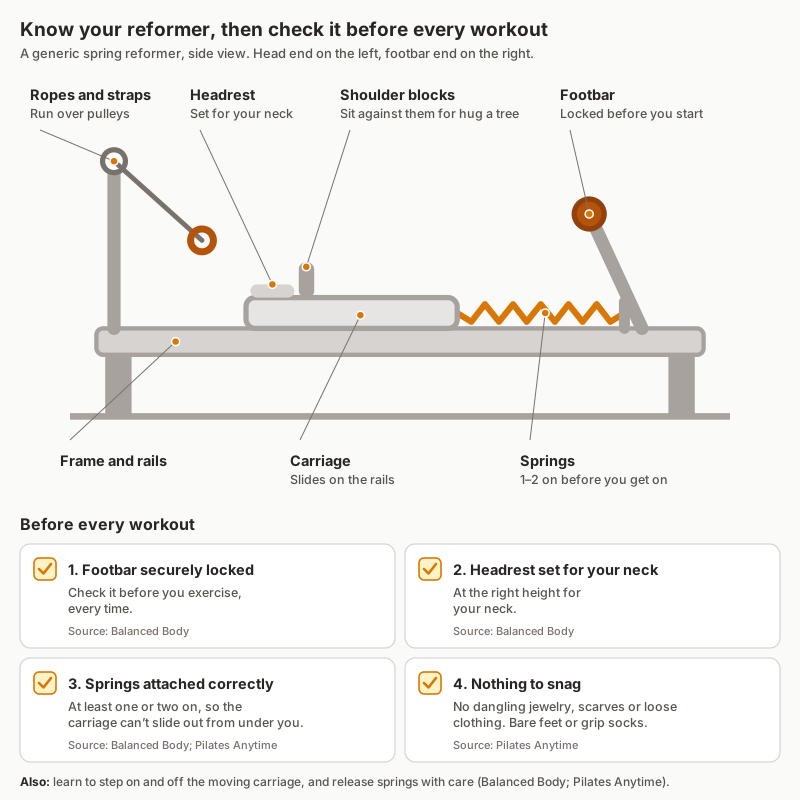
Balanced Body, which makes reformers, says to check three things before you exercise: that "your footbar is securely locked, the headrest is at the appropriate height for your neck, and the specific spring configuration is attached correctly." It also says to learn to "safely mount and dismount the moving carriage without losing your balance."
Tap the diagram to enlarge
Pilates Anytime adds a few rules for home machines:
- Springs on before you step on. "Check that at least one or two resistance springs are connected to ensure that the carriage will not slide out from under you."
- "Release springs with care." Only take springs off when they aren't stretched (Pilates Anytime).
- Nothing loose. "Avoid dangling jewelry, scarves, or loose clothing that can become tangled." Balanced Body suggests "comfortable clothing that allows for unrestricted movement," with no "exposed zippers, metal rivets, or plastic buttons." See what to wear to Pilates.
- Bare feet or grip socks. See our best Pilates grip socks.
- Skip the advanced moves. Pilates Anytime says to avoid "advanced Reformer exercises that are best attempted with a spotter."
Most sources suggest learning from an instructor first. Balanced Body says "it's beneficial to receive instruction from a certified Pilates instructor first to ensure proper form and technique." Cleveland Clinic's Judi Bar says that although reformers "can be purchased for home use, it's important to work with an instructor to learn the correct alignment." If you're booking a studio session, our first reformer Pilates class guide covers what to expect.
What makes an exercise "beginner"
Pilates Anytime defines beginner-level reformer exercises as ones that are "two-limbed, require no twisting, and limit spinal extension." It says beginners "will likely start with the Footwork, then the Hundred, Leg Circles, Frog, and continue with Stomach Massage, Knee Stretch, Running, and Pelvic Lift, at a minimum."
Club Pilates says every 50-minute Reformer Flow class follows the same structure: "warm up with footwork, bridging and abdominals, segue into a full-body, progressive series targeting core, legs, arms, and back, then close with stretching."
Merrithew's STOTT PILATES Essential Reformer chart, used to train instructors, marks the exercises to be "accomplished within first five sessions." That list includes Footwork, the Hundred, Running, Hip Lift and seated rowing preps.
The routine below draws on these lists. We left out Mansour's seated side twist because it conflicts with Pilates Anytime's "no twisting" rule for beginners. Knee stretches and Stomach massage are also on Pilates Anytime's beginner list; we've put them under next beginner moves so your first session stays short.
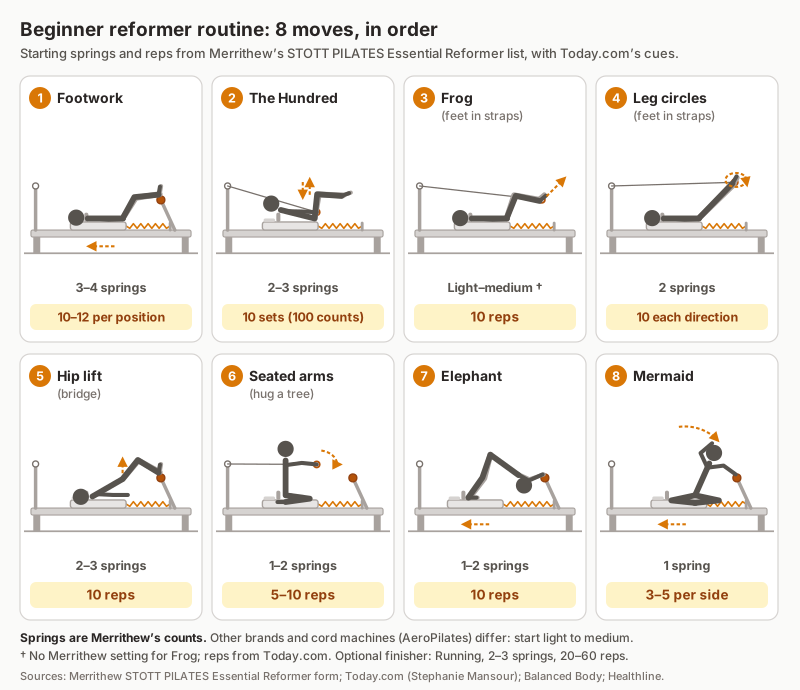
8 Pilates reformer exercises for beginners, in order
Tap the diagram to enlarge
Spring counts below are from Merrithew's chart unless noted. They're written for Merrithew springs and don't translate one-to-one to other brands or to cord machines (see springs vs. cords below). Move slowly, and stop any move that hurts.
1. Footwork
Lie on your back with your feet on the footbar. Balanced Body describes it this way: "you smoothly press the carriage away and return it." Mansour's breathing cue on Today.com: "Inhale as you bend your knees, bringing the carriage in toward you, and then exhale as you press the carriage back out."
- Springs: 3 or 4 (Merrithew). Mansour uses two red springs "to start."
- Reps: 10–12 (Merrithew; we read this as per foot position); 10 per position (Mansour).
- Positions: Merrithew's chart lists toes apart with heels together, toes wrapped on the bar, heels on the bar, high half toe, and lower and lift. Mansour keeps it to toes, arches and heels.
- Why first: Merrithew's blog says Footwork warms up "the calves, quads, feet and ankles," and that the heels-on-the-bar version is "great for training the muscles of the legs and warming up the abs." Healthline says it works the legs and glutes "while engaging your core."
2. The Hundred (or Hundred Prep)
Lie on your back with your legs in tabletop and hold the straps. Lift your head, neck and shoulders. Mansour's cue: "Pump your arms up and down while inhaling for 5 counts and exhaling for 5 counts," for 100 counts. Balanced Body's beginner list starts with a Hundred Prep, a simpler version.
- Springs: 2 or 3 (Merrithew).
- Reps: 10 sets (Merrithew). With Mansour's five-in, five-out breath, that's 100 counts.
- Skip or ask a PT if: you have osteoporosis. Lifting the head and chest is a crunch-like move (see who should check first).
3. Feet in straps: Frog
Put both feet in the straps. Mansour says to open the legs wide "like a frog… Inhale as you open, and exhale as you press them in front of you at a 45 degree angle."
- Springs: none of our sources gives a separate count. Our suggestion is to keep the leg-circle setting below.
- Reps: 10 (Mansour).
4. Feet in straps: Leg circles
Keep your feet in the straps and your legs at 45 degrees, and draw small circles. Mansour's cue: "Keep your core tight and avoid using momentum; focus on controlled movements." Healthline says the move helps "improve hip mobility and strengthen your core," and Merrithew's blog says it can "strengthen the abs, leg muscles and hip joints."
- Springs: 2 (Merrithew).
- Reps: 10 (Merrithew); 10 each direction (Mansour).
5. Hip lift (bridge)
Feet back on the footbar. Pilates Anytime calls this Pelvic Lift. Its tutorial with instructor Monica Wilson goes like this:
- Place "the arches of both feet onto the outside edges of the footbar."
- Curl the pelvis "off of the carriage about three to four inches."
- Press the carriage out and bend your knees to bring it back in, "keeping the pelvis in the same curled under and lifted position."
- With the carriage all the way home, lower your pelvis.
Keep your knees in line between your big and little toes.
- Springs: 2 or 3 (Merrithew). Pilates Anytime uses the same tension as Footwork, three to four springs, and notes that "the lighter the spring tension, the more difficult the exercise becomes."
- Reps: 10 (Merrithew).
6. Seated arms: Chest expansion and Hug a tree
Change springs before you sit up. Mansour's rule is lighter springs for hands-in-straps work and heavier ones for two-legged leg work.
- Chest expansion: sit tall with your feet on the footboard, facing the straps. Pull the straps back "while opening your chest." 10 reps (Mansour).
- Hug a tree: sit cross-legged with your back against the shoulder blocks, holding the long loops at shoulder height. "Press the arms towards each other… as if you are hugging a tree." 10 reps (Mansour).
- Springs: 1 or 2 for Merrithew's front rowing preps, done seated facing the straps, at 5 reps. Mansour gives "a blue and yellow spring" as an example of a lighter setting.
Balanced Body's beginner list also includes "Seated Arm Work Facing Back."
7. Elephant
Balanced Body describes it this way: "Standing on the carriage with your hands on the footbar, you use your hips and core to press the carriage out and pull it back in." It says the move gives "a deep, dynamic stretch for the calves and hamstrings while reinforcing pelvic control." Merrithew lists two versions: round back and straight back. It's not on Merrithew's first-five-sessions list, so save it until you're steady getting on and off the carriage.
- Springs: 1 or 2 (Merrithew). On an AeroPilates cord machine, Brugman writes that "on 2 black cords the Elephant is attainable by most people."
- Reps: 10 (Merrithew).
- If you have osteoporosis: skip the round-back version, which bends the spine forward.
8. Mermaid stretch
Sit sideways on the carriage. Mansour says to keep your sitz bones planted and "press the footbar away from you as the carriage glides," reaching into a side stretch. Balanced Body calls it Seated Side Stretch/Mermaid.
- Springs: 1 (Merrithew).
- Reps: 3–5 (Merrithew); 5 per side (Mansour).
Optional finisher: Running
Lie back down with the balls of your feet on the footbar, legs parallel. In Pilates Anytime's tutorial, you press the carriage out until both legs are straight, then "lower the right heel underneath the footbar as the left knee bends," press both legs straight, and switch sides. It also says to "avoid hyperextension of the legs." Merrithew lists Running in the first five sessions, and Pilates Anytime includes it in its beginner list.
- Springs: 2 or 3 (Merrithew); three to four (Pilates Anytime).
- Reps: 20–60 (Merrithew); 10 per side (Pilates Anytime).
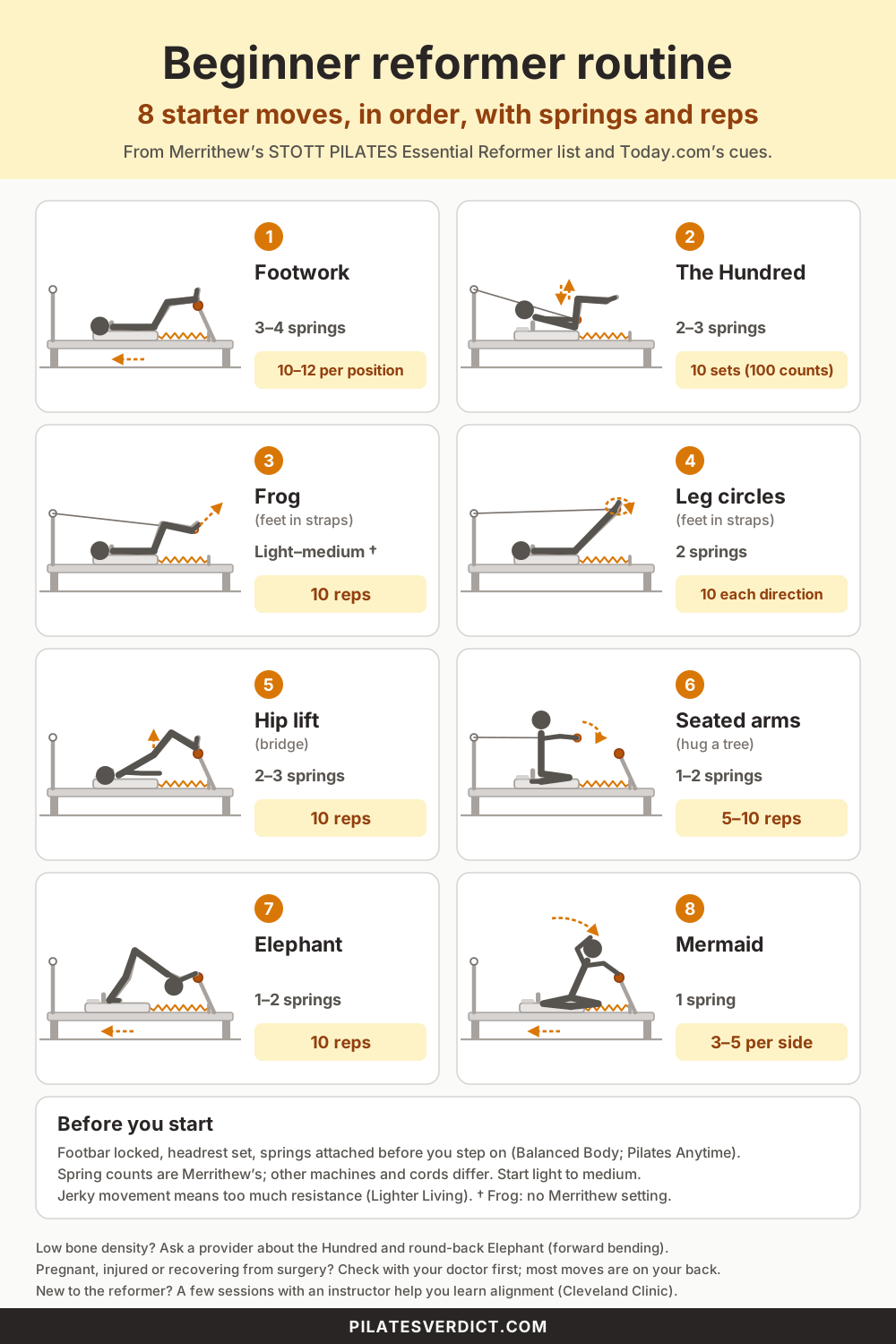
Reformer Pilates workout for beginners at a glance
Tap the diagram to enlarge
| Move | Springs | Reps | Source |
|---|---|---|---|
| 1. Footwork | 3–4 | 10–12 | Merrithew |
| 2. Hundred | 2–3 | 10 sets | Merrithew |
| 3. Frog | Not given | 10 | Today.com |
| 4. Leg circles | 2 | 10 | Merrithew |
| 5. Hip lift | 2–3 | 10 | Merrithew |
| 6. Seated arms | 1–2 | 5–10 | Merrithew, Today.com |
| 7. Elephant | 1–2 | 10 | Merrithew |
| 8. Mermaid | 1 | 3–5 | Merrithew |
| Running (optional) | 2–3 | 20–60 | Merrithew |
Spring counts are for Merrithew springs. Today.com's Mansour uses two red springs for Footwork and lighter springs for arms. Check your machine's own chart.
Pilates reformer exercises at home: springs, cords and videos
Springs vs. cords
Most of the numbers above are for spring reformers. Many budget home machines, including AeroPilates, use elastic cords instead. Our reformer springs vs. cords guide explains the difference, and spring colors vary by brand.
A few rules from cord-machine sources:
- Start in the middle. Marjolein Brugman, whose guide Stamina links from its AeroPilates page, says to start "in the middle with a medium resistance."
- Heavier isn't always harder. Brugman notes that adding cords makes pushing harder but makes returning the carriage easier. Stamina's AeroPilates guide says: "More resistance is not always better! More tension focuses on mobilizing muscle strength, and less tension makes the core work harder."
- Watch for jerky movement. "If the movements become jerky and imbalanced it is always a sign that you are using too much resistance" (Brugman).
- New cords are stiff. Stamina says new cords "will be very stiff. They will relax a little with use."
- Keep a neutral spine. Stamina's guide says to leave "a small gap between your lumbar spine and the platform" and to "keep your tailbone on the platform."
We couldn't find AeroPilates' own per-exercise cord chart, so we don't give cord settings for each move here beyond Brugman's Elephant example. Use the chart that came with your machine. If you own one, our AeroPilates models compared guide covers the differences between them.
Follow along with video
Healthline notes that "many brands also offer virtual classes or video tutorials" for home machines. Merrithew posts free STOTT PILATES home reformer videos on its blog, including Footwork demonstrated on its At Home SPX Reformer. A paid library like Pilates Anytime has reformer classes by level.
Check price at Pilates AnytimeToday.com's Mansour also suggests "newcomers to Pilates try a mat class first." Our Pilates exercises at home for beginners routine needs only a mat.
Which machine fits these moves
All eight moves need a footbar, straps and a carriage, which every machine below has. The AeroPilates 4420 is a cord machine that folds and rolls on wheels. The VEVOR is a budget spring option with 5 springs. The Balanced Body Allegro 2 and Merrithew At Home SPX use studio-style springs, and the SPX is the machine in Merrithew's Footwork home video.
AeroPilates Foldable Reformer 4420
- Best for
- Cord machine; folds on wheels
- Price tier
- Under $500
VEVOR Foldable Pilates Reformer (S1002)
- Best for
- Budget spring machine, 5 springs
- Price tier
- Under $500
Balanced Body Allegro 2
- Best for
- Studio-style springs at home
- Price tier
- $1,000+
Merrithew At Home SPX Reformer Bundle
- Best for
- Machine in Merrithew's Footwork home video
- Price tier
- $1,000+
| Product | Best for | Price tier | |
|---|---|---|---|
| AeroPilates Foldable Reformer 4420 | Cord machine; folds on wheels | Under $500 | View |
| VEVOR Foldable Pilates Reformer (S1002) | Budget spring machine, 5 springs | Under $500 | View |
| Balanced Body Allegro 2 | Studio-style springs at home | $1,000+ | View |
| Merrithew At Home SPX Reformer Bundle | Machine in Merrithew's Footwork home video | $1,000+ | View |
If you want the cheapest way to try these moves at home, the AeroPilates 4420 is one of the two Under $500 options here and folds away; if you want spring counts that match this guide, look at a spring reformer like the Allegro 2 or SPX.
Check price on AmazonNot sure a home machine is worth it yet? Read is a home Pilates reformer worth it?, then compare our best home Pilates reformers.
Common beginner mistakes on the reformer
- Locking the knees: Pilates Anytime says to "avoid hyperextension of the legs."
- Using momentum: Mansour says to "avoid using momentum; focus on controlled movements."
- Too much resistance: "If the movements become jerky and imbalanced it is always a sign that you are using too much resistance" (Brugman).
- Stepping on with no springs attached: Pilates Anytime says to have at least one or two springs connected so the carriage "will not slide out from under you."
- Jumping ahead: Cleveland Clinic's Judi Bar says to build up slowly: "You can't just jump in."
How often, and when to progress
Balanced Body says "2-3 times per week is recommended," for "30-60 mins on a regular basis." Club Pilates suggests two classes a week as a starting point, with the first four weeks focused on form, and says "consistency in the first eight weeks matters more than intensity."
Don't rush the next step. Cleveland Clinic's Judi Bar says "the exercises have to be at your level — and you have to build up the difficulty slowly. You can't just jump in."
Next beginner moves: Knee stretches, Stomach massage, Long stretch
When the routine feels familiar, these are the next moves the sources point to.
Knee stretches are on Pilates Anytime's beginner list. In its tutorial with Sarah Bertucelli, you kneel on the carriage facing the footbar, hands on the bar "shoulder distance apart," feet against the shoulder rests with toes curled under. Round your spine into a C-curve, then press the carriage back "just as far as the knees are under the hips" and use your abs to bring it in. Pilates Anytime starts with "two medium springs"; Merrithew lists 2 springs, 10 reps. If you have osteoporosis, skip the round-back version.
- Stomach massage: 2 or 3 springs, 10 reps (Merrithew). On Pilates Anytime's beginner list. Skip the round-back version if you have osteoporosis.
- Stomach massage: 2 or 3 springs, 10 reps (Merrithew). On Pilates Anytime's beginner list. Skip the round-back version if you have osteoporosis.
- Long stretch: a plank with hands on the footbar and feet on the carriage, "maintaining a straight line from head to heels," 10 reps (Mansour). Merrithew's blog includes it in its five home reformer exercises. It's not on Merrithew's Essential list, so treat it as a later step.
For a full-length follow-along, Merrithew's Essential Reformer Repertoire video is described on its product page as a beginner-level workout with 35 exercises in about 70 minutes.
For more workouts, browse Pilates workouts or try our Pilates band exercises.
What the research says
Reformer Pilates has a small but growing body of trials. Two from 2025:
- Women with overweight or obesity: Gökalp and Kirmizigil (Scientific Reports, 2025) randomized 47 women aged 30–60 to reformer Pilates 3 times a week for 8 weeks or a control group. Sessions ran 50–60 minutes, supervised by a physiotherapist; the first two weeks used "2 sets of 10 repetitions using green and yellow springs." The exercise group improved in body composition, strength, endurance, depression and anxiety compared with controls. Sleep quality didn't change significantly. The authors list a "small sample size, lack of dietary control, short intervention period, and lack of long-term follow-up" as limitations.
- Chronic back or neck pain: Şahan, Uluğ and Özeren (BMC Psychology, 2025) studied 54 women aged 30–50 with chronic low back or neck pain. Six weeks of one-to-one reformer Pilates with a physiotherapist, twice a week, improved pain, fear of movement, fatigue and sleep quality compared with a waitlist. The trial had no follow-up, included only women and used self-reported measures.
More broadly, a 2016 meta-analysis of 9 randomized trials in healthy adults (Campos et al.) found that mat or apparatus Pilates 2–3 times a week for 5–12 weeks improved abdominal muscular endurance compared with no exercise.
Both reformer trials were small and supervised by physiotherapists. Neither studied people training alone on a home machine, so the results may not carry over to unsupervised home practice.
Who should modify or check with a doctor
- Injury or surgery: Cleveland Clinic says talking to a provider first is "especially important… if you're injured or recovering from surgery." Healthline also lists spinal conditions.
- Mobility or bone conditions: Medical News Today says people with conditions affecting mobility or bone strength may benefit from speaking with their healthcare team first.
- Osteoporosis: the Bone Health & Osteoporosis Foundation says people with spinal bone loss should not "bend forward from the waist," "twist and bend at the torso (trunk) to an extreme," or "do toe-touches, sit-ups or abdominal crunches." In this routine, that affects the Hundred (head and chest lift) and the round-back Elephant, plus Stomach Massage's round back and any twists later on. Ask a provider trained in osteoporosis for alternatives.
- Pregnancy: Medical News Today says "people who are pregnant should also speak with their doctor before trying reformer Pilates." ACOG lists "modified Pilates" among exercises for pregnancy and says to "avoid poses that require you to be still or lie on your back for long periods." Most of this routine is done on your back. Physical therapist Julie O'Connell told Today.com that reformer work means you "need to be able to lie down flat on your back without injuring yourself," and said that in the third trimester it's "not the best workout" because lying down for long periods isn't recommended. Ask your ob-gyn which moves suit you.
Frequently Asked Questions
What reformer exercises should a beginner start with?
Footwork comes first in most beginner sessions, followed by the Hundred and feet-in-straps work such as frog and leg circles, according to Pilates Anytime. Balanced Body's beginner list also includes seated arm work, Elephant and Mermaid, and Merrithew's STOTT PILATES Essential program asks for Footwork, the Hundred, Running and Hip Lift within the first five sessions.
How many springs should a beginner use on a reformer?
It depends on the move and the machine. Merrithew's Essential Reformer chart uses 3–4 springs for Footwork, 2–3 for the Hundred, 2 for leg circles and 1–2 for seated arm work. Today.com's instructor Stephanie Mansour suggests heavier springs for two-legged leg work and lighter ones for arm and plank work. On cord machines, Stamina's AeroPilates guide says more resistance isn't always better.
Can you do reformer Pilates at home as a beginner?
Yes, but sources recommend learning with an instructor first. Cleveland Clinic's Judi Bar says that although reformers can be bought for home use, 'it's important to work with an instructor to learn the correct alignment.' Balanced Body says the same. Check the footbar, headrest and springs before every session, and have at least one or two springs on before you step on the carriage (Pilates Anytime).
How often should beginners do reformer Pilates?
Balanced Body suggests 30–60 minutes, 2–3 times a week. Club Pilates suggests starting with two classes a week and says consistency in the first eight weeks matters more than intensity.
Is reformer Pilates good for beginners?
Yes, with an instructor to start. Pilates Anytime describes beginner reformer exercises as two-limbed, with no twisting and limited spinal extension, and Club Pilates says the first four weeks should focus on form. Cleveland Clinic's Judi Bar says to build up difficulty slowly.
How long is a beginner reformer workout?
Balanced Body suggests 30–60 minutes per session. The eight-move routine here takes roughly 20–30 minutes by our estimate, and Merrithew's Essential Reformer Repertoire video runs about 70 minutes for 35 exercises.
Is reformer Pilates safe for everyone?
Not without checks. Healthline advises talking to a doctor if you're pregnant, have a spinal condition, or are injured or recovering from surgery. The Bone Health & Osteoporosis Foundation advises people with spinal osteoporosis to avoid forward bending and crunch-type moves, and ACOG advises against poses that keep you still or on your back for long periods in pregnancy.
Sources
- Merrithew (brand): STOTT PILATES instructor-trainer admin forms, Section 23: Essential Reformer chart (PDF)
- Merrithew blog (Otiena Ellwand; brand): STOTT PILATES Reformer exercises to try at home
- Merrithew blog (Laureen DuBeau; brand): Footwork, heels on the bar
- Merrithew (brand): STOTT PILATES Essential Reformer Repertoire, 4th ed.
- Balanced Body (brand): Everything you need to know about Reformer Pilates
- Pilates Anytime: At-home Reformer Pilates
- Pilates Anytime (Monica Wilson): Pelvic Lift exercise tutorial
- Pilates Anytime (Sarah Bertucelli): Knee Stretches exercise tutorial
- Pilates Anytime (Monica Wilson): Running exercise tutorial
- Today.com (Stephanie Mansour): Curious about Reformer Pilates? Start with these 10 staple exercises
- Today.com (with Paula Lester, Julie O'Connell and Stephanie Mansour): Reformer Pilates explainer
- Stamina Products (brand): Getting started with AeroPilates
- Lighter Living (Marjolein Brugman): How much resistance is correct on your reformer?
- Club Pilates blog (brand): Your first Reformer Pilates class: a beginner's guide
- Cleveland Clinic (Judi Bar): Pilates 101
- Medical News Today (Megan Austwick; reviewed by Danielle Hildreth, RN, CPT): Reformer Pilates: benefits, risks, and how to start
- Healthline (Traci Pedersen; reviewed by Courtney L. Gilbert, PT, DPT): Reformer Pilates
- Gökalp and Kirmizigil, Scientific Reports (2025): Reformer Pilates in women with overweight and obesity, RCT
- Şahan, Uluğ and Özeren, BMC Psychology (2025): Reformer Pilates in chronic musculoskeletal pain, RCT
- Campos et al., J Sports Med Phys Fitness (2016): Pilates and physical conditioning in healthy adults, meta-analysis
- Bone Health & Osteoporosis Foundation: Protecting your spine
- ACOG: Exercise during pregnancy
Update history
- : Published.
Found an error? See how we research and correct guides in our editorial policy.
Was this guide helpful?
Related Articles
How-To
Pilates band exercises for beginners: a 10-move routine
10 beginner Pilates band exercises with where the band goes, reps from Merrithew and Pilates instructors, band safety tips and what the research says.
October 10, 2026 · 21 min read
How-To
Pilates bar exercises for beginners: an 8-move routine
8 Pilates bar exercises for beginners: setup, 4 standing and 4 mat moves, reps, band safety and how a bar compares with a reformer, all from named sources.
October 10, 2026 · 17 min read
How-To
Pilates foam roller exercises: 10 beginner moves + printable chart
10 Pilates foam roller exercises for beginners: where the roller goes, reps and easier versions from Merrithew and Pilates Anytime, plus a printable chart.
October 10, 2026 · 17 min read
How-To
28-Day Wall Pilates Challenge: A Free Schedule and What to Expect
Free 28-day wall Pilates challenge options, a 4-week schedule with rest days, 8 sourced moves, and what 28 days can realistically change.
October 7, 2026 · 16 min read