Pilates with weights for beginners: 9-move full-body dumbbell routine
By The Pilates Verdict Team · October 14, 2026 · 20 min read
This article contains affiliate links. If you buy through them, we may earn a commission at no extra cost to you. As an Amazon Associate I earn from qualifying purchases. Learn more.
Pilates with weights usually means a pair of 1–2 lb dumbbells, not a heavy rack. Below is a 9-move beginner routine that moves from lying on your back to seated, all fours, kneeling and standing, plus how heavy to go, how to structure the session, what light weights can and can't do, and who should modify.
"In Pilates, we use light Hand Weights to keep the emphasis on the entire body," Pilates Anytime's Alison Manheim writes. She adds that they "make a good stand-in for the Arm Springs on the Cadillac and the handles on the Reformer," so moves like Rowing and Backstroke can be done on the mat.
Teacher Lesley Logan says the weights "help us connect our arms to our back." Her 30-minute full-body mat class with weights runs from Footwork and the Hundred through Teaser and Seal, then finishes standing.
How we researched this:
- Move cues: Pilates Anytime exercise pages (BASI instructors Meredith Rogers and Sarah Bertucelli), Lesley Logan's OnlinePilatesClasses.com tutorials and Virgin Active's Pilates dumbbell class plan
- How heavy: Pilates Anytime, Lesley Logan, Laura Hanlon, Mo Wolfe (NCPT), Clare Dunphy Hemani and Complete Pilates
- Evidence: peer-reviewed studies, the ACSM position stand on resistance training and the US Physical Activity Guidelines
- Safety: the Bone Health & Osteoporosis Foundation (BHOF), ACOG and Harvard Health
We don't coach or test workouts. Every source is listed at the end.
Quick version:
- Weight: 1–2 lb per hand, or water bottles (Pilates Anytime, Lesley Logan).
- Breath: exhale on the effort (Virgin Active); don't rush the arms (Logan).
- Reps: 3–5 per move in classical style (Logan, Hemani), 5–10 for the roll up (Pilates Anytime).
- How often: muscle-strengthening activity at least 2 days a week (US guidelines).
How heavy should weights be for Pilates?
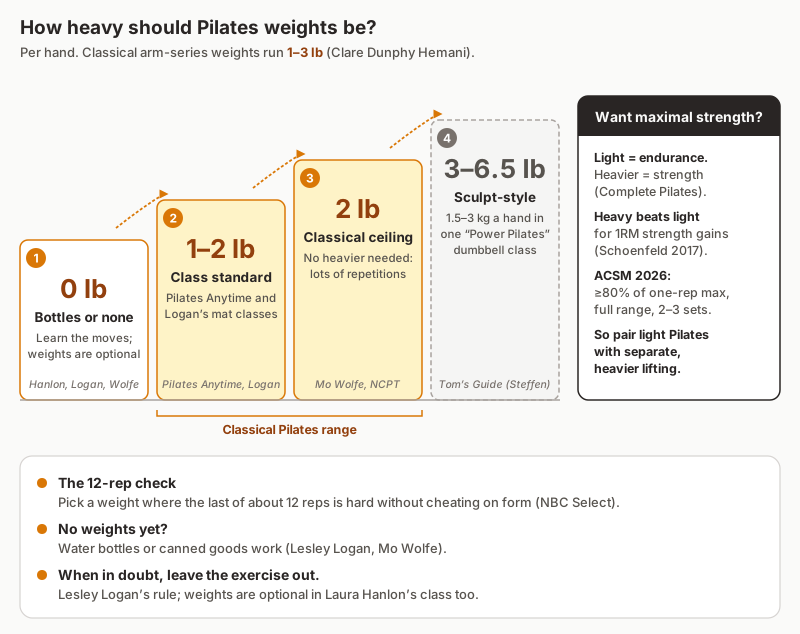
Light. Pilates teachers mostly use 1–2 lb per hand:
- Pilates Anytime: "One- or two-pound weights add challenge to the Standing Arm Series and the Wall Exercises."
- Lesley Logan: "You can use one or two pound weights," or water bottles and canned goods.
- Laura Hanlon (Pilates Anytime): uses "two pounds" in her hand-weight mat class, and makes them optional: "Do what you need. Of course, option to not use weights at all."
- Mo Wolfe, NCPT (Evolution Pilates): "For Pilates, you don't need anything heavier than the two-pound weights because we do a fair amount of repetitions."
- Clare Dunphy Hemani (Progressive Bodyworks): the small weights "weigh only 1-3 pounds (or .4-1.3 kilos)," but "can pack a punch."
Some "Power Pilates" or sculpt-style classes go heavier. In a Tom's Guide workout, instructor Marie Steffen suggests 1.5–3 kg (about 3–6.5 lb) per weight, depending on your strength and whether you can hold it for many reps. Treat that as the heavy end of the range, not the norm.
For a general dumbbell rule, University of Utah's Traci Thompson tells NBC Select to pick a weight where the last of about 12 reps feels hard without "cheating" on form.
| Level | Weight per hand | Who says |
|---|---|---|
| Learning moves | 0 lb or bottles | Logan, Hanlon, Wolfe |
| Class standard | 1–2 lb | Pilates Anytime, Logan |
| Classical ceiling | 2 lb | Mo Wolfe |
| Sculpt-style | about 3–6.5 lb (1.5–3 kg) | Marie Steffen |
Tap the diagram to enlarge
Need a pair? A 1 or 2 lb neoprene set covers everything in this routine. Our best hand weights for Pilates compares light pairs.
Check price on AmazonThe 9-move full-body Pilates dumbbell workout
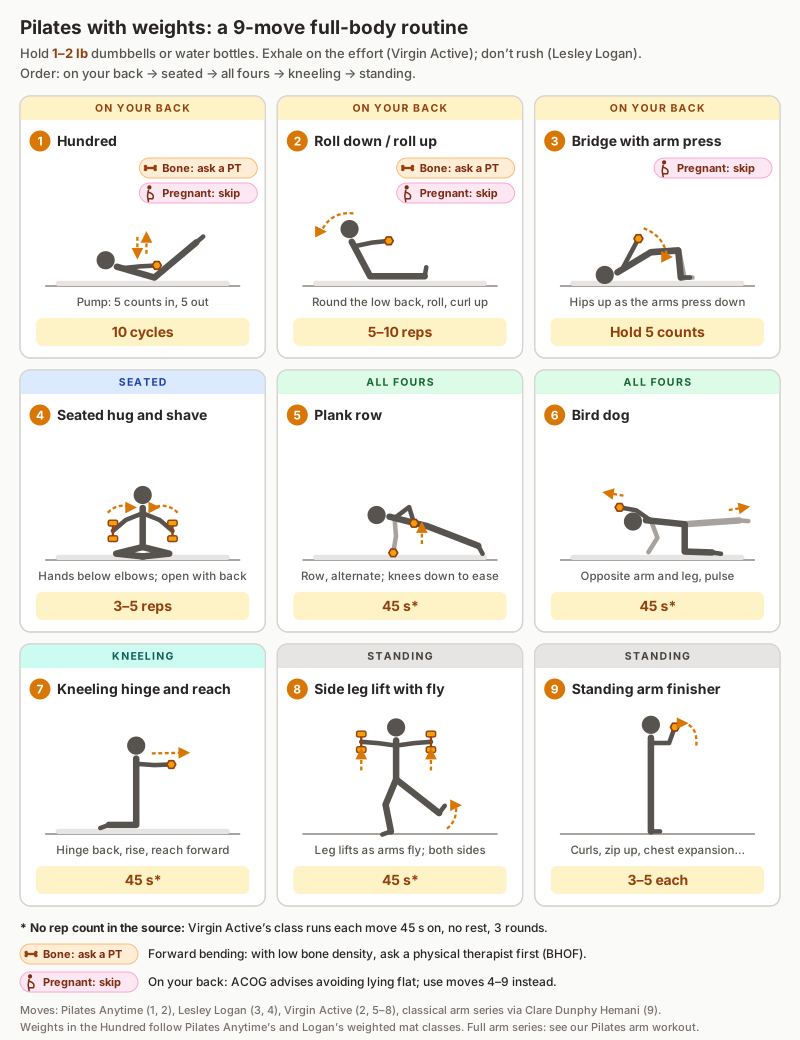
Three rules apply to every move:
- Breathe with it. Virgin Active's Pilates dumbbell class pairs each move with a breath, usually an exhale on the effort.
- Don't rush. "It's super easy to rush the arms or drag the hips," Logan says in her bridge tutorial. "Timing the two and staying connected to your center is a real skill."
- Keep the neck long. "The neck stays in line with the spine as one unit," Pilates Anytime's Meredith Rogers cues for the Hundred.
Tap the diagram to enlarge
Most hand-weight classes on Pilates Anytime's class list are rated intermediate, so start light and go without weights for any move that feels shaky.
Warm up first (no weights)
Virgin Active's class opens with head tilts, full roll downs, back strokes, lateral bends and chair sits before any weights come out. A few minutes of these, unweighted, is enough. If you have low bone density, leave out the roll down (see who should modify).
1. Hundred with light weights
Pilates Anytime's Meredith Rogers (BASI) rates this a beginner move. Lie on your back with your legs together. Exhale to lift your head and shoulders, hover your arms and float your legs to a comfortable height. "Inhale for five arm pumps and exhale for five arm pumps," for 10 cycles. She lists the focus as "abdominals and muscles of respiration."
To make it easier, Rogers suggests raising the legs higher, holding them vertical or bending the knees. Logan's weighted mat class includes the Hundred. Holding 1–2 lb weights while you pump is our reading of Pilates Anytime's and Logan's guidance, not a separate instruction.
2. Roll down (or roll up) with weights
Pilates Anytime's Sarah Bertucelli rates the roll up beginner. Sit with your legs long and arms forward. "Round through the back slightly, using the abdominals to create a slight curve in the lumbar spine." Exhale to roll back as the arms float overhead, then inhale and curl up. She gives 5–10 reps.
Bertucelli's modification is a hand towel placed 1–2 inches behind your pelvis, where your low back lands as you roll back. She notes that a longer torso and shorter legs make it harder. Virgin Active's "Roll Down With Weights" version has you "rolling down to a forward fold and peeling up through your spine using weights."
This is a spinal flexion move. If you have low bone density, see who should modify.
3. Bridge with arm press
Logan calls this "Breathing with weights." Lie on your back, knees bent and about a fist distance apart, feet parallel, with the weights held up toward the ceiling. Inhale, press into your feet and roll your hips up as your arms press down. Hold for 5 counts, then exhale to lower your hips as your arms lift back up.
She uses 1 or 2 lb weights for 2–5 reps, then progresses to a single-leg version, 3–5 per leg. Logan says adding weights to the shoulder bridge lets you feel your arms connect to your back, and that it "may not be suitable for some knee or back issues."
4. Seated hug and shave
Both moves come from Logan's "Rowing with Weights on the Mat," using 1–2 lb for 3–5 reps.
- Shave: sit cross-legged with your hands behind your head and the ends of the weights pressed together. Lift the arms up, then bend them back down. Logan says not to turn it into a triceps exercise.
- Hug: arms out to the sides with a slight bend. "Hands lower than elbows, elbows lower than shoulders." Hug the arms together, then use your back to open them.
Her posture cue: "Use your legs to maintain your inner thigh and seat to sit tall!" She notes the series "may not be suitable for some neck issues." Logan's full rowing series is rated intermediate, so treat the rest of it as a later progression.
5. Plank row
From Virgin Active: "Holding a high plank, complete a single arm row. Continue alternating arms." For an easier version, "complete this on your knees for a regression."
Hex-shaped dumbbells help here because they don't roll, as NBC Select points out.
6. Bird dog with a weight
Virgin Active's cue is short: "Extend opposite arm and leg and pulse," with a dumbbell in the reaching hand. Reach slowly and don't let your lower back sag (our tip). Laura Hanlon's hand-weight class also includes all-fours arm and leg lifts.
7. Kneeling hinge with arm reach
Virgin Active calls this "Half Squat With Offerings." "Starting on knees: Inhale- To hinge back through your hips holding weights with arms bent at a 90-degree angle. Exhale- to extend back up to kneeling, whilst extending the weights out forward of your body."
An alternative from the same class is the kneeling hinge, arms reaching forward: "Inhale - to hinge through your knees in a diagonal line. Exhale - to slowly lengthen back to the starting position." A folded towel under your knees helps (our tip).
8. Standing side leg lift with arm fly
Virgin Active: "Starting with the torso slightly hinged forward, with a bent supporting leg and flexed extended foot. Exhale- to lift your left leg to the side whilst your arms are completing an arm fly. Inhale- to lower arms and leg." Do both sides.
For an easier option, Virgin Active's calf raise with lateral arms: "Inhale- to lift heels and extend arms to the side. Exhale-to slowly lower heels and lower arms." A wall or chair nearby helps with balance.
For more leg work with arms, Tom's Guide notes that Marie Steffen's "Power Pilates" class pairs overhead presses or arm raises with single-sided leg moves like lunges. Laura Hanlon's hand-weight class keeps the arm work kneeling instead, including biceps curls. For side-lying leg work, our ankle weight Pilates exercises cover it in detail.
9. Standing arm finisher
Finish with 3–4 moves from the classical standing arm weight series, such as biceps curls, zip up, chest expansion or sparklers, at 3–5 reps each. Hemani and Logan both teach this series, and Logan ends her weighted mat class with standing arm work. Full instructions for all 10 moves are in our Pilates arm workout with weights.
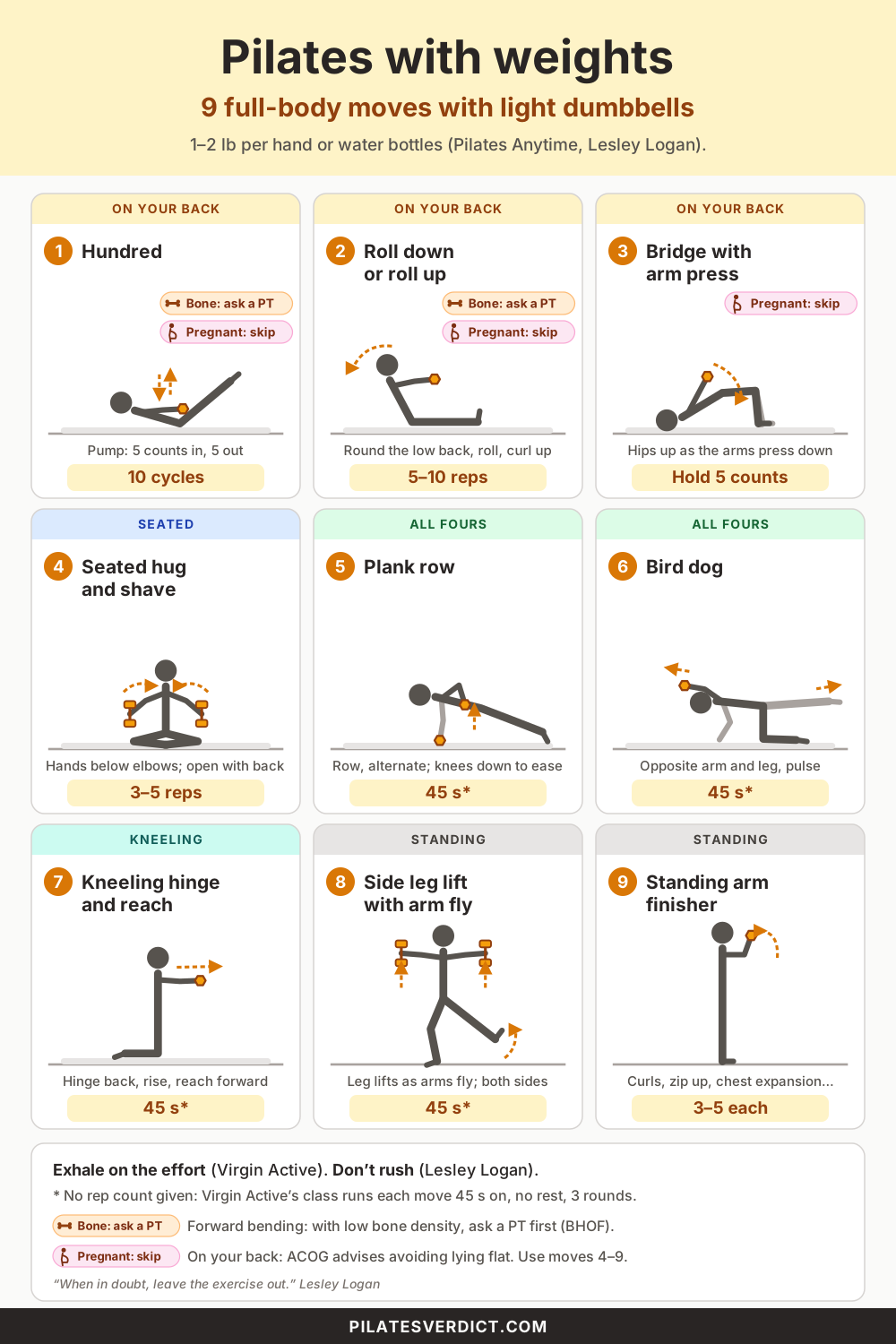
Pilates dumbbell workout at a glance
| Move | Position | Reps | Source |
|---|---|---|---|
| 1. Hundred | On back | 10 breath cycles | Pilates Anytime |
| 2. Roll down | Seated/back | 5–10 | Pilates Anytime |
| 3. Bridge + arms | On back | 2–5 (3–5 per leg) | Lesley Logan |
| 4. Hug and shave | Seated | 3–5 | Lesley Logan |
| 5. Plank row | Plank | 45 s* | Virgin Active |
| 6. Bird dog | All fours | 45 s* | Virgin Active |
| 7. Kneeling hinge | Kneeling | 45 s* | Virgin Active |
| 8. Leg lift + fly | Standing | 45 s* | Virgin Active |
| 9. Arm finisher | Standing | 3–5 each | Hemani, Logan |
*Virgin Active's class uses timed sets (45 seconds on) rather than reps. If you prefer counting, 5–8 reps works (our rule of thumb).
Tap the diagram to enlarge
How to structure a weighted Pilates workout
Three session formats come from the sources:
- Classical style: 3–5 reps per move (Logan, Hemani) or 5–10 for the roll up (Pilates Anytime). Slow and precise.
- Circuit: Virgin Active's 30-minute beginner/intermediate class is "10 exercises / 45 seconds on / no rest / repeat circuit x 3 / rest 45 seconds."
- Strength-study tempo: a 2016 randomized trial of light 1 kg (about 2.2 lb) dumbbell training used 12 reps per move, "two seconds of concentric and two seconds of eccentric movement in continuous motion," with 15–30 seconds of rest between moves. That study wasn't Pilates, but the tempo is a useful template.
Our suggestion for beginners: do one round of the 9 moves at 5–8 reps, then add a second round once it feels controlled. By our estimate, one round takes roughly 15–20 minutes including the warm-up. Virgin Active's full circuit runs 30 minutes. US Physical Activity Guidelines say adults need "muscle-strengthening activity, like lifting weights or doing push-ups, at least 2 days each week."
Benefits of Pilates with weights: what light dumbbells can and can't do
No randomized trial we found compares mat Pilates with and without dumbbells. Here's what the wider evidence supports.
Light weights lean toward endurance. Complete Pilates' Magda Strugariu, a clinical Pilates instructor, says adding weights "can increase the resistance of an exercise, helping you develop strength and endurance while maintaining the control and quality of movement." She also notes: "A light weight will challenge endurance, while a heavier one will aid in building strength."
Heavier loads build more maximal strength. A 2017 meta-analysis by Schoenfeld and colleagues (21 studies) found 1RM strength gains were "significantly greater in favor of high- vs. low-load training," though muscle growth "can be equally achieved across a spectrum of loading ranges." Those studies took sets to failure, which light Pilates sets of 3–10 reps rarely approach.
The 2026 ACSM position stand, drawing on 137 systematic reviews, found strength was enhanced by "lifting heavier loads (≥80% one-repetition maximum), through a complete range of motion, for 2-3 sets."
One light-dumbbell trial, with caveats. Yaacob and colleagues (2016) randomized about 138 adults in Malaysia with a BMI of 23 or higher to group exercise with a pair of 1 kg (about 2.2 lb) dumbbells (at least 15 minutes a day, 3 days a week) or to wearing 0.5 kg ankle and wrist weights during daily activities. They found "significant reductions in BMI only at week six for the dumbbell group."
Both groups improved waist circumference, waist-to-hip ratio, body-fat percentage and skeletal-muscle percentage from baseline over 6 months, and "there was no adverse event reported."
Limits: it wasn't Pilates, there was no non-exercise control group, only 89 of about 138 finished, most participants were women, and body fat was measured by bioimpedance. The "potential cardiovascular disease risk reduction" in its title refers to risk factors, not heart events.
Pilates and lifting do different jobs. Carrasco-Poyatos and colleagues (2019) assigned women aged 60–80 to 18 weeks of Pilates, resistance training or a non-exercise control group. Pilates came out ahead on isometric hip and trunk extension strength, and resistance training on isokinetic strength (small cluster trial, 49 finished, with a control group).
Pilates teacher Nikki Naab-Levy, who holds a B.S. in exercise science, writes for Girls Gone Strong that "Pilates has given me the body awareness and mobility to progress more quickly when lifting weights, while lifting weights has made advanced Pilates exercises that I previously struggled with feel effortless." That's one expert's view, but it fits doing both.
No spot reduction. A 2022 meta-analysis (Ramirez-Campillo et al., 13 studies, 1,158 people) concluded "there was no spot reduction." Arm moves with weights won't target arm fat.
Bones: unproven at this load. BHOF counts lifting weights as muscle-strengthening exercise and says yoga and Pilates "can also improve strength, balance and flexibility." We found no study showing that 1–2 lb Pilates weights improve bone density, so we don't claim it.
Pilates with weights vs. lifting weights
Our verdict: add 1–2 lb weights if you want more endurance work and variety in mat Pilates. If your goal is maximal strength or bone loading, keep the Pilates and also lift heavier at least 2 days a week (ACSM, US guidelines). Pilates with weights doesn't replace lifting.
Who should modify or skip
- Osteoporosis or low bone density: BHOF warns that "exercises that have you bend forward may increase the chance of breaking a bone in the spine," and advises avoiding bending forward from the waist, sit-ups, crunches and extreme twisting. The Hundred and the roll down both involve that kind of flexion. BHOF says a physical therapist can help you pick safe exercises. Our suggestion: ask a PT whether the bridge, bird dog, kneeling and standing moves suit you.
- Pregnancy: ACOG lists modified Pilates among exercises considered safe, advises avoiding lying flat on your back as much as possible and recommends talking with your ob-gyn. Moves 1–3 are on your back. Our suggestion: use the seated, all-fours, kneeling and standing moves instead.
- Neck, knee or back issues: Logan flags her bridge for "some knee or back issues" and her rowing series for "some neck issues."
- Grip or wrist problems: Spaulding physical therapist Terry Downey tells Harvard Health that wrist weights are "great for targeted exercise if you can't grip a dumbbell." Don't swing them.
- Everyone: "When in doubt, leave the exercise out," Logan says. Hanlon's no-weights option is always available.
What you need
Bottom line: start with a 1 lb pair if you're new to Pilates, or 2 lb if you already do mat classes (Pilates Anytime, Logan, Wolfe). Pick hex neoprene for plank rows, Bala Bars if you also do barre, or Portzon for a softer grip (our picks, based on the NBC Select and Women's Health roundups cited below).
You need a mat and a light pair of dumbbells. NBC Select calls Amazon Basics neoprene dumbbells budget-friendly with no noticeable odor, and the hex shape won't roll during the plank row.
Check price on AmazonIf you want a Pilates-styled pair, Women's Health named Bala Bars "Best for Yoga and Pilates," while noting they may be too light for advanced exercisers. NBC Select calls Portzon's neoprene pair soft and easy to grip.
Amazon Basics Neoprene Dumbbell Hand Weights (pair)
- Weights
- 1–20 lb pairs
- Best for
- Budget hex pair
Bala Bars (pair, 1/2/3 lb each)
- Weights
- 1, 2 or 3 lb
- Best for
- Pilates and barre styling
Portzon Neoprene Dumbbells (pair, 1–15 lb)
- Weights
- 1–15 lb pairs
- Best for
- Soft grip
Our best hand weights for Pilates covers more options, and our best Pilates mats helps with the mat. New to Pilates? Learn the unweighted basics first with our Pilates exercises at home for beginners. More routines are in Pilates workouts.
Frequently Asked Questions
Can you do Pilates with weights?
Yes. Pilates teachers commonly add 1–2 lb hand weights to mat work. Pilates Anytime says light weights keep "the emphasis on the entire body" and can stand in for Reformer handles and Cadillac arm springs. Clinical Pilates instructor Magda Strugariu (Complete Pilates) says weights add resistance while keeping the control and quality of movement.
What weight dumbbells should a beginner use for Pilates?
Light: 1–2 lb per hand is the range Pilates Anytime and teacher Lesley Logan use. Classical teacher Mo Wolfe says you don't need more than 2 lb because Pilates uses a fair number of reps. Water bottles or cans work to start, according to Logan and Wolfe.
Does Pilates with weights build muscle?
It adds endurance work and some challenge, but light loads have limits. A 2017 meta-analysis and the 2026 ACSM position stand both found heavier loads produce bigger strength gains. No study we found has compared mat Pilates with and without dumbbells. A 2016 trial of 1 kg dumbbell training (not Pilates) found improvements in waist size and body-fat percentage, but it had no non-exercise control group.
Is weighted Pilates better than lifting weights?
They do different jobs. In a small trial of older women, the two programs improved somewhat different strength measures. A Pilates teacher writing for Girls Gone Strong says Pilates helped her progress faster in lifting, and lifting made advanced Pilates moves easier. US guidelines call for muscle-strengthening activity at least 2 days a week.
Does Pilates with weights help you lose weight or tone arms?
Not on its own. A 2022 meta-analysis found no spot reduction, so arm moves won't target arm fat. A 2016 trial of light 1 kg (about 2.2 lb) dumbbell training (not Pilates) saw modest body-composition changes, but it had no non-exercise control group.
How long should a Pilates with weights workout be?
Lesley Logan's and Virgin Active's weighted classes both run about 30 minutes. One round of the 9 moves here is a shorter start (our suggestion).
How often should you do Pilates with weights?
US Physical Activity Guidelines call for muscle-strengthening activity at least 2 days a week. Two or three weighted sessions a week, with rest days between, fits that (our suggestion).
Can you use ankle or wrist weights instead of dumbbells?
Wrist weights work if gripping is hard, Spaulding physical therapist Terry Downey tells Harvard Health, but don't swing them. For leg work, see our ankle weight Pilates exercises.
Is Pilates with weights safe if you have osteoporosis?
Talk to a physical therapist first. The Bone Health & Osteoporosis Foundation warns that forward-bending exercises may raise the risk of spine fractures and advises avoiding sit-ups, crunches and extreme twisting. Several classic mat moves, such as the roll up and the Hundred, involve that kind of flexion.
Sources
- Pilates Anytime (Alison Manheim): Top 10 Pilates props for mat classes
- OnlinePilatesClasses.com (Lesley Logan): 30 min full body Pilates mat workouts with weights
- OnlinePilatesClasses.com (Lesley Logan): Breathing with weights on the mat
- OnlinePilatesClasses.com (Lesley Logan): Rowing with weights on the mat
- Pilates Anytime (Laura Hanlon): Mat with hand weights
- Pilates Anytime: Hand weights classes
- Pilates Anytime (Meredith Rogers): Hundred
- Pilates Anytime (Sarah Bertucelli): Roll up
- Virgin Active (gym class plan): Pilates dumbbell workout
- Complete Pilates (Magda Strugariu; studio content): Pilates with weights
- Progressive Bodyworks (Clare Dunphy Hemani): Small weights pack a punch
- Evolution Pilates (Mo Wolfe, NCPT): 2-pound weights
- Tom's Guide (Marie Steffen): This "Power Pilates" workout with one set of dumbbells
- NBC Select: Best dumbbells
- Women's Health: Best dumbbells
- Yaacob et al., J Taibah Univ Med Sci (2016): Dumbbells and ankle-wrist weight training leads to changes in body composition (PDF)
- Schoenfeld et al., J Strength Cond Res (2017): Strength and hypertrophy adaptations between low- vs. high-load resistance training
- Currier et al., Med Sci Sports Exerc (2026): ACSM position stand on resistance training and ACSM news release
- Carrasco-Poyatos et al., PeerJ (2019): Pilates versus resistance training on trunk strength and balance adaptations in older women
- Girls Gone Strong (Nikki Naab-Levy): Why Pilates and lifting weights aren't mutually exclusive
- Ramirez-Campillo et al., Human Movement (2022): Exercise-induced localized fat reduction meta-analysis
- ODPHP: Physical Activity Guidelines, top 10 things to know
- Bone Health & Osteoporosis Foundation: Exercise to stay healthy
- Bone Health & Osteoporosis Foundation: Protecting your spine
- ACOG: Exercise during pregnancy
- Harvard Health Publishing: Wearable weights: how they can help or hurt
Update history
- : Published.
Found an error? See how we research and correct guides in our editorial policy.
Was this guide helpful?
Related Articles
How-To
Pilates jump board exercises for beginners: an 8-step progression
Eight Pilates jump board exercises for beginners in a safe order, plus what a reformer jump board is, spring tips and what the evidence says on benefits.
October 14, 2026 · 20 min read
How-To
Ankle weight Pilates exercises: an 8-move mat routine
Ankle weight Pilates exercises: an 8-move mat routine with reps, how heavy to go, the real benefits of Pilates with ankle weights and who should skip them.
October 13, 2026 · 19 min read
How-To
Wunda chair exercises for beginners: an 8-move routine
Eight beginner Wunda chair exercises in order, with spring settings, reps and form cues, plus the full classical list, a free PDF and combo chair tips.
October 13, 2026 · 25 min read
How-To
Pilates arm workout with weights: a 10-move standing arm series
A Pilates arm workout with weights you can do at home: the 10-move standing series with 1–3 lb dumbbells, a no-weights version and wrist-weight tips.
October 12, 2026 · 18 min read