Pilates jump board exercises for beginners: an 8-step progression
By The Pilates Verdict Team · October 14, 2026 · 20 min read
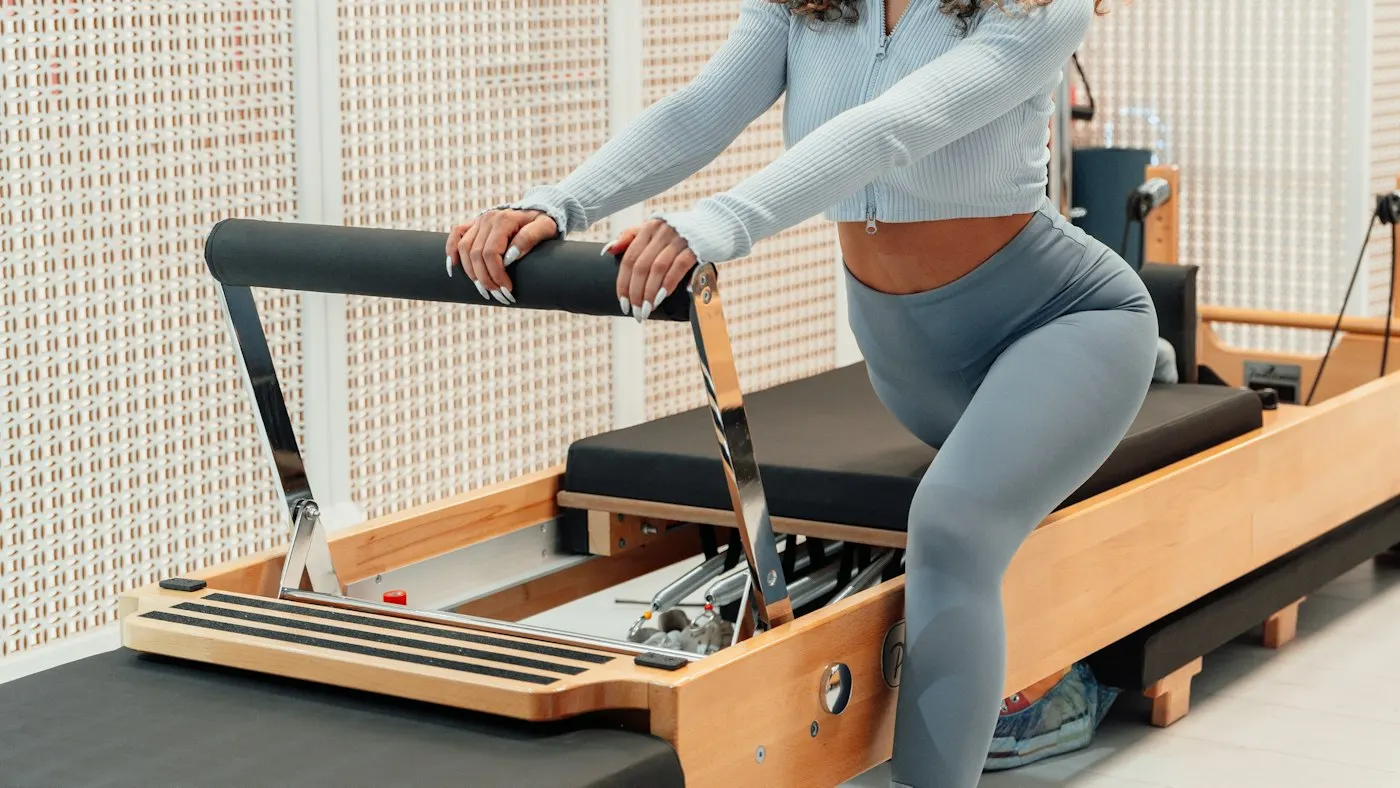
This article contains affiliate links. If you buy through them, we may earn a commission at no extra cost to you. As an Amazon Associate I earn from qualifying purchases. Learn more.
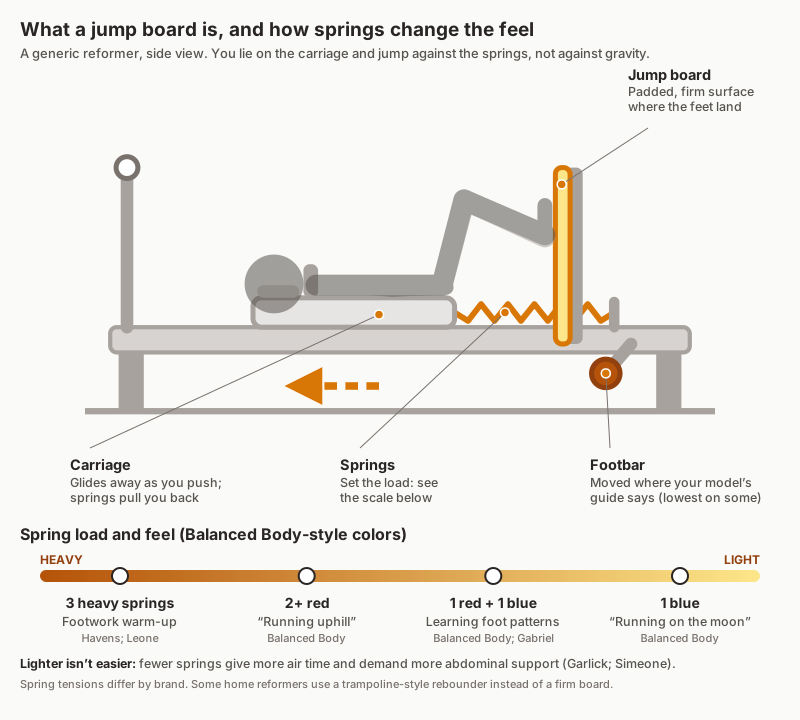
Pilates jump board exercises turn the reformer into a lying-down jumping machine. The jump board is a padded board that attaches at the foot end of the reformer. You lie on the carriage, push away from the board and land back on it, with springs controlling the ride. Balanced Body describes its board as "a firm, stable and comfortable surface for jumping and plyometric exercise."
It looks simple, but teachers don't treat it that way. "Jumping is not a beginner exercise," writes Kimberley Garlick, a Senior Polestar Practitioner, in The Pilates Journal. "Foundational footwork and alignment must be understood first." So this guide builds up to jumping in eight steps, in the order instructors teach it.
Looking for the standalone at-home "Pilates board" with bands and a rolling platform? That's a different piece of equipment. See our Pilates board exercises instead, or compare the best Pilates boards for home.
How we researched this: The exercise order follows Niedra Gabriel's jump board tutorial on Pilates Anytime and Garlick's progression in The Pilates Journal. The exercise list comes from Balanced Body's jumpboard article. Form cues come from Pilates Anytime classes by Melissa Connolly, Amy Havens and Maria Leone, plus a Pilates Journal piece by Kylie McGuiggan. Equipment details come from Balanced Body, Merrithew and Stamina (AeroPilates) product pages and install guides. For the benefits section we read one peer-reviewed study on reformer intensity, a physical therapist's analysis of jumping and bone, and Healthy Bones Australia's exercise guidance. We don't coach or test workouts, and spring settings vary by brand, so check your own reformer. All sources are listed at the end.
Quick version:
- The progression: footwork on the board, ankle hinge, heel lifts, small bounces to full jumps, changing foot positions, running in place, jumping jacks, single-leg jumps. Jump to the steps.
- Learn reformer footwork first. If you're new to the reformer, start with our reformer exercises for beginners.
- Lighter springs aren't easier. They give you more air time and ask more of your core.
- Check first if you have osteoporosis, heart issues, inflamed joints, pelvic floor symptoms or are pregnant.
- Need a board? Jump boards are model-specific. See which one fits your reformer.
What is a jump board in Pilates?
A jump board (also written "jumpboard") replaces or sits in front of the footbar at the foot end of the reformer. Instead of pressing the footbar with your feet, you press a flat, padded surface, which lets you leave it and land on it again.
Balanced Body says its Padded Jumpboard "supports a bio-mechanically accurate standing position while lying on the Reformer," and lists its uses as jumping and plyometrics, cardio with spring resistance, squatting and flexibility work. Merrithew calls its version "a firm, padded jumping surface that allows for biomechanically sound foot placement for plyometric and aerobic exercise."
It's a later addition to the Pilates apparatus. Garlick writes that the jump board is "often credited to Pilates elder Eve Gentry in the 1970s," so it isn't part of Joseph Pilates' original equipment.
Jump board vs. rebounder
Not every jumping attachment is a firm board:
- Firm jump board: a padded, flat surface. Balanced Body and Merrithew both sell these.
- Rebounder: a trampoline-style surface. Merrithew describes its Cardio-Tramp as "a resilient landing surface for rebounding activity." The AeroPilates Cardio Rebounder, made by Stamina, replaces the footbar on AeroPilates reformers.
This matters if you shop on Amazon. Several AeroPilates home reformers ship with a Cardio Rebounder, not a firm jump board. The exercises below work on either, but a rebounder gives you a softer, bouncier landing.
Tap the diagram to enlarge
Before you jump: setup and springs
Install the board the way your model's guide says. Balanced Body's install guide notes that the footbar must sit in a specific position for each reformer model. "Failure to correctly position the footbar when installing the jumpboard could damage the foam on the footbar. This damage is NOT covered under warranty." On the Rialto and Allegro 2, for example, "the footbar must be in the lowest position and set closest to the standing platform end of the Reformer."
Test the springs before you jump. Niedra Gabriel advises trying the tension first because "different reformers have different tensions."
Know that lighter is harder on your core. This is the part that surprises people. Garlick writes: "Lighter springs increase suspension time and demand more abdominal support, while heavier springs can sometimes mask inefficiencies or overload the system."
Aspasia Simeone, a PIA-certified instructor and ACE trainer with an applied-physics degree, says the same thing on Pilates Bridge: more springs give an "intense muscle response" with less core effort, while fewer springs give "more air time," which takes more control.
Here's how the published settings compare. Colors are Balanced Body's; other brands use different colors and tensions.
| Spring load | How it's described | Used for |
|---|---|---|
| 3 heavy (red) | Warm-up load | Footwork (Havens, Leone) |
| 1 red + 1 blue | Moderate | Learning foot patterns (Balanced Body, Gabriel, Connolly) |
| 2 or more red | "Running uphill" (Balanced Body) | Strength-focused jumping |
| 1 blue | "Running on the moon" (Balanced Body) | More air time, more pelvic control |
A sensible pattern from these classes: warm up on heavier springs for footwork, then jump on a moderate setting. Don't assume a single light spring is the gentle option.
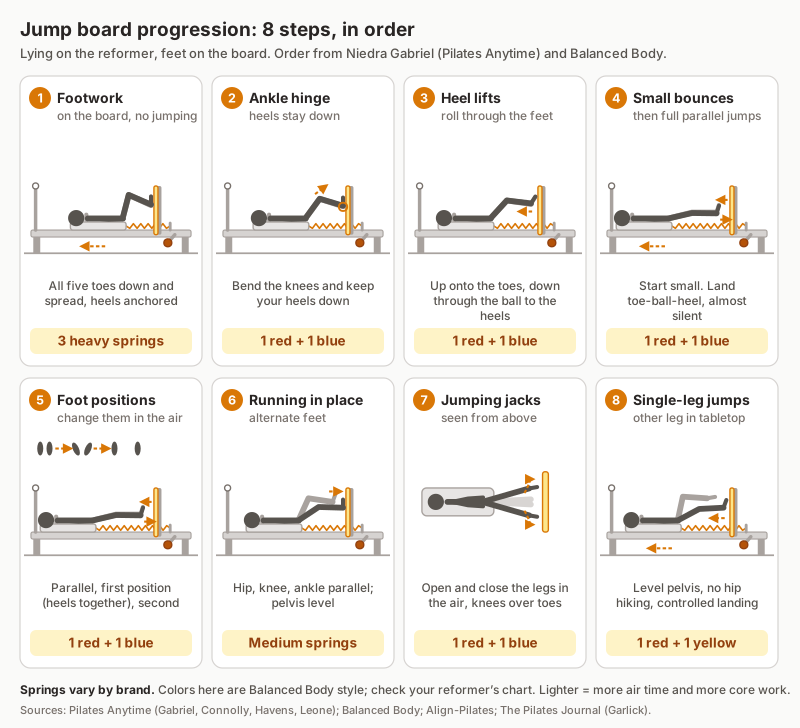
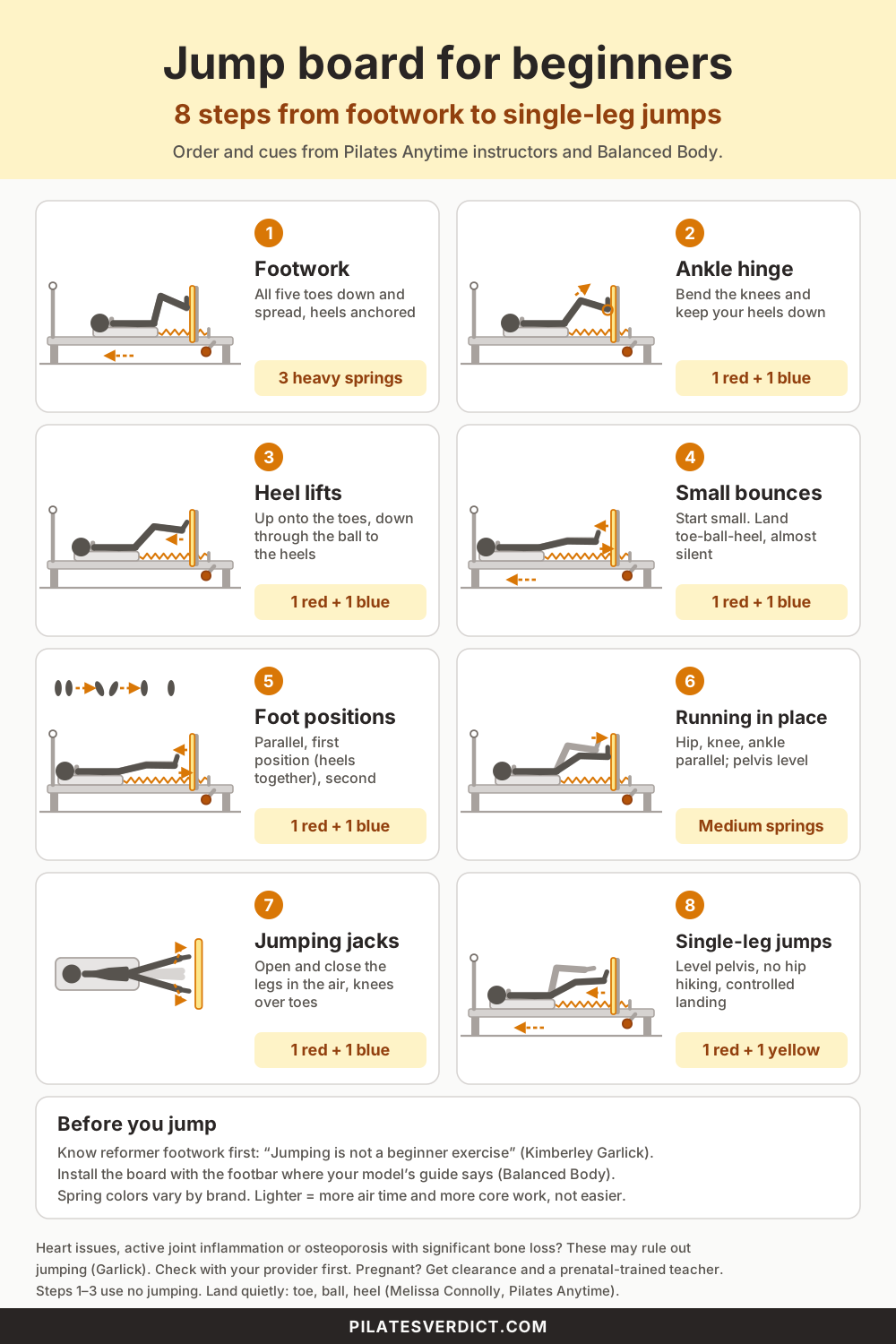
8 Pilates jump board exercises for beginners, in order
This progression is for people who already know reformer footwork. The order comes from Gabriel's tutorial, which Pilates Anytime rates "Suitable for All," and Garlick's advice to use supported variations before double-leg jumping. The full jump board classes cited here are rated Intermediate or higher, and Merrithew rates its Jumpboard Interval Training program "Intermediate (Level 3 of 5)," so take your time with the early steps.
Tap the diagram to enlarge
1. Footwork on the board
Start without leaving the board. Merrithew's jumpboard program opens with footwork before its jump series, and Amy Havens and Maria Leone both warm up with footwork on three heavy springs in their Pilates Anytime classes. A Merrithew dealer listing notes the board "can be used for footwork as a flat secure surface to create stability through lower extremity joints."
- What to do: press the carriage out and back with your feet on the board. Havens works through parallel, Pilates V, second position and toes-in.
- Cue (Gabriel): "all five toes down, all five toes are spread," with "heels anchored."
- Springs: heavier, such as 3 red (Havens).
2. Ankle hinge
Gabriel's next step teaches ankle mobility before any bounce.
- What to do: with the carriage pressed out partway, bend the knees while you "keep your heels down," then straighten.
- Why: you'll need that ankle bend to absorb each landing later.
3. Heel lifts and rolling through the feet
Still no jumping. Gabriel has you lift the heels with the balls of the feet down, then lower.
- What to do: lift and lower the heels. Then progress to rolling up onto the toes and back down through the ball of the foot to the heels.
- Why: this is the landing pattern in slow motion.
4. Small bounces to full parallel jumps
Now you leave the board, but only a little. Gabriel starts with small bounces, then adds power while "zippering everything together."
- Setup (Connolly): "Place your feet up on the jump board. You want your toes to be right up towards the top edge of the jump board feet parallel hip distance apart."
- Landing (Connolly): "Land nice and easy. Toe ball heel."
- Alignment (Havens): "hip, knee, ankle, nice and parallel," with a level pelvis.
- Focus (Leone): "I want the emphasis to be on the landing." Garlick says the landing "should be precise, controlled, and almost silent."
- Springs: Connolly uses 1 red + 1 blue for her first jumps.
5. Changing foot positions
Once parallel jumps feel steady, change your foot position in the air. Connolly moves between first position (heels together, toes apart), parallel hip-distance and second position.
Balanced Body teaches foot patterns before arm patterns. It adds 2 lb hand weights only once the foot patterns are coordinated, and adds music last.
6. Running in place
"Running in place" and "prancing" are both on Balanced Body's list of basic jumpboard exercises. Align-Pilates, a reformer maker, opens its beginner single-leg jump series with "Single Leg Jogs" and "Single Leg Double Jogs."
- What to do: alternate feet, pushing off one foot and landing on the other, like a light jog on the board.
- Keep: the pelvis level and the carriage moving smoothly.
7. Jumping jacks
Jumping jacks are on Balanced Body's basic list. We didn't find step-by-step cues from a source we could check, so keep it simple: open and close the legs in the air, and land with your knees tracking over your toes.
8. Single-leg jumps
Single-leg jumps are on Balanced Body's list. Align-Pilates' beginner single-leg series includes Single Leg Jogs, Double Jogs, 4s, 8s, Knee Pulls and Half Bicycle.
- What to do: jump with one foot on the board and the other leg lifted, then switch.
- Cue (Gabriel): keep the hip stable as you move to single-leg work.
- Cue (Havens): she stresses a level pelvis throughout her class.
- Springs: Connolly uses 1 red + 1 yellow for single-leg jumps.
Cool down
Merrithew's jumpboard program ends with a hamstring stretch, an adductor (inner thigh) stretch and a thigh stretch. Ending the same way gives your legs a break after the jumps.
Sample beginner Pilates jump board workout (20 minutes)
This is our suggested structure based on the sequences above, not a prescription from any of the sources. Adjust springs to your reformer and stop anything that hurts.
| Block | Steps | Time |
|---|---|---|
| Warm-up | 1. Footwork, all positions | 4 min |
| Prep | 2–3. Ankle hinge, heel lifts | 3 min |
| Jumps | 4–6. Bounces, foot changes, running | 6 min: 1 min on, 1 min rest |
| Add-ons | 7–8. Jacks, single-leg | 4 min: 1 min on, 1 min rest |
| Cool down | Hamstring, adductor, thigh stretches | 3 min |
For reference, Merrithew's intermediate jumpboard program has 39 minutes of workout content across 20 exercises, and the Pilates Anytime classes cited here run 30–35 minutes. Align-Pilates' jump board workout uses 45–60 seconds per exercise, repeated 3–5 times, on 2 red springs, though its moves (side-lying jumps, star jumps, jump squats) go past this beginner list.
To follow along, Niedra Gabriel's jump board tutorial on Pilates Anytime is rated "Suitable for All."
Tap the diagram to enlarge
Common jump board mistakes
- Landing loud or stiff: aim for "toe ball heel" (Connolly) and a landing that's "almost silent" (Garlick).
- Heels popping up in footwork: keep your "heels anchored" (Gabriel).
- Pelvis rocking: keep "hip, knee, ankle, nice and parallel" with a level pelvis (Havens).
- Dropping to one light spring too soon: lighter springs mean more air time and more core demand (Garlick, Simeone).
More reformer jump board exercises after the basics
When the eight steps feel controlled, the classes in this guide point to these:
- Side-lying jumps: Havens teaches them on 1 blue spring. McGuiggan describes a stacked version on the knee and forearm with a medium spring.
- Kneeling or all-fours jumps: Havens' cue is "we've gotta pull those abdominals up and in."
- Jump series with arm work: Merrithew's program mixes numbered jump series with exercises like the kneeling shoulder press.
- Star: Merrithew has a version on its Jumpboard and Cross-Bow.
McGuiggan's rule for adding variety: "If we can't achieve the foundational move then the fancy creative layer does not get added in."
For more reformer and apparatus routines, browse Pilates workouts.
Jump board benefits: what the evidence says
There are no published studies on the jump board itself. Here's what the sources do and don't support.
Joint-friendly cardio (brand claim, not measured). Balanced Body says the "non-gravitational nature" of jumping on your back puts "less stress on the joints," and that correct alignment is easier lying down than standing. Stamina says its rebounder "adds low-impact cardio without placing excessive stress on your joints." Both are manufacturers describing their own products. Balanced Body also claims jumpboard work "burns more calories than traditional Pilates," but gives no data.
Intensity. The one peer-reviewed measurement we found is de Souza Andrade and colleagues (Journal of Bodywork and Movement Therapies, 2021). In 18 healthy women, a standard reformer session averaged 2.59 kcal/min and a mat session 1.93 kcal/min. "There was no significant increase in blood lactate, HR, and BP for either session above resting values," and the authors say the sessions "elicit low cardiovascular stress."
The study didn't include a jump board. Jump board work is designed to raise your heart rate, but no published study has measured how much.
AeroPilates cites a brand-sponsored study by Neil Wolkodoff, PhD, and colleagues in 14 relatively unconditioned adults, reporting gains in VO2 peak and anaerobic threshold. AeroPilates doesn't give a journal or year, and we couldn't confirm it was published or peer-reviewed.
Bones: probably not on its own. Balanced Body calls jumpboard work "good for bone building." Physical therapist Sherri Betz disagrees. She writes that bone-stimulating jumping is "4-8x body weight" and "the Reformer jumping is actually LESS than body weight and is not against gravity (2 strikes against it for building bone)." Garlick also says jumping can support bone health, though she doesn't cite a study. Healthy Bones Australia's guidance for physiotherapists recommends "around 50 impacts of 2-4 x body weight magnitude, a minimum of 3 days per week," and says "weight bearing exercise provides a superior stimulus than non-weightbearing activity."
Betz still sees a role for it. She calls the reformer "a fantastic tool to safely introduce someone to jumping with correct form and alignment," and says it may "help to increase leg strength to help clients tolerate the impact on their hip, knee and ankle joints."
Is it plyometric? Partly. Simeone says the answer is "yes and no," depending on spring tension. Garlick writes that with thoughtful spring choice, "the jump board can function almost like a leg press, building strength through deep hip, knee, and ankle flexion."
Coordination. Gabriel calls jumping "a really fun way to get more sophistication in the feet," and Garlick lists power, coordination and confidence among its benefits.
Who should skip or modify jumping
- Heart issues, inflamed joints, significant bone loss: Garlick writes that "conditions such as certain heart issues, active joint inflammation, or osteoporosis with significant bone loss may contraindicate jumping."
- Osteoporosis: Betz writes: "If you have below a -3.0 T-Score in the hip or spine DO NOT Jump!!" The Bone Health & Osteoporosis Foundation advises people with spinal bone loss against crunches and bending forward from the waist, so skip jump variations that add an ab curl or tuck. Ask a provider trained in osteoporosis what's right for you.
- Pelvic floor symptoms: we didn't find jump board-specific guidance. Healthy Bones Australia lists pelvic floor dysfunction among conditions that "may require referral, rehabilitation and/or modification." If you notice leaking or heaviness, stop and check with a pelvic health physical therapist.
- Pregnancy: ACOG advises talking with your ob-gyn about exercise during pregnancy. We found no jump board-specific guidance, so get clearance and work with a prenatal-trained teacher.
- Knees and ankles: Balanced Body says jumping lying down can help people with knee and ankle problems. That's a brand claim, and Garlick's caution about active joint inflammation still applies.
Pacific Northwest Pilates suggests a simpler first step: ask your instructor "whether jumping suits" you.
Which Pilates reformer jump board fits your machine?
Jump boards are model-specific. Buy the one made for your frame.
- Balanced Body: sells padded jumpboards for specific reformers, including the Allegro 2, Studio, Metro IQ, Allegro Stretch, Allegro Nextgen, Bravo (US only), Rialto, CenterLine and Clinical.
- It also sells a larger Jumpus Maximus and a Cardio Cloud cover that "creates a softer jumping surface on all Balanced Body jumpboards." Pricing is through a local representative. If you own or are considering an Allegro, see our Balanced Body Allegro 2 review.
- Merrithew: its Jumpboard is dense EVA foam over a steel frame, 23.8 x 30.6 in and 23 lb. It's listed in versions for SPX/SPX Max/NX3 Max, MPX and V2 Max/Rehab V2 Max frames; ST01043 is the 22-inch SPX version. Match your frame width.
- The Cardio-Tramp (ST02067 for V2 Max, ST02068 for SPX/SPX Max/MPX/NX3 Max) is the rebounder alternative.
- Merrithew's At Home SPX page says its springs are made for "vigorous use with Jumpboards, Cardio-Tramp Rebounders and other Reformer accessories," but the ST01043 page names only SPX/SPX Max/NX3 Max frames, so confirm the exact version with Merrithew before buying. Our Merrithew SPX review covers that reformer.
- AeroPilates: the Cardio Rebounder replaces the footbar on AeroPilates models 55-4286 and 55-4287, according to Stamina. Several AeroPilates reformers already include one; our AeroPilates models compared guide shows which.
Balanced Body Padded Jumpboard
- Surface
- Firm, padded
- Fits
- Model-specific BB reformers
- Price tier
- Contact rep
Merrithew Jumpboard
- Surface
- Firm, EVA foam
- Fits
- SPX, SPX Max, NX3 Max (MPX and V2 Max versions too)
- Price tier
- $300–500
Merrithew Cardio-Tramp Rebounder
- Surface
- Rebounder
- Fits
- SPX, SPX Max, MPX, NX3 Max (V2 Max version too)
- Price tier
- $300–500
AeroPilates Cardio Rebounder
- Surface
- Rebounder, nylon pad
- Fits
- AeroPilates 55-4286, 55-4287
- Price tier
- $100–150
| Product | Surface | Fits | Price tier | |
|---|---|---|---|---|
| Balanced Body Padded Jumpboard | Firm, padded | Model-specific BB reformers | Contact rep | View |
| Merrithew Jumpboard | Firm, EVA foam | SPX, SPX Max, NX3 Max (MPX and V2 Max versions too) | $300–500 | View |
| Merrithew Cardio-Tramp Rebounder | Rebounder | SPX, SPX Max, MPX, NX3 Max (V2 Max version too) | $300–500 | View |
| AeroPilates Cardio Rebounder | Rebounder, nylon pad | AeroPilates 55-4286, 55-4287 | $100–150 | View |
Quick verdict: own a Balanced Body reformer? Get the padded jumpboard for your model through a rep. Own a Merrithew SPX Max? The ST01043 Jumpboard, or the ST02068 Cardio-Tramp for a softer landing. At Home SPX owners should confirm fit with Merrithew first. Own an AeroPilates 286 or 287 without a rebounder? The Cardio Rebounder.
If you don't have a reformer yet, the most affordable way to get a jumping surface at home is a reformer that includes a rebounder. Stamina includes a Cardio Rebounder with the AeroPilates 4420, which sits in the under-$500 tier.
Check price on AmazonFor more options, see our best home Pilates reformers.
Frequently Asked Questions
What is a jump board in Pilates?
It's a padded board that attaches at the foot end of a reformer so you can jump while lying on the carriage, pushing against spring resistance. Balanced Body describes it as 'a firm, stable and comfortable surface for jumping and plyometric exercise.' Merrithew makes a firm Jumpboard and a trampoline-style Cardio-Tramp, and AeroPilates reformers use a Cardio Rebounder in place of the footbar.
Can beginners do jump board Pilates?
Yes, after learning reformer footwork. Polestar educator Kimberley Garlick writes that 'Jumping is not a beginner exercise. Foundational footwork and alignment must be understood first.' Instructors like Niedra Gabriel build up from heels-down footwork and heel lifts to small bounces before full jumps.
What springs should I use for jump board exercises?
It depends on the brand. Balanced Body teaches basic foot patterns on one red and one blue spring. Pilates Anytime instructors warm up with footwork on heavier spring loads (Amy Havens uses three red), then jump on lighter combinations. Lighter springs aren't easier: Garlick and instructor Aspasia Simeone say they add air time and demand more abdominal control.
Is jump board Pilates good cardio?
It's designed to raise your heart rate, but no published study has measured it. The one peer-reviewed comparison of standard reformer and mat sessions, by de Souza Andrade and colleagues, found low cardiovascular stress for both. Balanced Body's claim that it 'burns more calories than traditional Pilates' is a brand claim without data.
Can you use a jump board without a reformer?
No. Jump boards and rebounders mount on a specific reformer frame. Balanced Body, Merrithew and Stamina (AeroPilates) each sell boards made for their own models, and Balanced Body's install guide sets a footbar position for each one. If you don't have a reformer yet, see our best home Pilates reformers guide; some AeroPilates models include a Cardio Rebounder.
Are light springs easier for beginners?
Not necessarily. Kimberley Garlick writes in The Pilates Journal that lighter springs 'increase suspension time and demand more abdominal support,' and instructor Aspasia Simeone says fewer springs give more air time, which takes more control. Tensions also differ between machines, so Niedra Gabriel advises testing the springs before you jump.
Does jump board Pilates build bone density?
Probably not on its own. Physical therapist Sherri Betz notes reformer jumping is 'LESS than body weight and is not against gravity,' while Healthy Bones Australia recommends impacts of 2–4 times body weight for bone. Betz calls the reformer a useful way to learn jumping form before jumping on the ground, and says people with a T-score below -3.0 should not jump.
Sources
- Balanced Body (Barbara Wintroub; brand): Aerobic Pilates and the jumpboard
- Balanced Body (brand): Pilates jumpboard collection and Padded Jumpboard for Studio Reformer
- Balanced Body (brand): How to install the Padded Jumpboard, guide 10636A (PDF)
- Merrithew (brand): Jumpboard, ST01043 (with MPX and V2 Max versions)
- Pique Fitness (authorized dealer): Merrithew 22" Jumpboard for SPX/SPX Max
- Merrithew (brand): Cardio-Tramp Rebounder V2 Max/Rehab V2 Max, ST02067
- Merrithew (brand): Cardio-Tramp Rebounder SPX/SPX Max/MPX/NX3 Max, ST02068
- Merrithew (brand): At Home SPX Reformer Package, ST11010
- Merrithew (brand): Jumpboard Interval Training
- Merrithew (brand): Star on the Jumpboard and Cross-Bow
- Stamina Products (brand): AeroPilates Cardio Rebounder 55-0011
- Align-Pilates (Loraine Prokopiou; brand): Jump board exercises using medium springs
- Align-Pilates (brand): Jump board workout on the Pilates reformer
- The Pilates Journal (Kimberley Garlick): The Pilates jump board: benefits beyond cardio
- The Pilates Journal (Kylie McGuiggan): Get more creative reformer jumpboard ideas
- Pilates Anytime (Niedra Gabriel): Jump board tutorial
- Pilates Anytime (Melissa Connolly): Cardio & strength jump board
- Pilates Anytime (Amy Havens): Jump board flow
- Pilates Anytime (Maria Leone): Jumpboard reformer
- Pilates Bridge (Aspasia Simeone): Pilates jumpboard jumping defies vertical jumping & gravity
- CenterWorks (Sherri Betz, PT): Osteoporosis and exercise
- Healthy Bones Australia: Exercise prescription to support the management of osteoporosis (PDF)
- de Souza Andrade L et al., J Bodyw Mov Ther 2021: What is the exercise intensity of Pilates? (Europe PMC)
- AeroPilates (brand): AeroPilates leads the way with clinical study
- Pacific Northwest Pilates (Leslie Braverman; studio): Bump-up a Pilates workout with jumps
- Bone Health & Osteoporosis Foundation: Protecting your spine
- ACOG: Exercise during pregnancy
Update history
- : Published.
Found an error? See how we research and correct guides in our editorial policy.
Was this guide helpful?
Related Articles
How-To
Pilates with weights for beginners: 9-move full-body dumbbell routine
Pilates with weights for beginners: a 9-move full-body dumbbell routine, how heavy to go, what light weights can and can't do, and who should modify.
October 14, 2026 · 20 min read
How-To
Ankle weight Pilates exercises: an 8-move mat routine
Ankle weight Pilates exercises: an 8-move mat routine with reps, how heavy to go, the real benefits of Pilates with ankle weights and who should skip them.
October 13, 2026 · 19 min read
How-To
Wunda chair exercises for beginners: an 8-move routine
Eight beginner Wunda chair exercises in order, with spring settings, reps and form cues, plus the full classical list, a free PDF and combo chair tips.
October 13, 2026 · 25 min read
How-To
Pilates arm workout with weights: a 10-move standing arm series
A Pilates arm workout with weights you can do at home: the 10-move standing series with 1–3 lb dumbbells, a no-weights version and wrist-weight tips.
October 12, 2026 · 18 min read