What to wear to Pilates: a simple checklist for mat and reformer
By The Pilates Verdict Team · October 6, 2026 · 12 min read
This article contains affiliate links. If you buy through them, we may earn a commission at no extra cost to you. As an Amazon Associate I earn from qualifying purchases. Learn more.
What to wear to Pilates comes down to one rule: fitted, stretchy clothes with no zippers, rivets or buttons. Skip the shoes. Wear grip socks for reformer classes, and for mat work go barefoot or in grip socks. You don't need special or expensive gear. Club Pilates' FAQ simply asks for "comfortable athletic wear that you can move in."
Below is a quick checklist, then the details piece by piece, plus advice for men and a short packing list for your first class.
How we researched this: We read Balanced Body's reformer guidance and warranty terms, the Club Pilates FAQ and instructor advice, instructor interviews published by NBC Select and ELLE, grip-sock roundups from NBC Select and Garage Gym Reviews, studio guidance from The Pilates Circuit and BodyMindLife, apparel guidance from Under Armour (a brand that sells workout clothes), and general guidance from the American Academy of Dermatology and the American Council on Exercise. We didn't try on or test any clothing.
What to wear to Pilates class: quick checklist
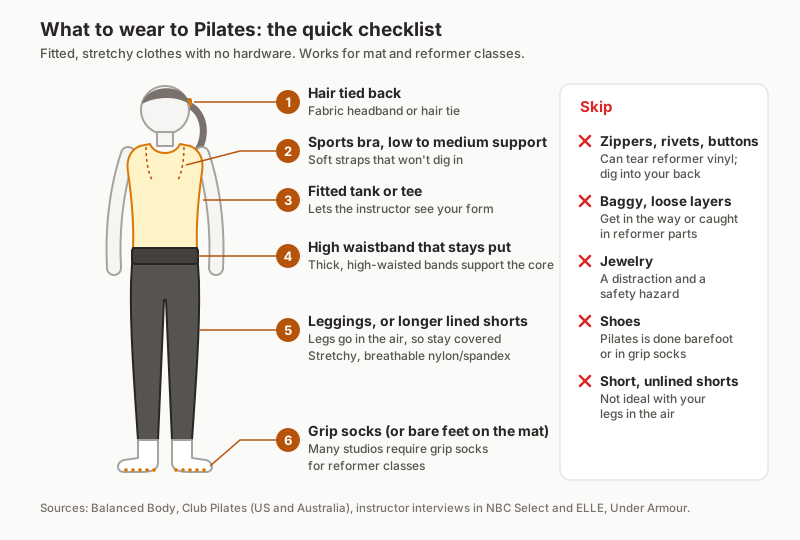
Tap the diagram to enlarge
| Item | Wear | Skip |
|---|---|---|
| Bottoms | High-waist leggings, lined shorts | Loose, short shorts |
| Top | Fitted tank or tee | Baggy layers |
| Sports bra | Low–medium support | Straps that dig in |
| Feet | Grip socks or bare feet | Shoes |
| Extras | Hair tie, water bottle | Jewelry, zippers |
What to wear, piece by piece
The experts agree on the basics. Balanced Body, which makes reformers, advises "comfortable, form-fitting clothing that allows for a full range of motion without being loose enough to get caught in the Reformer's parts."
Fitted clothes also help your instructor. Vanessa Johnson, a master instructor at Club Pilates, told NBC Select that "form-fitting clothing helps instructors see your body and correct your form more accurately." Obé Fitness instructor Marcia Meade told NBC Select to wear "whatever makes you feel comfortable, but try to avoid oversized, baggy clothing, which can get in the way."
Bottoms: high-waisted leggings or lined shorts
Leggings are the most common choice. Nofar Hagag, founder of the Nofar Method, told ELLE that high-waisted leggings support the core, stay in place, and pair well with a crop top or fitted tank.
Club Pilates instructors agree. Lead instructor Amanda Duckstein says high-waist leggings "make me feel supported" and likes a pair that doesn't "budge, even during difficult poses." Master trainer Kelsey Gephart looks for a thick waistband that doesn't pinch but stays put.
Shorts can work, with a caveat. According to experts NBC Select spoke with, shorts "are not ideal unless they're longer and have a liner, since you often have your legs in the air." Club Pilates Australia says leggings offer full coverage while shorts give better ventilation, so pick by preference.
NBC Select lists leggings, joggers, biker shorts and workout unitards among appropriate options. Whatever you choose, do a quick bend-and-squat check at home to make sure the fabric isn't see-through when stretched.
Tops: fitted tank or tee
Club Pilates Australia says "fitted tank tops or moisture-wicking tees are excellent choices." NBC Select also lists T-shirts and tank tops.
Fit matters more than style. Many Pilates exercises have you lying on your back or rolling your legs overhead, and a loose top can ride up or slide toward your face. That's the kind of baggy clothing Meade says "can get in the way."
Sports bra: low to medium support, comfortable straps
Pilates isn't high-impact, so you don't need maximum support. Sources differ a little: Hagag told ELLE she recommends medium support "with soft, flexible straps that won't dig in," while Under Armour suggests a low-impact bra with a wide band and adjustable straps. In practice, pick low to medium support based on what feels comfortable.
Duckstein's test is a bra that "holds my chest in comfortably without cutting me off in bad spots." Since you'll spend time lying on your back, flat straps and closures are more comfortable than bulky ones.
Fabric: stretchy and breathable
Hagag told ELLE to "look for high-quality, breathable materials like nylon or spandex blends," adding that "the four-way stretch is non-negotiable." Club Pilates instructor Kate Snyder likes sweat-wicking fabric, and Monica Lodwig likes a lightweight performance knit that "helps keep you cool." Many instructors prefer synthetic blends like these, but any fabric that stretches with you and stays in place will do.
Layers, drawstrings and seams
- A light layer for warm-up. ELLE's shopping editors suggest a pre- or post-workout top with sleeves in colder months, to keep you comfortable while you warm up. Pick something light you can take off once you're moving.
- Skip bulky pieces. Club Pilates Australia says hoodies and sweatpants can weigh you down, limit flexibility and make you overheat, and suggests lightweight pieces instead.
- No drawstrings or tiebacks. Club Pilates Australia says they can get caught in the reformer and pose a safety hazard.
- Flat seams. Club Pilates Australia notes that seamless construction and flatlock seams help reduce friction and chafing.
Feet: grip socks, bare feet, or shoes?
Pilates isn't done in shoes. Club Pilates Australia says shoes must be removed in class.
- Reformer: Balanced Body says "it's also common to practice Reformer Pilates barefoot or in socks with grips on the bottom." According to NBC Select, most studios require grippy socks. The Club Pilates FAQ says, "Every class participant needs grip socks," and sells them at the studio if you don't have a pair.
- Mat: NBC Select says "you can go barefoot, but if you want extra traction, you can throw on a pair of grippy socks."
Hagag told ELLE that grip socks are required at her studio, "not only for safety, as they prevent slipping on equipment like the Reformer or Cadillac, but also for improving stability." In NBC Select's grip sock roundup, experts advised against toeless designs because they're less hygienic on shared equipment.
Hygiene is part of the picture too. The American Academy of Dermatology recommends shower shoes or sandals when walking around gyms, showers and locker areas (not during class) and changing your socks every day, more often when they get wet. For more on studio policies, see do you need grip socks for Pilates?
If you need a first pair, Garage Gym Reviews named the Pointe Studio Happy Full Grip Sock, with grips from toe to heel, its best overall pick:
Check price on AmazonNBC Select's best overall pick was the Tavi Savvy, and its budget pick was the Gaiam Grippy Studio Yoga Socks. For the full comparison, see our best Pilates grip socks.
What to wear to reformer Pilates (extra rules)
Reformer classes add a few rules because of the machine itself: springs, straps, a moving carriage and padded upholstery.
- No hardware on your clothes. Balanced Body says to "always choose clothing without exposed zippers, metal rivets, or plastic buttons, as these can easily tear or puncture the delicate vinyl upholstery of the Pilates equipment."
- No loose fabric. Clothing shouldn't be loose enough to get caught in the reformer's parts, according to Balanced Body.
- Comfort when lying down. Club Pilates instructor Kate Snyder says to skip zippers for your own sake too: "There's nothing more uncomfortable than a zipper digging into your lower back for 50 minutes!"
- Jewelry off, hair tied back. Club Pilates Australia asks students to remove jewelry, since "necklaces, bracelets, and large earrings can be a distraction and can pose a safety hazard," and to use "fabric headbands and hair ties."
- Hair back in a comfortable style. The Pilates Circuit, a reformer studio, points out that you lie on the back of your head on the reformer and that loose hair can get caught in the springs, so it recommends tying hair back in a style that's comfortable to lie on.
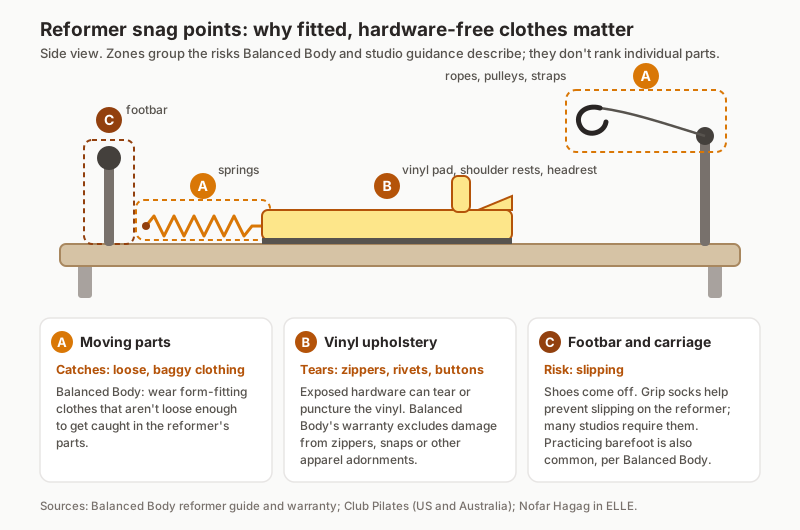
Tap the diagram to enlarge
If you own a home reformer, this matters for your wallet. Balanced Body's warranty excludes "damage to fabric caused by zippers, snaps or other apparel adornments" from its upholstery coverage. Check your own reformer's warranty for similar terms.
What to wear to Pilates as a man
The same rules apply. Under Armour suggests fitted T-shirts or tanks with stretchy shorts or pants, and recommends avoiding loose basketball shorts.
NBC Select's advice about shorts applies directly to men: choose longer shorts with a liner, because your legs are often in the air and you want to stay covered. Its one men's pick was the Lululemon License to Train Lined Short. One simple fix (our suggestion, not NBC's): if your shorts aren't lined, a fitted pair of shorts underneath keeps you covered when your legs are up. Joggers or fitted training pants also work.
For grip socks, check the size chart before you buy, since many grip socks are cut for women's sizes. Garage Gym Reviews flagged the Bombas Men's Gripper Ankle Sock for larger feet, and its Amazon size chart goes up to a men's 16:
Check price on AmazonIf standard sizes feel tight, see our guide to grip socks for wide feet.
What to bring to Pilates class
- Grip socks. Required at many studios, including Club Pilates. Club Pilates sells them at the studio if you don't have a pair.
- A water bottle. The Club Pilates FAQ suggests bringing "your reusable water bottle to rehydrate after class."
- A small towel. Club Pilates Australia suggests one.
- Hair ties or a fabric headband. Also from Club Pilates Australia.
- A mat, only if needed. Ask your studio whether it provides mats. For home practice, you'll need your own; see our best Pilates mats.
For a typical class, plain water is enough. The American Council on Exercise's general guidance says water is the best choice for most people, with sports drinks mainly useful for high-intensity sessions longer than 45 to 60 minutes. If you have a condition that affects fluid intake, ask your doctor.
If you have an injury or limitation, the Club Pilates FAQ says to talk to your instructor before class. It's also a good idea to arrive a few minutes early for your first class.
What to skip
- Shoes. Pilates is done barefoot or in grip socks.
- Baggy layers. They get in the way, according to Meade, and can catch on reformer parts, according to Balanced Body.
- Zippered jackets and riveted pants. They can damage upholstery (Balanced Body) and dig into your back (Snyder).
- Jewelry. Club Pilates Australia calls it a distraction and a safety hazard.
- Strong scents and heavy makeup. Under Armour suggests skipping both.
The bottom line
Wear fitted, stretchy clothes with no hardware, and check your studio's sock and mat rules before your first class.
- Going to a mat class? Leggings or lined shorts and a fitted top you already own will do. Grip socks are optional.
- Going to a reformer class? Grip socks are the one thing worth buying ahead of time, because many studios require them (Club Pilates does) and charge for them at the desk. Everything else can come from your current workout drawer, as long as it has no zippers or rivets.
For sock options, see our best Pilates grip socks.
Check price on AmazonFor more home-practice guides, browse Pilates at home.
Frequently Asked Questions
Can I wear shorts to Pilates?
Yes, if they're longer and lined. Experts NBC Select spoke with say shorts aren't ideal otherwise because your legs are often in the air. NBC Select also lists biker shorts as an appropriate option.
Can I wear just a sports bra or a crop top to Pilates?
Yes, at most studios. Nofar Hagag told ELLE that high-waisted leggings pair well with a crop top or fitted tank. If you're unsure, check your studio's dress guidance.
Do you wear shoes to Pilates?
No. Pilates is done barefoot or in grip socks. Club Pilates requires grip socks in every class, and Balanced Body notes that barefoot or grip socks are common on the reformer.
What should a man wear to Pilates?
A fitted T-shirt or tank with stretchy shorts or pants. Under Armour recommends skipping loose basketball shorts. If you wear shorts, NBC Select's experts suggest longer, lined ones so you stay covered. Add grip socks if your studio requires them.
What should I bring to my first Pilates class?
Grip socks (Club Pilates sells them at the studio), a reusable water bottle (Club Pilates FAQ), and a small towel and hair ties (Club Pilates Australia). Check whether the studio provides mats.
Can I wear regular socks to reformer Pilates?
Usually not. Balanced Body says reformer Pilates is commonly done barefoot or in socks with grips on the bottom, and NBC Select reports that most studios require grippy socks. BodyMindLife, a Sydney studio, notes that plain socks slip on the moving carriage and footbar. If you forget yours, many studios, including Club Pilates, sell grip socks on site.
Why can't I wear clothes with zippers on a reformer?
Balanced Body says exposed zippers, rivets and buttons can tear or puncture the vinyl upholstery, and its warranty doesn't cover damage from apparel adornments. A Club Pilates instructor also notes zippers dig into your back when you lie down.
Sources
- Balanced Body: Everything you need to know about Reformer Pilates
- Balanced Body: Warranty
- Club Pilates: FAQ
- Club Pilates: Exactly what to wear to your first Club Pilates class, straight from the studio's instructors
- NBC Select: Everything you need for mat and reformer Pilates, according to expert instructors
- NBC Select: The best Pilates socks
- Garage Gym Reviews: Best Pilates socks
- ELLE: The best Pilates clothes to wear to class, according to an expert
- Club Pilates Australia: What to wear to Reformer Pilates
- The Pilates Circuit: What to wear to Pilates reformer class?
- BodyMindLife: What to wear to Reformer Pilates: a simple guide
- Under Armour: What to wear to Pilates class
- American Academy of Dermatology: Athlete's foot prevention
- American Council on Exercise: Healthy hydration (Fit Facts)
Related Articles
Comparison
Reformer Pilates vs. Mat Pilates: Which Is Right for You?
Springs or body weight, studio or living room? Here's how reformer and mat Pilates differ in difficulty, cost and results, and what the research actually shows.
October 5, 2026 · 7 min read