Wall Pilates Exercises for Beginners: A 15-Minute Routine (With Chart)
By The Pilates Verdict Team · October 7, 2026 · 16 min read
This article contains affiliate links. If you buy through them, we may earn a commission at no extra cost to you. As an Amazon Associate I earn from qualifying purchases. Learn more.
Coach notes that wall Pilates videos "abound on TikTok," and the trend is often packaged as a 28-day challenge. Strip away the marketing and most wall Pilates exercises for beginners are familiar mat Pilates and bodyweight moves, with a wall for support and feedback.
Below are 10 beginner moves, each taken from a named instructor or outlet with the reps that source gives. Together they make a routine of about 15 minutes. You'll also find a free printable chart, easier options and a short, honest read on what to expect.
How we researched this: We took every move and rep count from published guidance: Life Time's Experience Life (instructor Agnieszka Karasek), Pilates Anytime (Mychele Sims), OnlinePilatesClasses (Lesley Logan), Well+Good via theSkimm, Harvard Health, Healthline's medically reviewed beginner routine and TODAY. We added safety guidance from Cleveland Clinic and ACOG, and read peer-reviewed reviews on Pilates in general. We found no studies on wall Pilates itself, and we didn't do or coach these workouts ourselves. Every source is listed at the end.
Quick version:
- What you need: a clear stretch of wall and a mat, towel or blanket (optional gear).
- How long: about 15 minutes for the 10 moves plus a cool-down.
- How often: Pilates studies used 1–3 sessions a week (2–3 in healthy adults; 1–2 in low back pain trials).
- What to expect: core endurance, balance and flexibility gains are plausible. Fast fat loss isn't.
How the wall helps (and is it "real" Pilates?)
Wall Pilates takes traditional Pilates moves and uses the wall as static resistance, a bit like a reformer's footbar, according to TODAY. Heather A. Milton, an exercise physiologist supervisor at NYU Langone's Sports Performance Center, told TODAY that in Pilates "the only resistance you have really is the force of gravity. Using a wall for static resistance, you can actually exert the force." She calls this "isometric training."
Healthline's medically reviewed guide calls wall Pilates "a great beginner-friendly practice that can help you master foundational movements before moving on to mat or reformer Pilates." In a video covered by Coach, STOTT-certified instructor Rachel (Rachel's Fit Pilates) asks whether it's "real" Pilates: "The simple answer is no. It's not something we get a ton of training on." She doesn't write it off, though. She says "wall Pilates makes some exercises easier and some more difficult": for abs, the wall reduces range of motion but increases contraction, and for glutes it adds time under tension. She suggests working with "an instructor who understands body mechanics."
For the bigger picture (where wall Pilates came from, its pros and cons, and whether you need special gear), see our wall Pilates guide.
Wall Pilates exercises for beginners: a 15-minute workout
Clear enough floor to lie down with your feet on the wall. Moves 1–4 are standing, 5–9 are on the floor, and 10 is standing again. Take breaks whenever you need them, and stop any move that causes pain. If you're pregnant, postpartum or managing an injury, read the safety section first.
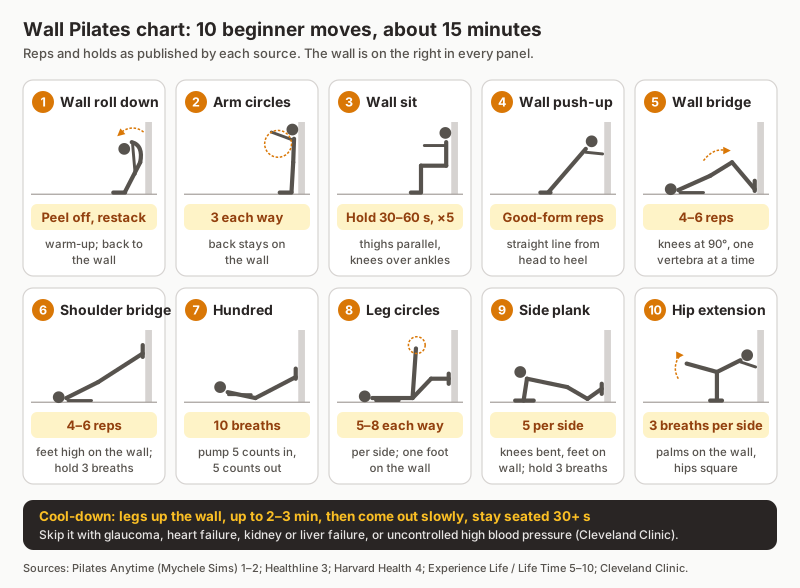
Tap the diagram to enlarge
1. Wall roll down
Stand with your back against the wall. Mychele Sims (Pilates Anytime) cues you to drop your chin to your chest and "roll and peel yourself off of the wall," letting your arms hang heavy. Then restack your spine back up the wall, one vertebra at a time. Woman & Home also lists the roll down as a starter move.
2. Wall arm circles
From the classical wall series (Pilates Anytime): keep your back against the wall and circle your arms without losing contact with the wall. Sims does three circles in each direction.
3. Wall sit
Per Healthline, stand with your feet hip-width apart and slide down until your thighs are parallel to the floor, knees over ankles.
- Hold: 30–60 seconds, 5 times (Healthline).
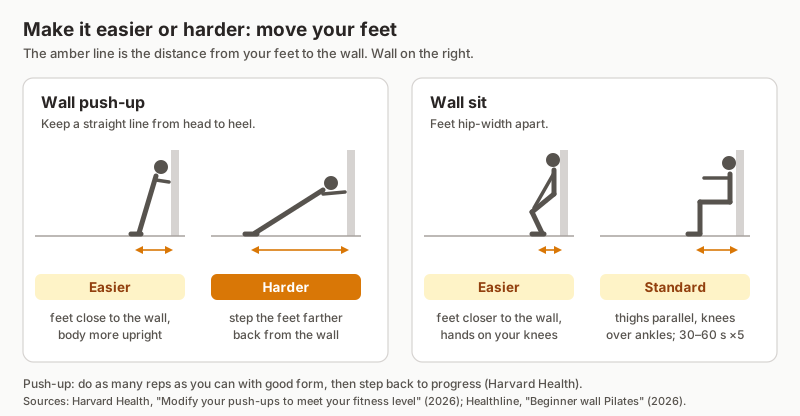
- Easier: move closer to the wall and rest your hands on your knees (Healthline).
- Classical version: Lesley Logan, a certified Pilates teacher and founder of OnlinePilatesClasses, teaches a wall squat where you slide down as your arms lift to shoulder height, for 3–5 reps.
- Add-on: TODAY adds 15 heel raises while you hold the squat.
4. Wall push-up
Harvard Health describes it this way: place your palms on the wall at chest height with your arms extended, bend your elbows while keeping "a straight line from head to heel," then push back. To make it harder, step your feet farther from the wall. Harvard Health quotes Dr. Edward Phillips on adjusting the angle, hand placement and speed to match your level. Aim for as many reps as you can do with good form.
Tap the diagram to enlarge
5. Wall bridge (spinal articulation)
Lie on your back with your feet on the wall and knees at 90 degrees. Press into the wall and curl your hips up one vertebra at a time, then roll back down. Karasek suggests 4–6 reps (Experience Life). TODAY's elevated hip bridge uses 10–15 reps.
6. Straight-leg shoulder bridge
Place your feet higher on the wall with your legs straight. Lift your hips and hold for 3 breaths, for 4–6 reps (Karasek, Experience Life). If that feels steady, she offers single-leg lifts as an option.
7. The hundred, feet on the wall
Lie on your back with your feet on the wall 1–2 feet off the floor. Curl your head and shoulders up and pump your arms: 5 counts as you breathe in, 5 as you breathe out, for 10 breaths (Karasek, Experience Life). Instructor Jennifer Kreichman teaches a bent-knee version with your toes on the wall (Well+Good via theSkimm), which is a useful starting point.
8. Single-leg circles
Keep one foot on the wall and lift the other leg. Draw small circles, 5–8 in each direction, then switch sides (Karasek, Experience Life).
9. Bent-knee side plank
Lie on your side with your knees bent and feet pressing into the wall. Press up onto your forearm and hold for 3 breaths. Karasek suggests 5 per side (Experience Life).
10. Standing hip extension
Face the wall and hinge forward with your palms on it. Lift one leg back, keeping your hips square, and hold for 3 breaths. Repeat on the other side (Karasek, Experience Life).
Cool-down: legs up the wall
Lie on your back and rest your legs up the wall. Cleveland Clinic's Robert Saper, MD, says to hold "anywhere up to two to three minutes," then come out slowly and stay seated for at least 30 seconds before standing. See the safety section below before you try it. Healthline's beginner routine also ends with legs-up-the-wall and a wall butterfly stretch, each held for 30 seconds.
Want a plan to follow? Try our 28-day wall Pilates challenge schedule.
When it feels easy: how to progress
Once the routine feels comfortable, these sourced options make it harder:
- Wall push-up: step your feet farther from the wall (Harvard Health).
- Straight-leg shoulder bridge: add single-leg lifts (Karasek, Experience Life).
- Bridge: try TODAY's elevated hip bridge for 10–15 reps.
- Wall sit: add 15 heel raises while you hold the squat (TODAY).
- Wall marches: Well+Good's version runs for 40 seconds.
- Light ankle weights: Alo Moves (a brand that sells classes) says light weights can be added. Coach reports that Rachel adds hand and ankle weights to her sessions.
Wall Pilates chart (printable)
Download the printable wall Pilates chart (PDF). It's the chart above on one US Letter page. Or use the table below as a text version.
| Move | Focus | Reps / hold | Easier option |
|---|---|---|---|
| 1. Roll down | Spine | Slow, controlled | Bend knees |
| 2. Arm circles | Shoulders | 3 each way | Smaller circles |
| 3. Wall sit | Legs | 30–60 s × 5 | Closer to wall |
| 4. Push-up | Arms | Good-form max | Feet closer |
| 5. Bridge | Glutes | 4–6 | Lower hips |
| 6. Shoulder bridge | Glutes | 3 breaths × 4–6 | Feet lower |
| 7. Hundred | Core | 10 breaths | Knees bent |
| 8. Leg circles | Hips | 5–8 each way | Smaller circles |
| 9. Side plank | Obliques | 3 breaths × 5/side | Shorter hold |
| 10. Hip extension | Glutes | 3 breaths/side | Smaller lift |
| Legs up the wall | Cool-down | Up to 2–3 min | Shorter hold |
Reps and holds come from the sources named for each move above. The "easier" options for the wall sit, push-up and hundred come from Healthline, Harvard Health and Well+Good. The other easier options are general ways to shrink a move's range, not sourced instructions.
Common beginner mistakes
- Knees drifting past your ankles in the wall sit. Healthline cues thighs parallel to the floor with knees over ankles. Healthline's easier version: move closer to the wall and rest your hands on your knees.
- Sagging hips in the wall push-up. Harvard Health's cue is "a straight line from head to heel." Step closer to the wall if you can't hold it.
- Rushing the roll down and bridge. Sims (Pilates Anytime) and Karasek (Experience Life) both cue moving one vertebra at a time, restacking your spine slowly rather than in one block.
- Twisting in the hip extension. Karasek's cue is to keep your hips square as you lift the leg back. If they rotate, lift the leg less.
How often should beginners do wall Pilates?
The published beginner routines are short. Karasek's and Healthline's each take about 15 minutes, and Well+Good's takes 10. Karasek says hers is gentle enough to do daily.
Research on Pilates in general used modest doses. A 2016 meta-analysis on healthy adults looked at programs of 2–3 sessions a week for 5–12 weeks, and a 2022 analysis of low back pain trials in JOSPT found 1–2 sessions a week over 3–9 weeks among the most effective doses. Starting with 2–3 sessions a week is a reasonable middle ground.
Treat wall Pilates as one part of your week. US Physical Activity Guidelines call for 150–300 minutes a week of moderate aerobic activity plus muscle-strengthening work on at least 2 days.
What results to expect
- No wall-specific studies. A Europe PMC search for "wall pilates" on October 7, 2026 returned zero results, so everything below comes from studies of mat and equipment Pilates.
- Flexibility, balance and core endurance are plausible. A 2011 systematic review of 16 studies in healthy people found "strong evidence" that Pilates improves flexibility and dynamic balance (Cruz-Ferreira et al.), and a 2016 meta-analysis of 9 trials found better abdominal muscular endurance than in no-exercise groups (Campos et al.).
- Fast fat loss isn't. A 2022 systematic review concluded that "the influence of Pilates on the body composition of healthy individuals is still uncertain" (Silva et al.), and in a 2011 trial, 6 weeks of ab exercises didn't reduce belly fat or waist size (Vispute et al.).
Milton told TODAY that wall Pilates is low-moderate intensity, so it won't give the same body-composition or heart-health benefits as moderate or vigorous exercise. She says strength gains take about 4–6 weeks (mostly your nervous system adapting) and about 12 weeks for visible muscle change. That's worth remembering when a 28-day challenge promises a transformation.
The full evidence review is in our wall Pilates guide.
Safety and who should modify
- Legs up the wall: Cleveland Clinic's Dr. Saper says to avoid it if you have glaucoma, congestive heart failure, kidney failure, liver failure or cirrhosis, or uncontrolled high blood pressure.
- Pregnancy: ACOG's exercise-during-pregnancy FAQ includes modified Pilates among the exercises it calls safest for pregnant women, and advises avoiding lying flat on your back as much as possible. Moves 5–9 and the cool-down are done on your back or side, so get clearance from your ob-gyn and ask about standing or seated alternatives.
- Modify freely: Healthline offers an easier version of each move, such as moving closer to the wall for the wall sit or putting a pillow under your hips for the butterfly stretch.
- Expect some moves to feel harder: Rachel's Fit Pilates says the wall makes some exercises easier and some more difficult: for abs it reduces range of motion but increases contraction, and for glutes it adds time under tension. If you have an injury or condition, working with a qualified instructor is the safer route.
Bottom line: should you start with this routine?
- Good fit: you're new to Pilates, want a short at-home routine and like the wall telling you where your spine and pelvis are. Healthline calls it a beginner-friendly way to learn foundational moves.
- Look elsewhere: if your main goal is weight loss or cardio fitness. Milton told TODAY it's low-moderate intensity, so pair it with aerobic activity.
- Get guidance first: if you're pregnant, postpartum or managing an injury. Rachel's Fit Pilates suggests an instructor who understands body mechanics.
If it fits, the only thing worth buying is a cushioned mat for moves 5–9.
What you need (optional gear)
Healthline's routine needs only a wall plus a mat, towel or blanket. For the spine-on-floor moves, the Balanced Body EcoWise (3/8 in, per Balanced Body) is the cushioned pick in our best Pilates mats guide. Yahoo Health named it Best Cushioned and called it "especially supportive for rolling moves, side-lying leg work, and supine spine articulation." On a budget, the Gaiam Classic 5mm works. For more padding, the Manduka CLOUD is 12 mm, per Manduka:
Check price on AmazonOther options, all optional:
Gaiam Classic Solid Color Yoga Mat (5mm)
- Use in this routine
- Budget mat for moves 5–9
- Price tier
- $20–30
Manduka CLOUD Pilates Mat 12mm
- Use in this routine
- Extra cushion for spine-on-floor moves
- Price tier
- $100–150
Gaiam Grippy Studio Yoga Socks
- Use in this routine
- Grip socks (our suggestion) to help feet stay put on a painted wall
- Price tier
- Under $10
Trideer 9-Inch Pilates Ball
- Use in this routine
- Squeeze between your knees once bridges feel easy
- Price tier
- Under $20
Gaiam Restore Ankle Weights (2.5 or 5 lb per ankle)
- Use in this routine
- Light weights for leg circles and hip extensions later on
- Price tier
- Under $30
| Product | Use in this routine | Price tier | |
|---|---|---|---|
| Gaiam Classic Solid Color Yoga Mat (5mm) | Budget mat for moves 5–9 | $20–30 | View |
| Manduka CLOUD Pilates Mat 12mm | Extra cushion for spine-on-floor moves | $100–150 | View |
| Gaiam Grippy Studio Yoga Socks | Grip socks (our suggestion) to help feet stay put on a painted wall | Under $10 | View |
| Trideer 9-Inch Pilates Ball | Squeeze between your knees once bridges feel easy | Under $20 | View |
| Gaiam Restore Ankle Weights (2.5 or 5 lb per ankle) | Light weights for leg circles and hip extensions later on | Under $30 | View |
The grip-sock idea is our reasoning, not a sourced claim. For ankle weights, Alo Moves (a brand that sells classes) says light weights can be added. Compare more in our do you need grip socks for Pilates? and best ankle weights for Pilates guides, or browse more Pilates workouts.
Frequently Asked Questions
Is wall Pilates good for beginners?
Healthline's medically reviewed guide calls it a beginner-friendly way to learn foundational moves before mat or reformer Pilates, and the wall gives you feedback on your alignment. In a video covered by Coach, STOTT-certified instructor Rachel (Rachel's Fit Pilates) says the wall makes some exercises easier and some more difficult (for abs it reduces range of motion but increases contraction; for glutes it adds time under tension), and suggests working with an instructor who understands body mechanics.
Can wall Pilates help you lose weight?
No study has looked at wall Pilates and weight loss. A 2022 systematic review found the effect of Pilates on body composition in healthy people 'still uncertain,' and a 2011 trial found that ab exercises alone didn't reduce belly fat. NYU Langone's Heather Milton told TODAY it's low-moderate intensity, so it won't give the same body-composition benefits as moderate or vigorous exercise. Pair it with aerobic activity as the US Physical Activity Guidelines recommend.
How long until I see results from wall Pilates?
Heather Milton told TODAY that early strength gains come at about 4–6 weeks, as your nervous system adapts, with visible muscle change around 12 weeks. Studies of Pilates in healthy adults ran 5–12 weeks at 2–3 sessions a week, according to a 2016 meta-analysis.
How often should I do wall Pilates as a beginner?
Published beginner routines from Healthline and Life Time's Agnieszka Karasek take about 15 minutes, and Karasek says hers is gentle enough to do daily. Pilates studies used 1–3 sessions a week (2–3 in healthy adults; 1–2 in low back pain trials). Start there and keep up the other weekly activity the US guidelines recommend.
Can I do wall Pilates every day?
Life Time's Agnieszka Karasek says her 15-minute beginner routine is gentle enough to do daily. Pilates studies used 1–3 sessions a week (2–3 in healthy adults; 1–2 in low back pain trials), so 2–3 sessions is a reasonable start. Skip a day if anything is sore or painful.
Do I need equipment for wall Pilates?
No. Healthline's routine needs only a wall plus a mat, towel or blanket. A mini ball or light ankle weights can make moves harder later; Alo Moves, a brand that sells classes, mentions adding light weights.
Sources
- Healthline (medically reviewed by Micky Lal, MA, CSCS, RYT): Beginner wall Pilates
- Experience Life (Life Time): The wall-Pilates workout
- TODAY: Wall Pilates review and exercises
- theSkimm / Well+Good: Wall Pilates workout
- Coach: Rachel's Fit Pilates asks: is wall Pilates a waste of time?
- Harvard Health: Modify your push-ups to meet your fitness level
- Cleveland Clinic: The health benefits of legs up the wall
- Pilates Anytime: Wall Pilates with Mychele Sims
- OnlinePilatesClasses: Pilates wall squat (Lesley Logan)
- Woman & Home: Wall Pilates workout
- Fernández-Rodríguez et al., JOSPT (2022): Best exercise options for reducing pain and disability in adults with chronic low back pain
- Campos et al., J Sports Med Phys Fitness (2016): Effect of the Pilates method on physical conditioning of healthy subjects
- Cruz-Ferreira et al., Arch Phys Med Rehabil (2011): A systematic review of the effects of Pilates method of exercise in healthy people
- Silva et al., J Bodyw Mov Ther (2022): Is the Pilates method efficient to cause changes in the body composition of healthy individuals?
- Vispute et al., J Strength Cond Res (2011): The effect of abdominal exercise on abdominal fat
- Europe PMC: search results for "wall pilates"
- ODPHP: Physical Activity Guidelines, top 10 things to know
- ACOG: Exercise during pregnancy
- Alo Moves blog (brand): Best wall Pilates exercises for beginners
- Balanced Body: EcoWise Pilates Mat
- Yahoo Health: Best exercise mats
- Manduka: CLOUD Pilates Mat 12mm
Update history
- : Published.
Found an error? See how we research and correct guides in our editorial policy.
Was this guide helpful?
Related Articles
How-To
28-Day Wall Pilates Challenge: A Free Schedule and What to Expect
Free 28-day wall Pilates challenge options, a 4-week schedule with rest days, 8 sourced moves, and what 28 days can realistically change.
October 7, 2026 · 16 min read
How-To
Pilates ball exercises: a 10-move mini ball routine for beginners
10 Pilates ball exercises for beginners, with where the mini ball goes, reps and easier versions from named instructors, plus size, inflation and safety tips.
October 7, 2026 · 18 min read
How-To
Pilates exercises at home for beginners: a 10-move mat routine
10 Pilates exercises at home for beginners, no equipment beyond a mat. Reps and easier versions from instructor guides, plus how often to practice.
October 7, 2026 · 18 min read
How-To
Pilates ring exercises for beginners: a 10-move routine
10 Pilates ring exercises for beginners, with where the ring goes, how hard to squeeze and reps from named instructors, plus what the research says.
October 7, 2026 · 20 min read