Pilates reformer vs. Pilates board: Is a board worth it?
By The Pilates Verdict Team · October 6, 2026 · 13 min read
This article contains affiliate links. If you buy through them, we may earn a commission at no extra cost to you. As an Amazon Associate I earn from qualifying purchases. Learn more.
Foldable Pilates boards from Flo, Mila and Umay are marketed as "portable reformers" and sell for a fraction of a reformer's price. So in a Pilates reformer vs. Pilates board matchup, is the board the same workout?
The short version: no. But that doesn't make a board useless. It depends on what you want it for.
How we researched this: We compared manufacturer specs from Flo, Mila, Umay, Balanced Body and AeroPilates (Stamina). We read reviews, buying guides and workout guides from Yahoo Health, NBC Select, Healthline, Marie Claire UK, Woman & Home and The Everygirl, and we looked for research on Pilates boards (we didn't find any). We did not test these products. Where we could only read an excerpt of a source, we say so. All sources are listed at the end.
The short answer
- Choose a reformer if you want to replace studio classes, need adjustable resistance, or want strap and footwork exercises.
- Choose a Pilates board if you're short on space or budget and want to add core and instability work to mat Pilates, or to fill the gaps between studio classes.
- Not sure? Take a few reformer classes first. A budget cord reformer like the AeroPilates 287 is a middle ground between the two.
Our Top Picks
- Check price at Flo Pilates
Pilates board
Flo Portable Pilates Reformer
Foldable, about 11 lb, light band resistance. Reviewed by Yahoo Health.
- Check price on Amazon
Budget reformer
AeroPilates Reformer 287
Real carriage and rails with 3 cords, Under $500.
- Check price on Amazon
Studio-grade reformer
Balanced Body Allegro 2
5 springs, adjustable footbar, 10-year frame warranty.
Pilates reformer vs. Pilates board at a glance
| Reformer | Pilates board | |
|---|---|---|
| Resistance | Springs (budget models: cords) | Resistance bands or cables |
| Size and weight | ~85–94 in long, ~56–155 lb | ~41–42 in long, ~9–11 lb |
| Straps and footbar | Yes | No full strap system |
| Storage | Needs a room-length strip of floor | Folds to fit a closet |
| Price tier | Under $500 to $1,000+ | Under $300 |
Size and weight ranges come from the manufacturer specs below (board figures from Flo and Mila; Umay lists only a 40 in slide rail).
How they differ
What each one is
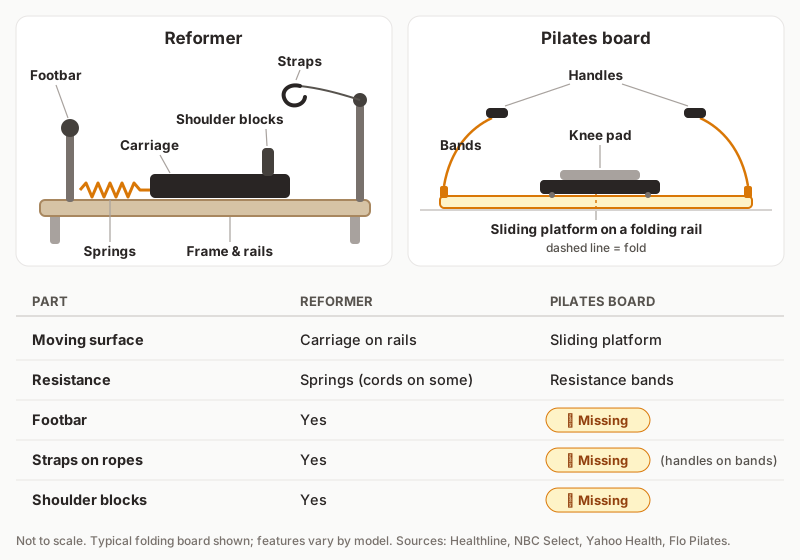
Healthline describes a reformer as "a padded platform called a carriage that moves back and forth on rails." It has adjustable springs for resistance, a footbar for pushing movements, shoulder blocks, and straps or handles for hand and foot work.
A Pilates board is a short, foldable sliding platform. Instead of springs, it uses bands or cables: Flo says its board uses "adjustable resistance bands." Yahoo Health's reviewer puts the difference simply: a classic reformer uses "a full system of springs, straps and a moving carriage, whereas the Flo board relies on a simple sliding mechanism."
Brands call these boards "portable reformers" (Flo sells the "Flo Portable Pilates Reformer," and Umay the "Portable Pilates Board Reformer"). That's marketing language. They don't have a reformer's carriage, rails or springs.
Tap the diagram to enlarge
Don't confuse a board with a Pilates springboard, either. That's a spring unit some studios use, where each limb works its own spring. Body Harmonics explains the difference.
Resistance: springs vs. bands
NBC Select explains that "most Pilates reformers use metal springs to create tension. However, some budget options use rubber bands instead." Both are adjustable and work, but NBC Select notes that "metal is a more durable material that may last longer."
Boards sit at the light end. Yahoo Health lists "light level of resistance" as a con of the Flo and says "the challenge comes from the board's natural instability and light resistance." The Everygirl's Umay reviewer noted that "you cannot change the resistance" (we could only read an excerpt of that review).
That matters for beginners as well as strong users. Healthline says reformer springs can be adjusted to change resistance or to make exercises more comfortable. Pilates instructor Bianca Melas told NBC Select that "springs can be adjusted to be more supportive in certain movements to really help beginners." Reviewers describe board resistance as light, even on boards like Flo's that come with two bands, so don't expect the range of spring settings a reformer offers.
Size, weight and storage
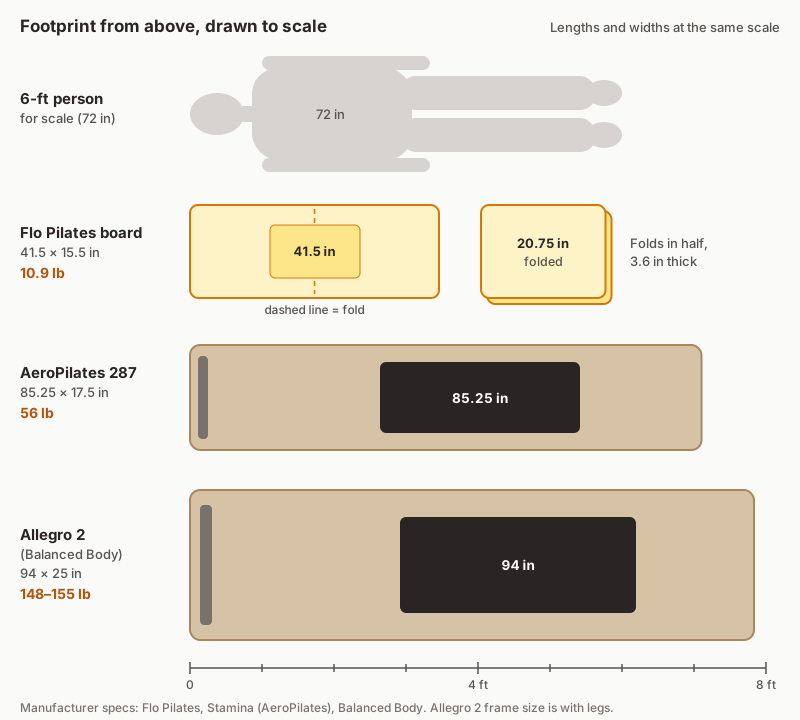
This is where a board wins clearly. According to the manufacturers:
- Flo Portable Pilates Reformer: 41.5 × 15.5 × 1.8 in unfolded, 20.75 × 15.5 × 3.6 in folded, about 10.9 lb.
- Mila Portable Pilates Board 2.0: 41.7 × 16 × 1.8 in unfolded, 20.5 × 16 × 3 in folded, 9.4 lb.
- AeroPilates Reformer 287: 85.25 × 17.5 × 9 in assembled, 56 lb.
- Balanced Body Allegro 2: 94 × 25 × 15 in with legs, 148–155 lb.
A board folds small enough for a closet. Even a budget reformer needs a strip of floor more than 7 feet long. If space is your main problem, also see our foldable reformer guide.
Tap the diagram to enlarge
Exercise range
What a board does well, according to reviewers, is core and instability work. Yahoo Health says "the challenge comes from the board's natural instability and light resistance," and recommends the Flo as a way to add a new challenge to floor Pilates or bodyweight workouts. Woman & Home's Kerry Law found her core was the most worked area (from an excerpt). Flo also includes push-up handles and a knee mat with its board.
Marie Claire UK's instructor-picked board workouts give a sense of the range: short full-body flows, upper-body sessions for the arms, shoulders and triceps, lower-body work focused on the feet and alignment, and abs and core sessions. Instructor James Shaw adds a caveat there: "A board can't fully replicate the spring tension of a Reformer."
Without a full strap system and footbar, a board can't do a large part of the reformer repertoire. Yahoo Health's reviewer says: "Without straps, you miss out on the huge variety of lower-body exercises that make reformer classes feel so dynamic."
Pilates instructor Sam Deville, quoted in Marie Claire UK, says a board is "not a complete Reformer replacement." She notes that some exercises, like her "mid-back abs series (supine, hands in straps), just aren't possible." (We could only read an excerpt of that article.)
Cost
Boards sit in the $100–200 tier (Mila), Under $200 (Umay) and Under $300 (Flo). Budget for the app, too: Flo's companion app is a paid subscription after a trial, according to both Flo and Yahoo Health.
Budget reformers like the AeroPilates 287 and the foldable AeroPilates 4420 are in the Under $500 tier. Studio-grade machines like the Balanced Body Allegro 2 are $1,000+.
Durability and warranty
The warranty gap is large. Balanced Body lists a 10-year frame warranty on the Allegro 2. AeroPilates lists 3 years on the frame and 90 days on parts for the 287. Flo, Mila and Umay each list a 1-year warranty.
Bands and cables are also consumables. Mila estimates its board's cables last 12–18 months.
Is a Pilates board worth it?
When a board makes sense
Yahoo Health's Kelli McGrane, MS, RD, used the Flo two to three times a week for a month. She called it "a great Pilates tool, but not a true reformer stand-in." She recommends it as "a convenient, space-saving and relatively affordable way to add a new challenge" to floor Pilates or bodyweight workouts. Her pros: portable, no assembly, good for beginners, and it adds instability.
The Everygirl called the Umay board "an affordable and effective way to add variety and challenge." Sam Deville told Marie Claire UK that "for the price, a Pilates board is probably a good investment." (Both from excerpts.)
Woman & Home's Kerry Law swapped reformer classes for a board for two weeks. In the excerpt we could read, she found the board less sturdy than a reformer, but said "what feels easy at first very quickly creeps up on you," with her core worked most. We couldn't confirm which board she used.
When it will disappoint you
If you want to replace studio classes, McGrane is direct: "If you're trying to replace your studio reformer classes, I'd recommend saving up for a traditional reformer instead." Her other cons were light resistance and short classes in the Flo app.
What about research on boards?
We couldn't find any peer-reviewed study on Pilates boards. Healthline cites reformer studies on outcomes like balance in older adults and back pain, but those were done on reformers. Don't assume they apply to a board. Any claim that a board builds strength "like a reformer" is unproven. That includes brand marketing that compares a board to a reformer; we found no independent data behind those comparisons. For what the research says about reformer and mat Pilates, see reformer vs. mat Pilates.
Options on each side
Flo Portable Pilates Reformer
- Type
- Board
- Length / weight
- 41.5 in / 10.9 lb
- Resistance
- Bands
- Price tier
- Under $300
Mila Portable Pilates Board 2.0
- Type
- Board
- Length / weight
- 41.7 in / 9.4 lb
- Resistance
- Cables
- Price tier
- $100–200
Umay TB10 5-in-1
- Type
- Board
- Length / weight
- 40 in rail / not listed
- Resistance
- Bands
- Price tier
- Under $200
AeroPilates Reformer 287
- Type
- Reformer
- Length / weight
- 85.25 in / 56 lb
- Resistance
- 3 cords
- Price tier
- Under $500
Balanced Body Allegro 2
- Type
- Reformer
- Length / weight
- 94 in / 148–155 lb
- Resistance
- 5 springs
- Price tier
- $1,000+
| Product | Type | Length / weight | Resistance | Price tier | |
|---|---|---|---|---|---|
| Flo Portable Pilates Reformer | Board | 41.5 in / 10.9 lb | Bands | Under $300 | View |
| Mila Portable Pilates Board 2.0 | Board | 41.7 in / 9.4 lb | Cables | $100–200 | View |
| Umay TB10 5-in-1 | Board | 40 in rail / not listed | Bands | Under $200 | View |
| AeroPilates Reformer 287 | Reformer | 85.25 in / 56 lb | 3 cords | Under $500 | View |
| Balanced Body Allegro 2 | Reformer | 94 in / 148–155 lb | 5 springs | $1,000+ | View |
Pilates boards
Many Amazon boards look like Flo or Umay but are made by other sellers. Check the brand on the listing; we only cover boards with published manufacturer specs.
- Flo Portable Pilates Reformer: 300 lb capacity and a recommended user height of 5'0"–6'3", per Flo. Flo lists 99-day returns and includes two bands, push-up handles, a knee mat and socks. It's the board Yahoo Health reviewed.
- Mila Portable Pilates Board 2.0: 300 lb capacity, ships assembled, 1-year warranty and a 30-day guarantee, per Mila. Mila says it was "built with beginners in mind." We found no independent review, so this rests on brand specs only.
- Umay TB10 5-in-1: 300 lb capacity, a 40-inch slide rail and eight rollers, per Umay, which also claims "50 LBS Automatic Rebound" resistance. The Everygirl's reviewer liked it but found the handles "still feel a little sticky" after a few weeks (from an excerpt). Look-alike boards are common on Amazon, so buy from umayfitness.com or check that the listing's brand is Umay.
Budget and folding reformers
The AeroPilates Reformer 287 uses three resistance cords and a padded footbar, with a 300 lb max user weight, per Stamina. It's a real carriage-and-rails machine in the Under $500 tier. The foldable AeroPilates 4420 sits in the same tier, and the AeroPilates Premier Studio 700 is a step up (AeroPilates models compared).
Separately, NBC Select describes an AeroPilates Premier model as costing "significantly less than other brands on this list," meaning the other reformers in its roundup.
Studio-grade home reformers
The Balanced Body Allegro 2 has five springs (three red, one blue, one yellow), and Balanced Body says the footbar adjusts to 4 vertical positions and 9 horizontal positions. Our home reformer guide compares it with other options, and you can browse all home reformers.
Safety and fit checklist
- Weight and height: Flo, Mila and Umay all list a 300 lb capacity, and Flo gives a 5'0"–6'3" height range. NBC Select advises making sure a reformer fits your height and that its weight capacity suits your body.
- Floor: If a board shifts on a hard floor, put it on a mat or rug. Our Pilates mat guide can help.
- Form: Healthline calls reformer Pilates "generally safe" but says injuries can happen with improper use or poor form. NBC Select's experts stress learning from an instructor, in person or online.
- Health conditions: Healthline advises people who are pregnant, have spinal conditions or are recovering from surgery or an injury to check with a doctor first.
Frequently Asked Questions
Is a Pilates board the same as a reformer?
No. A reformer has a carriage on rails, adjustable springs, a footbar and straps, according to Healthline. A board is a short sliding platform with resistance bands or cables. Yahoo Health's reviewer called the Flo board "not a true reformer stand-in."
Is a Pilates board worth it?
It depends on your goal. Yahoo Health calls the Flo a space-saving, relatively affordable way to add a challenge to floor Pilates, but recommends saving up for a traditional reformer if you want to replace studio classes. Instructor Sam Deville told Marie Claire UK that for the price a board is "probably a good investment," while noting some strap exercises aren't possible.
Can you get the same results from a Pilates board?
We found no studies on Pilates boards. Reviewers describe the resistance as light and say the challenge comes mostly from instability. Research on reformers shouldn't be assumed to apply to boards.
Are Pilates boards good for beginners?
Yahoo Health calls the Flo good for beginners, and Mila says its board was built with beginners in mind. NBC Select's experts say reformers suit beginners too, because springs can be set to be more supportive, and they stress learning from an instructor.
How much space does each need?
Flo and Mila list their boards at about 41–42 inches long unfolded and about 21 inches folded (Umay lists only a 40-inch slide rail). The reformers in our examples are 85–94 inches long and weigh 56–155 lb.
The verdict
A Pilates board is not a reformer, whatever the product name says. It's a light, foldable add-on for core and instability work, and reviewers like it in that role.
Pick a board if you can't spare a 7-foot strip of floor or want a low-cost add-on to mat work. Pick a reformer, even a budget cord model, if you want to replace studio classes or need adjustable resistance.
The cheapest real reformer here is a budget cord machine like the AeroPilates 287. Not sure you need either? Start with mat Pilates and a good mat.
Check price on Amazon Check the Flo boardSources
- Yahoo Health: Flo Pilates Reformer review (Kelli McGrane, MS, RD)
- Flo Pilates: Flo Portable Pilates Reformer
- Mila Pilates: Portable Pilates Board 2.0
- Umay Fitness: TB10 5-in-1 Portable Pilates Board Reformer
- Healthline: Reformer Pilates (medically reviewed by Courtney L. Gilbert, PT, DPT)
- NBC Select: How to choose an at-home Pilates reformer
- Balanced Body: Allegro 2 Reformer
- Stamina Products: AeroPilates Reformer 287
- Marie Claire UK: Best Pilates boards (excerpt only)
- Marie Claire UK: 5 best Pilates board workouts (Georgia Brown, with instructor James Shaw)
- Woman & Home: I swapped reformer classes for an at-home Pilates board (excerpt only)
- The Everygirl: Umay at-home Pilates reformer review (excerpt only)
- Body Harmonics: Pilates springboard vs. reformer (excerpt only)
Related Articles
How-To
AeroPilates reformer models compared: 287 vs 4420 and which to buy
Which AeroPilates reformer is best? Compare the 287, 4420, 266, 651, Studio 700 and Pro XP 557 by cords vs. springs, height, rebounder and size.
October 6, 2026 · 15 min read
Buying Guide
Best Pilates Reformer for Tall People: 6 Picks by Height (2026)
The best Pilates reformer for tall people, from 5'10" to 6'6"+: 6 machines compared on frame and carriage length, height range, weight limit and extensions.
October 6, 2026 · 16 min read
Review
VEVOR Pilates reformer review: Which model, and is it worth it?
VEVOR Pilates reformer review by model (S1002, S3003, Z88-F-A): springs, 400 lb limit, weight, warranty and buyer feedback, plus AeroPilates vs. VEVOR.
October 6, 2026 · 16 min read
Buying Guide
Best Foldable Pilates Reformers for Small Spaces (2026)
Foldable Pilates reformers for small spaces, compared on folded size, springs vs. cords, user limits and price. 7 picks that fold, telescope or stand up.
October 5, 2026 · 17 min read