Hot Pilates at home: no-heater flow, equipment and safe setup
By The Pilates Verdict Team · November 19, 2026 · 16 min read
This article contains affiliate links. If you buy through them, we may earn a commission at no extra cost to you. As an Amazon Associate I earn from qualifying purchases. Read our affiliate disclosure.
Hot Pilates studios usually heat the room to about 95°F (35°C) at 40% humidity, according to Healthline. You can do hot Pilates at home by warming a small room, but no studies have looked at hot Pilates, and the closest yoga trial found the heat wasn't needed for a heart-health benefit. Heat also brings real risks.
This guide covers a cautious warm-room setup: how warm to go, which heater features matter, how to keep humidity in check, how much to drink and when to stop. If you only want a sweaty Pilates workout, you can also skip the heater and pick up the pace.
How we researched this: We read Healthline's hot Pilates explainer, the American Council on Exercise (ACE) and University of Wisconsin–La Crosse research on core temperature in hot yoga, a peer-reviewed heated vs room-temperature yoga trial, ACSM hydration guidance, CDC and NIOSH heat-illness guidance, ACOG's pregnancy exercise FAQ, EPA humidity guidance, NFPA and CPSC space heater safety rules, TechGearLab's space heater testing and manufacturer specs. We don't test products. Sources are listed at the end.
Who should skip hot Pilates: ACOG lists hot yoga and hot Pilates among activities to avoid during pregnancy, because they may cause overheating. The CDC says people 65 and older "are more prone to heat-related health problems" and that heat "can be especially dangerous for those with chronic medical conditions." Healthline adds that people with heart conditions, high or low blood pressure or poor heat tolerance should avoid it. If any of this applies to you, talk to your doctor first.
Our Top Picks
- Check price on Amazon
Mat towel for heavy sweat
Manduka Yogitoes Hot Yoga Mat Towel
Manduka recommends a towel over its PRO mat for heated practice; silicone nubs (brand claim).
- Check price on Amazon
Budget mat towel
Gaiam Stay-Put Yoga Mat Towel
26 x 70 in with corner pockets that slip over the mat ends.
- Check price on Amazon
Room thermometer-hygrometer
TempPro (ThermoPro) TP50 Digital Indoor Thermometer & Hygrometer
Shows temperature and humidity; EPA recommends a hygrometer to check humidity.
- Check price on Amazon
Heater with tip-over shutoff (optional)
Vornado AVH10 Whole Room Heater with Auto Climate
Only if you add heat: tip-over and overheat shutoff (TechGearLab). Never leave it on unattended (NFPA).
Does hot Pilates at home make sense?
Healthline describes a typical hot Pilates class as 45 to 60 minutes set to high-energy music, at a moderate-to-fast pace. It mixes Pilates core and back work with squats, lunges and mountain climbers. In Marie Claire UK, instructor Eloise Skinner (Third Space) puts heated Pilates at "anywhere between 32 and 35 degrees" Celsius (about 90–95°F). Abigail McLachlan (East of Eden) calls it "a HIIT workout using Pilates principles in a heated room."
The evidence for the heat is thin:
- No studies on hot Pilates itself. Healthline says it found none. It also says heavy sweating means losing water, "rather than burning calories or fat."
- One small yoga study found the heat wasn't needed for one heart-health benefit. In a 12-week trial in Experimental Physiology (Hunter et al., 2018), 52 sedentary adults aged 40 to 60 did Bikram yoga at 105°F, the same yoga at 73°F, or nothing. Artery function improved significantly in the room-temperature group and only "tended" to improve in the hot group, and the two yoga groups didn't differ significantly.
- Opinion, not data. The Pilates Journal says heat "isn't a shortcut to better outcomes" but may "increase cardiovascular demand." It cites no studies.
Body fat dropped more in the hot group of the Hunter trial. The authors concluded the postures can improve vascular health "in the absence of a heated practice environment." That's one yoga study with one outcome, not Pilates.
So you have two options. Warm the room a little with the safety steps below, or skip the heater and do a faster, HIIT-style flow like the one Healthline and Marie Claire describe. Either way, you'll sweat.
Our verdict: For most people, skip the heater. No study has tested hot Pilates, the one yoga trial above found heat wasn't needed for better artery function, and a home heater adds fire risk with no instructor watching. Do the no-heater flow below with a mat towel and water. Only warm the room if you're healthy, already used to heated classes and willing to watch a hygrometer and stop early.
Hot Pilates at home without a heater: a sweaty flow
Healthline says most hot Pilates classes follow the same order, and the standing part is "the main cardio component." You can follow that order at room temperature. The example moves below come from our beginner guide.
- Bridges, such as the pelvic curl (shoulder bridge).
- Focused core work, such as the modified Hundred or single leg stretch (see our beginner exercises).
- Side-body work, such as side kicks or clamshells.
- Back extensions, such as swan prep or swimming.
- Standing work for legs and upper body, such as squats and lunges, plus mountain climbers (Healthline).
Healthline puts a typical class at 45 to 60 minutes, kept at a "consistent rhythm." Our sources don't give times for each block, so any split is our suggestion: divide your session to suit your level and start shorter.
Some hot Pilates studios and Pilates apps sell on-demand classes you can follow at home; check what each includes before you subscribe.
The 6-step warm-room setup
1. Pick a small room with a clear exit
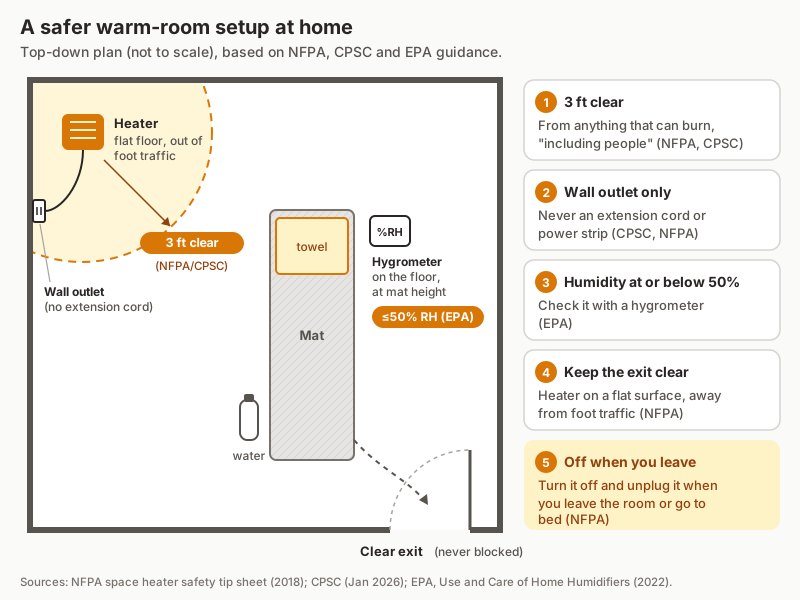
NFPA's space heater checklist says to put the heater on a solid, flat surface away from foot traffic and to never block an exit. Choose a room where your mat, the heater and a clear path to the door all fit.
Tap the diagram to enlarge
2. Choose a heater with tip-over and overheat shutoff
NFPA says to buy a heater "with the seal of a qualified testing laboratory," with a thermostat, overheat protection and an automatic shut-off if it tips over. Don't assume every heater has all of these. TechGearLab found that the Lasko 755320, one of the heaters it tested, had no tip-over protection, so check the spec sheet before you buy.
As of its May 2025 update, TechGearLab named the Vornado AVH10 its best overall space heater. In its testing, the AVH10 shut off immediately when tipped and within 10 seconds when it overheated. Its listed cons were weak direct heat, no oscillation and slow heating in drafty rooms.
If you want a heater with tip-over and overheat shutoff
Vornado AVH10 Whole Room Heater with Auto Climate
Vornado lists two heat settings plus fan-only, a digital thermostat, a cool-touch case and automatic safety shutoff. TechGearLab measured the grille at 120°F.
3. Plug it straight into the wall and keep 3 feet clear
The CPSC says to keep portable heaters at least 3 feet from drapes, furniture and bedding, and to "plug electric space heaters directly into a wall outlet—never into an extension cord or power strip." NFPA's 3-foot rule applies to anything that can burn, "including people," so don't put your mat right next to it.
Turn the heater off and unplug it when you leave the room or go to bed, per NFPA. The CPSC says portable heaters are involved in an average of 1,600 fires, 70 deaths and 150 injuries a year (2020–2022).
4. Put a thermometer-hygrometer at mat height
There's no official guidance on a safe temperature for exercising in a heated room at home. Set your own limit, start well below studio heat and watch a thermometer instead of guessing.
Keep expectations modest. In TechGearLab's in-house test, the AVH10 raised the room by about 8°F over 65 minutes, and its average room temperature increase was 6.3°F, the most of any heater in TechGearLab's lineup. That's a few degrees, well short of studio heat. Vornado's product page doesn't list a maximum thermostat setting.
For humidity, the EPA says indoor relative humidity "should be kept below 60 percent," ideally between 30% and 50%. Its humidifier guide says not to go above 50% and recommends a hygrometer to check. Studio humidity of about 40% (Healthline) is already inside that range.
For a simple readout by the mat
TempPro (ThermoPro) TP50 Digital Indoor Thermometer & Hygrometer
TempPro lists ±1°F accuracy, readings that update every 10 seconds and a three-level dry/comfortable/wet indicator. It has a tabletop stand, a magnetic back and a hanging mount (brand specs). Some packaging and reviews still use the ThermoPro name.
If you want an alert at a set limit
Govee Bluetooth Hygrometer Thermometer H5075
Govee lists ±0.5°F and ±3% humidity accuracy and app alerts when readings leave a range you set. It keeps 20 days of history and connects over Bluetooth only, not Wi-Fi (brand specs).
5. Skip the humidifier, or follow EPA care rules
Since studio humidity already sits within the EPA's range, there's no reason to push it higher at home. If you do use a humidifier, the EPA says to:
- Empty, dry and refill portable units daily, and clean them every third day.
- Use low-mineral water, such as distilled water.
- Turn it down if water condenses on windows or walls.
The EPA says ultrasonic and impeller ("cool mist") humidifiers spread the most microbes and minerals into the air, and steam vaporizers can cause burns. It's also a good idea to air the room out after your session.
6. Hydrate before, during and after
ACSM's general hydration advice:
- Drink 16–20 fl oz of water or a sports drink at least 4 hours before exercise.
- Drink 8–12 fl oz 10–15 minutes before.
- During a session under 60 minutes, drink 3–8 fl oz every 15–20 minutes.
- Don't drink more than 1 quart an hour. ACSM warns that overhydration can be dangerous.
- Afterward, drink 20–24 fl oz for every pound lost.
ACSM suggests weighing yourself before and after to estimate sweat loss. Losing more than 1% of body weight signals dehydration, and thirst "is not a good indicator of hydration."
For a sense of scale: in a small 2020 study in Physiological Reports, five experienced women in a 90-minute Bikram class at 105°F lost about 1.54 liters of sweat, or 1.9% of body weight.
Studio vs home at a glance
| Factor | Studio | Home |
|---|---|---|
| Temperature | About 95°F (Healthline) | A few degrees warmer (TechGearLab) |
| Humidity | About 40% (Healthline) | 50% or less (EPA) |
| Supervision | Instructor | None; stop early |
| Length | 45–60 min (Healthline) | Start shorter |
Warning signs: stop and cool down
Tap the diagram to enlarge
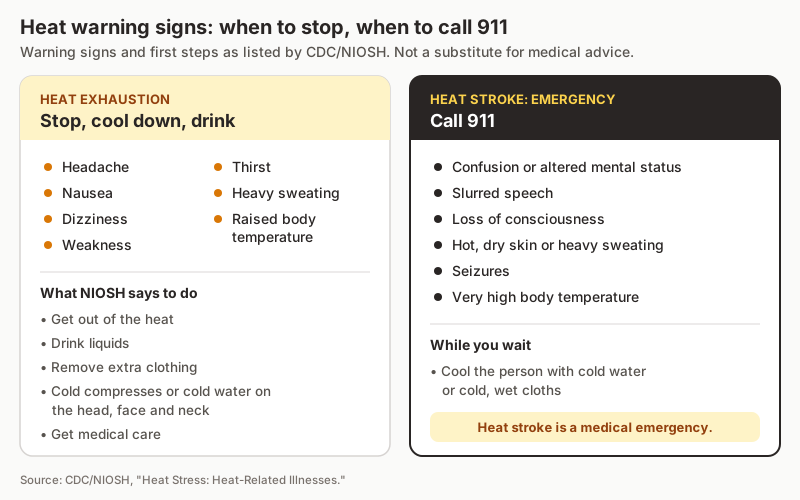
CDC/NIOSH lists these signs of heat exhaustion: headache, nausea, dizziness, weakness, thirst, heavy sweating and raised body temperature. If you notice them, NIOSH says to get out of the heat, drink liquids, remove extra clothing, cool down with cold compresses or cold water on the head, face and neck, and get medical care.
Signs of heat stroke include confusion, slurred speech, loss of consciousness, hot dry skin or heavy sweating, seizures and very high body temperature. NIOSH says heat stroke is an emergency: call 911 and cool the person with cold water or cold wet cloths.
How hot your body can get
In an ACE-funded study, 20 regular Bikram students did a 90-minute class at 105°F and 40% humidity. Average peak core temperature was 103.2°F for men and 102.0°F for women, and 7 of the 20 went above 103°F.
ACE notes that 104°F is where sports medicine guidelines flag heat-illness risk. ACE chief science officer Cedric X. Bryant said hot, humid rooms "can place participants at risk for heat-related illness, especially if individuals do not adequately hydrate."
According to UW–La Crosse, researcher John Porcari says the results don't point to concerns for typical hot yoga classes at about 90–95°F. That finding comes from supervised classes with healthy regulars, though, not from people working out alone at home. Porcari recommends learning the signs of heat illness, such as dizziness and lightheadedness, and drinking often.
Hot Pilates at home equipment: what you actually need
Healthline's bring list for hot Pilates is short: a mat, water, a towel and clothes you don't mind getting soaked. Manduka says its PRO mat's closed-cell surface is "built for stability and support, not for sweat absorption," and that in heated or very sweaty practice "a yoga towel is your best friend."
Manduka Yogitoes Mat Towel
- Role
- Mat towel
- Key detail
- Silicone nubs (brand)
- Price tier
- $50–100
Gaiam Stay-Put Mat Towel
- Role
- Budget mat towel
- Key detail
- Corner pockets
- Price tier
- Under $30
Manduka Yogitoes Hand Towel
- Role
- Face and hands
- Key detail
- 16 x 24 in
- Price tier
- $20–30
Manduka PRO 6mm
- Role
- Mat
- Key detail
- Pair with a towel (Manduka)
- Price tier
- $100–150
Owala FreeSip 24 oz
- Role
- Water bottle
- Key detail
- Insulated steel
- Price tier
- $30–40
TempPro TP50
- Role
- Temp + humidity readout
- Key detail
- EPA recommends a hygrometer
- Price tier
- Under $20
Vornado AVH10
- Role
- Optional heater
- Key detail
- Tip-over shutoff (TechGearLab)
- Price tier
- $80–120
| Product | Role | Key detail | Price tier | |
|---|---|---|---|---|
| Manduka Yogitoes Mat Towel | Mat towel | Silicone nubs (brand) | $50–100 | View Manduka Yogitoes Mat Towel |
| Gaiam Stay-Put Mat Towel | Budget mat towel | Corner pockets | Under $30 | View Gaiam Stay-Put Mat Towel |
| Manduka Yogitoes Hand Towel | Face and hands | 16 x 24 in | $20–30 | View Manduka Yogitoes Hand Towel |
| Manduka PRO 6mm | Mat | Pair with a towel (Manduka) | $100–150 | View Manduka PRO 6mm |
| Owala FreeSip 24 oz | Water bottle | Insulated steel | $30–40 | View Owala FreeSip 24 oz |
| TempPro TP50 | Temp + humidity readout | EPA recommends a hygrometer | Under $20 | View TempPro TP50 |
| Vornado AVH10 | Optional heater | Tip-over shutoff (TechGearLab) | $80–120 | View Vornado AVH10 |
For clothes that handle sweat, see what to wear to Pilates. For more towel options, see our best Pilates towels. Our own suggestion: sweaty feet can slip, so look at synthetic or open-toe styles in our best grip socks for sweaty feet guide.
Frequently Asked Questions
What temperature should hot Pilates be at home?
There's no official guidance on a safe home temperature. Studios commonly run about 95°F (35°C) at 40% humidity, according to Healthline, and UK instructors quoted in Marie Claire cite 32–35°C. Home heaters may not get a room that hot: TechGearLab's best overall pick, the Vornado AVH10, raised its test room by about 8°F over 65 minutes. Keep humidity at or below 50% (EPA), start well below studio heat and stop at any warning sign of heat illness (CDC/NIOSH).
Is hot Pilates at home safe?
It carries the same heat risks as a studio class, which Healthline lists as heat exhaustion, dehydration and extra strain on the heart, plus fire risk from space heaters (NFPA, CPSC), and no instructor is watching. In an ACE-funded study of a 105°F yoga class, 7 of 20 participants passed 103°F core temperature. ACOG says to avoid hot Pilates during pregnancy, and the CDC says people 65 and older or with chronic conditions are at higher risk. Check with your doctor first.
Do you burn more calories in hot Pilates?
There's no evidence on hot Pilates itself. Healthline says most of the extra sweat is water loss, not fat. The Pilates Journal says heat may slightly raise energy use but "isn't a shortcut to better outcomes," though it cites no studies. One small 12-week yoga trial found more body-fat loss in the heated group, but no extra gain in artery function (Hunter et al., 2018).
What equipment do you need for hot Pilates at home?
The essentials are a mat with a sweat towel and water (Healthline, Manduka). Grip socks are our own optional suggestion if your feet slip. If you add heat, NFPA says to use a heater with a testing-laboratory listing, a thermostat, tip-over and overheat shutoff, plugged directly into the wall. A thermometer-hygrometer lets you track temperature and humidity, as the EPA recommends. A humidifier is optional; if you use one, follow EPA's daily refill and cleaning rules.
Can you do hot Pilates at home without a heater?
Yes. Healthline describes hot Pilates as a fast, HIIT-style mat class, and you can follow the same order (bridges, core, side-body, back extensions, standing cardio) at room temperature and still sweat. No study has tested hot Pilates (Healthline). In one yoga trial the heat wasn't needed for better artery function (Hunter et al., 2018).
Can I use an infrared heater for hot Pilates at home?
If it's an electric portable heater, NFPA's checklist applies the same way: a testing-laboratory listing, a thermostat, tip-over and overheat shutoff, a direct wall-outlet connection and at least 3 feet of clearance from anything that can burn, including people. Our sources don't show that infrared heat offers any extra benefit for Pilates.
How much water should I drink for hot Pilates?
ACSM's general advice is 16–20 fl oz about 4 hours before, 8–12 fl oz 10–15 minutes before, 3–8 fl oz every 15–20 minutes during, no more than a quart an hour, then 20–24 fl oz for every pound lost afterward.
Sources
- Healthline (Roxy Menzies, reviewed by Courtney Sullivan, Feb 2, 2022): Hot Pilates
- American Council on Exercise (press release, Apr 22, 2015): ACE study focuses on safety of Bikram yoga
- University of Wisconsin–La Crosse: UW-L researchers study safety of hot exercise trend
- Hunter SD et al., Experimental Physiology (2018): Effects of yoga interventions practised in heated and thermoneutral conditions on endothelium-dependent vasodilatation
- Alrefai H et al., Physiological Reports (2020): Salt and water balance after sweat loss: a study of Bikram yoga
- American College of Sports Medicine (2011): Selecting and effectively using hydration for fitness (PDF)
- CDC/NIOSH: Heat stress: heat-related illnesses
- CDC: Heat and health: people at higher risk
- ACOG: Exercise during pregnancy
- U.S. Consumer Product Safety Commission (Jan 23, 2026): Keep warm and safe this winter
- NFPA (2018): Electric portable space heater safety (PDF)
- EPA: Mold course chapter 2
- EPA (rev. June 2022): Use and care of home humidifiers (PDF)
- TechGearLab (Ross Patton, May 14, 2025): The best space heaters
- TechGearLab: Vornado AVH10 review
- Vornado: AVH10 whole room space heater
- TempPro: TP50 digital indoor hygrometer thermometer
- Govee: Bluetooth hygrometer thermometer H5075
- Manduka (brand blog): Why your PRO mat feels slippery and what actually helps
- Manduka: Yogitoes hot yoga mat towel
- Marie Claire UK (Ciara McGinley, Aug 5, 2023): Hot Pilates is trending
- The Pilates Journal (CJ Zarb): Heated Pilates: what the science really says
More home guides in our Pilates at home section.
Update history
- : Published.
Found an error? See how we research and correct guides in our editorial policy.
Was this guide helpful?
Related Articles
Buying Guide
Best Grip Socks for Sweaty Feet (2026): 6 Picks for Hot Pilates
Best grip socks for sweaty feet in hot Pilates and hot yoga: 6 moisture-wicking and mesh picks compared by fabric, toe style and fit, with sources.
October 15, 2026 · 18 min read
Buying Guide
Best Pilates Towels for Reformer and Mat (2026)
The best Pilates towels for reformer and mat class: seven carriage, mat and hand towels compared by size, grip backing, care rules and price tier.
October 9, 2026 · 17 min read
How-To
What to wear to Pilates: mat, reformer and cold-weather checklist
What to wear to Pilates: fitted, stretchy clothes with no zippers, grip socks for reformer class, how to layer in winter, and what to bring, per instructors.
November 20, 2026 · 22 min read
How-To
Pilates exercises at home for beginners: a 10-move mat routine
10 Pilates exercises at home for beginners, no equipment beyond a mat. Reps and easier versions from instructor guides, plus how often to practice.
October 7, 2026 · 19 min read