Best Pilates Spine Correctors (2026): 8 Arcs and Barrels Compared
By The Pilates Verdict Team · October 9, 2026 · 22 min read
This article contains affiliate links. If you buy through them, we may earn a commission at no extra cost to you. As an Amazon Associate I earn from qualifying purchases. Learn more.
The best Pilates spine corrector depends less on the brand than on the shape. How high is the arc? Is there a step and a well to sit in? Can you lift it with one hand? Those details decide which exercises you can do and whether the curve fits your body.
The names get confusing, so here's the short version:
- Spine corrector (or step barrel): an arc with a step and a well you sit in.
- Arc barrel or baby arc: a lower curve with no step.
- Pilates Arc: Balanced Body's name for its two-piece foam arc.
Merrithew uses "Spine Corrector" for its stepped model and "Arc Barrel" for its low one.
All of these sit in our Pilates accessories category.
How we chose: We compared dimensions, unit weight, weight capacity, curve and warranty from the makers' spec pages: Balanced Body, Merrithew, Balanced Body's Contrology line, Stamina/AeroPilates and Gratz. We also checked Amazon listings where they exist. For fit and exercise range, we relied on instructor write-ups from Aliesa George at CenterWorks, Andrea Maida and Gratz. For safety, we checked the Bone Health & Osteoporosis Foundation and published Pilates posture research.
We don't test products in-house. Some specs are missing or unconfirmed: Balanced Body doesn't publish prices for its main-line arcs or a capacity for any of them, Gratz doesn't publish a capacity, and the Yes4All specs come partly from search listings rather than an open product page. We say so where it matters.
Our Top Picks
- Check price on Amazon
Most versatile
Balanced Body Pilates Arc
Under 4 lb, splits into two pieces and doubles as a Reformer wedge, per Balanced Body.
- Check price on Amazon
Best for a home studio
Merrithew STOTT PILATES Spine Corrector
A full stepped corrector in birch and maple with a 425 lb capacity.
- Check price on Amazon
Best low arc
Merrithew STOTT PILATES Arc Barrel
A 6-inch-high, 117° foam arc for supported mat work, with a 425 lb capacity.
- Check price on Amazon
Best wood-frame value
AeroPilates Precision Series Spine Corrector Barrel
A stepped wood-and-vinyl barrel with a carry handle and no assembly; its Amazon listing states 300 lb. $200–350 tier.
- Check price on Amazon
Best budget
Yes4All Pilates Spine Corrector (350 lb, foldable)
A foldable foam arc rated to 350 lb in the under-$150 tier (some specs unconfirmed).
- Check price at Gratz
Best classical
Gratz Spine (Half) Corrector
Built to Joseph Pilates' specifications, per Gratz, and an instructor's pick for classical work; custom made with about a 3-month lead time.
Quick comparison
Balanced Body Pilates Arc
- Type
- 2-piece foam arc
- Size (in)
- 38 L × 10.5 H
- Weight / capacity
- Under 4 lb / not stated
- Price tier
- $150–250 (unconfirmed)
Merrithew Spine Corrector
- Type
- Stepped corrector
- Size (in)
- 30.75 L × 12 H
- Weight / capacity
- 24 lb / 425 lb
- Price tier
- $500–1,000
Merrithew Arc Barrel
- Type
- Low arc barrel
- Size (in)
- 23.5 L × 6 H
- Weight / capacity
- 8 lb / 425 lb
- Price tier
- $300–400
AeroPilates Precision Spine Corrector
- Type
- Stepped corrector
- Size (in)
- 28.5 L × 13.4 H (order not labeled)
- Weight / capacity
- 14 lb / 300 lb (Amazon listing)
- Price tier
- $200–350
Yes4All Foldable Spine Corrector
- Type
- Foldable foam arc
- Size (in)
- About 26.5 L × 10.8 H (unconfirmed)
- Weight / capacity
- About 5.2 lb / 350 lb
- Price tier
- Under $150
Balanced Body Baby Arc, East Coast
- Type
- Low upholstered arc
- Size (in)
- 23 L × 7.5 H
- Weight / capacity
- 12 lb / not stated
- Price tier
- $250–350 (unconfirmed)
Gratz Spine (Half) Corrector
- Type
- Classical stepped corrector
- Size (in)
- 30 L × 12 H
- Weight / capacity
- 22 lb / not stated
- Price tier
- $500–1,000
Contrology Spine Corrector
- Type
- Classical stepped corrector (foam)
- Size (in)
- 28.5 L × 13 H
- Weight / capacity
- 19 lb / not stated
- Price tier
- $500–1,000
| Product | Type | Size (in) | Weight / capacity | Price tier | |
|---|---|---|---|---|---|
| Balanced Body Pilates Arc | 2-piece foam arc | 38 L × 10.5 H | Under 4 lb / not stated | $150–250 (unconfirmed) | View |
| Merrithew Spine Corrector | Stepped corrector | 30.75 L × 12 H | 24 lb / 425 lb | $500–1,000 | View |
| Merrithew Arc Barrel | Low arc barrel | 23.5 L × 6 H | 8 lb / 425 lb | $300–400 | View |
| AeroPilates Precision Spine Corrector | Stepped corrector | 28.5 L × 13.4 H (order not labeled) | 14 lb / 300 lb (Amazon listing) | $200–350 | View |
| Yes4All Foldable Spine Corrector | Foldable foam arc | About 26.5 L × 10.8 H (unconfirmed) | About 5.2 lb / 350 lb | Under $150 | View |
| Balanced Body Baby Arc, East Coast | Low upholstered arc | 23 L × 7.5 H | 12 lb / not stated | $250–350 (unconfirmed) | View |
| Gratz Spine (Half) Corrector | Classical stepped corrector | 30 L × 12 H | 22 lb / not stated | $500–1,000 | View |
| Contrology Spine Corrector | Classical stepped corrector (foam) | 28.5 L × 13 H | 19 lb / not stated | $500–1,000 | View |
The best Pilates spine correctors
Most versatile
1. Balanced Body Pilates Arc
Balanced Body's Pilates Arc is a foam arc in two pieces, so it's far lighter than a wood-frame barrel. Balanced Body markets it as "3 exercise tools in 1: spine corrector, Reformer wedge, and fitness training tool."
- Size: 38 L × 15.5 W × 10.5 H inches, under 4 lb, according to Balanced Body.
- Build: High-density foam, in a patented two-piece asymmetrical design with a removable foot.
- Extras: A downloadable exercise guide and free streaming videos.
- Weight note: Balanced Body says the foam "will flex temporarily" if a user over 200 lb stands on it for a while.
Aliesa George, a Pilates instructor writing on the CenterWorks blog, says the long Arc "tends to fit their body better" for taller clients. Her post dates from 2013, so details may have changed since.
Not every instructor agrees. Andrea Maida, a classical instructor, wrote in a 2022 reply to a reader: "I do not recommend the shallow ones like the foam ones by Balanced Body. The foam in my opinion does not feel good on the back and you will not receive the same benefit from the exercises due to the dimensions." If you follow a classical repertoire, weigh that against the Arc's convenience.
Balanced Body asks buyers to contact a local representative for pricing. The $150–250 tier comes from a third-party listing, and we couldn't confirm it.
Pros
- ✓ Lightest pick here (under 4 lb)
- ✓ Splits into two pieces; also works as a Reformer wedge
- ✓ Long arc that an instructor says suits taller users
- ✓ Exercise guide and videos included
Cons
- ✗ Foam flexes temporarily under users over 200 lb standing on it, per Balanced Body
- ✗ Instructor Andrea Maida doesn't recommend shallow foam arcs like this for classical work
- ✗ No published weight capacity or price
- ✗ No handles
Best for a home studio
2. Merrithew STOTT PILATES Spine Corrector
If you want a full stepped spine corrector that looks and feels like studio equipment, Merrithew's is the most thoroughly specified one here. Merrithew says it's for exercises that "lengthen and strengthen the torso, shoulders, back and legs while correcting or restoring the spine's natural curvature." That last part is a brand claim, not a tested outcome.
- Size: 21.5 W (32 inches with handles) × 30.75 L × 12 H inches, 24 lb, per Merrithew.
- Capacity: 425 lb.
- Build: Solid Baltic Birch panels, maple handgrips and dense foam. Some assembly required.
- Warranty: 90 days on upholstery, 2 years on other parts. Includes 60 days of Merrithew Connect online classes.
Some listings show 24 lb as a "max weight." That's the unit's own weight; Merrithew lists the user capacity as 425 lb.
Pros
- ✓ 425 lb capacity (tied highest here)
- ✓ Wood frame with maple handgrips
- ✓ Clear specs and warranty
- ✓ Online classes included
Cons
- ✗ 24 lb, so it's not very portable
- ✗ Some assembly
- ✗ $500–1,000 tier
Best low arc
3. Merrithew STOTT PILATES Arc Barrel
The Arc Barrel is Merrithew's low, step-free option. At 6 inches high, it's the lowest curve here.
- Size: 22.5 W × 23.5 L × 6 H inches, 8 lb, according to Merrithew.
- Curve: 117°.
- Capacity: 425 lb.
- Build: Dense EVA foam with upholstery in 6 standard and 20+ custom colors.
- Use: Merrithew says it also works on a Cadillac or Raised Mat.
- Warranty: 90 days on upholstery, 2 years on other parts, plus 60 days of Merrithew Connect.
A low arc gives you support under the back or hips without the height of a stepped corrector. With no step or well, though, it can't do step-based work, such as the Spine Stretch Forward that Gratz describes with the pelvis raised at the edge of the step. If you follow a classical repertoire, treat it as a complement to a full corrector, not a replacement.
Pros
- ✓ 425 lb capacity
- ✓ Light at 8 lb
- ✓ Published curve angle
- ✓ Lots of upholstery colors
Cons
- ✗ No step or well, so no step-based exercises
- ✗ $300–400 tier for a foam piece
Best wood-frame value
4. AeroPilates Precision Series Spine Corrector Barrel
AeroPilates, Stamina's Pilates line, makes a stepped wood-frame barrel for well under the price of the studio brands.
- Size: 28.5 × 16.5 × 13.4 inches, 14 lb, per Stamina. Stamina doesn't label the order; we read it as length × width × height.
- Build: Wood and vinyl with a padded surface, plus a built-in carry handle.
- Setup: No assembly.
- Extras: Two online workouts (Level 1 Workout and Back Care Routine).
- Warranty: 90 days.
Stamina's own page doesn't list a maximum user weight. Its Amazon listing, which shows the same model number (55-4255), states a capacity of "up to 300 lbs." Instructor Aliesa George called an earlier Stamina barrel's quality "good" at a lower price and said she uses both Stamina and Peak Pilates barrels in her studio. Her post is from 2013, so it may not describe this exact model.
On Amazon it's titled "AeroPilates Precision Series Posture Corrector Barrel." Older AeroPilates barrels are also listed there, so check for model 55-4255 before you buy.
Pros
- ✓ Stepped design with a carry handle
- ✓ No assembly
- ✓ 300 lb capacity, per its Amazon listing
- ✓ $200–350 tier
Cons
- ✗ 90-day warranty
- ✗ Capacity not on Stamina's own page
- ✗ Older models share similar names on Amazon
Best budget
5. Yes4All Pilates Spine Corrector (350 lb, foldable)
Yes4All's foldable arc is the cheapest pick here, in the under-$150 tier. Its Amazon title confirms a 350 lb rating and a foldable design.
The rest of the specs come from search listings, not an open product page, so treat them as unconfirmed:
- Build: EPP foam with a removable wedge.
- Size: About 26.5 × 19.8 × 10.8 inches, about 5.2 lb.
- Extras: A guiding arrow that shows where to place your back.
Check the listing for current specs before you buy.
Pros
- ✓ Under $150
- ✓ 350 lb rating
- ✓ Foldable and light
Cons
- ✗ Most specs unconfirmed
- ✗ No warranty details found
- ✗ No instructor or brand guidance on fit
Best low arc with handles
6. Balanced Body Baby Arc, East Coast Style
Balanced Body's Baby Arcs are low, step-free arcs. The East Coast Style version adds handles.
- Size: 20.5 W × 23 L × 7.5 H inches, 12 lb, according to Balanced Body.
- Build: Dense foam with vinyl and integrated cotton web handles.
- Use: Balanced Body says it suits rehab clients and positioning on Reformers and trapeze tables (brand claim).
The West Coast Style Baby Arc has the same footprint but weighs 8.6 lb and has no handles or sides. Balanced Body doesn't publish prices; the $250–350 tier comes from a third-party listing and is unconfirmed.
Pros
- ✓ Handles for carrying and positioning
- ✓ Works on a Reformer or trapeze table, per Balanced Body
- ✓ Compact footprint
Cons
- ✗ No step
- ✗ No published price or weight capacity
Best classical
7. Gratz Spine (Half) Corrector
Gratz says its Spine (Half) Corrector was "designed to meet Joseph Pilates' specifications," and that its curve matches the curve on its Ladder Barrel and Small Barrel.
- Size: 30 L × 20 W × 12 H inches, 22 lb, per Gratz.
- Build: Upholstered wood frame with "sturdy metal handles on each side," per Gratz, and 70+ vinyl colors in its color picker.
- Price: The $500–1,000 tier, depending on options.
- Lead time: Gratz says each one is custom made, with an estimated 3-month lead time.
- Capacity: Gratz doesn't publish a weight capacity on its page.
Instructor Andrea Maida prefers this one. In a 2015 reply to a reader, she wrote: "The Gratz one is really the best dimensions for the exercises." In a 2022 reply, she warned that wooden-sided designs "limit the number of exercises you can do"; the Gratz is upholstered all over. We didn't find it on Amazon, so the link goes to Gratz.
Pros
- ✓ Built to classical specs, per Gratz
- ✓ Curve matches Gratz's other barrels
- ✓ Instructor-recommended for classical work
- ✓ Metal handles on each side, per Gratz
Cons
- ✗ No published weight capacity
- ✗ About 3-month lead time
- ✗ $500–1,000 tier
- ✗ Not on Amazon; buy from Gratz
Best classical alternative
8. Balanced Body Contrology Spine Corrector
Balanced Body's Contrology line makes classical-style apparatus. Balanced Body says its Contrology Spine Corrector is "based on the original step barrel design," with a contour profile that's the "same as step barrels made in late 50s and early 60s."
- Size: 16.25 W × 28.5 L × 13 H inches, 19 lb, per Balanced Body. The seat sits 6.25 inches high at its lowest point and 9.25 inches at its highest.
- Build: High-density foam on a frame Balanced Body calls lightweight, with metal handles. Made in Sacramento, California.
- Warranty: 10-year limited warranty.
- Lead time: 15 days for the stock color (black); other colors cost extra.
- Capacity: Balanced Body doesn't publish one on the page.
Unlike Balanced Body's main-line barrels, the Contrology page lists a price, in the $500–1,000 tier. The shorter lead time is the main practical difference from the Gratz. We didn't check Amazon for it, so the link goes to Balanced Body's Contrology store.
Pros
- ✓ Classical step-barrel profile, per Balanced Body
- ✓ 10-year limited warranty
- ✓ 15-day lead time for the stock color
- ✓ Published dimensions, including seat height
Cons
- ✗ No published weight capacity
- ✗ $500–1,000 tier
- ✗ Extra cost for non-black colors
- ✗ Sold direct by Balanced Body; Amazon not checked
Spine corrector vs. Pilates arc vs. arc barrel
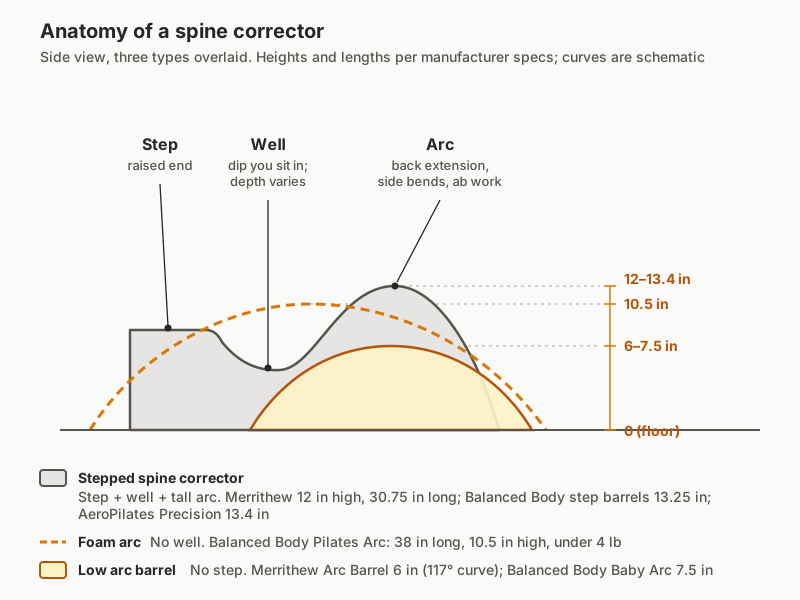
Tap the diagram to enlarge
Stepped spine correctors
A stepped corrector has a raised arc on one side and a step on the other, with a well between them where you sit. The Merrithew, AeroPilates, Gratz and Contrology picks are all this type. They're the tallest (12 to 13.4 inches where published) and the heaviest.
Balanced Body sells several stepped barrels, per its product pages:
- East Coast Step Barrel: 16 W × 31 L × 13.25 H inches, 17 lb, dense foam with metal handles. Balanced Body says it has a shallower well, a higher step and a gentler curve than the Clara, for taller clients with less flexible spines who want a more challenging, less supported ab workout (brand claim).
- Clara Step Barrel: A deeper well and a larger arch. Balanced Body says Fletcher Pilates practitioners prefer it for "greater lumbar spine support and more precise pelvic placement" (brand claim).
- Contour Step Barrel: Wood, 37 inches long, 28.4 lb, with an "elongated arch and rounded step."
Balanced Body doesn't publish prices for these. Its Contrology line sells a classical-style foam corrector, covered above. Other studio brands also make stepped correctors; we left them out because we couldn't confirm their specs.
Foam arcs
Foam arcs, like the Balanced Body Pilates Arc and the Yes4All, skip the wood frame. They're light enough to carry with one hand and easy to store, and some split into pieces. The trade-off is stiffness: Balanced Body notes its Arc flexes temporarily under heavier users standing on it.
Low arc barrels and baby arcs
The Merrithew Arc Barrel (6 inches high) and Balanced Body Baby Arcs (7.5 inches) are low curves with no step. They work as support under your back or hips during mat work, or as a positioning tool on other apparatus.
What you can do on a spine corrector
The exercise list is longer than the name suggests. These come from Gratz's spine corrector article by instructor Taylor Kinsey and from Andrea Maida's post:
- Back extension and arm work: Maida describes lying back over the arc for Arm Circles to open the chest and upper back. Gratz lists an Arm Series and extension work like Swan.
- Abdominal work: Gratz lists an Abdominal Series and says the corrector helps with Teaser and with learning the C-curve.
- Spine Stretch Forward and Saw: Gratz has you sit with the pelvis raised at the edge of the step, so these need a step.
- Leg series: Gratz lists a Leg Series, and Maida describes Scissors, Bicycle and Shoulder Bridge over the arc.
- Seated options: Maida says you can do the arm series sitting on the step or on the mat beside the arc. A step and well give you that choice; a foam arc or low arc barrel doesn't.
How to choose a spine corrector
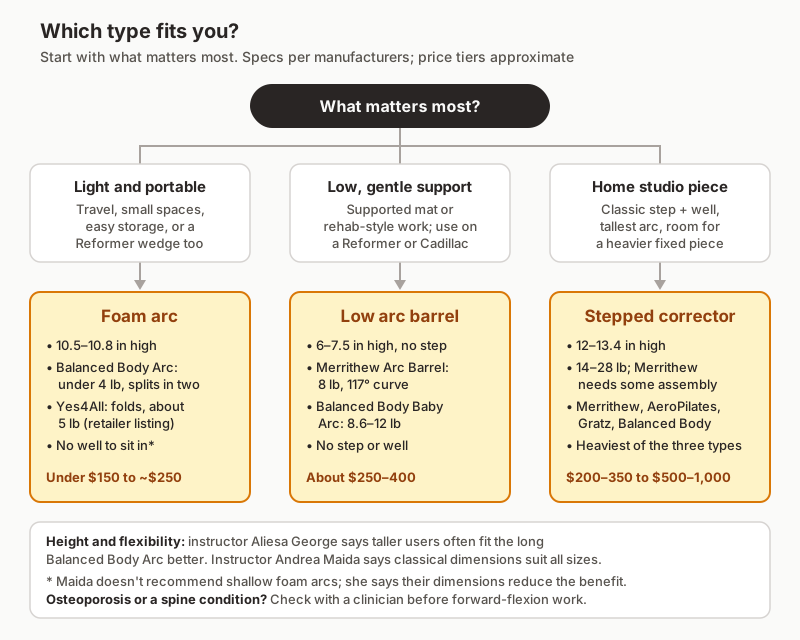
Tap the diagram to enlarge
Your height and flexibility
Instructors disagree here. Aliesa George says the long Balanced Body Arc tends to fit taller clients better, while the traditional East Coast-style barrel suits shorter people (she's 5'4"). Balanced Body designs its East Coast Step Barrel for taller clients with less flexible spines who want a more challenging, less supported ab workout (brand claim).
Andrea Maida disagrees that tall people need shallow models. In a 2022 reply to a reader, she said classical dimensions are "perfect for all sizes," because you can choose among ways to do each exercise depending on your height and flexibility. George's own advice: "There is not a right or wrong brand." If you can, try a few shapes at a studio before you buy.
Curve depth and step height
A taller, deeper arc gives you more range for backbends and side work. A shallower one is gentler, but Maida doesn't recommend shallow foam arcs, saying "you will not receive the same benefit from the exercises due to the dimensions." In a 2015 reply about one specific model with a shallow well, Balanced Body's East Coast-style corrector, she wrote that the well "will limit or remove one of your options for the exercises." Published heights run from 6 inches (Merrithew Arc Barrel) to 13.4 inches (AeroPilates). If you're mostly doing supported mat work, a low arc may be all you need.
Weight, storage and portability
Foam arcs here weigh from under 4 lb (Balanced Body Arc) to 12 lb (Baby Arc); Balanced Body's foam East Coast Step Barrel is 17 lb. The foam Contrology corrector is 19 lb. Wood-frame correctors weigh from 14 lb (AeroPilates) to 22 lb (Gratz) and about 28 lb (Balanced Body Contour). If it lives in a closet between workouts, that difference matters.
Weight capacity
Only some makers publish a user capacity:
- Merrithew Spine Corrector and Arc Barrel: 425 lb
- Yes4All: 350 lb (from its Amazon title)
- AeroPilates Precision Spine Corrector: 300 lb, per its Amazon listing
- AeroPilates Precision Arc Barrel (a different, low model, not reviewed above): 300 lb, per a retailer
Balanced Body (including Contrology) and Gratz don't list one, and neither does Stamina's own page for the stepped barrel. Ask the maker if you're near any of these limits.
Buying a spine corrector on Amazon
The Merrithew, AeroPilates and Yes4All picks are sold on Amazon, and our Balanced Body Arc link runs an Amazon search. Cheaper unbranded wooden correctors also show up there, but we couldn't find maker spec pages or weight capacities for them, so we left them out. Check the listing for a stated user capacity and dimensions before you buy.
Foam vs. wood frame
Foam is lighter, cheaper and easier to store. A wood frame is more rigid and usually has handholds. Maida notes that wooden-sided designs can limit the number of exercises you can do, so check the shape, not just the material.
Safety: osteoporosis, pregnancy and back pain
We found no peer-reviewed trial that tests a spine corrector or arc barrel on its own. "Spine corrector" is a traditional name, and the makers' "correct" or "restore" language is a brand claim.
Pilates programs as a whole have been studied. In a 9-month randomized trial of 236 adolescents published in Scientific Reports (González-Gálvez et al., 2020), two 15-minute mat-only Pilates sessions a week "averted the increase of the thoracic curvature" compared with controls and reduced standing lumbar lordosis. That trial didn't use a barrel, so it says nothing about the equipment itself.
Some spine corrector exercises, such as the abdominal series and C-curve work Gratz describes, involve rounding the spine forward. The Bone Health & Osteoporosis Foundation tells people with osteoporosis: "Do not flex or bend your spine forward." If you have osteoporosis, a spinal condition or back pain, check with a clinician or a qualified instructor before doing flexion work over a barrel. Balanced Body markets its Arc for prenatal exercise support; that's a brand claim, so check with your provider first if you're pregnant.
Frequently Asked Questions
What is a Pilates spine corrector used for?
It's a curved, padded apparatus with a step, used for back extension, side bends and abdominal work, and as support during mat exercises. Merrithew says its Spine Corrector is for exercises that lengthen and strengthen the torso, shoulders, back and legs (brand claim). Balanced Body markets its Pilates Arc as a spine corrector, Reformer wedge and training tool.
What's the difference between a spine corrector and an arc barrel?
A spine corrector has a step and a well you sit in, plus a taller arc; Merrithew's is 12 inches high. An arc barrel is a low curve with no step; Merrithew's is 6 inches high with a 117° curve. Balanced Body's Baby Arcs are also low, step-free arcs.
Which spine corrector is best for tall people?
Instructor Aliesa George says the long Balanced Body Arc usually fits taller clients better and that traditional East Coast barrels suit shorter people. Balanced Body designs its East Coast Step Barrel for taller clients with less flexible spines who want a more challenging, less supported ab workout (brand claim). Instructor Andrea Maida disagrees: she says classical dimensions are 'perfect for all sizes,' because you can choose among ways to do each exercise depending on your height and flexibility.
Can a spine corrector fix posture?
We found no study that tests the device on its own. Pilates programs have shown posture effects in trials, such as a mat-only trial in adolescents that kept thoracic curvature from increasing. 'Corrector' is a traditional name and a brand claim, not a proven outcome.
Is a spine corrector worth it for home use?
It's worth it if you already do mat or studio Pilates and want back-extension and side work at home. A foam arc is the lower-cost, easier-to-store way to start. If you're new to Pilates, a mat and small props come first; see our Pilates equipment for beginners guide.
Is a spine corrector good for beginners?
Gratz says the spine corrector suits people of any age, experience or ability, and that it helps beginners learn the C-curve and spinal articulation. If you're new, a low arc or foam arc is a gentler, lower-cost start; learn the moves with an instructor first.
What's the difference between a spine corrector and a ladder barrel?
A ladder barrel is a larger, floor-standing apparatus: Gratz's is 43.25 inches long, 37.5 inches high and 100 lb, with a four-rung wooden ladder next to a barrel that slides to fit different heights. A spine corrector is a smaller, portable arc with a step; Gratz's is 22 lb. Gratz says its spine corrector's curve matches its Ladder Barrel's curve.
Is a spine corrector safe with osteoporosis?
The Bone Health & Osteoporosis Foundation advises people with osteoporosis not to flex or bend the spine forward. Some spine corrector exercises, such as abdominal work, involve rounding the spine forward, so check with a clinician or a qualified instructor first.
The verdict
For most home buyers, the Balanced Body Pilates Arc is the easiest fit: it's light, splits in two and doubles as a Reformer wedge. If you weigh over 200 lb, note that Balanced Body says the foam flexes temporarily when heavier users stand on it, and it publishes no capacity; you may prefer a model with a published capacity, like the Merrithew models (425 lb) or the Yes4All (350 lb). Then pick by need:
- You want studio-grade equipment at home: The Merrithew Spine Corrector (425 lb capacity, birch and maple).
- You mostly want support for mat work or rehab-style positioning: The Merrithew Arc Barrel, or the Balanced Body Baby Arc if you want handles.
- You want a wood-frame stepped barrel on a mid budget: The AeroPilates Precision Spine Corrector Barrel.
- Tight budget: The Yes4All foldable arc, after you check the listing's specs.
- You follow classical Pilates: The Gratz Spine Corrector, or the Contrology Spine Corrector if you want it sooner (15-day lead time, per Balanced Body).
New to Pilates equipment? Start with Pilates equipment for beginners. Balanced Body says its Arc doubles as a Reformer wedge; compare machines in our best home Pilates reformers guide, or pair a corrector with one of our Pilates chairs. Browse all Pilates accessories.
Sources
- Balanced Body: Barrels and arcs, Pilates Arc, Contour Step Barrel, East Coast Step Barrel, Baby Arc, West Coast Style and Baby Arc, East Coast Style
- Merrithew: Arc Barrel and Spine Corrector
- Stamina: AeroPilates Precision Series Spine Corrector Barrel
- Amazon: AeroPilates Precision Series Posture Corrector Barrel listing (model 55-4255, "up to 300 lbs")
- Pilates Reformers Plus (retailer): AeroPilates Precision Arc Barrel
- Balanced Body Contrology: Spine Corrector
- Gratz: Spine (Half) Corrector, Ladder Barrel and Taylor Kinsey, Spine Corrector: More Than Its Name (2025)
- Aliesa George, CenterWorks (2013): Shopping for a Pilates arc barrel
- Andrea Maida: Build a better backbend with the spine corrector (2013, with reader replies from 2015 and 2022)
- González-Gálvez et al., Scientific Reports 2020: Pilates and spinal curvature in adolescents
- Bone Health & Osteoporosis Foundation: Strengthening exercise guidance
- Yes4All Pilates Spine Corrector (350 lb, foldable): Amazon product title
Update history
- : Published.
Found an error? See how we research and correct guides in our editorial policy.
Was this guide helpful?
Related Articles
Buying Guide
Best Pilates Towels for Reformer and Mat (2026)
The best Pilates towels for reformer and mat class: seven carriage, mat and hand towels compared by size, grip backing, care rules and price tier.
October 9, 2026 · 16 min read
Buying Guide
Best Hand Weights for Pilates (2026): 6 Light Dumbbells Compared
The best hand weights for Pilates are light and easy to grip. We compare 6 picks from Amazon Basics, Bala, Portzon, Stakt and Balanced Body.
October 8, 2026 · 15 min read
Buying Guide
Best Pilates Bags for Reformer and Mat Class (2026)
The best Pilates bags for reformer and mat class: totes with a mat holder and mat bags that fit a thick Pilates mat, compared by fit, pockets and price tier.
October 8, 2026 · 17 min read
Buying Guide
Best Ankle Weights for Pilates (2026): 4 Light Picks Compared
The best ankle weights for Pilates are light (1–3 lb) and slim. We compare Bala, TheraBand, Sportneer and Gaiam by weight per ankle, fit and wrist use.
October 6, 2026 · 14 min read